

Аннотация
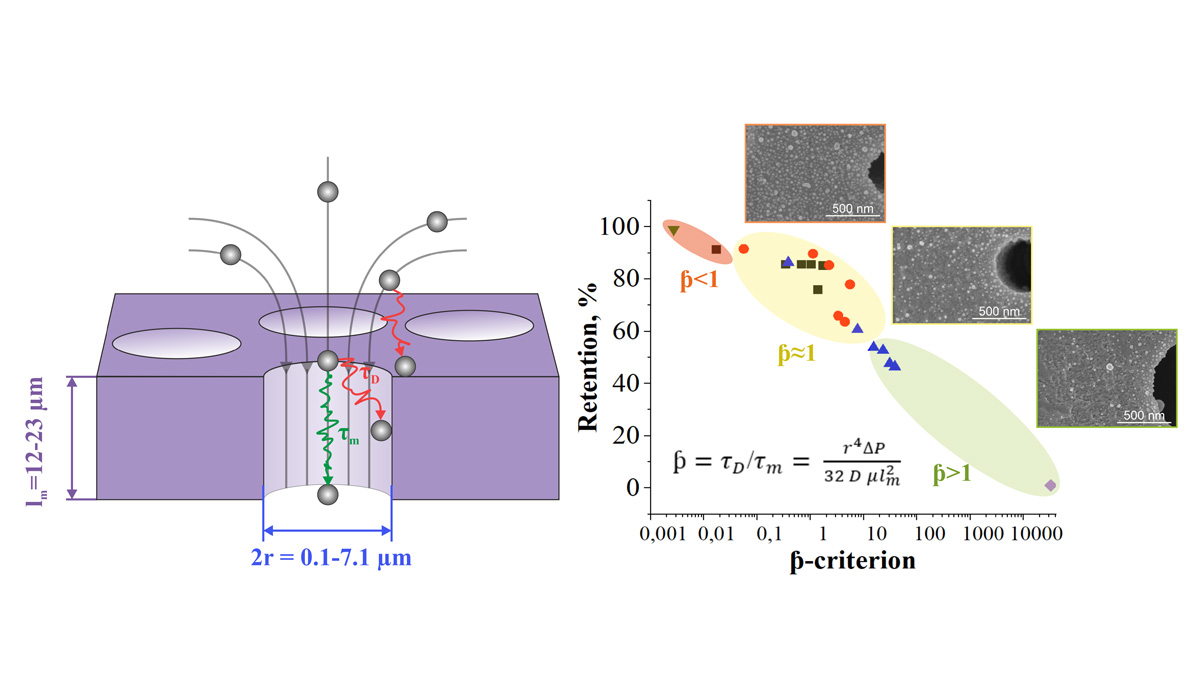
Исследование взаимодействия компонентов коллоидных растворов с микрофильтрационными мембранами представляет неубывающий интерес как в связи с разработкой композитных пористых материалов, так и в связи с многочисленными применениями мембран для разделения суспензий. Настоящая работа посвящена изучению транспорта наночастиц серебра при фильтрации через трековые мембраны в условиях, когда наночастицы и поверхность мембраны несут противоположный заряд. Цель работы состояла в установлении закономерностей осаждения наночастиц в зависимости от структурных параметров мембраны и скорости протекания раствора. Рассмотрение процессов конвекции и диффузии в порах позволило вывести простой критерий, определяющий эффективность задержания наночастиц. Применимость данного критерия исследовали в экспериментах с полиэтилентерефталатными трековыми мембранами, диаметр пор которых варьировали от 0.1 до 7.1 мкм. Средний диаметр наночастиц составил 24 нм. Изменяя перепад давления, варьировали скорость течения коллоидного раствора сквозь поры мембраны.
Эффективность задержания наночастиц мембраной определяли методами оптической спектроскопии и рентгеновского энергодисперсионного анализа. Распределение наночастиц на поверхности мембраны исследовали с помощью растровой электронной микроскопии.
Установили, что предложенный критерий удовлетворительно предсказывает переход от практически полной задержки частиц к полному пропусканию при изменении ключевых параметров — диаметра пор, толщины мембраны и перепада давления.
Полученные результаты обеспечивают условия для контролируемой иммобилизации наночастиц на поверхности мембраны, необходимой при изготовлении функциональных нанокомпозитных устройств, например, сенсоров.
Поддерживающие организации
Библиографические ссылки
[1] J. Kim, The use of nanoparticles in polymeric and ceramic membrane structures: Review of manufacturing procedures and performance improvement for water treatment, Environ. Pollut. 158 (7) (2010) 2335–2349. https://doi.org/10.1016/j.envpol.2010.03.024. DOI: https://doi.org/10.1016/j.envpol.2010.03.024
[2] M. Ulbricht, Advanced functional polymer membranes, Polymer 47 (7) (2006) 2217–2262. https://doi.org/10.1016/j.polymer.2006.01.084. DOI: https://doi.org/10.1016/j.polymer.2006.01.084
[3] A. B. Yaroslavtsev, Y. A. Dobrovolsky, L. A. Frolova, E. V. Gerasimova, E. A. Sanginov, N. S. Shaglaeva, Nanostructured materials for low-temperature fuel cells, Russ. Chem. Rev. 81 (3) (2012) 191–220. https://doi.org/10.1070/RC2012v081n03ABEH004290. DOI: https://doi.org/10.1070/RC2012v081n03ABEH004290
[4] Yu. A. Krutyakov, A. A. Kudrinskiy, A. Yu. Olenin, G. V. Lisichkin, Synthesis and properties of silver nanoparticles: Advances and prospects, Russ. Chem. Rev. 77 (3) (2008) 233–257. https://doi.org/10.1070/RC2008v077n03ABEH003751. DOI: https://doi.org/10.1070/RC2008v077n03ABEH003751
[5] D. D. Evanoff, G. Chumanov, Synthesis and optical properties of silver nanoparticles and arrays, ChemPhysChem 6 (7) (2005) 1221–1231. https://doi.org/10.1002/cphc.200500113. DOI: https://doi.org/10.1002/cphc.200500113
[6] J. S. Taurozzi, V. V. Tarabara, Silver nanoparticle arrays on track etch membrane support as flow-through optical sensors for water quality control, Environ. Engin. Sci. 24 (1) (2007) 122–137. https://doi.org/10.1089/ees.2007.24.122. DOI: https://doi.org/10.1089/ees.2007.24.122
[7] A. Yu. Solov’ev, T. S. Potekhina, I. A. Chernova, B. Ya. Basin, Track membrane with immobilized colloid silver particles, Russ. J. Appl. Chem. 80 (3) (2007) 438–442. DOI: https://doi.org/10.1134/S1070427207030172
[8] O. V. Kristavchuk, I. V. Nikiforov, A. N. Nechaev, P. Y. Apel, V. I. Kukushkin, Immobilization of silver nanoparticles obtained by electric discharge method on a track membrane surface, Colloid J. 79 (5) (2017) 637–646. https://doi.org/10.7868/S0023291217050093. DOI: https://doi.org/10.1134/S1061933X17050088
[9] B. Krafft, R. Panneerselvam, D. Geissler, D. Belder, A microfluidic device enabling surfaceenhanced Raman spectroscopy at chip integrated multifunctional nanoporous membranes, Anal. Bioanal. Chem. 412 (2020) 267–277. https://doi.org/10.1007/s00216-019-02228 9. DOI: https://doi.org/10.1007/s00216-019-02228-9
[10] R. L. Fleischer, P. B. Price, R. M. Walker, Nuclear Tracks in Solids, California Press, Berkeley, 1973.
[11] D. M. Karl, Plastics-irradiated-etched: The Nuclepore filter turns 45 years old, Limnol. Oceanogr. Bull. 16 (2007) 49–54. https://doi.org/10.1002/iroh.200711044. DOI: https://doi.org/10.1002/lob.200716349
[12] P. Y. Apel, Track-Etching, in: Encycl. Membr. Sci. Technol., John Wiley & Sons. Inc., Hoboken, NJ, USA, 2013, pp. 1–25. https://doi.org/10.1002/9781118522318.emst040. DOI: https://doi.org/10.1002/9781118522318.emst040
[13] P. Y. Apel, Fabrication of functional micro- and nanoporous materials from polymers modified by swift heavy ions, Radiat. Phys. Chem. 159 (2019) 25–34. https://doi.org/10.1016/j. radphyschem.2019.01.009. DOI: https://doi.org/10.1016/j.radphyschem.2019.01.009
[14] A. Kros, R. J. M. Nolte, N. A. J. M. Sommerdijk, Conducting polymers with confined dimensions: Track-etch membranes for amperometric biosensor applications, Adv. Mater. 14 (2002) 1779–1782. https://doi.org/10.1002/1521-4095(20021203)14:23<1779::AID ADMA1779>3.0.CO;2-T. DOI: https://doi.org/10.1002/1521-4095(20021203)14:23<1779::AID-ADMA1779>3.0.CO;2-T
[15] B. Schiedt, K. Healy, A. P. Morrison, R. Neumann, Z. Siwy, Transport of ions and biomolecules through single asymmetric nanopores in polymer films, Nucl. Instrum. Meth. Phys. Res. B 236 (2005) 109–116. https://doi.org/10.1016/j.nimb.2005.03.265. DOI: https://doi.org/10.1016/j.nimb.2005.03.265
[16] L. T. Sexton, L. P. Horne, S. A. Sherrill, G. W. Bishop, L. A. Baker, C. R. Martin, Resistivepulse studies of proteins and protein/antibody complexes using a conical nanotube sensor, J. Am. Chem. Soc. 129 (2007) 13144–13152. https://doi.org/10.1021/ja0739943. DOI: https://doi.org/10.1021/ja0739943
[17] P. Y. Apel, I. V. Blonskaya, S. Dmitriev, O. L. Orelovitch, A. Presz, B. A. Sartowska, Fabrication of nanopores in polymer foils with surfactant-controlled longitudinal profile, Nanotechnology 18 (2007) 305302. https://doi.org/10.1088/0957-4484/18/30/305302. DOI: https://doi.org/10.1088/0957-4484/18/30/305302
[18] O. V. Kristavchuk, A. S. Sohatsky, V. V. Skoi, A. I. Kuklin, V. V. Trofimov, A. N. Nechaev, P. Y. Apel’, V. I. Kozlovskiy, V. V. Sleptsov, Structural characteristics and ionic composition of a colloidal solution of silver nanoparticles obtained by electrical-spark discharge in water, Colloid J. 83 (4) (2021) 448–460. https://doi.org/10.31857/S0023291221040042. DOI: https://doi.org/10.1134/S1061933X21040049
[19] V. R. Oganesyan, O. L. Orelovich, I. V. Yanina, P. Yu. Apel’, Study of retention ability of nucleopore membranes, Colloid J. 63 (6) (2001) 755–761. DOI: https://doi.org/10.1023/A:1013232222177
[20] A. O. Orlova, Yu. A. Gromova, A. V. Savelyeva, V. G. Maslov, M. V. Artemyev, A. Prudnikau, A. V. Fedorov, A. V. Baranov, Track membranes with embedded semiconductor nanocrystals: Structural and optical examinations, Nanotechnology 22 (2011) 455201. https://doi.org/10.1088/0957-4484/22/45/455201. DOI: https://doi.org/10.1088/0957-4484/22/45/455201
[21] T. Y. Ling, J. Wang, D. Y. H. Pui, Measurement of filtration efficiency of Nuclepore filters challenged with polystyrene latex nanoparticles: Experiments and modeling, J. Nanopart. Res. 13 (2011) 5415–5424. https://doi.org/10.1007/s11051-011-0529-2. DOI: https://doi.org/10.1007/s11051-011-0529-2
[22] A. Duek, E. Arkhangelsky, R. Krush, A. Brenner, V. Gitis, New and conventional pore size tests in virus-removing membranes, Water Res. 46 (8) (2012) 2505–2514. https://doi.org/10.1016/j.memsci.2021.119417. DOI: https://doi.org/10.1016/j.watres.2011.12.058
[23] S.-C. Chen, D. Segets, T.-Y. Ling, W. Peukert, D. Y. H. Pui, An experimental study of ultrafiltration for sub-10 nm quantum dots and sub-150 nm nanoparticles through PTFE membrane and Nuclepore filters, J. Membr. Sci. 497 (2016) 153–161. https://doi.org/10.1016/j.memsci.2015.09.022. DOI: https://doi.org/10.1016/j.memsci.2015.09.022
[24] H. Lee, D. Segets, S. S¨uß, W. Peukert, S.-C. Chen, D. Y. H. Pui, Liquid filtration of nanoparticles through track-etched membrane filters under unfavorable and different strength conditions: Experiments and modeling, J. Membr. Sci. 524 (2017) 682–690. https://doi.org/10.1016/j.memsci.2016.11.023. DOI: https://doi.org/10.1016/j.memsci.2016.11.023
[25] I. Kulik, Yu. Eremchev, P. Yu. Apel, D. L. Zagorski, A. V. Naumov, Fluorescence imaging of ultrafiltration of single nanoparticles from colloid solution in track membranes, J. Appl. Spectrosc. 85 (5) (2018) 814–821. DOI: https://doi.org/10.1007/s10812-018-0739-9
[26] A. Delavari, D. Breite, A. Schulze, R. E. Baltus, Latex particle rejection from virgin and mixed charged surface polycarbonate track etched membranes, J. Membr. Sci. 584 (2019) 110–119. https://doi.org/10.1016/j.memsci.2019.04.065. DOI: https://doi.org/10.1016/j.memsci.2019.04.065
[27] H. Lee, D. Segets, S. S¨uß, W. Peukert, S.-C. Chen, D. Y. H. Pui, Effects of filter structure, flow velocity, particle concentration and fouling on the retention efficiency of ultrafiltration for sub20 nm gold nanoparticles, Sep. Purif. Technol. 241 (2020) 116689. https://doi.org/10.1016/j.seppur.2020.116689. DOI: https://doi.org/10.1016/j.seppur.2020.116689
[28] S. Y. Liu, Z. Chen, P. Sanaei, Effects of particles diffusion on membrane filters performance, Fluids 5 (2020) 121. https://doi.org/10.3390/fluids5030121. DOI: https://doi.org/10.3390/fluids5030121
[29] H. Urch, C. Geisman, M. Ulbricht, M. Epple, Deposition of functionalized calcium phosphate nanoparticles on functionalized polymer surface, Mat.-wiss. u. Werkstofftech 37 (6) (2006) 422–425. https://doi.org/10.1002/mawe.200600008. DOI: https://doi.org/10.1002/mawe.200600008
[30] M. Elimelech, Particle deposition on ideal collectors from dilute flowing suspensions: Mathematical formulation, numerical solution, and simulations, Sep. Technol. 4 (1994) 186–212. https://doi.org/10.1016/0956-9618(94)80024-3. DOI: https://doi.org/10.1016/0956-9618(94)80024-3
[31] Sh. Yamamoto, H. Koshikawa, T. Taguchi, T. Yamaki, Precipitation of Pt nanoparticles inside ion-track-etched capillaries, Quantum Beam Sci. 4 (2020) 8. https://doi.org/10.3390/qubs4010008. DOI: https://doi.org/10.3390/qubs4010008
[32] J.-N. Kao, Y. Wang, R. Pfeffer, S. Weinbaum, A theoretical model for Nuclepore filters including hydrodynamic and molecular wall interaction effects, J. Colloid Interface Sci. 121 (1988) 543–557. DOI: https://doi.org/10.1016/0021-9797(88)90456-0
[33] V. I. Kukushkin, A. B. Van’kov, I. V. Kukushkin, Long-range manifestation of surfaceenhanced Raman scattering, JETP Lett. 98 (2) (2013) 64–69. https://doi.org/10.1134/S0021364013150113. DOI: https://doi.org/10.1134/S0021364013150113
[34] V. Shvalya, G. Filipic, J. Zavasnik, I. Abdulhalim, U. Cvelbar, Surface-enhanced Raman spectroscopy for chemical and biological sensing using nanoplasmonics: The relevance of interparticle spacing and surface morphology, Appl. Phys. Rev. 7 (2020) 031307. https://doi.org/10.1063/5.0015246. DOI: https://doi.org/10.1063/5.0015246
[35] W. R. Bowen, J. I. Calvo, A. Hern´andez, Steps of membrane blocking in flux decline during protein microfiltration, J. Membr. Sci. 101 (1–2) (1995) 153–165. https://doi.org/10.1016/0376-7388(94)00295-A. DOI: https://doi.org/10.1016/0376-7388(94)00295-A
[36] C.-C. Ho, A. L. Zydney, A combined pore blockage and cake filtration model for protein fouling during microfiltration, J. Colloid Interface Sci. 232 (2) (2000) 389–399. https://doi.org/10.1006/jcis.2000.7231. DOI: https://doi.org/10.1006/jcis.2000.7231
[37] P. Y. Apel, S. Velizarov, A. V. Volkov, A. B. Yaroslavtsev, T. V. Eliseeva, A. V. Parshina, V. V. Nikonenko, N. D. Pismenskaya, K. I. Popov, Fouling and membrane degradation in electromembrane and baromembrane processes, Membranes and Membrane Technol. 4 (2) (2022) 69–92. https://doi.org/10.1134/S2218117222020031. DOI: https://doi.org/10.1134/S2517751622020032
[38] C. Duclos-Orsello, W. Li, C.-C. Ho, A three mechanism model to describe fouling of microfiltration membranes, J. Membr. Sci. 280 (1–2) (2006) 856–866. https://doi.org/10.1016/j.memsci.2006.03.005. DOI: https://doi.org/10.1016/j.memsci.2006.03.005
[39] J. Lin, D. Bourrier, M. Dilhan, P. Duru, Particle deposition onto a microsieve, Phys. Fluids 21 (2009) 073301. https://doi.org/10.1007/s11242-022-01810-7. DOI: https://doi.org/10.1063/1.3160732
[40] G. C. Agbangla, E. Climent, P. Bacchin, Experimental investigation of pore clogging by microparticles: Evidence for a critical flux density of particle yielding arches and deposits, Sep. Purif. Technol. 101 (2012) 42–48. https://doi.org/10.1016/j.seppur.2012.09.011. DOI: https://doi.org/10.1016/j.seppur.2012.09.011
[41] W. R. Bowen, A. N. Filippov, A. O. Sharif, V. M. Starov, A model of the interaction between a charged particle and a pore in a charged membrane surface, Adv. Colloid Interface Sci. 81 (1999) 35–72. https://doi.org/10.1134/S0965544111070085. DOI: https://doi.org/10.1016/S0001-8686(99)00004-4
[42] A. N. Filippov, T. S. Philippova, Electrostatic and molecular interaction between a charged spherical particle and a charged membrane pore: The case of given surface charge densities? Membranes and Membrane Technol. 3 (1) (2021) 15–23. https://doi.org/10.1134/S2218117221010065. DOI: https://doi.org/10.1134/S2517751621010066
[43] J. Happel, H. Brenner, Low Reynolds Number Hydrodynamics, Mir, Moscow, 1976, p. 630.
[44] J. I. Calvo, A. Hernandez, P. Pradanos, F. Tejerina, Charge adsorption and zeta potential in cyclopore membranes, J. Colloid Interface Sci. 181 (1996) 399–412. https://doi.org/10.1006/jcis.1996.0397. DOI: https://doi.org/10.1006/jcis.1996.0397
[45] E. Z. Gribova, A. I. Saichev, Fizicheskij podkhod k analizu diffuzii chastits: Monografiya, Izd-vo Nizhegorodskogo gosuniversiteta, Nizhnij Novgorod, 2012, p. 232 (In Russian).
[46] V. M. Sukhov, O. V. Dement’eva, M. E. Kartseva, V. M. Rudoy, V. A. Ogarev, Metal nanoparticles on polymer surfaces: 3. Adsorption kinetics of gold hydrosol particles on polystyrene and poly(2-vinylpyridine), Colloid J. 66 (4) (2004) 482–488. https://doi.org/10.1134/S1061933X1606003X. DOI: https://doi.org/10.1023/B:COLL.0000037457.44230.c9
[47] A. Movahedi, A. Lundin, N. Kann, M. Nyd´en, K. Moth-Poulsen, Cu(I) stabilizing crosslinked polyethyleneimine, Phys. Chem. Chem. Phys. 17 (2015) 18327–36. https://doi.org/10.1039/c5cp02198g. DOI: https://doi.org/10.1039/C5CP02198G
[48] K. L. Rubow, B. Y. H. Liu, Characteristics of Membrane Filters for Particle Collection, in: Raber R.R. (Ed.), Fluid Filtration: Gas, Vol. 1, ASTM STP 975, American Society for Testing and Materials, Philidelphia, 1986. DOI: https://doi.org/10.1520/STP42082S
[49] I. Yu. Eremchev, M. Yu. Eremchev, A. V. Naumov, Multifunctional far-field luminescence nanoscope for studying single molecules and quantum dots (50th anniversary of the Institute of Spectroscopy, Russian Academy of Sciences), Phys. Usp. 62 (3) (2019) 294–303. https://doi.org/10.3367/UFNe.2018.06.038461. DOI: https://doi.org/10.3367/UFNe.2018.06.038461
[50] R. E. Beck, J. S. Schultz, Hindrance of solute diffusion within membranes as measured with microporous membranes of known pore geometry, Biochim. Biophys. Acta 255 (1972) 273–303. DOI: https://doi.org/10.1016/0005-2736(72)90028-4
[51] C. Cockerham, A. Caruthers, J. McCloud, L. M. Fortner, S. Youn, S. P. McBride, Azo-dyefunctionalized polycarbonate membranes for textile dye and nitrate ion removal, Micromachines 13 (2022) 577. https://doi.org/10.3390/mi13040577. DOI: https://doi.org/10.3390/mi13040577
[52] E. S. Peri Ibàñez, M. H. Argüelles, C. Y. Flores, M. G. Mandile, M. C. Carzoglio, Design and development of a syringe-based POCT prototype using track-etched PET membranes for simple and rapid detection of group A Rotavirus in human samples, ACS Infectious Diseases 11 (8) (2025) 2205–2217. https://doi.org/10.1021/acsinfecdis.5c00239. DOI: https://doi.org/10.1021/acsinfecdis.5c00239
[53] V. Kukushkin, O. Kristavchuk, E. Andreev, N. Meshcheryakova, O. Zaborova, A. Gambaryan, A. Nechaev, E. Zavyalova, Aptamer-coated track-etched membranes with a nanostructured silver layer for single virus detection in biological fluids, Front. Bioengin. Biotechnol. 10 (2023) 1076749. https://doi.org/10.3389/fbioe.2022.1076749. DOI: https://doi.org/10.3389/fbioe.2022.1076749
[54] M. Zinggeler, T. Brandstetter, J. R¨uhe, Biophysical insights on the enrichment of cancer cells from whole blood by (affinity) filtration, Sci. Rep. 9 (1) (2019) 1246. https://doi.org/10.1038/s41598-018-37541-3. DOI: https://doi.org/10.1038/s41598-018-37541-3
[55] M. Zarubin, E. Andreev, E. Kravchenko, U. Pinaeva, A. Nechaev, P. Apel, Developing tardigradeinspired material: Track membranes functionalized with Dsup protein for cell-free DNA isolation, Biotechnol. Progr. 40 (5) (2024) e3478. https://doi.org/10.1002/btpr.3478. DOI: https://doi.org/10.1002/btpr.3478
Лицензия

Это произведение доступно по лицензии Creative Commons «Attribution-NonCommercial» («Атрибуция — Некоммерческое использование») 4.0 Всемирная.