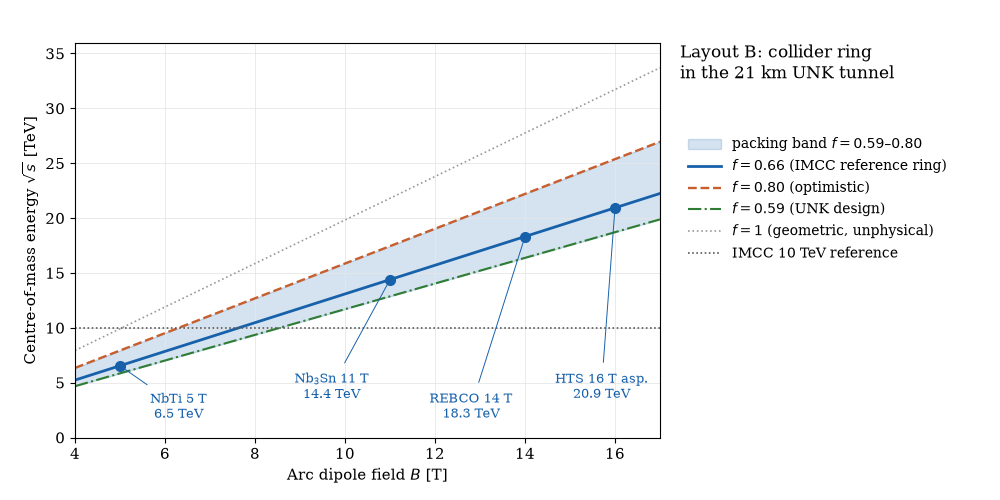
Natural Sci. Rev. 3 100902 (2026) DOI: 10.54546/NaturalSciRev.100902 Physics DOI: 10.54546/NaturalSciRev.100902 The muon collider: Expected physics, technological challenges, and the prospects for reusing the 21 km UNK tunnel A multi-TeV muon collider is now among the main options considered for the post-LHC energy frontier. The muon is an elementary particle that radiates ∼10 9 times less synchrotron power than an electron of the same energy. A circular muon collider would therefore deliver the full beam energy to the hard collision in a compact collider ring, although its acceleration chain needs a longer tunnel. It combines the energy reach of a 100 TeV-class proton machine with the clean final states of a lepton collider. This review summarizes the expected physics results. They include Higgs couplings and selfcouplings, electroweak and vector-boson-fusion processes, the top quark, and a broad programme of searches beyond the Standard Model. The programme would close nearly all of the thermal window for electroweak WIMP dark matter. The review also covers the technological challenges, namely muon production, ionization cooling, rapid acceleration, high-field high-temperature-superconductor (HTS) magnets, the machine–detector interface, and the neutrino-flux constraint. For each, the review describes the proposed solution, its present status, and the open issues. None of these technologies has yet been demonstrated at the required performance, and the design luminosity is a target. The review then examines three ways of reusing the existing 21 km UNK tunnel near Protvino, by scaling the parameters of the International Muon Collider Collaboration (IMCC). If the tunnel houses the last rapid-cycling synchrotron, as the LHC tunnel does in the IMCC option at CERN, this synchrotron limits the centre-of-mass energy to about 6 TeV. A new collider ring of about 7−9 km is then needed. If the tunnel houses the collider ring, arc dipoles of 11−14 T give about 14−18 TeV, and aspirational 16 T dipoles about 21 TeV. The acceleration chain then needs a separate tunnel of about 50−73 km. If the tunnel houses both the collider ring and the last synchrotron, as proposed earlier for the LHC tunnel, only the first synchrotrons need new ring tunnels. This layout gives about 6 TeV with the IMCC baseline magnets and about 10 TeV only with 16 T fixed and ±3.8 T pulsed synchrotron dipoles, neither yet demonstrated, at 35−57% of the target luminosity. Such a facility would also support a programme of non-collider applications of intense muon beams, such as an aimed neutrino beam, as well as muon-catalyzed fusion, muography, muonic-atom isotopic analysis, and muon spin spectroscopy. Some of these directions have a long history in the Russian physics institutes. L. V. Dudko 05.11.2026
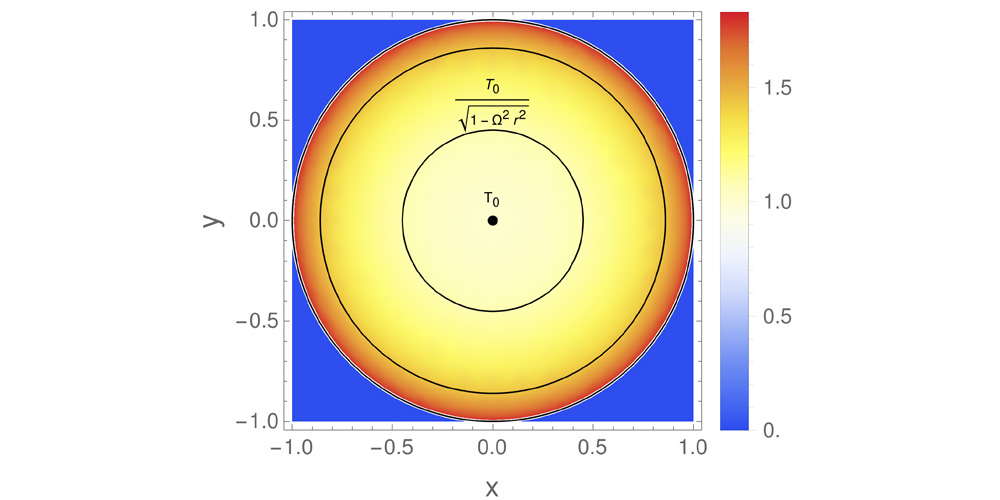
Natural Sci. Rev. 3 200901 (2026) DOI: 10.54546/NaturalSciRev.200901 Physics 70th anniversary of JINR DOI: 10.54546/NaturalSciRev.200901 Spin hydrodynamics in graphene and thermovortical magnetization We examine the framework of relativistic spin hydrodynamics in the context of the Dirac quasiparticle fluid in graphene. We develop a spin hydrodynamic model for a (2 + 1)-dimensional system of fermions under the condition of small spin polarization. Our analysis confirms that thermal vorticity, which satisfies the global equilibrium condition, is also a solution to the spin hydrodynamic equations. Additionally, we calculate the magnetization of the system in global equilibrium and introduce a novel phenomenon — thermovortical magnetization — resulting from thermal vorticity, which can be experimentally observed in graphene. Amaresh Jaiswal 23.10.2026
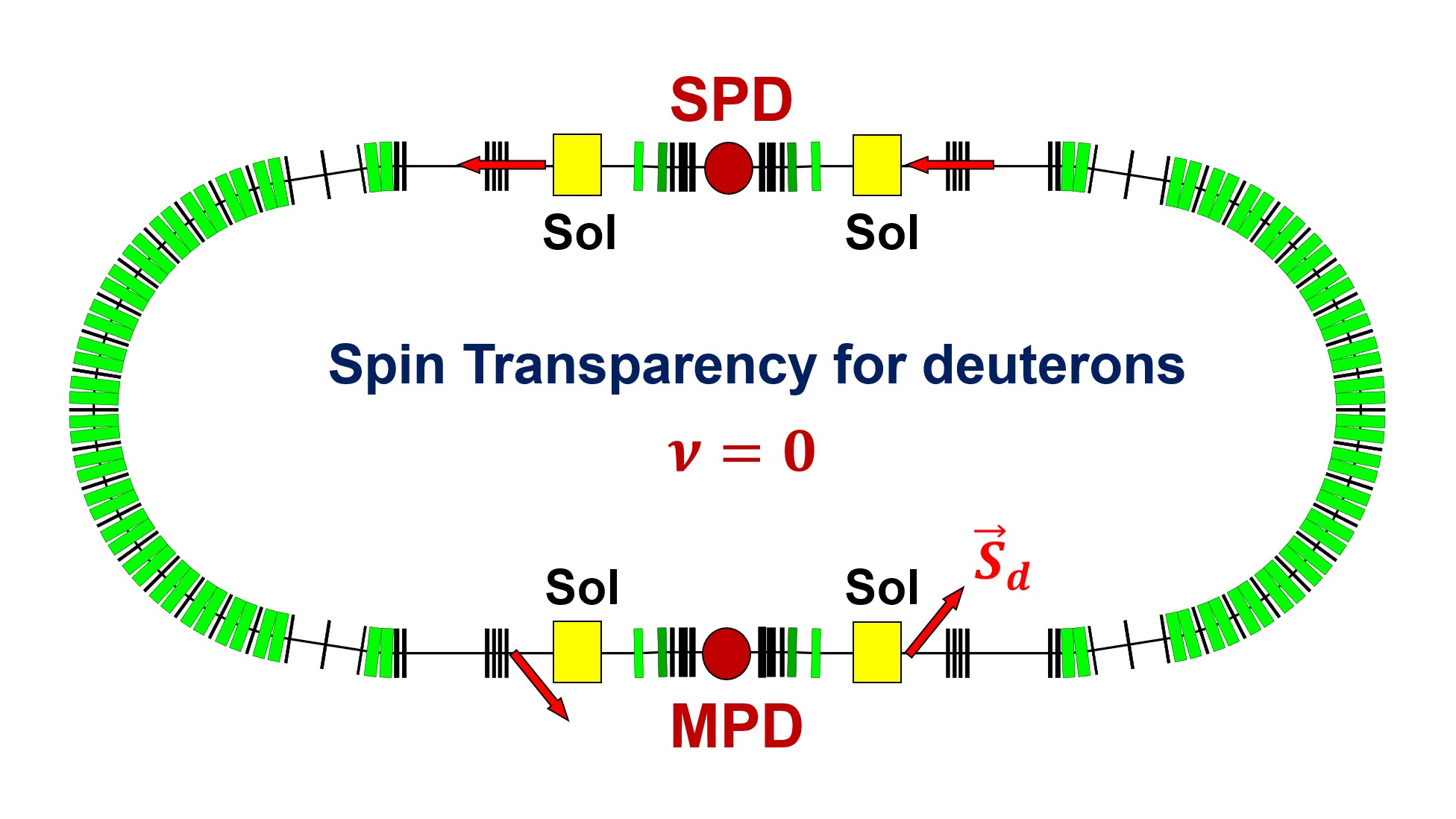
Natural Sci. Rev. 3 100901 (2026) DOI: 10.54546/NaturalSciRev.100901 Physics DOI: 10.54546/NaturalSciRev.100901 Polarized deuterons in the spin transparency mode at the NICA accelerator complex The specific features of spin dynamics control for polarized deuterons in the NICA accelerator complex (JINR, Dubna) are discussed. While the small deuteron G -factor simplifies the preservation of polarization during acceleration to relativistic energies, it simultaneously creates significant technical difficulties for controlling the spin orientation in the experimental area. Conventional spin-rotator methods based on strong transverse magnetic fields cannot be employed for deuterons, because they would demand unfeasibly large field integrals. As a solution, the spin transparency (ST) mode is proposed, which allows stabilizing any desired polarization direction at a given point of the orbit using spin navigators based on weak quasi-stationary magnetic fields. An analysis of deuteron polarization preservation in the Nuclotron and NICA collider rings is performed for different operating points of betatron tunes. For the NICA collider, two implementations of the ST mode are considered: at a single integer spin resonance ( γG = −1) at a momentum of 13 GeV/ c , and in a continuous energy range using two solenoidal snakes. The prospects for constructing a new figure-8 shaped injector for polarized deuterons are discussed, which provides the ST mode over the entire energy range without using snakes and also opens up opportunities for experiments with internal and external targets. Y. N. Filatov, A. M. Kondratenko, M. A. Kondratenko, E. D. Tsyplakov, A. V. Butenko, V. P. Ladygin, V. A. Lebedev, E. M. Syresin, E. A. Butenko 14.10.2026