

Аннотация
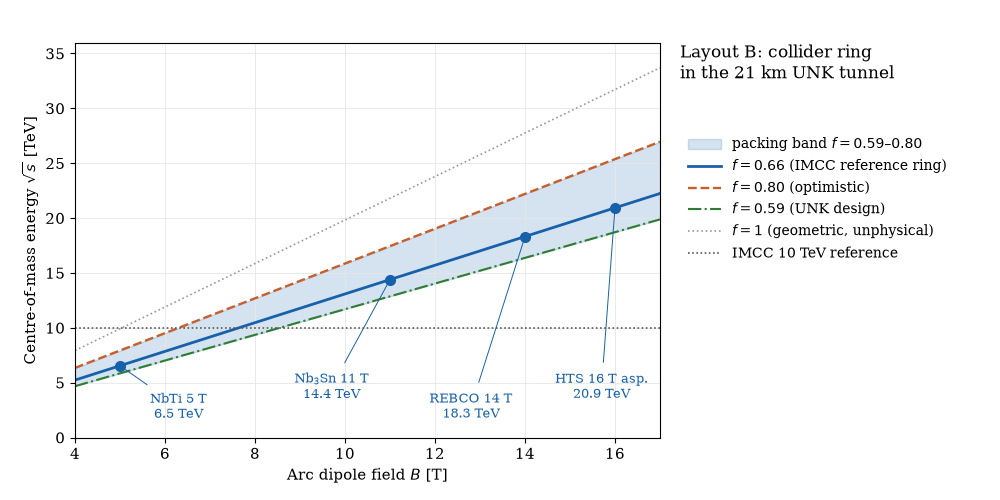
Мюонный коллайдер на энергию в несколько ТэВ сейчас рассматривается как один из основных вариантов продвижения на энергетическом рубеже после LHC. Мюон — элементарная частица, которая излучает примерно в 109 раз меньшую мощность синхротронного излучения, чем электрон той же энергии. Поэтому круговой мюонный коллайдер мог бы передавать в жёсткое столкновение всю энергию пучка при компактном кольце коллайдера, хотя его ускорительной цепочке нужен более длинный тоннель. Такой коллайдер сочетает энергетический охват протонной машины класса 100 ТэВ с чистыми конечными состояниями лептонного коллайдера. В обзоре изложены ожидаемые физические результаты. Среди них константы связи бозона Хиггса и его самодействие, электрослабые процессы и процессы слияния векторных бозонов, физика топ-кварка и широкая программа поиска физики за пределами Стандартной модели. Эта программа позволила бы почти полностью закрыть окно масс термальной электрослабой тёмной материи типа WIMP. В обзоре рассмотрены и технологические проблемы: получение мюонов, ионизационное охлаждение, быстрое ускорение, магниты с сильным полем на основе высокотемпературных сверхпроводников (ВТСП), сопряжение ускорителя с детектором и ограничение по потоку нейтрино. Для каждой из них описаны предложенное решение, его текущее состояние и открытые вопросы. Ни одна из этих технологий пока не продемонстрирована на требуемых параметрах, а проектная светимость остаётся целевым значением. Затем на основе масштабирования параметров Международной коллаборации по мюонному коллайдеру (IMCC) рассмотрены три варианта использования существующего тоннеля УНК длиной 21 км в Протвино. Если в тоннеле разместить последний быстроциклирующий синхротрон, как тоннель LHC в варианте IMCC для ЦЕРН, этот синхротрон ограничивает энергию в системе центра масс величиной около 6 ТэВ. Тогда нужно новое кольцо коллайдера длиной около 7–9 км. Если в тоннеле разместить кольцо коллайдера, дипольные магниты арок с полем 11–14 Тл дают около 14–18 ТэВ, а перспективные диполи на 16 Тл — около 21 ТэВ. Ускорительной цепочке тогда нужен отдельный тоннель длиной около 50–73 км. Если в тоннеле разместить и кольцо коллайдера, и последний синхротрон, как ранее предлагалось для тоннеля LHC, новые кольцевые тоннели нужны только для первых синхротронов. Такая схема даёт около 6 ТэВ с базовыми магнитами IMCC. Около 10 ТэВ она даёт только с постоянными диполями на 16 Тл и импульсными диполями синхротрона на ±3,8 Тл, которые пока не продемонстрированы. Светимость при этом составляет 35–57% от целевой. Такая установка позволила бы также развивать программу неколлайдерных применений интенсивных мюонных пучков: направленный нейтринный пучок, мюонный катализ ядерного синтеза, мюонографию, изотопный анализ по мюонным атомам и мюонную спиновую спектроскопию. Некоторые из этих направлений имеют давнюю историю в российских физических институтах.
Поддерживающие организации
Библиографические ссылки
[1] J. P. Delahaye, M. Diemoz, K. Long, B. Mansouliè, N. Pastrone, L. Rivkin, D. Schulte, A. Skrinsky, A. Wulzer, Muon colliders, arXiv:1901.06150 [physics.acc-ph] (2019). doi:10.48550/arXiv.1901.06150.
[2] H. Al Ali et al., The muon smasher’s guide, Rept. Prog. Phys. 85 (2022) 084201. doi:10.1088/1361-6633/ac6678.
[3] R. Assmann et al., Calibration of centre-of-mass energies at LEP 2 for a precise measurement of the W boson mass, Eur. Phys. J. C 39 (2005) 253–292. doi:10.1140/epjc/s2004-02108-8.
[4] R. L. Workman et al., Review of particle physics, Prog. Theor. Exp. Phys. 2022 (2022) 083C01.doi:10.1093/ptep/ptac097.
[5] C. Adolphsen et al., The International Linear Collider Technical Design Report — Volume 3.II: Accelerator Baseline Design, Tech. Rep. ILC-REPORT-2013-040, ILC, arXiv:1306.6328 (2013). doi:10.2172/1347940.
[6] L. Linssen, A. Miyamoto, M. Stanitzki, H. Weerts, Physics and Detectors at CLIC: CLIC Conceptual Design Report, Tech. Rep. CERN-2012-003, CERN, arXiv:1202.5940 (2012). doi:10.5170/CERN-2012-003.
[7] R. Taylor et al., MuCol Milestone Report No. 7: Consolidated parameters, arXiv:2510.27437 [physics.acc-ph] (2025). doi:10.48550/arXiv.2510.27437.
[8] C. Accettura et al., The muon collider, arXiv:2504.21417 [physics.acc-ph] (2025). doi:10.48550/arXiv.2504.21417.
[9] K. Long, D. Lucchesi, M. Palmer, N. Pastrone, D. Schulte, V. Shiltsev, Muon colliders to expand frontiers of particle physics, Nat. Phys. 17 (2021) 289–292. doi:10.1038/s41567-020-01130-x.
[10] A. Costantini et al., Vector boson fusion at multi-TeV muon colliders, JHEP 09 (2020) 080.doi:10.1007/JHEP09(2020)080.
[11] C. Accettura et al., Towards a muon collider, Eur. Phys. J. C 83 (2023) 864. doi:10.1140/epjc/s10052-023-11889-x.
[12] F. F. Tikhonin, On the effects at colliding µ-meson beams, Tech. Rep. JINR-P2-4120, Joint Institute for Nuclear Research, Dubna, in Russian; digitized as arXiv:0805.3961 (1968). doi:10.48550/arXiv.0805.3961.
[13] G. I. Budker, Accelerators and colliding beams, in: Proceedings of the 7th International Conference on High-Energy Accelerators, Yerevan, 1969, pp. 33–39, reprinted in AIP Conf. Proc. 352 (1996) 4. URL https://inspirehep.net/literature/931295
[14] Y. M. Ado, V. I. Balbekov, Use of ionization friction in the storage of heavy particles, Sov. Atom. Energy 31 (1971) 731–736, [At. Energ. 31 (1971) 40]. doi:10.1007/BF01123390.
[15] A. N. Skrinsky, V. V. Parkhomchuk, Cooling methods for beams of charged particles, Sov. J. Part. Nucl. 12 (1981) 223–247, [Fiz. Elem. Chast. Atom. Yadra 12 (1981) 557].
[16] D. Neuffer, Principles and applications of muon cooling, Part. Accel. 14 (1983) 75–90, fERMILAB-FN-0378. doi:10.2172/1156195.
[17] J. C. Gallardo, R. B. Palmer, A. V. Tollestrup, et al., µ+µ− collider: A feasibility study, Tech.Rep. BNL-52503, FERMILAB-CONF-96-092, LBNL-38946, BNL / Fermilab / LBNL, eConf C960625, R4 (1996). URL https://inspirehep.net/literature/422722
[18] C. M. Ankenbrandt et al., Status of muon collider research and development and future plans, Phys. Rev. ST Accel. Beams 2 (1999) 081001. doi:10.1103/PhysRevSTAB.2.081001.
[19] R. B. Palmer, Muon colliders, Rev. Accel. Sci. Tech. 7 (2014) 137–159. doi:10.1142/S1793626814300072.
[20] M. Bogomilov et al., Demonstration of cooling by the Muon Ionization Cooling Experiment, Nature 578 (2020) 53–59. doi:10.1038/s41586-020-1958-9.
[21] M. Bogomilov et al., Transverse emittance reduction in muon beams by ionization cooling, Nat. Phys. 20 (2024) 1558–1563. doi:10.1038/s41567-024-02547-4.
[22] CERN Council, 2020 Update of the European Strategy for Particle Physics, Tech. Rep. CERNESU-015-2020, CERN (2020). doi:10.17181/ESU2020.
[23] C. Adolphsen et al., European Strategy for Particle Physics — Accelerator R&D Roadmap, CERN Yellow Rep. Monogr. 1 (2022) 1–270. doi:10.23731/CYRM-2022-001.
[24] C. Accettura et al., Interim Report for the International Muon Collider Collaboration, Tech. Rep. CERN-2024-002, CERN (2024). doi:10.23731/CYRM-2024-002.
[25] Particle Physics Project Prioritization Panel (P5), Exploring the Quantum Universe: Pathways to Innovation and Discovery in Particle Physics, Tech. rep., DOE/NSF HEPAP (2023).URL https://www.usparticlephysics.org/2023-p5-report/
[26] K. M. Black et al., Muon collider forum report, JINST 19 (2024) T02015. doi:10.1088/1748-0221/19/02/T02015.
[27] M. Begel et al., United States Muon Collider Community White Paper for the European Strategy for Particle Physics Update, arXiv:2503.23695 [hep-ex] (2025). doi:10.48550/arXiv.2503.23695.
[28] A. de Gouvêa et al., Update to the U.S. National Input to the European Strategy Update for Particle Physics, arXiv:2602.15295 [hep-ex] (2026). doi:10.48550/arXiv.2602.15295.
[29] National Academies of Sciences, Engineering, and Medicine, Elementary Particle Physics: Progress and Promise, Tech. rep., The National Academies Press, Washington, DC (2025). doi:10.17226/28909.
[30] D. Buttazzo, R. Franceschini, A. Wulzer, Two paths towards precision at a very high energy lepton collider, JHEP 05 (2021) 219. doi:10.1007/JHEP05(2021)219.
[31] T. Roser et al., On the feasibility of future colliders: Report of the Snowmass’21 Implementation Task Force, JINST 18 (2023) P05018. doi:10.1088/1748-0221/18/05/P05018.
[32] C. Aimè et al., Muon collider physics summary, arXiv:2203.07256 [hep-ph] (2022). doi:10. 48550/arXiv.2203.07256.
[33] T. Han, D. Liu, I. Low, X. Wang, Electroweak scattering at the muon shot, Phys. Rev. D 110 (2024) 013005. doi:10.1103/PhysRevD.110.013005.
[34] T. Han, Y. Ma, K. Xie, High energy leptonic collisions and electroweak parton distribution functions, Phys. Rev. D 103 (2021) L031301. doi:10.1103/PhysRevD.103.L031301.
[35] M. Benedikt et al., Future Circular Collider Feasibility Study Report: Volume 2, Accelerators, Technical Infrastructure and Safety, Eur. Phys. J. Spec. Top. 234 (2025) 5713–6197. doi:10.1140/epjs/s11734-025-01967-4.
[36] G. Arduini et al., Comparative evaluation of future collider options, CERN Yellow Rep. Monogr. CERN-2025-011 (2025). doi:10.23731/CYRM-2025-0011.
[37] V. D. Barger, M. S. Berger, J. F. Gunion, T. Han, Higgs boson physics in the s-channel at µ+µ−colliders, Phys. Rept. 286 (1997) 1–51. doi:10.1016/S0370-1573(96)00041-5.
[38] D. de Florian et al., Handbook of LHC Higgs Cross Sections: 4. Deciphering the Nature of the Higgs Sector, Tech. Rep. CERN-2017-002-M, CERN, arXiv:1610.07922 (2017). doi:10.23731/CYRM-2017-002.
[39] J. de Blas, J. Gu, Z. Liu, Higgs boson precision measurements at a 125 GeV muon collider, Phys. Rev. D 106 (2022) 073007. doi:10.1103/PhysRevD.106.073007.
[40] P. Andreetto et al., Prospects for precision Higgs boson measurements at a 10 TeV muon collider, arXiv:2609.08392 [hep-ex] (2026). doi:10.48550/arXiv.2609.08392.
[41] M. Forslund, P. Meade, Precision Higgs width and couplings with a high energy muon collider, JHEP 01 (2024) 182. doi:10.1007/JHEP01(2024)182.
[42] L. Castelli, Higgs physics at the muon collider, Particles 8 (2025) 28. doi:10.3390/particles8010028.
[43] P. Andreetto et al., Aspects of Higgs physics at a √s = 3 TeV muon collider with detailed detector simulation, Eur. Phys. J. C 85 (2025) 221. doi:10.1140/epjc/s10052-025-13923-6.
[44] P. Andreetto et al., MUSIC: A multi-purpose detector concept for physics at the 10 TeV muon collider, Eur. Phys. J. C 86 (2026) 554. doi:10.1140/epjc/s10052-026-15654-8.
[45] E. Celada, T. Han, W. Kilian, N. Kreher, Y. Ma, F. Maltoni, D. Pagani, J. Reuter, T. Striegl, K. Xie, Probing Higgs-muon interactions at a multi-TeV muon collider, JHEP 08 (2024) 021. doi:10.1007/JHEP08(2024)021.
[46] D. Buttazzo, P. Paradisi, Probing the muon g−2 anomaly with the Higgs boson at a muon collider, Phys. Rev. D 104 (2021) 075021. doi:10.1103/PhysRevD.104.075021.
[47] A. M. Sirunyan et al., Evidence for Higgs boson decay to a pair of muons, JHEP 01 (2021) 148. doi:10.1007/JHEP01(2021)148.
[48] G. Aad et al., Evidence for the dimuon decay of the Higgs boson in pp collisions with the ATLAS detector, Phys. Rev. Lett. 135 (2025) 231802. doi:10.1103/gzdh-p159.
[49] M. Cepeda et al., Report from Working Group 2: Higgs Physics at the HL-LHC and HE-LHC, CERN Yellow Rep. Monogr. 7 (2019) 221–584. doi:10.23731/CYRM-2019-007.221.
[50] M. Benedikt et al., Future Circular Collider Feasibility Study Report: Volume 1, Physics, Experiments, Detectors, Eur. Phys. J. C 85 (2025) 1468. doi:10.1140/epjc/s10052-025-15077-x.
[51] P. Li, Z. Liu, K.-F. Lyu, Higgs boson width and couplings at high energy muon colliders with forward muon detection, Phys. Rev. D 109 (2024) 073009. doi:10.1103/PhysRevD.109.073009.
[52] M. Ruhdorfer, E. Salvioni, A. Wulzer, Building the case for forward muon detection at a muon collider, Phys. Rev. D 111 (2025) 053010. doi:10.1103/PhysRevD.111.053010.
[53] J. de Blas et al., The physics case of a 3 TeV muon collider stage, arXiv:2203.07261 [hep-ph] (2022). doi:10.48550/arXiv.2203.07261.
[54] M. Chiesa, F. Maltoni, L. Mantani, B. Mele, F. Piccinini, E. Vryonidou, Measuring the quartic Higgs self-coupling at a multi-TeV muon collider, JHEP 09 (2020) 098. doi:10.1007/JHEP09(2020)098.
[55] F. Cornet-Gomez, V. Miralles, M. Miralles López, M. Moreno Ll´ácer, M. Vos, Future collider constraints on top-quark operators, JHEP 10 (2025) 156. doi:10.1007/JHEP10(2025)156.
[56] T. Han, D. Liu, S. Wang, Top-quark electroweak dipole moment at a high-energy muon collider, Phys. Rev. D 111 (2025) 035015. doi:10.1103/PhysRevD.111.035015.
[57] S. Frixione et al., Precision phenomenology at multi-TeV muon colliders, JHEP 09 (2025) 036. doi:10.1007/JHEP09(2025)036.
[58] T. Han, M. Low, T. A. Wu, K. Xie, Colorful particle production at high-energy muon colliders, JHEP 06 (2025) 109. doi:10.1007/JHEP06(2025)109.
[59] R. Franceschini, G. Greco, Higgs and BSM physics at the future muon collider, Symmetry 13 (2021) 851. doi:10.3390/sym13050851.
[60] R. Bedi, T. Gherghetta, S. Kumar, P. Li, Z. Liu, Heavy QCD axions at high-energy muon colliders, JHEP 01 (2026) 003. doi:10.1007/JHEP01(2026)003.
[61] P. Asadi, H. Bagherian, K. Fraser, S. Homiller, Q. Lu, Lepton flavor violation: From muon decays to muon colliders, Phys. Rev. D 113 (2026) 015003. doi:10.1103/bg4z-dmgb.
[62] P. Dehghani, M. Frank, B. Fuks, Vector boson fusion signatures of superheavy Majorana neutrinos at muon colliders, Phys. Rev. D 112 (2025) 035020. doi:10.1103/3sxk-glsw.
[63] S. C. ˙Inan, A. V. Kisselev, Probe of a Randall–Sundrum-like model from muon pair production at a high energy muon collider, J. Phys. G 52 (2025) 025004. doi:10.1088/1361-6471/ada173.
[64] H. Amarkhail, S. C. ˙Inan, A. V. Kisselev, Probing anomalous γγγγ couplings at a future muon collider, Nucl. Phys. B 1005 (2024) 116592. doi:10.1016/j.nuclphysb.2024.116592.
[65] H. Amarkhail, S. C. ˙Inan, A. V. Kisselev, Probing anomalous Zγγγ couplings at a future muon collider, J. Phys. G 52 (2025) 015001. doi:10.1088/1361-6471/ad8cf3.
[66] S. C. İnan, A. V. Kisselev, Probe of axion-like particles in vector boson scattering at a muon collider, J. Phys. G 50 (2023) 105002. doi:10.1088/1361-6471/ace3df.
[67] S. Bottaro, D. Buttazzo, M. Costa, R. Franceschini, P. Panci, D. Redigolo, L. Vittorio, Closing the window on WIMP dark matter, Eur. Phys. J. C 82 (2022) 31. doi:10.1140/epjc/s10052-021-09917-9.
[68] S. Bottaro, D. Buttazzo, M. Costa, R. Franceschini, P. Panci, D. Redigolo, L. Vittorio, The last complex WIMPs standing, Eur. Phys. J. C 82 (2022) 992. doi:10.1140/epjc/s10052-022-10918-5.
[69] R. Capdevilla, F. Meloni, R. Simoniello, J. Zurita, Hunting wino and higgsino dark matter at the muon collider with disappearing tracks, JHEP 06 (2021) 133. doi:10.1007/JHEP06(2021)133.
[70] R. Capdevilla, F. Meloni, J. Zurita, Discovering electroweak interacting dark matter at muon colliders using soft tracks, Phys. Rev. Lett. 134 (2025) 181802. doi:10.1103/PhysRevLett.134.181802.
[71] R. Franceschini, X. Zhao, Going all the way in the search for WIMP dark matter at the muon collider through precision measurements, Eur. Phys. J. C 83 (2023) 552. doi:10.1140/epjc/s10052-023-11724-3.
[72] T. Han, Z. Liu, L.-T. Wang, X. Wang, WIMPs at high energy muon colliders, Phys. Rev. D 103 (2021) 075004. doi:10.1103/PhysRevD.103.075004.
[73] J. Braathen, M. Gabelmann, T. Robens, P. Stylianou, Probing the inert doublet model via vector-boson fusion at a muon collider, JHEP 05 (2025) 055. doi:10.1007/JHEP05(2025)055.
[74] R. Aliberti et al., The anomalous magnetic moment of the muon in the Standard Model: An update, Phys. Rept. 1143 (2025) 1–158. doi:10.1016/j.physrep.2025.08.002.
[75] D. P. Aguillard et al., Measurement of the positive muon anomalous magnetic moment to 127 ppb, Phys. Rev. Lett. 135 (2025) 101802. doi:10.1103/7clf-sm2v.
[76] A. Boccaletti et al., Hybrid calculation of hadronic vacuum polarization in muon g−2 to 0.48%, Nature 653 (8114) (2026) 373–377. arXiv:2407.10913, doi:10.1038/s41586-026-10449-z.
[77] R. Capdevilla, D. Curtin, Y. Kahn, G. Krnjaic, No-lose theorem for discovering the new physics of (g−2)µ at muon colliders, Phys. Rev. D 105 (2022) 015028. doi:10.1103/PhysRevD.105.015028.
[78] R. Ding, A. Ruzi, S. Qian, A. Levin, Y. Wu, Q. Li, Quantum entanglement between gauge boson pairs at a muon collider, J. Phys. G 53 (10) (2026) 105201. arXiv:2504.09832, doi:10.1088/1361-6471/ae9f76.
[79] C. Bell et al., MAIA: A new detector concept for a 10 TeV muon collider, arXiv:2502.00181 [physics.ins-det] (2025). doi:10.48550/arXiv.2502.00181.
[80] D. Stratakis, N. Mokhov, M. Palmer, et al., A muon collider facility for physics discovery, arXiv:2203.08033 [physics.acc-ph] (2022). doi:10.48550/arXiv.2203.08033.
[81] K. Ammigan et al., HEP High Power Targetry Roadmap — Workshop Report, arXiv:2502.03305 [physics.acc-ph]FERMILAB-CONF-25-0069-AD (2025). doi:10.48550/arXiv.2502.03305.
[82] R. Al-Harthy, FLUKA-based optimization of muon production target design, arXiv:2602.16672 [physics.acc-ph] (2026). doi:10.48550/arXiv.2602.16672.
[83] A. Hoover, A. Narayan, M. Piller, V. Morozov, Feasibility of proton bunch compression in an operational high-power accelerator, JACoW NAPAC2025 (2026) THP033. doi:10.18429/JACoW-NAPAC2025-THP033.
[84] Oak Ridge National Laboratory, Twenty years of discovery science at the Spallation Neutron Source, ORNL news release, 24 April 2026. URL https://www.ornl.gov/node/111036.
[85] K. Yonehara, S. Ganguly, D. A. Wickremasinghe, P. Snopok, Y. Yu, Exploring the focusing mechanism of the NuMI horn magnets, arXiv:2305.08695 [physics.acc-ph] (2023). doi:10.48550/arXiv.2305.08695.
[86] V. Papadimitriou et al., Design of the LBNF beamline, in: 7th International Particle Accelerator Conference, 2016, p. TUPMR025. arXiv:1704.04471, doi:10.18429/JACoW-IPAC2016-TUPMR025.
[87] Y. Hamada, R. Kitano, R. Matsudo, H. Takaura, M. Yoshida, µTRISTAN, Prog. Theor. Exp. Phys. 2022 (5) (2022) 053B02. doi:10.1093/ptep/ptac059.
[88] D. Bowring et al., Operation of normal-conducting RF cavities in multi-tesla magnetic fields for muon ionization cooling: A feasibility demonstration, Phys. Rev. Accel. Beams 23 (2020) 072001. doi:10.1103/PhysRevAccelBeams.23.072001.
[89] M. Chung et al., Pressurized H2 RF cavities in ionizing beams and magnetic fields, Phys. Rev. Lett. 111 (2013) 184802. doi:10.1103/PhysRevLett.111.184802.
[90] P. A. Adderley et al., The continuous electron beam accelerator facility at 12 GeV, Phys. Rev. Accel. Beams 27 (8) (2024) 084802. arXiv:2408.16880, doi:10.1103/PhysRevAccelBeams.27.084802.
[91] Fermilab Accelerator Division, Booster Rookie Book, Version 3.0, Fermilab Beams-doc-1022 (1998). URL https://beamdocs.fnal.gov/AD/DocDB/0010/001022/001/Booster%20V3_0.pdf
[92] M. Yoshii et al., The status of the J-PARC RF systems, in: I. Andrian, C. Petit-JeanGenaz (Eds.), Proc. 11th European Particle Accelerator Conference (EPAC’08), Genoa, 2008, p. MOPC134.
[93] L. Bottura et al., Magnet R&D for the muon collider: A European Strategy input, arXiv:2503.21185 [physics.acc-ph] (2025). doi:10.48550/arXiv.2503.21185.
[94] STFC ISIS Neutron and Muon Source, A Practical Guide to the ISIS Neutron and Muon Source, STFC Rutherford Appleton Laboratory, PDF dated March 2021, accessed October 2026. URL https://www.isis.stfc.ac.uk/wp-content/uploads/2025/12/A-Practical-Guide-to-the-ISIS-Neutron-and-Muon-Source.pdf
[95] H. Piekarz, B. Claypool, S. Hays, M. Kufer, V. Shiltsev, A. Zlobin, L. Rossi, Fast cycling HTS based superconducting accelerator magnets: Feasibility study and readiness demonstration program driven by neutrino physics and muon collider needs, arXiv:2203.06253 [physics.accph]Snowmass 2021 contribution (2022). doi:10.48550/arXiv.2203.06253.
[96] L. Bottura et al., Magnet R&D for the muon collider, arXiv:2503.21179 [physics.acc-ph] (2025). doi:10.48550/arXiv.2503.21179.
[97] S. Hahn et al., 45.5-tesla direct-current magnetic field generated with a high-temperature superconducting magnet, Nature 570 (2019) 496–499. doi:10.1038/s41586-019-1293-1.
[98] L. Cooley et al., The 2025 roadmaps for the US Magnet Development Program, arXiv:2508.19220 [physics.acc-ph] (2025). doi:10.48550/arXiv.2508.19220.
[99] D. Neuffer, V. Shiltsev, On the feasibility of a pulsed 14 TeV c.m.e. muon collider in the LHC tunnel, JINST 13 (2018) T10003. doi:10.1088/1748-0221/13/10/T10003.
[100] N. Bartosik et al., Simulated detector performance at the muon collider, arXiv:2203.07964 [hepex] (2022). doi:10.48550/arXiv.2203.07964.
[101] D. Ally, L. Carpenter, T. Holmes, L. Lee, P. Wagenknecht, Strategies for beam-induced background reduction at muon colliders, arXiv:2203.06773 [physics.ins-det] (2022). doi:10.48550/arXiv.2203.06773.
[102] M. Casarsa, D. Lucchesi, L. Sestini, Experimentation at a muon collider, Ann. Rev. Nucl. Part. Sci. 74 (2024) 233–261. doi:10.1146/annurev-nucl-102622-011319.
[103] N. Phinney, SLC final performance and lessons, eConf C00082 (2000) MO102, arXiv:physics/0010008.
[104] G. Apollinari, O. Br¨uning, T. Nakamoto, L. Rossi, High Luminosity Large Hadron Collider HL-LHC, CERN Yellow Rep. 5 (2015) 1–19. doi:10.5170/CERN-2015-005.1.
[105] D. Zhou, K. Ohmi, Y. Funakoshi, Y. Ohnishi, Luminosity performance of SuperKEKB, JINST 19 (02) (2024) T02002. arXiv:2306.02692, doi:10.1088/1748-0221/19/02/T02002.
[106] F. Zimmermann, FCC-ee lessons from SuperKEKB, arXiv:2509.07448 [physics.acc-ph] (2025). doi:10.48550/arXiv.2509.07448.
[107] A. Blondel, P. Janot, et al., FCC-ee: Your questions answered, arXiv:1906.02693 [hep-ph] (2019). doi:10.48550/arXiv.1906.02693.
[108] F. Willeke, Electron Ion Collider Conceptual Design Report 2021, Tech. Rep. BNL-221006-2021- FORE, Brookhaven National Laboratory (2021). doi:10.2172/1765663.
[109] E. Wang, F. Willeke, K. Deitrick, M. Blaskiewicz, N. Sereno, S. Setiniyaz, W. Bergan, Electron Ion Collider strong hadron cooling design summary, JACoW COOL2025 (2026) TUA2. doi: 10.18429/JACoW-COOL2025-TUA2.
[110] European Strategy Group, The European Strategy for Particle Physics: 2026 update — Recommendations by the European Strategy Group, Tech. Rep. CERN-ESU-2025-002, CERN, adopted by the CERN Council on 22 May 2026 (2026). URL https://cds.cern.ch/record/2950671
[111] D. Stratakis, Essay: A path for the construction of a muon collider, Phys. Rev. Lett. 134 (2025) 160001. doi:10.1103/PhysRevLett.134.160001.
[112] G. Gurov, UNK status and plans, in: Proceedings of the 1995 Particle Accelerator Conference (PAC’95), Dallas, IEEE, 1996, pp. 416–418. URL https://proceedings.jacow.org/p95/ARTICLES/MPG/MPG06.PDF
[113] V. I. Balbekov et al., The IHEP Accelerating and Storage Complex (UNK) status, in: F. T. Cole, R. Donaldson (Eds.), Proceedings of the 12th International Conference on High-Energy Accelerators (HEACC’83), Batavia, Fermilab, 1984, pp. 40–44. URL https://inspirehep.net/files/19560d3fb32d349c420e2848d53be8a2
[114] V. A. Yarba, The status and development of the UNK project, in: L. Lizama, J. Chew (Eds.), Proc. 1991 IEEE Particle Accelerator Conference (PAC’91), San Francisco, 1991, pp. 2913–2917.
[115] L. Evans, P. Bryant, LHC machine, JINST 3 (2008) S08001. doi:10.1088/1748-0221/3/08/S08001.
[116] Federal Law of the Russian Federation No. 3-FZ of 9 January 1996 “On the radiation safety of the population”, Art. 9 (current edition); in Russian (1996).
[117] Radiation Safety Standards NRB-99/2009 (Sanitary Rules SanPiN 2.6.1.2523-09), Approved by Resolution No. 47 of the Chief State Sanitary Physician of the Russian Federation, 7 July 2009; registered by the Ministry of Justice, 14 August 2009, No. 14534; in Russian (2009).
[118] N. V. Mokhov, A. Van Ginneken, Neutrino radiation at muon colliders and storage rings, J. Nucl. Sci. Technol. 37 (sup1) (2000) 172–179. doi:10.1080/00223131.2000.10874869.
[119] S. Geer, Neutrino beams from muon storage rings: Characteristics and physics potential, Phys. Rev. D 57 (1998) 6989–6997, [Erratum: Phys. Rev. D 59, 039903 (1999)]. doi:10.1103/PhysRevD.57.6989.
[120] L. Alvarez Ruso et al., Neutrinos from stored muons (nuSTORM): ESPP 2026 input, arXiv:2505.06137 [hep-ex] (2025). doi:10.48550/arXiv.2505.06137.
[121] J. Franklin, R. Kamath, D. Pasari, Y. F. Perez-Gonzalez, J. Turner, M. A. Vogiatzi, nuSTORM as a precision probe of the Standard Model and new physics, JHEP 02 (2026) 127. doi:10.1007/JHEP02(2026)127.
[122] A. de Gouvêa, A. Thompson, Electroweak observables in neutrino-electron scattering from a muon storage ring, JHEP 12 (2025) 098. doi:10.1007/JHEP12(2025)098.
[123] R. J. Abrams et al., Interim Design Report, Tech. Rep. IDS-NF-020, International Design Study for the Neutrino Factory (2011). arXiv:1112.2853, doi:10.2172/1029650.
[124] A. Bogacz et al., The physics case for a Neutrino Factory, arXiv:2203.08094 [hep-ph]Snowmass 2021 contribution, FERMILAB-CONF-22-179-ND-V (2022). doi:10.48550/arXiv.2203.08094.
[125] A. V. Akindinov et al., Letter of interest for a neutrino beam from Protvino to KM3NeT/ORCA, Eur. Phys. J. C 79 (9) (2019) 758. arXiv:1902.06083, doi:10.1140/epjc/s10052-019-7259-5.
[126] H. T. Klest, Fixed-target opportunities at the muon collider, Phys. Rev. D 112 (2025) L051504. doi:10.1103/cfkz-ql5j.
[127] C. Cesarotti, R. Gambhir, The new physics case for beam-dump experiments with accelerated muon beams, JHEP 05 (2024) 283. doi:10.1007/JHEP05(2024)283.
[128] J. Adhikary, K. J. Kelly, F. Kling, S. Trojanowski, Neutrino-portal dark matter detection prospects at a future muon collider, Phys. Rev. D 111 (2025) 075019. doi:10.1103/PhysRevD.111.075019.
[129] L. W. Alvarez, H. Bradner, F. S. Crawford, Jr., J. A. Crawford, P. Falk-Vairant, M. L. Good, J. D. Gow, A. H. Rosenfeld, F. Solmitz, M. L. Stevenson, H. K. Ticho, R. D. Tripp, Catalysis of nuclear reactions by µ mesons, Phys. Rev. 105 (1957) 1127–1128. doi:10.1103/PhysRev.105.1127.
[130] S. S. Gershtein, Y. V. Petrov, L. I. Ponomarev, Muon catalysis and nuclear breeding, Sov. Phys. Usp. 33 (1990) 591–615. doi:10.1070/PU1990v033n08ABEH002619.
[131] V. P. Dzhelepov, V. V. Filchenkov, M. Friml, Y. V. Katyshev, V. I. Moskalev, P. F. Yermolov, Negative muon catalysis of the nuclear fusion reaction d+d → 3He+n, Nuovo Cimento 33 (1964) 40–44. doi:10.1007/BF02734060.
[132] V. M. Bystritskii, V. P. Dzhelepov, P. F. Yermolov, K. O. Oganesyan, M. N. Omel’yanenko, S. Y. Porokhovoi, V. S. Roganov, A. I. Rudenko, V. V. Filchenkov, Measurement of the rate of muon capture in gaseous hydrogen, Sov. Phys. JETP 39 (1974) 19–26.
[133] S. S. Gershtein, L. I. Ponomarev, µ− meson catalysis of nuclear fusion in a mixture of deuterium and tritium, Phys. Lett. B 72 (1977) 80, [Erratum: Phys.Lett.B 76, 664 (1978)]. doi:10.1016/0370-2693(77)90067-3.
[134] Q. Wu, M. Kamimura, Tractable T-matrix model for reaction processes in muon-catalyzed fusion, Phys. Rev. C 109 (2024) 054625. doi:10.1103/PhysRevC.109.054625.
[135] J. F. Parisi, A. Rutkowski, Isotope production in muon-catalyzed-fusion systems, arXiv:2511.20951 [physics.plasm-ph] (2025). doi:10.48550/arXiv.2511.20951.
[136] K. Morishima et al., Discovery of a big void in Khufu’s Pyramid by observation of cosmic-ray muons, Nature 552 (2017) 386–390. doi:10.1038/nature24647.
[137] S. Procureur et al., Precise characterization of a corridor-shaped structure in Khufu’s Pyramid by observation of cosmic-ray muons, Nat. Commun. 14 (2023) 1144. doi:10.1038/s41467-023-36351-0.
[138] L. Olàh, H. K. M. Tanaka, T. Ohminato, D. Varga, High-definition and low-noise muography of the Sakurajima volcano with gaseous tracking detectors, Sci. Rep. 8 (2018) 3207. doi:10.1038/s41598-018-21423-9.
[139] G. Saracino, Muography: Overview, applications and future developments, PoS Muon4Future2023 (2024) 027. doi:10.22323/1.452.0027.
[140] H. Fujii et al., Investigation of the Unit-1 nuclear reactor of Fukushima Daiichi by cosmic muon radiography, Prog. Theor. Exp. Phys. 2020 (2020) 043C02. doi:10.1093/ptep/ptaa027.
[141] K. Ninomiya et al., Development of non-destructive isotopic analysis methods using muon beams and their application to the analysis of lead, J. Radioanal. Nucl. Chem. 320 (2019) 801–805. doi:10.1007/s10967-019-06506-9.
[142] V. L. Fitch, J. Rainwater, Studies of X-rays from mu-mesonic atoms, Phys. Rev. 92 (1953) 789–800. doi:10.1103/PhysRev.92.789.
[143] V. B. Belyaev, V. S. Evseev, R. A. Eramzhyan, V. S. Roganov, V. V. Balashov, N. M. Kabachnik, Resonant absorption of negative muons by atomic nuclei, USSR State Register of Discoveries No. 173 (1976); SINP MSU and LNP JINR, theory: Balashov, Kabachnik (1963); experiment: Evseev group, LNP JINR (1968–1969) (1976).
[144] A. D. Hillier, S. J. Blundell, I. McKenzie, I. Umegaki, L. Shu, J. A. Wright, et al., Muon spin spectroscopy, Nat. Rev. Methods Primers 2 (2022) 4. doi:10.1038/s43586-021-00089-0.
[145] G. G. Myasishcheva, Y. V. Obukhov, V. S. Roganov, V. G. Firsov, A search for atomic muonium in chemically inert substances, Sov. Phys. JETP 26 (1968) 298–301, [Zh. Eksp. Teor. Fiz. 53 (1967) 451].
Лицензия

Это произведение доступно по лицензии Creative Commons «Attribution-NonCommercial» («Атрибуция — Некоммерческое использование») 4.0 Всемирная.