

Abstract
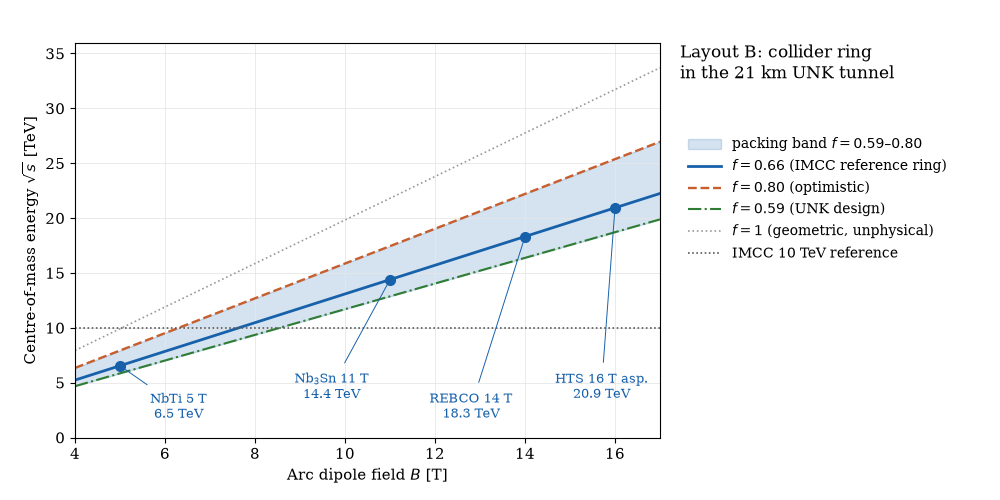
A multi-TeV muon collider is now among the main options considered for the post-LHC energy frontier. The muon is an elementary particle that radiates ∼109 times less synchrotron power than an electron of the same energy. A circular muon collider would therefore deliver the full beam energy to the hard collision in a compact collider ring, although its acceleration chain needs a longer tunnel. It combines the energy reach of a 100 TeV-class proton machine with the clean final states of a lepton collider. This review summarizes the expected physics results. They include Higgs couplings and selfcouplings, electroweak and vector-boson-fusion processes, the top quark, and a broad programme of searches beyond the Standard Model. The programme would close nearly all of the thermal window for electroweak WIMP dark matter. The review also covers the technological challenges, namely muon production, ionization cooling, rapid acceleration, high-field high-temperature-superconductor (HTS) magnets, the machine–detector interface, and the neutrino-flux constraint. For each, the review describes the proposed solution, its present status, and the open issues. None of these technologies has yet been demonstrated at the required performance, and the design luminosity is a target. The review then examines three ways of reusing the existing 21 km UNK tunnel near Protvino, by scaling the parameters of the International Muon Collider Collaboration (IMCC). If the tunnel houses the last rapid-cycling synchrotron, as the LHC tunnel does in the IMCC option at CERN, this synchrotron limits the centre-of-mass energy to about 6 TeV. A new collider ring of about 7−9 km is then needed. If the tunnel houses the collider ring, arc dipoles of 11−14 T give about 14−18 TeV, and aspirational 16 T dipoles about 21 TeV. The acceleration chain then needs a separate tunnel of about 50−73 km. If the tunnel houses both the collider ring and the last synchrotron, as proposed earlier for the LHC tunnel, only the first synchrotrons need new ring tunnels. This layout gives about 6 TeV with the IMCC baseline magnets and about 10 TeV only with 16 T fixed and ±3.8 T pulsed synchrotron dipoles, neither yet demonstrated, at 35−57% of the target luminosity. Such a facility would also support a programme of non-collider applications of intense muon beams, such as an aimed neutrino beam, as well as muon-catalyzed fusion, muography, muonic-atom isotopic analysis, and muon spin spectroscopy. Some of these directions have a long history in the Russian physics institutes.
Acknowledgements
References
[1] J. P. Delahaye, M. Diemoz, K. Long, B. Mansouliè, N. Pastrone, L. Rivkin, D. Schulte, A. Skrinsky, A. Wulzer, Muon colliders, arXiv:1901.06150 [physics.acc-ph] (2019). doi:10.48550/arXiv.1901.06150.
[2] H. Al Ali et al., The muon smasher’s guide, Rept. Prog. Phys. 85 (2022) 084201. doi:10.1088/1361-6633/ac6678.
[3] R. Assmann et al., Calibration of centre-of-mass energies at LEP 2 for a precise measurement of the W boson mass, Eur. Phys. J. C 39 (2005) 253–292. doi:10.1140/epjc/s2004-02108-8.
[4] R. L. Workman et al., Review of particle physics, Prog. Theor. Exp. Phys. 2022 (2022) 083C01.doi:10.1093/ptep/ptac097.
[5] C. Adolphsen et al., The International Linear Collider Technical Design Report — Volume 3.II: Accelerator Baseline Design, Tech. Rep. ILC-REPORT-2013-040, ILC, arXiv:1306.6328 (2013). doi:10.2172/1347940.
[6] L. Linssen, A. Miyamoto, M. Stanitzki, H. Weerts, Physics and Detectors at CLIC: CLIC Conceptual Design Report, Tech. Rep. CERN-2012-003, CERN, arXiv:1202.5940 (2012). doi:10.5170/CERN-2012-003.
[7] R. Taylor et al., MuCol Milestone Report No. 7: Consolidated parameters, arXiv:2510.27437 [physics.acc-ph] (2025). doi:10.48550/arXiv.2510.27437.
[8] C. Accettura et al., The muon collider, arXiv:2504.21417 [physics.acc-ph] (2025). doi:10.48550/arXiv.2504.21417.
[9] K. Long, D. Lucchesi, M. Palmer, N. Pastrone, D. Schulte, V. Shiltsev, Muon colliders to expand frontiers of particle physics, Nat. Phys. 17 (2021) 289–292. doi:10.1038/s41567-020-01130-x.
[10] A. Costantini et al., Vector boson fusion at multi-TeV muon colliders, JHEP 09 (2020) 080.doi:10.1007/JHEP09(2020)080.
[11] C. Accettura et al., Towards a muon collider, Eur. Phys. J. C 83 (2023) 864. doi:10.1140/epjc/s10052-023-11889-x.
[12] F. F. Tikhonin, On the effects at colliding µ-meson beams, Tech. Rep. JINR-P2-4120, Joint Institute for Nuclear Research, Dubna, in Russian; digitized as arXiv:0805.3961 (1968). doi:10.48550/arXiv.0805.3961.
[13] G. I. Budker, Accelerators and colliding beams, in: Proceedings of the 7th International Conference on High-Energy Accelerators, Yerevan, 1969, pp. 33–39, reprinted in AIP Conf. Proc. 352 (1996) 4. URL https://inspirehep.net/literature/931295
[14] Y. M. Ado, V. I. Balbekov, Use of ionization friction in the storage of heavy particles, Sov. Atom. Energy 31 (1971) 731–736, [At. Energ. 31 (1971) 40]. doi:10.1007/BF01123390.
[15] A. N. Skrinsky, V. V. Parkhomchuk, Cooling methods for beams of charged particles, Sov. J. Part. Nucl. 12 (1981) 223–247, [Fiz. Elem. Chast. Atom. Yadra 12 (1981) 557].
[16] D. Neuffer, Principles and applications of muon cooling, Part. Accel. 14 (1983) 75–90, fERMILAB-FN-0378. doi:10.2172/1156195.
[17] J. C. Gallardo, R. B. Palmer, A. V. Tollestrup, et al., µ+µ− collider: A feasibility study, Tech.Rep. BNL-52503, FERMILAB-CONF-96-092, LBNL-38946, BNL / Fermilab / LBNL, eConf C960625, R4 (1996). URL https://inspirehep.net/literature/422722
[18] C. M. Ankenbrandt et al., Status of muon collider research and development and future plans, Phys. Rev. ST Accel. Beams 2 (1999) 081001. doi:10.1103/PhysRevSTAB.2.081001.
[19] R. B. Palmer, Muon colliders, Rev. Accel. Sci. Tech. 7 (2014) 137–159. doi:10.1142/S1793626814300072.
[20] M. Bogomilov et al., Demonstration of cooling by the Muon Ionization Cooling Experiment, Nature 578 (2020) 53–59. doi:10.1038/s41586-020-1958-9.
[21] M. Bogomilov et al., Transverse emittance reduction in muon beams by ionization cooling, Nat. Phys. 20 (2024) 1558–1563. doi:10.1038/s41567-024-02547-4.
[22] CERN Council, 2020 Update of the European Strategy for Particle Physics, Tech. Rep. CERNESU-015-2020, CERN (2020). doi:10.17181/ESU2020.
[23] C. Adolphsen et al., European Strategy for Particle Physics — Accelerator R&D Roadmap, CERN Yellow Rep. Monogr. 1 (2022) 1–270. doi:10.23731/CYRM-2022-001.
[24] C. Accettura et al., Interim Report for the International Muon Collider Collaboration, Tech. Rep. CERN-2024-002, CERN (2024). doi:10.23731/CYRM-2024-002.
[25] Particle Physics Project Prioritization Panel (P5), Exploring the Quantum Universe: Pathways to Innovation and Discovery in Particle Physics, Tech. rep., DOE/NSF HEPAP (2023).URL https://www.usparticlephysics.org/2023-p5-report/
[26] K. M. Black et al., Muon collider forum report, JINST 19 (2024) T02015. doi:10.1088/1748-0221/19/02/T02015.
[27] M. Begel et al., United States Muon Collider Community White Paper for the European Strategy for Particle Physics Update, arXiv:2503.23695 [hep-ex] (2025). doi:10.48550/arXiv.2503.23695.
[28] A. de Gouvêa et al., Update to the U.S. National Input to the European Strategy Update for Particle Physics, arXiv:2602.15295 [hep-ex] (2026). doi:10.48550/arXiv.2602.15295.
[29] National Academies of Sciences, Engineering, and Medicine, Elementary Particle Physics: Progress and Promise, Tech. rep., The National Academies Press, Washington, DC (2025). doi:10.17226/28909.
[30] D. Buttazzo, R. Franceschini, A. Wulzer, Two paths towards precision at a very high energy lepton collider, JHEP 05 (2021) 219. doi:10.1007/JHEP05(2021)219.
[31] T. Roser et al., On the feasibility of future colliders: Report of the Snowmass’21 Implementation Task Force, JINST 18 (2023) P05018. doi:10.1088/1748-0221/18/05/P05018.
[32] C. Aimè et al., Muon collider physics summary, arXiv:2203.07256 [hep-ph] (2022). doi:10. 48550/arXiv.2203.07256.
[33] T. Han, D. Liu, I. Low, X. Wang, Electroweak scattering at the muon shot, Phys. Rev. D 110 (2024) 013005. doi:10.1103/PhysRevD.110.013005.
[34] T. Han, Y. Ma, K. Xie, High energy leptonic collisions and electroweak parton distribution functions, Phys. Rev. D 103 (2021) L031301. doi:10.1103/PhysRevD.103.L031301.
[35] M. Benedikt et al., Future Circular Collider Feasibility Study Report: Volume 2, Accelerators, Technical Infrastructure and Safety, Eur. Phys. J. Spec. Top. 234 (2025) 5713–6197. doi:10.1140/epjs/s11734-025-01967-4.
[36] G. Arduini et al., Comparative evaluation of future collider options, CERN Yellow Rep. Monogr. CERN-2025-011 (2025). doi:10.23731/CYRM-2025-0011.
[37] V. D. Barger, M. S. Berger, J. F. Gunion, T. Han, Higgs boson physics in the s-channel at µ+µ−colliders, Phys. Rept. 286 (1997) 1–51. doi:10.1016/S0370-1573(96)00041-5.
[38] D. de Florian et al., Handbook of LHC Higgs Cross Sections: 4. Deciphering the Nature of the Higgs Sector, Tech. Rep. CERN-2017-002-M, CERN, arXiv:1610.07922 (2017). doi:10.23731/CYRM-2017-002.
[39] J. de Blas, J. Gu, Z. Liu, Higgs boson precision measurements at a 125 GeV muon collider, Phys. Rev. D 106 (2022) 073007. doi:10.1103/PhysRevD.106.073007.
[40] P. Andreetto et al., Prospects for precision Higgs boson measurements at a 10 TeV muon collider, arXiv:2609.08392 [hep-ex] (2026). doi:10.48550/arXiv.2609.08392.
[41] M. Forslund, P. Meade, Precision Higgs width and couplings with a high energy muon collider, JHEP 01 (2024) 182. doi:10.1007/JHEP01(2024)182.
[42] L. Castelli, Higgs physics at the muon collider, Particles 8 (2025) 28. doi:10.3390/particles8010028.
[43] P. Andreetto et al., Aspects of Higgs physics at a √s = 3 TeV muon collider with detailed detector simulation, Eur. Phys. J. C 85 (2025) 221. doi:10.1140/epjc/s10052-025-13923-6.
[44] P. Andreetto et al., MUSIC: A multi-purpose detector concept for physics at the 10 TeV muon collider, Eur. Phys. J. C 86 (2026) 554. doi:10.1140/epjc/s10052-026-15654-8.
[45] E. Celada, T. Han, W. Kilian, N. Kreher, Y. Ma, F. Maltoni, D. Pagani, J. Reuter, T. Striegl, K. Xie, Probing Higgs-muon interactions at a multi-TeV muon collider, JHEP 08 (2024) 021. doi:10.1007/JHEP08(2024)021.
[46] D. Buttazzo, P. Paradisi, Probing the muon g−2 anomaly with the Higgs boson at a muon collider, Phys. Rev. D 104 (2021) 075021. doi:10.1103/PhysRevD.104.075021.
[47] A. M. Sirunyan et al., Evidence for Higgs boson decay to a pair of muons, JHEP 01 (2021) 148. doi:10.1007/JHEP01(2021)148.
[48] G. Aad et al., Evidence for the dimuon decay of the Higgs boson in pp collisions with the ATLAS detector, Phys. Rev. Lett. 135 (2025) 231802. doi:10.1103/gzdh-p159.
[49] M. Cepeda et al., Report from Working Group 2: Higgs Physics at the HL-LHC and HE-LHC, CERN Yellow Rep. Monogr. 7 (2019) 221–584. doi:10.23731/CYRM-2019-007.221.
[50] M. Benedikt et al., Future Circular Collider Feasibility Study Report: Volume 1, Physics, Experiments, Detectors, Eur. Phys. J. C 85 (2025) 1468. doi:10.1140/epjc/s10052-025-15077-x.
[51] P. Li, Z. Liu, K.-F. Lyu, Higgs boson width and couplings at high energy muon colliders with forward muon detection, Phys. Rev. D 109 (2024) 073009. doi:10.1103/PhysRevD.109.073009.
[52] M. Ruhdorfer, E. Salvioni, A. Wulzer, Building the case for forward muon detection at a muon collider, Phys. Rev. D 111 (2025) 053010. doi:10.1103/PhysRevD.111.053010.
[53] J. de Blas et al., The physics case of a 3 TeV muon collider stage, arXiv:2203.07261 [hep-ph] (2022). doi:10.48550/arXiv.2203.07261.
[54] M. Chiesa, F. Maltoni, L. Mantani, B. Mele, F. Piccinini, E. Vryonidou, Measuring the quartic Higgs self-coupling at a multi-TeV muon collider, JHEP 09 (2020) 098. doi:10.1007/JHEP09(2020)098.
[55] F. Cornet-Gomez, V. Miralles, M. Miralles López, M. Moreno Ll´ácer, M. Vos, Future collider constraints on top-quark operators, JHEP 10 (2025) 156. doi:10.1007/JHEP10(2025)156.
[56] T. Han, D. Liu, S. Wang, Top-quark electroweak dipole moment at a high-energy muon collider, Phys. Rev. D 111 (2025) 035015. doi:10.1103/PhysRevD.111.035015.
[57] S. Frixione et al., Precision phenomenology at multi-TeV muon colliders, JHEP 09 (2025) 036. doi:10.1007/JHEP09(2025)036.
[58] T. Han, M. Low, T. A. Wu, K. Xie, Colorful particle production at high-energy muon colliders, JHEP 06 (2025) 109. doi:10.1007/JHEP06(2025)109.
[59] R. Franceschini, G. Greco, Higgs and BSM physics at the future muon collider, Symmetry 13 (2021) 851. doi:10.3390/sym13050851.
[60] R. Bedi, T. Gherghetta, S. Kumar, P. Li, Z. Liu, Heavy QCD axions at high-energy muon colliders, JHEP 01 (2026) 003. doi:10.1007/JHEP01(2026)003.
[61] P. Asadi, H. Bagherian, K. Fraser, S. Homiller, Q. Lu, Lepton flavor violation: From muon decays to muon colliders, Phys. Rev. D 113 (2026) 015003. doi:10.1103/bg4z-dmgb.
[62] P. Dehghani, M. Frank, B. Fuks, Vector boson fusion signatures of superheavy Majorana neutrinos at muon colliders, Phys. Rev. D 112 (2025) 035020. doi:10.1103/3sxk-glsw.
[63] S. C. ˙Inan, A. V. Kisselev, Probe of a Randall–Sundrum-like model from muon pair production at a high energy muon collider, J. Phys. G 52 (2025) 025004. doi:10.1088/1361-6471/ada173.
[64] H. Amarkhail, S. C. ˙Inan, A. V. Kisselev, Probing anomalous γγγγ couplings at a future muon collider, Nucl. Phys. B 1005 (2024) 116592. doi:10.1016/j.nuclphysb.2024.116592.
[65] H. Amarkhail, S. C. ˙Inan, A. V. Kisselev, Probing anomalous Zγγγ couplings at a future muon collider, J. Phys. G 52 (2025) 015001. doi:10.1088/1361-6471/ad8cf3.
[66] S. C. İnan, A. V. Kisselev, Probe of axion-like particles in vector boson scattering at a muon collider, J. Phys. G 50 (2023) 105002. doi:10.1088/1361-6471/ace3df.
[67] S. Bottaro, D. Buttazzo, M. Costa, R. Franceschini, P. Panci, D. Redigolo, L. Vittorio, Closing the window on WIMP dark matter, Eur. Phys. J. C 82 (2022) 31. doi:10.1140/epjc/s10052-021-09917-9.
[68] S. Bottaro, D. Buttazzo, M. Costa, R. Franceschini, P. Panci, D. Redigolo, L. Vittorio, The last complex WIMPs standing, Eur. Phys. J. C 82 (2022) 992. doi:10.1140/epjc/s10052-022-10918-5.
[69] R. Capdevilla, F. Meloni, R. Simoniello, J. Zurita, Hunting wino and higgsino dark matter at the muon collider with disappearing tracks, JHEP 06 (2021) 133. doi:10.1007/JHEP06(2021)133.
[70] R. Capdevilla, F. Meloni, J. Zurita, Discovering electroweak interacting dark matter at muon colliders using soft tracks, Phys. Rev. Lett. 134 (2025) 181802. doi:10.1103/PhysRevLett.134.181802.
[71] R. Franceschini, X. Zhao, Going all the way in the search for WIMP dark matter at the muon collider through precision measurements, Eur. Phys. J. C 83 (2023) 552. doi:10.1140/epjc/s10052-023-11724-3.
[72] T. Han, Z. Liu, L.-T. Wang, X. Wang, WIMPs at high energy muon colliders, Phys. Rev. D 103 (2021) 075004. doi:10.1103/PhysRevD.103.075004.
[73] J. Braathen, M. Gabelmann, T. Robens, P. Stylianou, Probing the inert doublet model via vector-boson fusion at a muon collider, JHEP 05 (2025) 055. doi:10.1007/JHEP05(2025)055.
[74] R. Aliberti et al., The anomalous magnetic moment of the muon in the Standard Model: An update, Phys. Rept. 1143 (2025) 1–158. doi:10.1016/j.physrep.2025.08.002.
[75] D. P. Aguillard et al., Measurement of the positive muon anomalous magnetic moment to 127 ppb, Phys. Rev. Lett. 135 (2025) 101802. doi:10.1103/7clf-sm2v.
[76] A. Boccaletti et al., Hybrid calculation of hadronic vacuum polarization in muon g−2 to 0.48%, Nature 653 (8114) (2026) 373–377. arXiv:2407.10913, doi:10.1038/s41586-026-10449-z.
[77] R. Capdevilla, D. Curtin, Y. Kahn, G. Krnjaic, No-lose theorem for discovering the new physics of (g−2)µ at muon colliders, Phys. Rev. D 105 (2022) 015028. doi:10.1103/PhysRevD.105.015028.
[78] R. Ding, A. Ruzi, S. Qian, A. Levin, Y. Wu, Q. Li, Quantum entanglement between gauge boson pairs at a muon collider, J. Phys. G 53 (10) (2026) 105201. arXiv:2504.09832, doi:10.1088/1361-6471/ae9f76.
[79] C. Bell et al., MAIA: A new detector concept for a 10 TeV muon collider, arXiv:2502.00181 [physics.ins-det] (2025). doi:10.48550/arXiv.2502.00181.
[80] D. Stratakis, N. Mokhov, M. Palmer, et al., A muon collider facility for physics discovery, arXiv:2203.08033 [physics.acc-ph] (2022). doi:10.48550/arXiv.2203.08033.
[81] K. Ammigan et al., HEP High Power Targetry Roadmap — Workshop Report, arXiv:2502.03305 [physics.acc-ph]FERMILAB-CONF-25-0069-AD (2025). doi:10.48550/arXiv.2502.03305.
[82] R. Al-Harthy, FLUKA-based optimization of muon production target design, arXiv:2602.16672 [physics.acc-ph] (2026). doi:10.48550/arXiv.2602.16672.
[83] A. Hoover, A. Narayan, M. Piller, V. Morozov, Feasibility of proton bunch compression in an operational high-power accelerator, JACoW NAPAC2025 (2026) THP033. doi:10.18429/JACoW-NAPAC2025-THP033.
[84] Oak Ridge National Laboratory, Twenty years of discovery science at the Spallation Neutron Source, ORNL news release, 24 April 2026. URL https://www.ornl.gov/node/111036.
[85] K. Yonehara, S. Ganguly, D. A. Wickremasinghe, P. Snopok, Y. Yu, Exploring the focusing mechanism of the NuMI horn magnets, arXiv:2305.08695 [physics.acc-ph] (2023). doi:10.48550/arXiv.2305.08695.
[86] V. Papadimitriou et al., Design of the LBNF beamline, in: 7th International Particle Accelerator Conference, 2016, p. TUPMR025. arXiv:1704.04471, doi:10.18429/JACoW-IPAC2016-TUPMR025.
[87] Y. Hamada, R. Kitano, R. Matsudo, H. Takaura, M. Yoshida, µTRISTAN, Prog. Theor. Exp. Phys. 2022 (5) (2022) 053B02. doi:10.1093/ptep/ptac059.
[88] D. Bowring et al., Operation of normal-conducting RF cavities in multi-tesla magnetic fields for muon ionization cooling: A feasibility demonstration, Phys. Rev. Accel. Beams 23 (2020) 072001. doi:10.1103/PhysRevAccelBeams.23.072001.
[89] M. Chung et al., Pressurized H2 RF cavities in ionizing beams and magnetic fields, Phys. Rev. Lett. 111 (2013) 184802. doi:10.1103/PhysRevLett.111.184802.
[90] P. A. Adderley et al., The continuous electron beam accelerator facility at 12 GeV, Phys. Rev. Accel. Beams 27 (8) (2024) 084802. arXiv:2408.16880, doi:10.1103/PhysRevAccelBeams.27.084802.
[91] Fermilab Accelerator Division, Booster Rookie Book, Version 3.0, Fermilab Beams-doc-1022 (1998). URL https://beamdocs.fnal.gov/AD/DocDB/0010/001022/001/Booster%20V3_0.pdf
[92] M. Yoshii et al., The status of the J-PARC RF systems, in: I. Andrian, C. Petit-JeanGenaz (Eds.), Proc. 11th European Particle Accelerator Conference (EPAC’08), Genoa, 2008, p. MOPC134.
[93] L. Bottura et al., Magnet R&D for the muon collider: A European Strategy input, arXiv:2503.21185 [physics.acc-ph] (2025). doi:10.48550/arXiv.2503.21185.
[94] STFC ISIS Neutron and Muon Source, A Practical Guide to the ISIS Neutron and Muon Source, STFC Rutherford Appleton Laboratory, PDF dated March 2021, accessed October 2026. URL https://www.isis.stfc.ac.uk/wp-content/uploads/2025/12/A-Practical-Guide-to-the-ISIS-Neutron-and-Muon-Source.pdf
[95] H. Piekarz, B. Claypool, S. Hays, M. Kufer, V. Shiltsev, A. Zlobin, L. Rossi, Fast cycling HTS based superconducting accelerator magnets: Feasibility study and readiness demonstration program driven by neutrino physics and muon collider needs, arXiv:2203.06253 [physics.accph]Snowmass 2021 contribution (2022). doi:10.48550/arXiv.2203.06253.
[96] L. Bottura et al., Magnet R&D for the muon collider, arXiv:2503.21179 [physics.acc-ph] (2025). doi:10.48550/arXiv.2503.21179.
[97] S. Hahn et al., 45.5-tesla direct-current magnetic field generated with a high-temperature superconducting magnet, Nature 570 (2019) 496–499. doi:10.1038/s41586-019-1293-1.
[98] L. Cooley et al., The 2025 roadmaps for the US Magnet Development Program, arXiv:2508.19220 [physics.acc-ph] (2025). doi:10.48550/arXiv.2508.19220.
[99] D. Neuffer, V. Shiltsev, On the feasibility of a pulsed 14 TeV c.m.e. muon collider in the LHC tunnel, JINST 13 (2018) T10003. doi:10.1088/1748-0221/13/10/T10003.
[100] N. Bartosik et al., Simulated detector performance at the muon collider, arXiv:2203.07964 [hepex] (2022). doi:10.48550/arXiv.2203.07964.
[101] D. Ally, L. Carpenter, T. Holmes, L. Lee, P. Wagenknecht, Strategies for beam-induced background reduction at muon colliders, arXiv:2203.06773 [physics.ins-det] (2022). doi:10.48550/arXiv.2203.06773.
[102] M. Casarsa, D. Lucchesi, L. Sestini, Experimentation at a muon collider, Ann. Rev. Nucl. Part. Sci. 74 (2024) 233–261. doi:10.1146/annurev-nucl-102622-011319.
[103] N. Phinney, SLC final performance and lessons, eConf C00082 (2000) MO102, arXiv:physics/0010008.
[104] G. Apollinari, O. Br¨uning, T. Nakamoto, L. Rossi, High Luminosity Large Hadron Collider HL-LHC, CERN Yellow Rep. 5 (2015) 1–19. doi:10.5170/CERN-2015-005.1.
[105] D. Zhou, K. Ohmi, Y. Funakoshi, Y. Ohnishi, Luminosity performance of SuperKEKB, JINST 19 (02) (2024) T02002. arXiv:2306.02692, doi:10.1088/1748-0221/19/02/T02002.
[106] F. Zimmermann, FCC-ee lessons from SuperKEKB, arXiv:2509.07448 [physics.acc-ph] (2025). doi:10.48550/arXiv.2509.07448.
[107] A. Blondel, P. Janot, et al., FCC-ee: Your questions answered, arXiv:1906.02693 [hep-ph] (2019). doi:10.48550/arXiv.1906.02693.
[108] F. Willeke, Electron Ion Collider Conceptual Design Report 2021, Tech. Rep. BNL-221006-2021- FORE, Brookhaven National Laboratory (2021). doi:10.2172/1765663.
[109] E. Wang, F. Willeke, K. Deitrick, M. Blaskiewicz, N. Sereno, S. Setiniyaz, W. Bergan, Electron Ion Collider strong hadron cooling design summary, JACoW COOL2025 (2026) TUA2. doi: 10.18429/JACoW-COOL2025-TUA2.
[110] European Strategy Group, The European Strategy for Particle Physics: 2026 update — Recommendations by the European Strategy Group, Tech. Rep. CERN-ESU-2025-002, CERN, adopted by the CERN Council on 22 May 2026 (2026). URL https://cds.cern.ch/record/2950671
[111] D. Stratakis, Essay: A path for the construction of a muon collider, Phys. Rev. Lett. 134 (2025) 160001. doi:10.1103/PhysRevLett.134.160001.
[112] G. Gurov, UNK status and plans, in: Proceedings of the 1995 Particle Accelerator Conference (PAC’95), Dallas, IEEE, 1996, pp. 416–418. URL https://proceedings.jacow.org/p95/ARTICLES/MPG/MPG06.PDF
[113] V. I. Balbekov et al., The IHEP Accelerating and Storage Complex (UNK) status, in: F. T. Cole, R. Donaldson (Eds.), Proceedings of the 12th International Conference on High-Energy Accelerators (HEACC’83), Batavia, Fermilab, 1984, pp. 40–44. URL https://inspirehep.net/files/19560d3fb32d349c420e2848d53be8a2
[114] V. A. Yarba, The status and development of the UNK project, in: L. Lizama, J. Chew (Eds.), Proc. 1991 IEEE Particle Accelerator Conference (PAC’91), San Francisco, 1991, pp. 2913–2917.
[115] L. Evans, P. Bryant, LHC machine, JINST 3 (2008) S08001. doi:10.1088/1748-0221/3/08/S08001.
[116] Federal Law of the Russian Federation No. 3-FZ of 9 January 1996 “On the radiation safety of the population”, Art. 9 (current edition); in Russian (1996).
[117] Radiation Safety Standards NRB-99/2009 (Sanitary Rules SanPiN 2.6.1.2523-09), Approved by Resolution No. 47 of the Chief State Sanitary Physician of the Russian Federation, 7 July 2009; registered by the Ministry of Justice, 14 August 2009, No. 14534; in Russian (2009).
[118] N. V. Mokhov, A. Van Ginneken, Neutrino radiation at muon colliders and storage rings, J. Nucl. Sci. Technol. 37 (sup1) (2000) 172–179. doi:10.1080/00223131.2000.10874869.
[119] S. Geer, Neutrino beams from muon storage rings: Characteristics and physics potential, Phys. Rev. D 57 (1998) 6989–6997, [Erratum: Phys. Rev. D 59, 039903 (1999)]. doi:10.1103/PhysRevD.57.6989.
[120] L. Alvarez Ruso et al., Neutrinos from stored muons (nuSTORM): ESPP 2026 input, arXiv:2505.06137 [hep-ex] (2025). doi:10.48550/arXiv.2505.06137.
[121] J. Franklin, R. Kamath, D. Pasari, Y. F. Perez-Gonzalez, J. Turner, M. A. Vogiatzi, nuSTORM as a precision probe of the Standard Model and new physics, JHEP 02 (2026) 127. doi:10.1007/JHEP02(2026)127.
[122] A. de Gouvêa, A. Thompson, Electroweak observables in neutrino-electron scattering from a muon storage ring, JHEP 12 (2025) 098. doi:10.1007/JHEP12(2025)098.
[123] R. J. Abrams et al., Interim Design Report, Tech. Rep. IDS-NF-020, International Design Study for the Neutrino Factory (2011). arXiv:1112.2853, doi:10.2172/1029650.
[124] A. Bogacz et al., The physics case for a Neutrino Factory, arXiv:2203.08094 [hep-ph]Snowmass 2021 contribution, FERMILAB-CONF-22-179-ND-V (2022). doi:10.48550/arXiv.2203.08094.
[125] A. V. Akindinov et al., Letter of interest for a neutrino beam from Protvino to KM3NeT/ORCA, Eur. Phys. J. C 79 (9) (2019) 758. arXiv:1902.06083, doi:10.1140/epjc/s10052-019-7259-5.
[126] H. T. Klest, Fixed-target opportunities at the muon collider, Phys. Rev. D 112 (2025) L051504. doi:10.1103/cfkz-ql5j.
[127] C. Cesarotti, R. Gambhir, The new physics case for beam-dump experiments with accelerated muon beams, JHEP 05 (2024) 283. doi:10.1007/JHEP05(2024)283.
[128] J. Adhikary, K. J. Kelly, F. Kling, S. Trojanowski, Neutrino-portal dark matter detection prospects at a future muon collider, Phys. Rev. D 111 (2025) 075019. doi:10.1103/PhysRevD.111.075019.
[129] L. W. Alvarez, H. Bradner, F. S. Crawford, Jr., J. A. Crawford, P. Falk-Vairant, M. L. Good, J. D. Gow, A. H. Rosenfeld, F. Solmitz, M. L. Stevenson, H. K. Ticho, R. D. Tripp, Catalysis of nuclear reactions by µ mesons, Phys. Rev. 105 (1957) 1127–1128. doi:10.1103/PhysRev.105.1127.
[130] S. S. Gershtein, Y. V. Petrov, L. I. Ponomarev, Muon catalysis and nuclear breeding, Sov. Phys. Usp. 33 (1990) 591–615. doi:10.1070/PU1990v033n08ABEH002619.
[131] V. P. Dzhelepov, V. V. Filchenkov, M. Friml, Y. V. Katyshev, V. I. Moskalev, P. F. Yermolov, Negative muon catalysis of the nuclear fusion reaction d+d → 3He+n, Nuovo Cimento 33 (1964) 40–44. doi:10.1007/BF02734060.
[132] V. M. Bystritskii, V. P. Dzhelepov, P. F. Yermolov, K. O. Oganesyan, M. N. Omel’yanenko, S. Y. Porokhovoi, V. S. Roganov, A. I. Rudenko, V. V. Filchenkov, Measurement of the rate of muon capture in gaseous hydrogen, Sov. Phys. JETP 39 (1974) 19–26.
[133] S. S. Gershtein, L. I. Ponomarev, µ− meson catalysis of nuclear fusion in a mixture of deuterium and tritium, Phys. Lett. B 72 (1977) 80, [Erratum: Phys.Lett.B 76, 664 (1978)]. doi:10.1016/0370-2693(77)90067-3.
[134] Q. Wu, M. Kamimura, Tractable T-matrix model for reaction processes in muon-catalyzed fusion, Phys. Rev. C 109 (2024) 054625. doi:10.1103/PhysRevC.109.054625.
[135] J. F. Parisi, A. Rutkowski, Isotope production in muon-catalyzed-fusion systems, arXiv:2511.20951 [physics.plasm-ph] (2025). doi:10.48550/arXiv.2511.20951.
[136] K. Morishima et al., Discovery of a big void in Khufu’s Pyramid by observation of cosmic-ray muons, Nature 552 (2017) 386–390. doi:10.1038/nature24647.
[137] S. Procureur et al., Precise characterization of a corridor-shaped structure in Khufu’s Pyramid by observation of cosmic-ray muons, Nat. Commun. 14 (2023) 1144. doi:10.1038/s41467-023-36351-0.
[138] L. Olàh, H. K. M. Tanaka, T. Ohminato, D. Varga, High-definition and low-noise muography of the Sakurajima volcano with gaseous tracking detectors, Sci. Rep. 8 (2018) 3207. doi:10.1038/s41598-018-21423-9.
[139] G. Saracino, Muography: Overview, applications and future developments, PoS Muon4Future2023 (2024) 027. doi:10.22323/1.452.0027.
[140] H. Fujii et al., Investigation of the Unit-1 nuclear reactor of Fukushima Daiichi by cosmic muon radiography, Prog. Theor. Exp. Phys. 2020 (2020) 043C02. doi:10.1093/ptep/ptaa027.
[141] K. Ninomiya et al., Development of non-destructive isotopic analysis methods using muon beams and their application to the analysis of lead, J. Radioanal. Nucl. Chem. 320 (2019) 801–805. doi:10.1007/s10967-019-06506-9.
[142] V. L. Fitch, J. Rainwater, Studies of X-rays from mu-mesonic atoms, Phys. Rev. 92 (1953) 789–800. doi:10.1103/PhysRev.92.789.
[143] V. B. Belyaev, V. S. Evseev, R. A. Eramzhyan, V. S. Roganov, V. V. Balashov, N. M. Kabachnik, Resonant absorption of negative muons by atomic nuclei, USSR State Register of Discoveries No. 173 (1976); SINP MSU and LNP JINR, theory: Balashov, Kabachnik (1963); experiment: Evseev group, LNP JINR (1968–1969) (1976).
[144] A. D. Hillier, S. J. Blundell, I. McKenzie, I. Umegaki, L. Shu, J. A. Wright, et al., Muon spin spectroscopy, Nat. Rev. Methods Primers 2 (2022) 4. doi:10.1038/s43586-021-00089-0.
[145] G. G. Myasishcheva, Y. V. Obukhov, V. S. Roganov, V. G. Firsov, A search for atomic muonium in chemically inert substances, Sov. Phys. JETP 26 (1968) 298–301, [Zh. Eksp. Teor. Fiz. 53 (1967) 451].
License

This work is licensed under a Creative Commons Attribution-NonCommercial 4.0 International License.