
Fresh look at polarized deuterons at the Nuclotron/NICA & HIAF and beyond
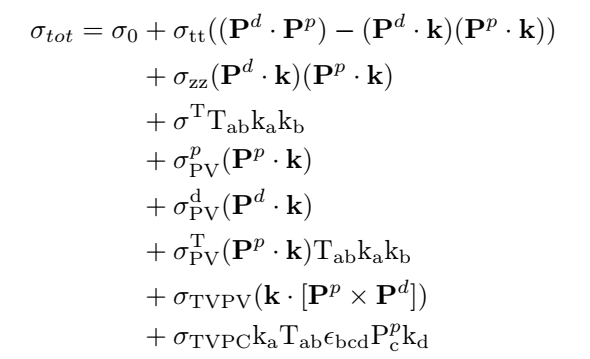
Being a spin-1 particle, the deuteron, when polarized, offers access to a wide range of interesting tensor observables. A quest for tensor asymmetries is at the heart of the spin physics with polarized deuterons at future colliders, and calls for frequent tensor polarization flips in storage rings or in deuterium targets. Here we focus on the JEDI developed technique of the Fourier analysis of the horizontal polarization oscillations under continuous radiofrequency-driven spin flips. The generated in this way time-stamped oscillating helicity of stored particles paves the way to the nucleon/nucleus spin structure studies and to the search for the parity violation. Simultaneously, a whole set of tensor spin asymmetries, including the off-diagonal ones needed for searches for the T-violation beyond the Standard Model, will be produced. A crucial ingredient is a long polarization lifetime, and we report the first analytic treatment of decoherence of the tensor polarization under continuous radiofrequency spin flips. Our principal conclusion is that at low- and intermediate-energy accelerators the deuteron polarization lifetime could be in the ballpark of several hours, making the oscillating polarization approach viable at the Nuclotron/NICA and HIAF. We comment on a utility of the flattop spin-tensor dichroism via oscillations in the cross section of interaction of deuterons in the internal target as a monitor of the tensor polarization. Simultaneously, the dichroism effect can be used for measuring the spin precession frequences and as a comagnetometer to synchronize spin phases of colliding bunches in a collider. Corrected: 11 August 2026 (Eq. (28) was revised; typos and grammar were corrected)
Interactions of exotic neutralino dark matter with nucleons in U (1) extensions of the MSSM originating from E6 GUTs
To ensure anomaly cancellation, the E 6 inspired U (1) extensions of the Minimal Supersymmetric (SUSY) Standard Model (MSSM) involve extra exotic matter. The lightest exotic neutralino in these models can be stable contributing to the cold dark matter density. We consider the interactions of such neutralino with nucleons within a specific extension of the MSSM with an additional U (1) N gauge symmetry (SE 6 SSM). The constraints on the couplings of this state, which are set by the present experimental bounds caused by the direct detection experiments, are examined. The obtained results can be generalised to other E 6 inspired SUSY models with extra U (1) gauge symmetry.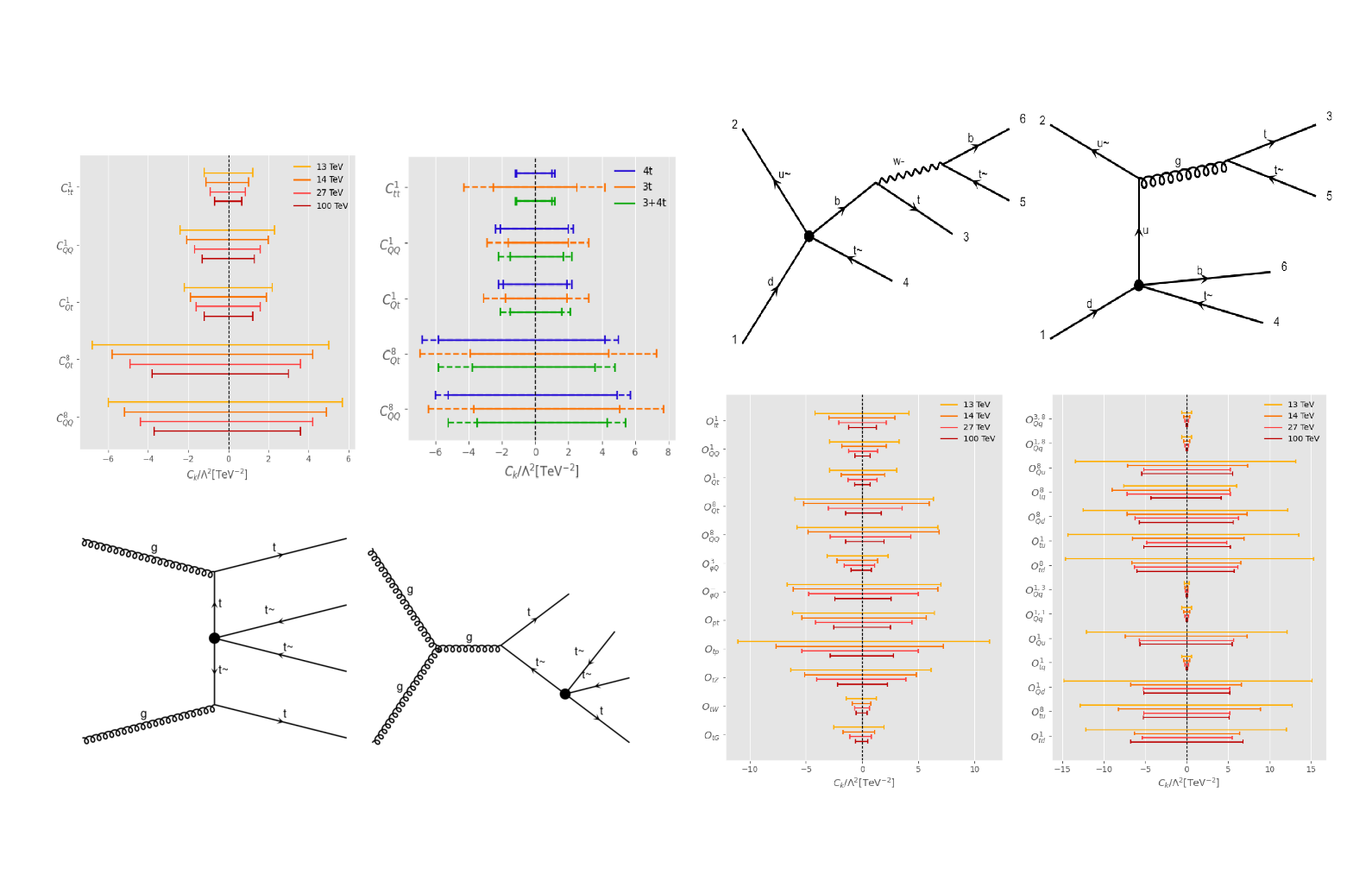
SMEFT operators in rare multi-top processes
Nowadays, the Standard Model Effective Field Theory (SMEFT) provides a standard framework to parameterize potential deviations from the Standard Model and to combine information from multiple processes in global analyses. This review summarizes dedicated studies that constrain dimension-six Wilson coefficients using three top-quark and four top-quark production processes. We highlight the complementarity of these channels, as well as summarize the main problems and prospects in the area. A concise introduction to the SMEFT formalism and a discussion of the problem of potential perturbative unitarity violation are also provided.