

Abstract
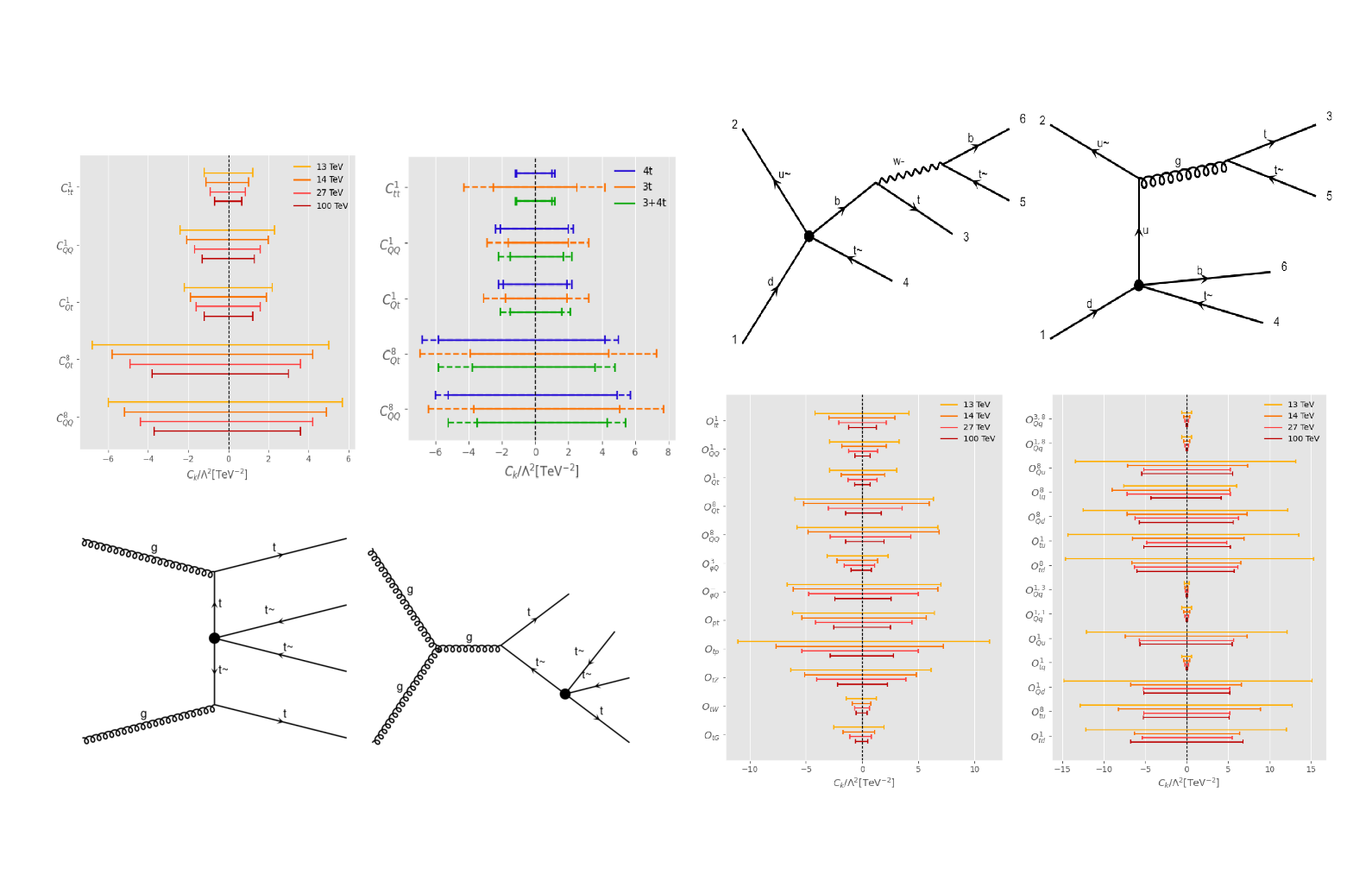
Nowadays, the Standard Model Effective Field Theory (SMEFT) provides a standard framework to parameterize potential deviations from the Standard Model and to combine information from multiple processes in global analyses. This review summarizes dedicated studies that constrain dimension-six Wilson coefficients using three top-quark and four top-quark production processes. We highlight the complementarity of these channels, as well as summarize the main problems and prospects in the area. A concise introduction to the SMEFT formalism and a discussion of the problem of potential perturbative unitarity violation are also provided.
References
[1] C. Arina, M. Backović, E. Conte, B. Fuks, J. Guo, J. Heisig, B. Hespel, M. Krämer, F. Maltoni, A. Martini, K. Mawatari, M. Pellen, E. Vryonidou, A comprehensive approach to dark matter studies: Exploration of simplified top-philic models, Journal of High Energy Physics 2016 (11) (Nov. 2016). doi:10.1007/jhep11(2016)111. DOI: https://doi.org/10.1007/JHEP11(2016)111
[2] O. Matsedonskyi, G. Panico, A. Wulzer, Top partners searches and composite Higgs models, Journal of High Energy Physics 2016 (4) (2016) 1–33. doi:10.1007/jhep04(2016)003. DOI: https://doi.org/10.1007/JHEP04(2016)003
[3] M. Garny, J. Heisig, M. Hufnagel, B. Lülf, Top-philic dark matter within and beyond the WIMP paradigm, Physical Review D 97 (7) (Apr. 2018). doi:10.1103/physrevd.97.075002. DOI: https://doi.org/10.1103/PhysRevD.97.075002
[4] R. Franceschini, Beyond-Standard-Model physics associated with the top quark (2023). arXiv: 2301.04407.
[5] S. Blasi, F. Maltoni, A. Mariotti, K. Mimasu, D. Pagani, S. Tentori, Top-philic ALP phenomenology at the LHC: The elusive mass-window (2024). arXiv:2311.16048. DOI: https://doi.org/10.1007/JHEP06(2024)077
[6] G. Aad et al., Search for ttbar resonances in final states with exactly one or two leptons using 140 fb−1 of pp collision data at √s = 13 TeV with the ATLAS experiment (2025). arXiv: 2512.17856.
[7] G. Aad et al., Inclusive and differential cross-sections for dilepton tt production measured in √s = 13 TeV pp collisions with the ATLAS detector, Journal of High Energy Physics 2023 (7) (Jul. 2023). doi:10.1007/jhep07(2023)141. DOI: https://doi.org/10.1007/JHEP07(2023)141
[8] A. Tumasyan et al., Measurement of differential tt¯ production cross sections in the full kinematic range using lepton + jets events from proton–proton collisions at √s = 13 TeV, Physical Review D 104 (9) (Nov. 2021). doi:10.1103/physrevd.104.092013. DOI: https://doi.org/10.1103/PhysRevD.104.092013
[9] M. Czakon, P. Fiedler, A. Mitov, Total top-quark pair-production cross section at hadron colliders through o(α4s), Physical Review Letters 110 (25) (Jun. 2013). doi:10.1103/physrevlett.110.252004. DOI: https://doi.org/10.1103/PhysRevLett.110.252004
[10] M. Czakon, A. Mitov, Top++: A program for the calculation of the top-pair cross-section at hadron colliders, Computer Physics Communications 185 (11) (2014) 2930–2938. doi:10.1016/j.cpc.2014.06.021. DOI: https://doi.org/10.1016/j.cpc.2014.06.021
[11] G. Aad et al., Measurement of t-channel production of single top quarks and antiquarks in pp collisions at 13 TeV using the full ATLAS Run 2 data sample, Journal of High Energy Physics 2024 (5) (May 2024). doi:10.1007/jhep05(2024)305. DOI: https://doi.org/10.1007/JHEP05(2024)305
[12] A. M. Sirunyan et al., Measurement of the single top quark and antiquark production cross sections in the t channel and their ratio in proton–proton collisions at √ s = 13 TeV, Physics Letters B 800 (2020) 135042. doi:10.1016/j.physletb.2019.135042. DOI: https://doi.org/10.1016/j.physletb.2019.135042
[13] J. Campbell, T. Neumann, Z. Sullivan, Single-top-quark production in the t-channel at NNLO, Journal of High Energy Physics 2021 (2) (Feb. 2021). doi:10.1007/jhep02(2021)040. DOI: https://doi.org/10.1007/JHEP02(2021)040
[14] A. Buckley, C. Englert, J. Ferrando, D. J. Miller, L. Moore, M. Russell, C. D. White, Global fit of top quark effective theory to data, Physical Review D 92 (9) (Nov. 2015). doi:10.1103/physrevd.92.091501. DOI: https://doi.org/10.1103/PhysRevD.92.091501
[15] N. P. Hartland, F. Maltoni, E. R. Nocera, J. Rojo, E. Slade, E. Vryonidou, C. Zhang, A Monte Carlo global analysis of the Standard Model effective field theory: The top quark sector, Journal of High Energy Physics 2019 (4) (Apr. 2019). doi:10.1007/jhep04(2019)100. DOI: https://doi.org/10.1007/JHEP04(2019)100
[16] I. Brivio, S. Bruggisser, F. Maltoni, R. Moutafis, T. Plehn, E. Vryonidou, S. Westhoff, C. Zhang, O new physics, where art thou? A global search in the top sector, Journal of High Energy Physics 2020 (2) (Feb. 2020). doi:10.1007/jhep02(2020)131. DOI: https://doi.org/10.1007/JHEP02(2020)131
[17] J. J. Ethier, G. Magni, F. Maltoni, L. Mantani, E. R. Nocera, J. Rojo, E. Slade, E. Vryonidou, C. Zhang, Combined SMEFT interpretation of Higgs, diboson, and top quark data from the LHC (2021). arXiv:2105.00006. DOI: https://doi.org/10.1007/JHEP11(2021)089
[18] J. Ellis, M. Madigan, K. Mimasu, V. Sanz, T. You, Top, Higgs, diboson and electroweak fit to the Standard Model effective field theory, Journal of High Energy Physics 2021 (4) (Apr. 2021). doi:10.1007/jhep04(2021)279. DOI: https://doi.org/10.1007/JHEP04(2021)279
[19] C. Zhang, Constraining qqtt operators from four-top production: A case for enhanced EFT sensitivity, Chinese Physics C 42 (2) (2018) 023104. doi:10.1088/1674-1137/42/2/023104. DOI: https://doi.org/10.1088/1674-1137/42/2/023104
[20] G. Banelli, E. Salvioni, J. Serra, T. Theil, A. Weiler, The present and future of four top operators, Journal of High Energy Physics 2021 (2) (Feb. 2021). doi:10.1007/jhep02(2021)043. DOI: https://doi.org/10.1007/JHEP02(2021)043
[21] F. Blekman, F. D´eliot, V. Dutta, E. Usai, Four-top quark physics at the LHC, Universe 8 (12) (2022) 638. doi:10.3390/universe8120638. DOI: https://doi.org/10.3390/universe8120638
[22] R. Aoude, H. El Faham, F. Maltoni, E. Vryonidou, Complete SMEFT predictions for four top quark production at hadron colliders, Journal of High Energy Physics 2022 (10) (Oct. 2022). doi:10.1007/jhep10(2022)163. DOI: https://doi.org/10.1007/JHEP10(2022)163
[23] A. Hayrapetyan et al., Observation of four top quark production in proton–proton collisions at √s = 13 TeV, Physics Letters B 847 (2023) 138290. doi:10.1016/j.physletb.2023.138290. DOI: https://doi.org/10.1016/j.physletb.2023.138290
[24] G. Aad et al., Observation of four-top-quark production in the multilepton final state with the ATLAS detector, European Physical Journal C 83 (6) (2023) 496, [Erratum: European Physical Journal C 84 (2024) 156]. arXiv:2303.15061, doi:10.1140/epjc/s10052-023-11573-0. DOI: https://doi.org/10.1140/epjc/s10052-023-11573-0
[25] G. Bevilacqua, M. Worek, Constraining BSM Physics at the LHC: Four top final states with NLO accuracy in perturbative QCD, Journal of High Energy Physics 07 (2012) 111. arXiv:1206.3064, doi:10.1007/JHEP07(2012)111. DOI: https://doi.org/10.1007/JHEP07(2012)111
[26] R. Frederix, D. Pagani, M. Zaro, Large NLO corrections in ttW¯ ± and ttt¯ t¯ hadron production from supposedly subleading EW contributions, Journal of High Energy Physics 02 (2018) 031. arXiv:1711.02116, doi:10.1007/JHEP02(2018)031. DOI: https://doi.org/10.1007/JHEP02(2018)031
[27] M. van Beekveld, A. Kulesza, L. Moreno Valero, Threshold resummation for the production of four top quarks at the LHC, Physical Review Letters 131 (2023) 211901. doi:10.1103/PhysRevLett.131.211901. DOI: https://doi.org/10.1103/PhysRevLett.131.211901
[28] M. Shooshtari, Search for physics beyond the Standard Model in four- and three-top quark production (2026). arXiv:2601.13089.
[29] E. Boos, L. Dudko, Triple top quark production in Standard Model, International Journal of Modern Physics A 37 (05) (2022) 2250023. arXiv:2107.07629, doi:10.1142/S0217751X22500233. DOI: https://doi.org/10.1142/S0217751X22500233
[30] V. Barger, W.-Y. Keung, B. Yencho, Triple-top signal of New Physics at the LHC, Physics Letters B 687 (2010) 70–74. arXiv:1001.0221, doi:10.1016/j.physletb.2010.03.001. DOI: https://doi.org/10.1016/j.physletb.2010.03.001
[31] M. Malekhosseini, M. Ghominejad, H. Khanpour, M. M. Najafabadi, Constraining top quark flavor violation and dipole moments through three and four top quark productions at the LHC, Physical Review D 98 (9) (Nov. 2018). doi:10.1103/physrevd.98.095001. DOI: https://doi.org/10.1103/PhysRevD.98.095001
[32] H. Khanpour, Probing top quark FCNC couplings in the triple-top signal at the high energy LHC and future circular collider, Nuclear Physics B 958 (2020) 115141. doi:10.1016/j.nuclphysb.2020.115141. DOI: https://doi.org/10.1016/j.nuclphysb.2020.115141
[33] G. D’Ambrosio, G. Giudice, G. Isidori, A. Strumia, Minimal flavour violation: An effective field theory approach, Nuclear Physics B 645 (1–2) (2002) 155–187. doi:10.1016/s0550-3213(02) 00836-2. DOI: https://doi.org/10.1016/S0550-3213(02)00836-2
[34] A. Aleshko, E. Boos, V. Bunichev, L. Dudko, Prospects for establishing limits on the SMEFT operators from the production processes of three and four top quarks in hadron collisions, International Journal of Modern Physics A 39 (32) (2024) 2450119. doi:10.1142/S0217751X24501197. DOI: https://doi.org/10.1142/S0217751X24501197
[35] W. Buchmuller, D. Wyler, Effective Lagrangian analysis of new interactions and flavor conservation, Nuclear Physics B 268 (1986) 621 653. doi:10.1016/0550-3213(86)90262-2. DOI: https://doi.org/10.1016/0550-3213(86)90262-2
[36] C. Degrande, N. Greiner, W. Kilian, O. Mattelaer, H. Mebane, T. Stelzer, S. Willenbrock, C. Zhang, Effective field theory: A modern approach to anomalous couplings, Annals of Physics 335 (2013) 21–32. arXiv:1205.4231, doi:10.1016/j.aop.2013.04.016. DOI: https://doi.org/10.1016/j.aop.2013.04.016
[37] D. Barducci et al., Interpreting top-quark LHC measurements in the Standard-Model effective field theory (Feb. 2018). arXiv:1802.07237, doi:10.48550/ARXIV.1802.07237.
[38] I. Brivio, M. Trott, The Standard Model as an effective field theory, Physics Reports 793 (2019) 1–98. doi:10.1016/j.physrep.2018.11.002. DOI: https://doi.org/10.1016/j.physrep.2018.11.002
[39] E. E. Boos, The SMEFT formalism is the basis for finding deviations from the Standard Model, Usp. Fiz. Nauk 192 (7) (2022) 697–721. doi:10.3367/UFNe.2021.02.038916. DOI: https://doi.org/10.3367/UFNr.2021.02.038916
[40] G. Isidori, F. Wilsch, D. Wyler, The Standard Model effective field theory at work, Reviews of Modern Physics 96 (1) (Mar. 2024). doi:10.1103/revmodphys.96.015006. DOI: https://doi.org/10.1103/RevModPhys.96.015006
[41] I. Brivio, J. Gonzalez-Fraile, M. C. Gonzalez-Garcia, L. Merlo, The complete HEFT Lagrangian after the LHC Run I, The European Physical Journal C 76 (7) (Jul. 2016). doi:10.1140/epjc/s10052-016-4211-9. DOI: https://doi.org/10.1140/epjc/s10052-016-4211-9
[42] L. Gr´af, B. Henning, X. Lu, T. Melia, H. Murayama, Hilbert series, the Higgs mechanism, and HEFT, Journal of High Energy Physics 2023 (2) (Feb. 2023). doi:10.1007/jhep02(2023)064. DOI: https://doi.org/10.1007/JHEP02(2023)064
[43] S. Weinberg, Baryon- and lepton-nonconserving processes, Physical Review Letters 43 (1979) 1566–1570. doi:10.1103/PhysRevLett.43.1566. DOI: https://doi.org/10.1103/PhysRevLett.43.1566
[44] A. Tumasyan et al., Probing heavy Majorana neutrinos and the Weinberg operator through vector boson fusion processes in proton–proton collisions at √s = 13 TeV, Physical Review Letters 131 (1) (Jul. 2023). doi:10.1103/physrevlett.131.011803. DOI: https://doi.org/10.1103/PhysRevLett.131.011803
[45] B. Grzadkowski, M. Iskrzynski, M. Misiak, J. Rosiek, Dimension-six terms in the Standard Model Lagrangian, Journal of High Energy Physics 10 (2010) 085. arXiv:1008.4884, doi:10.1007/JHEP10(2010)085. DOI: https://doi.org/10.1007/JHEP10(2010)085
[46] C. W. Murphy, Dimension-8 operators in the Standard Model effective field theory, Journal of High Energy Physics 2020 (10) (Oct. 2020). doi:10.1007/jhep10(2020)174. DOI: https://doi.org/10.1007/JHEP10(2020)174
[47] H.-L. Li, Z. Ren, J. Shu, M.-L. Xiao, J.-H. Yu, Y.-H. Zheng, Complete set of dimension-eight operators in the Standard Model effective field theory, Physical Review D 104 (1) (Jul. 2021). doi:10.1103/physrevd.104.015026. DOI: https://doi.org/10.1103/PhysRevD.104.015026
[48] L. Lehman, Extending the Standard Model effective field theory with the complete set of dimension-7 operators, Physical Review D 90 (12) (Dec. 2014). doi:10.1103/physrevd.90. 125023. DOI: https://doi.org/10.1103/PhysRevD.90.125023
[49] H.-L. Li, Z. Ren, M.-L. Xiao, J.-H. Yu, Y.-H. Zheng, Complete set of dimension-nine operators in the Standard Model effective field theory, Physical Review D 104 (1) (Jul. 2021). doi:10.1103/physrevd.104.015025. DOI: https://doi.org/10.1103/PhysRevD.104.015025
[50] B. Henning, X. Lu, T. Melia, H. Murayama, 2, 84, 30, 993, 560, 15456, 11962, 261485, . . . : Higher dimension operators in the SMEFT (2019). arXiv:1512.03433. DOI: https://doi.org/10.1007/JHEP09(2019)019
[51] I. Brivio, Y. Jiang, M. Trott, The SMEFTsim package, theory and tools, Journal of High Energy Physics 2017 (12) (Dec. 2017). doi:10.1007/jhep12(2017)070. DOI: https://doi.org/10.1007/JHEP12(2017)070
[52] C. Degrande, G. Durieux, F. Maltoni, K. Mimasu, E. Vryonidou, C. Zhang, Automated one-loop computations in the Standard Model effective field theory, Physical Review D 103 (9) (May 2021). doi:10.1103/physrevd.103.096024. DOI: https://doi.org/10.1103/PhysRevD.103.096024
[53] A. Celis, J. Fuentes-Mart´ın, A. Vicente, J. Virto, Dsixtools: The Standard Model effective field theory toolkit, The European Physical Journal C 77 (6) (June 2017). doi:10.1140/epjc/s10052-017-4967-6. DOI: https://doi.org/10.1140/epjc/s10052-017-4967-6
[54] J. Aebischer, J. Kumar, D. M. Straub, Wilson: A Python package for the running and matching of Wilson coefficients above and below the electroweak scale, The European Physical Journal C 78 (12) (Dec. 2018). doi:10.1140/epjc/s10052-018-6492-7. DOI: https://doi.org/10.1140/epjc/s10052-018-6492-7
[55] N. Castro, J. Erdmann, C. Grunwald, K. Kr¨oninger, N.-A. Rosien, EFTfitter: A tool for interpreting measurements in the context of effective field theories, The European Physical Journal C 76 (8) (Aug. 2016). doi:10.1140/epjc/s10052-016-4280-9. DOI: https://doi.org/10.1140/epjc/s10052-016-4280-9
[56] J. de Blas, D. Chowdhury, M. Ciuchini, A. M. Coutinho, O. Eberhardt, M. Fedele, E. Franco, G. G. di Cortona, V. Miralles, S. Mishima, A. Paul, A. Pe˜nuelas, M. Pierini, L. Reina, L. Silvestrini, M. Valli, R. Watanabe, N. Yokozaki, HEPfit: A code for the combination of indirect and direct constraints on high energy physics models, The European Physical Journal C 80 (5) (May 2020). doi:10.1140/epjc/s10052-020-7904-z. DOI: https://doi.org/10.1140/epjc/s10052-020-7904-z
[57] T. Giani, G. Magni, J. Rojo, SMEFiT: A flexible toolbox for global interpretations of particle physics data with effective field theories, The European Physical Journal C 83 (5) (May 2023). doi:10.1140/epjc/s10052-023-11534-7. DOI: https://doi.org/10.1140/epjc/s10052-023-11534-7
[58] P. Stangl, Smelli — the SMEFT Likelihood (2020). arXiv:2012.12211.
[59] J. Aebischer, M. Fael, A. Lenz, M. Spannowsky, J. Virto, I. Brivio, J. C. Criado, A. Dedes, J. Kumar, M. Misiak, G. Passarino, G. M. Pruna, S. Renner, J. Santiago, D. Scott, E. Slade, P. Stangl, P. Stoffer, D. M. Straub, D. Sutherland, D. van Dyk, A. Vicente, Computing tools for the SMEFT (2019). arXiv:1910.11003.
[60] J. Aebischer et al., Computing tools for effective field theories: SMEFT-Tools 2022 Workshop Report, 14–16 September 2022, Z¨urich, The European Physical Journal C 84 (2) (Feb. 2024). doi:10.1140/epjc/s10052-023-12323-y.
[61] A. Adams, N. Arkani-Hamed, S. Dubovsky, A. Nicolis, R. Rattazzi, Causality, analyticity and an IR obstruction to UV completion, Journal of High Energy Physics 2006 (10) (2006) 014–014. doi:10.1088/1126-6708/2006/10/014. DOI: https://doi.org/10.1088/1126-6708/2006/10/014
[62] G. N. Remmen, N. L. Rodd, Consistency of the Standard Model effective field theory, Journal of High Energy Physics 2019 (12) (Dec. 2019). doi:10.1007/jhep12(2019)032. DOI: https://doi.org/10.1007/JHEP12(2019)032
[63] K. Yamashita, C. Zhang, S.-Y. Zhou, Elastic positivity vs extremal positivity bounds in SMEFT: A case study in transversal electroweak gauge-boson scatterings, Journal of High Energy Physics 2021 (1) (Jan. 2021). doi:10.1007/jhep01(2021)095. DOI: https://doi.org/10.1007/JHEP01(2021)095
[64] B. Bellazzini, J. E. Mir´o, R. Rattazzi, M. Riembau, F. Riva, Positive moments for scattering amplitudes, Physical Review D 104 (3) (Aug. 2021). doi:10.1103/physrevd.104.036006. DOI: https://doi.org/10.1103/PhysRevD.104.036006
[65] M. Chala, J. Santiago, Positivity bounds in the Standard Model effective field theory beyond tree level, Physical Review D 105 (11) (Jun. 2022). doi:10.1103/physrevd.105.l111901. DOI: https://doi.org/10.1103/PhysRevD.105.L111901
[66] M. Chala, X. Li, Positivity restrictions on the mixing of dimension-eight SMEFT operators (2024). arXiv:2309.16611. DOI: https://doi.org/10.1103/PhysRevD.109.065015
[67] B. Henning, X. Lu, H. Murayama, One-loop matching and running with covariant derivative expansion (2016). arXiv:1604.01019.
[68] S. D. Bakshi, J. Chakrabortty, S. K. Patra, Codex: Wilson coefficient calculator connecting SMEFT to UV theory, The European Physical Journal C 79 (1) (Jan. 2019). doi:10.1140/epjc/s10052-018-6444-2. DOI: https://doi.org/10.1140/epjc/s10052-018-6444-2
[69] J. Fuentes-Mart´ın, M. K¨onig, J. Pag`es, A. E. Thomsen, F. Wilsch, A proof of concept for matchete: An automated tool for matching effective theories, The European Physical Journal C 83 (7) (Jul. 2023). doi:10.1140/epjc/s10052-023-11726-1. DOI: https://doi.org/10.1140/epjc/s10052-023-11726-1
[70] J. Fuentes-Mart´ın, A. Palavri´c, A. E. Thomsen, Functional matching and renormalization group equations at two-loop order, Physics Letters B 851 (2024) 138557. doi:10.1016/j.physletb.2024.138557. DOI: https://doi.org/10.1016/j.physletb.2024.138557
[71] C. Degrande, R. Rosenfeld, A. Vasquez, Collider sensitivity to SMEFT heavy-quark operators at one-loop in top-quark processes, Journal of High Energy Physics 07 (2024) 114. arXiv:2402. 06528, doi:10.1007/JHEP07(2024)114. DOI: https://doi.org/10.1007/JHEP07(2024)114
[72] A. M. Aleshko, E. E. Boos, V. E. Bunichev, L. V. Dudko, Comparison of constraints on Wilson coefficients of dimension six EFT operators obtained from processes of three and four top quarks production, Physics of Particles and Nuclei Letters 20 (3) (2023) 317–324. doi: 10.1134/S1547477123030044. DOI: https://doi.org/10.1134/S1547477123030044
[73] C.-R. Chen, Searching for New Physics with triple-top signal at the LHC, Physics Letters B 736 (2014) 321–324. doi:10.1016/j.physletb.2014.07.041. DOI: https://doi.org/10.1016/j.physletb.2014.07.041
[74] Q.-H. Cao, S.-L. Chen, Y. Liu, X.-P. Wang, What can we learn from triple top-quark production?, Physical Review D 100 (5) (Sep. 2019). doi:10.1103/physrevd.100.055035. DOI: https://doi.org/10.1103/PhysRevD.100.055035
[75] A. Aleshko, E. Boos, V. Bunichev, L. Dudko, Sensitivity of the three top quark production process to the contribution of top-related SMEFT operators, Physics of Particles and Nuclei 56 (2) (2025) 374–380. doi:10.1134/S1063779624701661. DOI: https://doi.org/10.1134/S1063779624701661
[76] M. Jacob, G. Wick, On the general theory of collisions for particles with spin, Annals of Physics 7 (4) (1959) 404–428. doi:https://doi.org/10.1016/0003-4916(59)90051-X. DOI: https://doi.org/10.1016/0003-4916(59)90051-X
[77] M. Rauch, Vector-boson fusion and vector-boson scattering (2016). arXiv:1610.08420.
[78] T. Corbett, O. Eboli, M. Gonzalez-Garcia, Unitarity constraints on dimension-six operators. ii. ´ including fermionic operators, Physical Review D 96 (3) (Aug. 2017). doi:10.1103/physrevd. 96.035006. DOI: https://doi.org/10.1103/PhysRevD.96.035006
[79] F. Maltoni, L. Mantani, K. Mimasu, Top-quark electroweak interactions at high energy, Journal of High Energy Physics 2019 (10) (Oct. 2019). doi:10.1007/jhep10(2019)004. DOI: https://doi.org/10.1007/JHEP10(2019)004
[80] T. Cohen, J. Doss, X. Lu, Unitarity bounds on effective field theories at the LHC, Journal of High Energy Physics 2022 (4) (Apr. 2022). doi:10.1007/jhep04(2022)155. DOI: https://doi.org/10.1007/JHEP04(2022)155
[81] Q.-H. Cao, Y. Liu, S.-R. Yuan, Unitarity bounds and basis transformations in SMEFT: An analysis of Warsaw and SILH bases (2024). arXiv:2309.14079. DOI: https://doi.org/10.1016/j.nuclphysb.2024.116781
[82] E. E. Boos, V. E. Bunichev, Unitary limitations of the SMEFT approach in describing New Physics in the processes of single top quark production, Physics of Particles and Nuclei Letters 20 (3) (2023) 330–335. doi:10.1134/S1547477123030147. DOI: https://doi.org/10.1134/S1547477123030147
[83] E. E. Boos, V. E. Bunichev, L. V. Dudko, M. A. Perfilov, G. A. Vorotnikov, Eligibility of EFT approach to search for tqg FCNC phenomenon, Physics of Atomic Nuclei 83 (6) (2020) 984–988. arXiv:2004.14498, doi:10.1134/S1063778820060083. DOI: https://doi.org/10.1134/S1063778820060083
License

This work is licensed under a Creative Commons Attribution-NonCommercial 4.0 International License.