

Аннотация
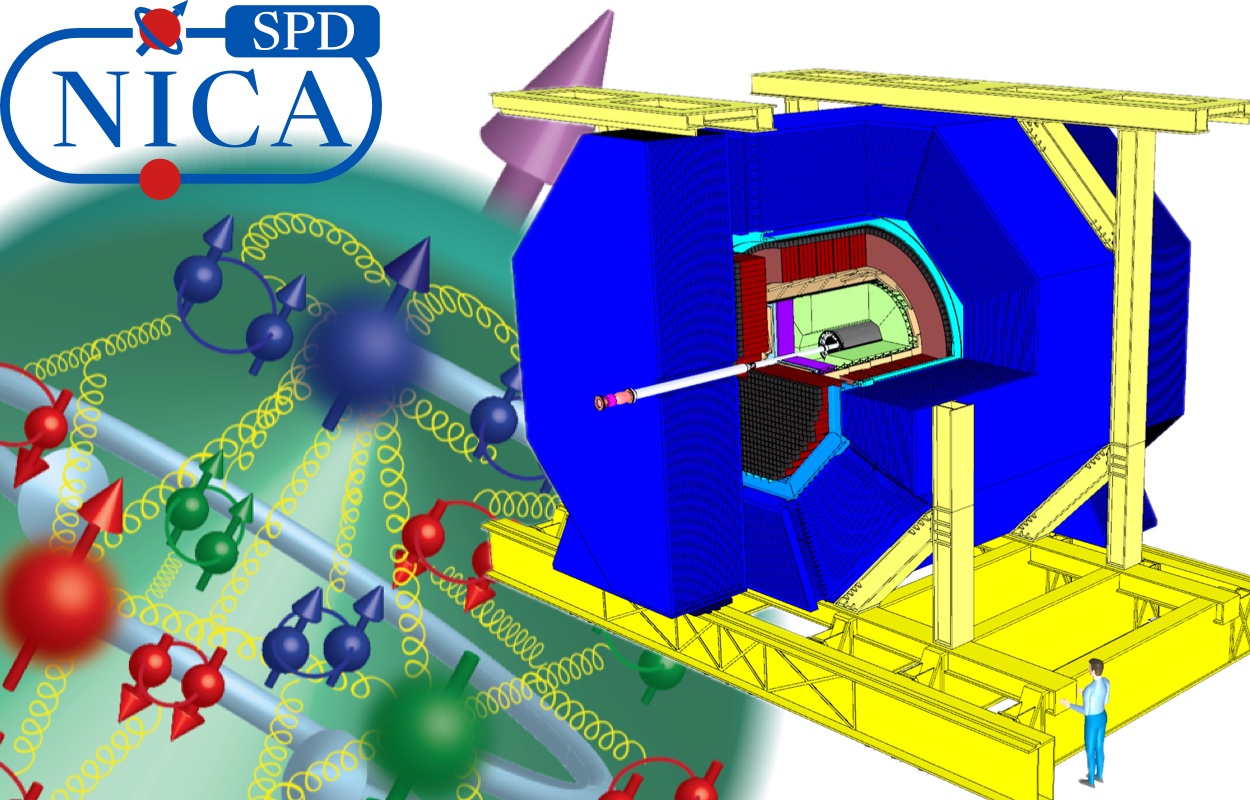
Коллаборация Spin Physics Detector предлагает установить универсальный детектор во второй точке взаимодействия строящегося коллайдера NICA (ОИЯИ, Дубна) для исследования спиновой структуры протона и дейтрона и других спин-зависимых явлений, используя уникальную возможность работы с поляризованными пучками протонов и дейтронов при энергии столкновения до 27 ГэВ и светимости до 1032 см−2 с−1. Главной целью эксперимента является обеспечение доступа к глюонным функциям партонных распределений, зависящим от поперечного импульса (TMD PDFs), в протонах и дейтронах, а также к распределению «трансверсити» (transversity) для глюонов и тензорным PDFs в дейтронах посредством измерения специфических одно- и двухспиновых асимметрий с использованием различных дополняющих друг друга процессов, таких как образование чармония, открытого чарма и прямых фотонов. Возможно изучение других поляризационных, а также не связанных с поляризацией эффектов, особенно на первом этапе работы коллайдера NICA в условиях пониженной светимости и энергии столкновений протонных и ионных пучков. Данная статья посвящена исключительно техническим вопросам построения установки SPD.
Исправлено:
5 февраля 2025 года (фамилия одного из авторов изначально была написана с ошибкой (M. Bolsunovskya), правильное написание: M. Bolsunovskaya).
23 апреля 2025 года (фамилия одного из авторов изначально была написана с ошибкой (A. Seleznev), правильное написание: A. Selezenev).Поддерживающие организации
Библиографические ссылки
[1] V. M. Abazov, et al., Conceptual design of the Spin Physics Detector (January 2021).arXiv:2102.00442.
[2] A. Arbuzov, et al., On the physics potential to study the gluon content of proton and deuteronat NICA SPD, Prog. Part. Nucl. Phys. 119 (2021) 103858.arXiv:2011.15005,doi:10.1016/j.ppnp.2021.103858.
[3] V. V. Abramov, et al., Possible Studies at the First Stage of the NICA Collider Operationwith Polarized and Unpolarized Proton and Deuteron Beams, Phys. Part. Nucl. 52 (6) (2021)1044–1119.arXiv:2102.08477,doi:10.1134/S1063779621060022.
[4] Z. Igamkulov, M. Cruceru, A. B. Kurepin, A. G. Litvinenko, E. I. Litvinenko, V. F. Peresedov,Luminosity Measurement and Control at NICA, Phys. Part. Nucl. Lett. 16 (6) (2019) 744–753.doi:10.1134/S1547477119060190.
[5] I. N. Meshkov, Luminosity of an Ion Collider, Phys. Part. Nucl. 50 (6) (2019) 663–682.doi:10.1134/S1063779619060042.
[6] V. M. Abazov, G. D. Alexeev, Y. I. Davydov, V. L. Malyshev, V. V. Tokmenin, A. A. Piskun,Comparative analysis of the performance characteristics of mini-drift tubes with different design,Instruments and Experimental Techniques 53 (3) (2010) 356–361.
[7] V. M. Abazov, G. D. Alexeev, Y. I. Davydov, V. L. Malyshev, A. A. Piskun, V. V. Tokmenin,Coordinate accuracy of mini-drift tubes in detection of an induced signal, Instruments and Ex-perimental Techniques 53 (5) (2010) 648–652.
[8] PANDA Collaboration, Technical Design Report for the: PANDA Muon System (AntiProtonAnnihilations at Darmstadt). Strong Interaction Studies with Antiprotons (September 2012),https://panda.gsi.de/publication/re-tdr-2012-003.
[9] V. M. Abazov, et al., The Muon system of the run II D0 detector, Nucl. Instrum. Meth. A 552(2005) 372–398.arXiv:physics/0503151,doi:10.1016/j.nima.2005.07.008.
[10] P. Abbon, et al., The COMPASS experiment at CERN, Nucl. Instrum. Meth. A 577 (2007)455–518.arXiv:hep-ex/0703049,doi:10.1016/j.nima.2007.03.026.
[11] G. D. Alekseev, M. A. Baturitsky, O. V. Dvornikov, A. I. Khokhlov, V. A. Mikhailov, I. A.Odnokloubov, V. V. Tokmenin, The eight-channel ASIC bipolar transresistance amplifier D0MAMPL-8.3, Nucl. Instrum. Meth. A 462 (2001) 494–505.doi:10.1016/S0168-9002(01)00195-4.
[12] G. Alexeev, M. Baturitsky, O. Dvornikov, V. Mikhailov, I. Odnokloubov, V. Tokmenin, Theeight-channel fast comparator IC, Nucl. Instrum. Meth. A 423 (1) (1999) 157–162.doi:https://doi.org/10.1016/S0168-9002(98)01185-1.
[13] G. D. Alekseev, M. A. Baturitsky, O. V. Dvornikov, A. I. Khokhlov, V. A. Mikhailov, I. A.Odnokloubov, A. A. Shishkin, V. V. Tokmenin, S. F. Zhirikov, The D0 forward angle muonsystem front-end electronics design, Nucl. Instrum. Meth. A 473 (2001) 269–282.doi:10.1016/S0168-9002(01)00865-8.
[14] G. D. Alekseev, A. Maggiora, N. I. Zhuravlev, Digital Front-end Electronics for COMPASSMuon-Wall 1 Detector, JINR Preprint E13-2005-37, 2005.
[15] P. Bredy, F. P. Juster, B. Baudouy, L. Benkheira, M. Cazanou, Experimental and theoreticalstudy of a two phase helium high circulation loop, AIP Conf. Proc. 823 (1) (2006) 496–503.doi:10.1063/1.2202453.
[16] N. Dhanaraj, G. Tatkowski, Y. Huang, T. M. Page, M. J. Lamm, R. L. Schmitt, T. J. Peterson,An analytical approach to designing a thermosiphon cooling system for large scale superconduct-ing magnets, IOP Conference Series: Materials Science and Engineering 101 (1) (2015) 012142.doi:10.1088/1757-899X/101/1/012142.
[17] The SPD proto-collaboration, Conceptual design of the Spin Physics Detector.
[18] AFI Electronicshttps://afi.jinr.ru.
[19] HVSys web pagehttp://hvsys.ru.
[20] O. P. Gavrishchuk, V. E. Kovtun, T. V. Malykhina, Simulation Studies of the Moliere Radiusfor EM Calorimeter Materials, Problems of Atomic Science and Technology 136 (2021) 171–174.
[21] V. N. Azorskyi, N. O. Graphov, O. P. Gavrischuk, A. I. Maltsev, V. V. Tereshenko, Electro-magnetic calorimeter for the SPD experiment, Physics of Particles and Nuclei 52 (2021) 975,http://www1.jinr.ru/Pepan/v-52-4/49_azor_ann.pdf.
[22] O. P. Gavrishchuk, V. E. Kovtun, T. V. Malykhina, Simulation study of energy resolution of the electromagnetic shashlyk calorimeter for different of layers and absorber combinations, EastEuropean Journal of Physics 3 (2020) 73–80.[23] p-Terphenilhttp://omlc.ogi.edu/spectra/PhotochemCAD/html/003.html.
[24] POPOPhttp://omlc.ogi.edu/spectra/PhotochemCAD/html/077.html.
[25] Kuraray pagehttp://kuraraypsf.jp/psf/ws.html.
[26] IHEP pagehttp://exwww.ihep.su/scint/mold/product.htm.
[27] IHEP pagehttp://www.newchemistry.ru/material.php?id=12.
[28] Hamamatsu web pagehttps://www.hamamatsu.com/eu/en/product/optical-sensors/mppc/index.html.
[29] AFI Electronics web pagehttps://afi.jinr.ru/ADC64.
[30] HVSys web pagehttp://hvsys.ru/images/data/news/3_small_1368802865.pdf.
[31] B. Wang, X. Chen, Y. Wang, D. Han, B. Guo, Y. Yu, The High-Rate Sealed MRPC to PromotePollutant Exchange in Gas Gaps: Status on the Development and Observations, Appl. Sciences11 (11) (2021) 4722.doi:10.3390/app11114722.
[32] Y. Wang, Y. Yu, Multigap Resistive Plate Chambers for Time of Flight Applications, Appl.Sciences 11 (1) (2020) 111.doi:10.3390/app11010111.
[33] A. Akindinov, et al., Latest results on the performance of the multigap resistive plate chamberused for the ALICE TOF, Nucl. Instrum. Meth. A 533 (2004) 74–78.doi:10.1016/j.nima.2004.07.004.
[34] V. Ammosov, et al., The HARP resistive plate chambers: Characteristics and physics perfor-mance, Nucl. Instrum. Meth. A 602 (2009) 639–643.doi:10.1016/j.nima.2008.12.213.
[35] The STAR TOF Collaboration, Proposal for a Large Area Time of Flight System for STAR,2004.
[36] J. Velkovska, et al., Multi-gap Resistive Plate Chambers: Time-of-Flight system of the PHENIXhigh-pT Detector. Conceptual Design Report.
[37] A. Golovin, et al., Technical Design Report of the Time of Flight System (TOF-700) BM@N,2017.
[38] Talk by E. Ladygin, S. Nagorniy, A. Semak,https://indico.jinr.ru/event/2616/contributions/15165/attachments/11660/19232/Semak_SPD_14.12.21.pdf.
[39] B. Wang, D. Han, Y. Wang, X. L. Chen, Y. Li, The CEE-eTOF wall constructed with new sealedMRPC, JINST 15 (08) (2020) C08022.doi:10.1088/1748-0221/15/08/C08022.
[40] L. Jinxin, Z. Lei, Y. Liujiang, L. Zhenyan, L. Shubin, A. Qi, Design of a prototype readoutelectronics with a few picosecond time resolution for MRPC detectors, Nucl. Instrum. Meth. A925 (2019) 53–59.doi:https://doi.org/10.1016/j.nima.2019.01.084.
[41] J. Wang, S. Liu, L. Zhao, X. Hu, Q. An, The 10-ps multitime measurements averaging TDCimplemented in an FPGA, IEEE Transactions on Nuclear Science 58 (4) (2011) 2011–2018.doi:10.1109/TNS.2011.2158551.
[42] N. Akopov, et al., Nucl. Instrum. Meth. A 479 (2002) 511,https://arxiv.org/abs/hep-ex/0209005.
[43] [LHC-B Collaboration], CERN-LHCC-2000-037, LHCb TDR 3, 7 September 2000.
[44] M. Buenerd, AMS RICH Collaboration, The RICH counter of the AMS experiment, Nucl. In-strum. Meth. A 502 (2003) 158,https://arxiv.org/abs/astro-ph/0211645.
[45] A.Yu. Barnyakov, et al., Nucl. Instrum. Meth. A 553 (2005) 70–75.
[46] T. Iijima, et al., Nucl. Instrum. Meth. A 548 (2005) 383–390.
[47] S. Nishida, et al., Aerogel RICH for the Belle II forward PID, Nucl. Instrum. Meth. A 766 (2014)28–31.
[48] A.Yu. Barnyakov, et al., Nucl. Instrum. Meth. A 595 (2008) 100–103.
[49] A. Katcin, Progress in the production of aerogel radiators for the RICH detectors in Novosi-birsk, TIPP2023, 4–8 September 2023, Cape Town, South Africa,https://indico.tlabs.ac.za/event/112/contributions/2775/attachments/1053/1418/tipp2023-katcin.pdf.
[50] G. Abramov, et al., Extracted electron and gamma beams in BINP, JINST 9 (2014) C08022.
[51] G. Abramov, et al., Measurement of the energy of electrons extracted from the VEPP-4M accel-erator, JINST 11 (2016) P03004.
[52] A. Barnyakov, et al., Nucl. Instrum. Meth. A 766 (2014) 235.
[53] A. Barnyakov, et al., Beam test of FARICH prototype with digital photon counter, Nucl. Instrum.Meth. A 732 (2013) 352–356.
[54] T. Frach, et al., The Digital Silicon Photomultiplier — Principle of Operation and IntrinsicDetector Performance, IEEE Nuclear Science Symposium Conference Record 28 (2009) 2009.
[55] J. Benitez, et al., Nucl. Instrum. Meth. A 595 (2008) 104.
[56] B. Dey, et al., Design and performance of the focusing DIRC detector, Nucl. Instrum. Meth. A775 (2015) 112–131.
[57] S. Iwata, et al., Particle identification performance of the prototype aerogel RICH counter for theBelle II experiment, Prog. Theor. Exp. Phys. 502 (2016) 033H01.doi:10.1093/ptep/ptw005.
[58] A. Barnyakov, Development of FARICH technique for the Super Charm-Tau Factory project,TIPP2023, 4–8 September 2023, Cape Town, South Africa,https://indico.tlabs.ac.za/event/112/contributions/2781/attachments/1081/1460/BarnyakovTIPP2023_pres.pdf.
[59] G. Bondarenko, et al., Nucl. Instrum. Meth. A 442 (2000) 187.
[60] Z. Sadygov, et al., Nucl. Instrum. Meth. A 504 (2003) 301.
[61] [DATASHEET] MPPC (Multi-Pixel Photon Counter) arrays. S13361-3050 series,https://www.hamamatsu.com/resources/pdf/ssd/s13361-3050_series_kapd1054e.pdf.
[62] A. Ferri, et al., Performance of a 64-channel, 3.2×3.2 cm2SiPM tile for TOF-PET application, Nucl. Instrum. Meth. A 824 (2016) 196–197.
[63] [DATASHEET] J-Series High PDE and Timing Resolution, TSV Package,https://www.onsemi.com/pdf/datasheet/microj-series-d.pdf.
[64] A. N. Otte, et al., Characterization of three high efficiency and blue sensitive silicon photomul-tipliers, Nucl. Instrum. Meth. A 846 (2017) 106–125.
(2016) 2530–2532.doi:10.1016/j.nuclphysbps.2015.09.448.
[65] D. Durini, et al., Evaluation of the dark signal performance of different SiPM-technologies underirradiation with cold neutrons, Nucl. Instrum. Meth. A 835 (2016) 99–109.
[66] M. Y. Barnyakov, et al., Radiation hardness test of the Philips Digital Photon Counter withproton beam, Nucl. Instrum. Meth. A 824 (2016) 83–84.
[67] M. Calvi, et al., Single photon detection with SiPMs irradiated up to 1014cm−21-MeV-equivalentneutron fluence, Nucl. Instrum. Meth. A 922 (2019) 243–249.
[68] M. Yonenaga, et al., Performance evaluation of the HAPD in the Belle II Aerogel RICH counters,JPS Conf. Proc. 27 (2019) 012016.
[69] A. Barnyakov, et al., Investigation and development of microchannel plate phototubes, Nucl.Instrum. Meth. A 572 (2007) 404–407.
[70] A. Barnyakov, et al., Photomultiplier tubes with three MCPs, Nucl. Instrum. Meth. A 598 (2009)160–162.
[71] A. Barnyakov, et al., Test of microchannel plates in magnetic fields up to 4.5 T, Nucl. Instrum.Meth. A 845 (2017) 588–590.
[72] K. Inami, et al., Nucl. Instrum. Meth. A 560 (2006) 303.
[73] C. Ugur, et al., A 16 channel high resolution (<11 ps RMS) Time-to-Digital Converter in aField-Programmable Gate Array, JINST 7 (2012) C02004.
[74] F. Anghinolfi, et al., NINO: An ultra-fast and low-power front-end amplifier/discriminator ASICdesigned for the multigap resistive plate chamber, Nucl. Instrum. Meth. A 533 (2004) 183.
[75] R. Gao, et al., Development of scalable electronics for the TORCH time-of-flight detector, JINST10 (2015) C02028.
[76]http://omega.in2p3.fr/index.php/products.html.
[77] P. Fischer, et al., Fast Self Triggered Multi Channel Readout ASIC for Time and Energy Mea-surement, IEEE Transactions on Nuclear Science 56 (3) (2009) 1153–1158.
[78] I. Sacco, et al., PETA4: a multi-channel TDC/ADC ASIC for SiPM readout, JINST 8 (2013)C12013.
[79] I. Sacco, et al., A compact, high-density gamma-detection module for Time-of-Flight measure-ments in PET applications, Nucl. Instrum. Meth. A 824 (2016) 233–236.
[80] A. Argentieri, et al., Design and characterization of CMOS multichannel front-end electronicsfor silicon photomultipliers, Nucl. Instrum. Meth. A 652 (2011) 516.
[81] J. Bario, et al., Performance of VATA64HDR16 ASIC for medical physics applications based oncontinuous crystals and SiPMs, JINST 10 (2015) P12001.
[82] M. D. Rolo, et al., TOFPET ASIC for PET applications, JINST 8 (2013) C02050.
[83] T. M. Conneely, et al., The TORCH PMT: a close packing, multi-anode, long life MCP-PMTfor Cherenkov applications, JINST 10 (2015) C05003.
[84] A. Sergi, NA62 Spectrometer: A Low Mass Straw Tracker, Phys. Procedia 37 (2012) 530–534.doi:10.1016/j.phpro.2012.03.713.
[85] H. Nishiguchi, et al., Development of an extremely thin-wall straw tracker operational in vacuum– The COMET straw tracker system, Nucl. Instrum. Meth. A 845 (2017) 269–272.doi:10.1016/j.nima.2016.06.082.
[86] M. Anelli, et al., A facility to Search for Hidden Particles (SHiP) at the CERN SPS (April 2015).arXiv:1504.04956.
[87] M. Lee, The Straw-tube Tracker for the Mu2e Experiment, Nucl. Part. Phys. Proc. 273–275 (2016) 2530–2532.doi:10.1016/j.nuclphysbps.2015.09.448.
[88] V. Bychkov, et al., Construction and manufacture of large size straw-chambers of the COMPASSspectrometer tracking system, Part. Nucl. Lett. 111 (2002) 64–73.
[89] K. Platzer, W. Dunnweber, N. Dedek, M. Faessler, R. Geyer, C. Ilgner, V. Peshekhonov,H. Wellenstein, Mapping the large area straw detectors of the COMPASS experiment with X-rays, IEEE Trans. Nucl. Sci. 52 (2005) 793–798.doi:10.1109/TNS.2005.850971.
[90] V. Volkov, P. Volkov, T. Enik, G. Kekelidze, V. Kramarenko, V. Lysan, D. Peshekhonov, A. Solin,A. Solin, Straw Chambers for the NA64 Experiment, Phys. Part. Nucl. Lett. 16 (6) (2019) 847–858.doi:10.1134/S1547477119060554.
[91] E. Cortina Gil, et al., The Beam and detector of the NA62 experiment at CERN, JINST 12 (05)(2017) P05025.arXiv:1703.08501,doi:10.1088/1748-0221/12/05/P05025.
[92] D. Moraes, W. Bonivento, N. Pelloux, W. Riegler, The CARIOCA Front End Chip for the LHCbmuon chambers (January 2003).
[93] R. Veenhof, Garfield, a drift chamber simulation program, Conf. Proc. C 9306149 (1993) 66–71.
[94] R. Veenhof, GARFIELD, recent developments, Nucl. Instrum. Meth. A 419 (1998) 726–730.doi:10.1016/S0168-9002(98)00851-1.
[95] F. Hahn, F. Ambrosino, A. Ceccucci, H. Danielsson, N. Doble, F. Fantechi, A. Kluge, C. Lazze-roni, M. Lenti, G. Ruggiero, M. Sozzi, P. Valente, R. Wanke, NA62: Technical Design Document,Tech. rep., CERN, Geneva,https://cds.cern.ch/record/1404985(December 2010).
[96] G. F. Knoll, Radiation Detection and Measurement, 3rd Edition, John Wi-ley and Sons, New York, 2000,https://phyusdb.files.wordpress.com/2013/03/radiationdetectionandmeasurementbyknoll.pdf.
[97] U. Fano, Ionization yield of radiations. II. The fluctuations of the number of ions, Phys. Rev.72 (1) (1947) 26–29,https://cds.cern.ch/record/425303.
[98] H. Akira, M. Kimiaki, D. Tadayoshi, T. Tan, F. Yuzo, Fano factor in gaseous argon measuredby the proportional scintillation method, Nucl. Instrum. Meth. A 227 (2) (1984) 305–310.doi:https://doi.org/10.1016/0168-9002(84)90138-4.
[99] H. Schindler, Microscopic Simulation of Particle Detectors (Presented 13 Dec. 2012),https://cds.cern.ch/record/1500583.
[100] LTspiceSimulatorhttps://www.analog.com/ru/design-center/design-tools-and-calculators/ltspice-simulator.html.
[101] G. Iakovidis, VMM3a, an ASIC for tracking detectors, JPCS 1498 (1) (2020) 012051.doi:10.1088/1742-6596/1498/1/012051.
[102] V. N. Bychkov, et al., The large size straw drift chambers of the COMPASS experiment, Nucl.Instrum. Meth. A 556 (2006) 66–79.doi:10.1016/j.nima.2005.10.026.
[103] G. Iakovidis, VMM – An ASIC for micropattern detectors, EPJ Web Conf. 174 (2018) 07001.doi:10.1051/epjconf/201817407001.
[104] A. Rivetti, M. Alexeev, R. Bugalho, F. Cossio, TIGER: A front-end ASIC for timing and energymeasurements with radiation detectors, Nucl. Instrum. Meth. A 924 (2019) 181–186,https://www.sciencedirect.com/science/article/pii/S0168900218311197.doi:https://doi.org/10.1016/j.nima.2018.09.010.
[105] M. Ablikim, Z. An, J. Bai, B. Niklaus, Design and construction of the BESIII detector, Nucl. In-strum. Meth. A 614 (3) (2010) 345–399,https://www.sciencedirect.com/science/article/pii/S0168900209023870.doi:https://doi.org/10.1016/j.nima.2009.12.050.
[106] V. Bautin, M. Demichev, T. Enik, E. Kuznetsova, V. Maleev, R. Petti, S. Nasybulin, K. Sala-matin, D. Sosnov, A. Zelenov, VMM3 ASIC as a potential front end electronics solution forfuture Straw Trackers, Nucl. Instrum. Meth. A 1047 (2023) 167864.doi:10.1016/j.nima.2022.167864.
[107] V. Abramov, Single-Spin Asymmetry in the Reactionp↑+A(p)→π0+X, JPS Conf. Proc. 37
(2022) 020901.doi:10.7566/JPSCP.37.020901.
[108] A. A. Terekhin, The pp-scattering simulation for the Beam-Beam Counter at SPD NICA, Pro-ceedings of the XIX International Workshop DSPIN-2023.
[109] J. Adams, et al., The STAR Event Plane Detector, Nucl. Instrum. Meth. A 968 (2020) 163970.arXiv:1912.05243,doi:10.1016/j.nima.2020.163970.
[110] FERS-5200 Front-End Readout System,https://www.caen.it/subfamilies/fers-5200/.
[111] A. Zakharov, Material selection of the SPD Beam-Beam Counter scintillation detector prototype,Proceedings of the XXV International Baldin Seminar on High Energy Physics Problems, 2003.
[112] M. A. A. Torres, et al., Performance of BeBe, a proposed dedicated beam-beam monitoringdetector for the MPD-NICA experiment at JINR, JINST 17 (09) (2022) P09031.arXiv:2110.02506,doi:10.1088/1748-0221/17/09/P09031.
[113] A. V. Tishevskiy, Y. V. Gurchin, A. Y. Isupov, A. N. Khrenov, T. V. Kulevoy, V. P. Ladygin,P. A. Polozov, S. G. Reznikov, A. A. Terekhin, I. S. Volkov, Development of the scintillationdetector prototypes with SiPM readout for SPD at NICA, J. Phys. Conf. Ser. 1690 (1) (2020)012051.doi:10.1088/1742-6596/1690/1/012051.[114] I. Alekseev, et al., DANSS: Detector of the reactor AntiNeutrino based on Solid Scintillator,JINST 11 (11) (2016) P11011.arXiv:1606.02896,doi:10.1088/1748-0221/11/11/P11011.
[115] A. V. Tishevsky, et al., Scintillation Detector Prototype for a Beam–Beam Counter at NICASPD, Phys. Atom. Nucl. 85 (9) (2022) 1497–1500.doi:10.1134/S1063778822090381.
[116] A. V. Tishevskiy, Development of the SPD Beam-Beam Counter scintillation detector prototypewith FERS 5200 front-end readout system, in: Proceedings of the XIX International WorkshopDSPIN-2023, 2023.
[117] L. Rossi, P. Fischer, T. Rohe, N. Wermes, Pixel Detectors: From Fundamentals to Appli-cations, Particle Acceleration and Detection, Springer-Verlag, Berlin, 2006.doi:10.1007/3-540-28333-1.
[118] B. Abelev, et al., Technical Design Report for the Upgrade of the ALICE Inner Tracking System,J. Phys. G 41 (2014) 087002.doi:10.1088/0954-3899/41/8/087002.
[119] M. Mager, ALPIDE, the Monolithic Active Pixel Sensor for the ALICE ITS upgrade, Nucl.Instrum. Meth. A 824 (2016) 434–438.doi:10.1016/j.nima.2015.09.057.
[120] Y. A. Murin, C. Ceballos, The Inner Tracking System for the MPD Setup of the NICA Collider,Phys. Part. Nucl. 52 (4) (2021) 742–751.doi:10.1134/S1063779621040444.
[121] Q. Chen, et al., LDLA14: a 14 Gbps optical transceiver ASIC in 55 nm for NICA multi purposedetector project, JINST 17 (01) (2022) C01027.doi:10.1088/1748-0221/17/01/C01027.
[122] Q. Chen, et al., A 13 Gbps 1:16 deserializer ASIC for NICA multi purpose detector project,JINST 17 (08) (2022) C08027.doi:10.1088/1748-0221/17/08/C08027.
[123] V. P. Kondratyev, N. A. Maltsev, Y. A. Murin, Identification Capability of the Inner TrackingSystem for Detecting D Mesons at the NICA-MPD Facility, Bull. Russ. Acad. Sci. Phys. 86 (8)(2022) 1005–1009.doi:10.3103/S1062873822080111.
[124] V. I. Zherebchevsky, V. P. Kondratiev, E. B. Krymov, T. V. Lazareva, N. A. Maltsev, A. O.Merzlaya, D. G. Nesterov, N. A. Prokofyev, G. A. Feofilov, Investigations of the new generationpixel detectors for ALICE experiment at LHC, Bull. Russ. Acad. Sci. Phys. 80 (8) (2016) 953–958.doi:10.3103/S1062873816080463.
[125] V. I. Zherebchevsky, V. P. Kondratiev, V. V. Vechernin, S. N. Igolkin, The concept of the MPDvertex detector for the detection of rare events in Au+Au collisions at the NICA collider, Nucl.Instrum. Meth. A 985 (2021) 164668.doi:10.1016/j.nima.2020.164668.
[126] L. Musa, S. Beole, ALICE tracks new territory, CERN Courier (June 2021).
[127] F. Reidt, Studies for the ALICE Inner Tracking System Upgrade, Ph.D. thesis, Heidelberg U.(February 2016).doi:10.11588/heidok.00020648.
[128] P. Yang, et al., Low-power priority Address-Encoder and Reset-Decoder data-driven readout for Monolithic Active Pixel Sensors for tracker system, Nucl. Instrum. Meth. A 785 (2015) 61–69.doi:10.1016/j.nima.2015.02.063.
[129] ARCADIA project (INFN)https://www.pg.infn.it/en/technological-research/arcadia-eng/.
[130] C. Neub ̈user, T. Corradino, G.-F. Dalla Betta, L. De Cilladi, L. Pancheri, Sensor Design Opti-mization of Innovative Low-Power, Large Area FD-MAPS for HEP and Applied Science, Front.in Phys. 9 (2021) 625401.arXiv:2011.09723,doi:10.3389/fphy.2021.625401.
[131] V. I. Zherebchevsky, et al., Experimental investigation of new ultra-lightweight support andcooling structures for the new Inner Tracking System of the ALICE Detector, JINST 13 (08)(2018) T08003.doi:10.1088/1748-0221/13/08/T08003.
[132] V. I. Zherebchevsky, S. N. Igolkin, E. B. Krymov, N. A. Maltsev, N. A. Makarov, G. A.Feofilov, Extra lightweight mechanical support structures with the integrated cooling sys-tem for a new generation of vertex detectors, Instrum. Exp. Tech. 57 (3) (2014) 356–360.doi:10.1134/S002044121402033X.
[133] A. Acker, et al., The CLAS12 Micromegas Vertex Tracker, Nucl. Instrum. Meth. A 957 (2020)163423.doi:10.1016/j.nima.2020.163423.
[134] Y. Giomataris, P. Rebourgeard, J. Robert, G. Charpak, Micromegas: a high-granularity position-sensitive gaseous detector for high particle-flux environments, Nucl. Instrum. Meth. A 376 (1)(1996) 29–35.doi:https://doi.org/10.1016/0168-9002(96)00175-1.
[135] M. Bianco, Micromegas detectors for the muon spectrometer upgrade of the ATLAS experiment,Nucl. Instrum. Meth. A 824 (2016) 496–500.doi:10.1016/j.nima.2015.11.076.
[136] M. Iodice, M. Alviggi, M. T. Camerlingo, V. Canale, M. Della Pietra, C. Di Donato, P. Iengo,F. Petrucci, G. Sekhniaidze, Small-pad Resistive Micromegas: Comparison of patterned embed-ded resistors and DLC based spark protection systems, J. Phys. Conf. Ser. 1498 (2020) 012028.doi:10.1088/1742-6596/1498/1/012028.
[137] I. Giomataris, R. De Oliveira, S. Andriamonje, S. Aune, G. Charpak, P. Colas, A. Giganon,P. Rebourgeard, P. Salin, Micromegas in a bulk, Nucl. Instrum. Meth. A 560 (2006) 405–408.arXiv:physics/0501003,doi:10.1016/j.nima.2005.12.222.
[138] P. Konczykowski, et al., Measurements of the Lorentz angle with a Micromegas detector in hightransverse magnetic fields, Nucl. Instrum. Meth. A 612 (2010) 274–277.doi:10.1016/j.nima.2009.10.105.
[139] G. Charles, Mise au point de d ́etecteurs micromegas pour le spectrom`etre CLAS12 au laboratoireJefferson, Ph.D. thesis, U. Paris-Sud 11, Dept. Phys., Orsay (2013).
[140] C. Adloff, et al., Construction and Commissioning of the CALICE Analog Hadron CalorimeterPrototype, JINST 5 (2010) P05004.arXiv:1003.2662,doi:10.1088/1748-0221/5/05/P05004.
[141] Scintillation materials: manufacturing and treatment, by UNIPLAST, Ltd., Vladimir, Russia.http://www.uniplast-vladimir.com/scintillation.
[142] FERS-5200 Boards.https://www.caen.it/subfamilies/fers-5200/.
[143] S. Agostinelli, et al., GEANT4–a simulation toolkit, Nucl. Instrum. Meth. A 506 (2003) 250–303.doi:10.1016/S0168-9002(03)01368-8.
[144] J. Allison, et al., Geant4 developments and applications, IEEE Trans. Nucl. Sci. 53 (2006) 270.doi:10.1109/TNS.2006.869826.
[145] J. Allison, et al., Recent developments in Geant4, Nucl. Instrum. Meth. A 835 (2016) 186–225.doi:10.1016/j.nima.2016.06.125.
[146] Vladikavkaz Technological Center BASPIK web pagehttps://baspik.com.
[147] A. N. Sissakian, A. S. Sorin, V. D. Kekelidze, et al., The MultiPurpose Detector – MPD to studyHeavy Ion Collisions at NICA (Conceptual Design Report), Dubna, 2014.
[148] M. E. Dinardo, The pixel detector for the CMS phase-II upgrade, JINST 10 (04) (2015) C04019.doi:10.1088/1748-0221/10/04/C04019.
[149] G. Timoshenko, M. Paraipan, Formation of secondary radiation fields at NICA, Nucl. Instrum.Meth. B 267 (2009) 2866–2869.
[150] I. S. Gordeev, A. R. Krylov, M. Paraipan, G. N. Timoshenko, Justification of radiation safety inthe operation of the NICA complex, 2019 (in Russian).
[151] V. N. Buchnev, S. V. Kulikov, V. Yu. Schegolev, Regulation no. IP on the procedure of work inthe fields of ionizing radiation at JINR, 2001 (in Russian).
[152] NICA project documentation, ZAO ”Kometa”, Vol 5.7.2, 2019 (in Russian).
[153] B. M. Michelson, Event-Driven Architecture Overview. Patricia Seybold Group / Business-Driven ArchitectureSM, February 2, (2006) 1–8,http://soa.omg.org/Uploaded%20Docs/EDA/bda2-2-06cc.pdf.
[154] K. Etschberger, IXXAT Automation GmbH. Controller Area Network (CAN) Basics, Protocols,Chips and Applications. IXXAT Press, 2001. ISBN 3-00-007376-0.
[155] J. Chaize, A. G ̈otz, W. Klotz, J. Meyer, M. Perez, E. Taurel, P. Verdier, TANGO, 8th Inter-national Conference on Accelerator & Large Experimental Physics Control Systems, 2001, SanJose, California (JACoW, 2001).
[156] E. Gorbachev, V. Andreev, A. Kirichenko, D. Monakhov, S. Romanov, T. Rukoyatkina,G. Sedykh, V. Volkov, The Nuclotron and NICA control system development status, Phys.Part. Nucl. Lett. 13 (5) (2016) 573–578.doi:10.1134/S154747711605023X.
[157] WinCC-OA: Introduction for Newcomers,https://lhcb-online.web.cern.ch/ecs/PVSSIntro.htm.
[158] H. Boterenbrood, H. J. Burckhart, J. Cook, V. Filimonov, B. I. Hallgren, F. Varela, VerticalSlice of the ATLAS Detector Control System, 2001.doi:10.5170/CERN-2001-005.334.
[159] P. Abbon, et al., The COMPASS Setup for Physics with Hadron Beams, Nucl. Instrum. Meth.A 779 (2015) 69–115.arXiv:1410.1797,doi:10.1016/j.nima.2015.01.035.
[160] Common Workflow Language.https://www.commonwl.org.
[161] G. Ososkov, et al., Tracking on the BESIII CGEM inner detector using deep learning, ComputerResearch and Modeling 12(6) (2020) 1361–1381.
[162] P. Goncharov, et al., BM@N Tracking with Novel Deep Learning Methods, EPJ Web Conf. 226(2020) 03009.
[163] E. Shchavelev, et al., Global strategy of tracking on the basis of graph neural network for BES-IIICGEM inner detector, AIP Conference Proceedings 2377 (2021) 060001.
[164] A. Nikolskaia, et al., Local strategy of particle tracking with TrackNETv2 on the BES-III CGEMinner detector, AIP Conference Proceedings 2377 (2021) 060004.
[165] O. Bakina, et al., Deep learning for track recognition in pixel and strip-based particle detectors,JINST 17 (12) (2022) P12023.arXiv:2210.00599,doi:10.1088/1748-0221/17/12/P12023.
[166] P. Goncharov, et al., Ariadne: PyTorch library for particle track reconstruction using deeplearning, AIP Conference Proceedings 2377 (2021) 040004.
[167] M. Al-Turany, D. Bertini, R. Karabowicz, D. Kresan, P. Malzacher, T. Stockmanns, F. Uhlig,The FairRoot framework, J. Phys. Conf. Ser. 396 (2012) 022001.doi:10.1088/1742-6596/396/2/022001.
[168] G. Barrand, et al., GAUDI – A software architecture and framework for building HEP data pro-cessing applications, Comput. Phys. Commun. 140 (2001) 45–55.doi:10.1016/S0010-4655(01)00254-5.
[169] S. A. Merkt, R. M. Bianchi, J. Boudreau, P. Gessinger-Befurt, E. Moyse, A. Salzburger, V. Tsu-laia, Going standalone and platform-independent, an example from recent work on the ATLASDetector Description and interactive data visualization, EPJ Web Conf. 214 (2019) 02035.doi:10.1051/epjconf/201921402035.
[170] T. Sjostrand, S. Ask, J. R. Christiansen, R. Corke, N. Desai, P. Ilten, S. Mrenna, S. Prestel,C. O. Rasmussen, P. Z. Skands, An Introduction to PYTHIA 8.2, Comput. Phys. Commun. 191
(2015) 159–177.arXiv:1410.3012,doi:10.1016/j.cpc.2015.01.024.
[171] B. Andersson, G. Gustafson, B. Nilsson-Almqvist, A Model for Low p(t) Hadronic Reactions,with Generalizations to Hadron–Nucleus and Nucleus–Nucleus Collisions, Nucl. Phys. B 281(1987) 289–309.doi:10.1016/0550-3213(87)90257-4.
[172] B. Nilsson-Almqvist, E. Stenlund, Interactions Between Hadrons and Nuclei: The Lund MonteCarlo, FRITIOF Version 1.6, Comput. Phys. Commun. 43 (1987) 387–397.doi:10.1016/0010-4655(87)90056-7.
[173] S. Bass, et al., Microscopic models for ultrarelativistic heavy ion collisions, Prog. Part. Nucl.Phys. 41 (1998) 255–369.arXiv:nucl-th/9803035,doi:10.1016/S0146-6410(98)00058-1.
[174] M. Bleicher, et al., Relativistic hadron-hadron collisions in the ultrarelativistic quantum molec-ular dynamics model, J. Phys. G 25 (1999) 1859–1896.arXiv:hep-ph/9909407,doi:10.1088/0954-3899/25/9/308.
[175] J. Rauch, T. Schl ̈uter, GENFIT — a Generic Track-Fitting Toolkit, J. Phys. Conf. Ser. 608 (1)(2015) 012042.arXiv:1410.3698,doi:10.1088/1742-6596/608/1/012042.
[176] S. Gorbunov, I. Kisel, Reconstruction of decayed particles based on the Kalman filter, Tech. Rep.CBM-SOFT-note-2007-003, CBM Collaboration (2007).
[177] F. Stagni, A. Tsaregorodtsev, L. Arrabito, A. Sailer, T. Hara, X. Zhang, DIRAC in Large ParticlePhysics Experiments, J. Phys. Conf. Ser. 898 (9) (2017) 092020.doi:10.1088/1742-6596/898/9/092020.
[178] Offline Framework for the SPD experimenthttps://git.jinr.ru/nica/spdroot.
[179] CernVM File Systemhttps://cernvm.cern.ch/fs/.
[180] F. B. Megino, et al., PanDA: Evolution and Recent Trends in LHC Computing, Procedia Comput.Sci. 66 (2015) 439–447.doi:10.1016/j.procs.2015.11.050.
[181] M. Barisits, T. Beermann, F. Berghaus, et al., Rucio: Scientific data management., Comput.Softw. Big Sci. 3 (2019) 11.doi:https://doi.org/10.1007/s41781-019-0026-3.