

Abstract
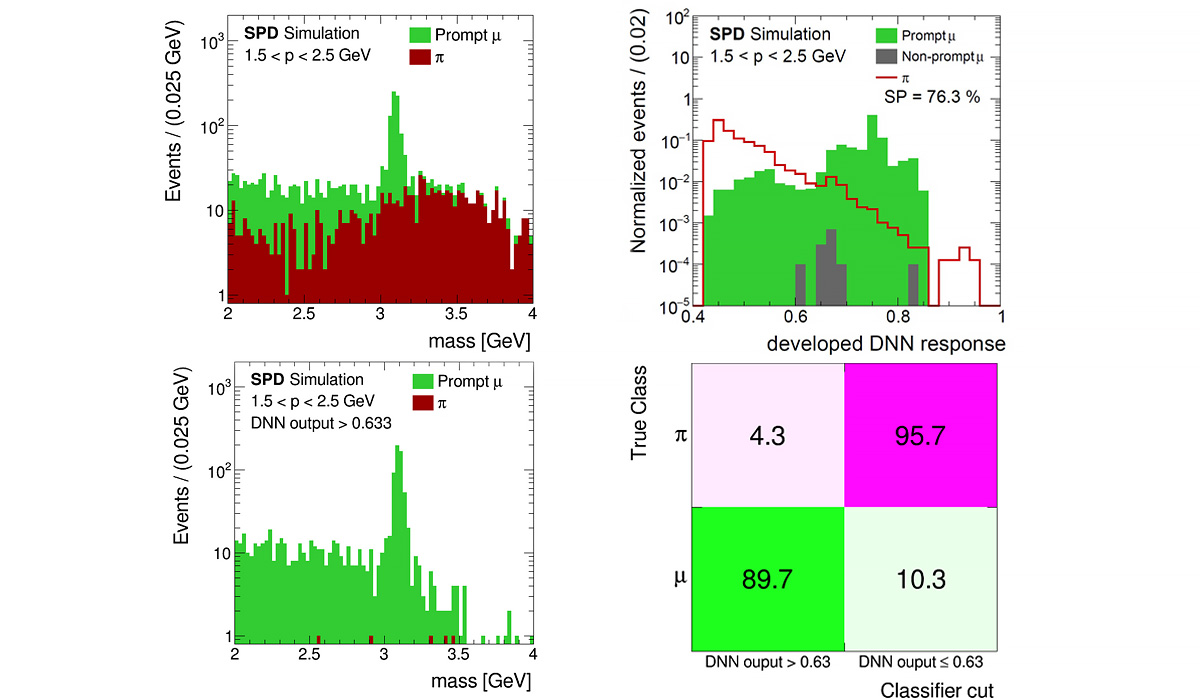
The Machine Learning (ML) approaches were applied to particle identification in the simulation of the Spin Physics Detector (SPD) at the NICA Collider. The results of the identification of muon tracks originating from charmonia decays and pion tracks in the intermediate momenta region (1.5–2.5 GeV/c) are presented. The obtained classifier accuracy is 77% while preserving 99% of muons and rejecting 48% of pions. The efficiency of developed binary classifier is demonstrated through background suppression in J/ψ → µµ decays.
References
[1] SPD Collaboration, Technical Design Report of the Spin Physics Detector at NICA, Natural Sci.Rev. 1 (1) (2024). doi:10.48550/arXiv.2404.08317.
[2] SPD Collaboration, SPDRoot, https://spd.jinr.ru/spd-software/.
[3] L. J. Fogel, A. J. Owens, and M. J. Walsh, Artificial Intelligence through Simulated Evolution, New York, 1966.
[4] J. H. Holland, Adaptation in Natural and Artificial Systems: An Introductory Analysis with Applications to Biology, Control, and Artificial Intelligence, 1975. doi:https://doi.org/10.7551/mitpress/1090.001.0001. DOI: https://doi.org/10.7551/mitpress/1090.001.0001
[5] F. Chollet et al., Keras: The Python Deep Learning Library, https://keras.io/, accessed: 2018-06.
License

This work is licensed under a Creative Commons Attribution-NonCommercial 4.0 International License.