

Abstract
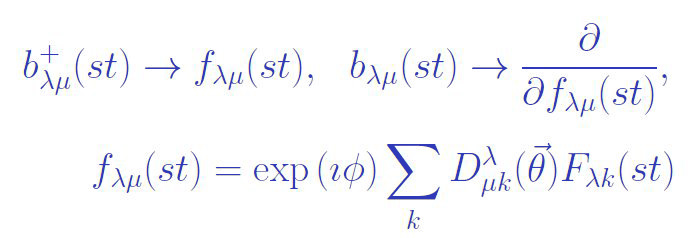
The problem of identifying and extracting the dynamic variables associated with symmetry transformations from the full set of dynamic variables is considered. It is demonstrated that employing a boson representation of bifermion operators enables the problem to be solved using the canonical transformation of dynamic variables proposed by N. N. Bogoliubov. The results obtained justify the application of the cranking model for the description of the rotational excitations of nuclei.
References
[1] E. R. Marshalek and J. Weneser, Physical Review C 2 (1970) 1682. doi:10.1103/PhysRevC.2.1682.
[2] E. R. Marshalek, Annals of Physics 143 (1982) 191. doi:10.1016/0003-4916(82)90219-6.
[3] E. R. Marshalek, Nuclear Physics A 224 (1974) 221. doi:10.1016/0375-9474(74)90686-1.
[4] S. T. Belyaev and V. G. Zelevinsky, Nuclear Physics 39 (1962) 582.
[5] A. Kerman and A. Klein, Physics Letters 1 (1962) 185.
[6] S. T. Belyaev and V. G. Zelevinsky, Yadernaya Fizika 11 (1970) 741 [Soviet Journal of NuclearPhysics 11 (1970) 416].
[7] N. N. Bogoliubov, Ukrainskii Matematicheskii Zhurnal 2 (1950) 3.
[8] E. P. Solodovnikova, A. N. Tavkhelidze, and O. A. Khrustalev, Theoretical and MathematicalPhysics 10 (1972) 105. doi: 10.1007/BF01090720.
[9] R. V. Jolos, V. G. Kartavenko, and V. Rybarska, Theoretical and Mathematical Physics 20 (1974)873. doi: 10.1007/BF01040168.
[10] Yu. T. Grin’, Yadernaya Fizika 12 (1970) 927 [Soviet Journal of Nuclear Physics 12 (1970) 506].
[11] G. F. Filippov, Fizika Elementarnykh Chastits i Atomnogo Yadra 4 (1974) 992.
[12] A. Ya. Dzublik, V. I. Ovcharenko, A. I. Steshenko, and G. F. Filippov, Yadernaya Fizika 15 (1972)869 [Soviet Journal of Nuclear Physics 15 (1972) 487].
[13] J. A. Castilho Alcaras, J. Tambergs, T. Krasta, J. Ruza, and O. Katkevicius, Brazilian Journalof Physics 27 (1997) 425. doi: 10.1590/S0103-97331997000400003.
[14] M. Moshincky, Physica A 114 (1982) 322. doi: 10.1016/0378-4371(82)90307-7.
[15] D. Janssen, F. D ̈onau, S. Frauendorf, and R. V. Jolos, Nuclear Physics A 172 (1971) 145. doi:10.1016/0375-9474(71)90122-9.
[16] A. Klein and E. R. Marshalek, Reviews of Modern Physics 63 (1991) 375. doi: 10.1103/RevMod-Phys.63.375.
[17] R. V. Jolos, V. G. Kartavenko, and E. A. Kolganova, Physics of Particles and Nuclei 49 (2018)125. doi: 10.1134/S1063779618020028.
[18] J. M. Eisenberg and W. Greiner, Nuclear Models, North-Holland, Amsterdam, London, 1970.
[19] A. Bohr and B. R. Mottelson, Nuclear Structure, Vol. I, W. A. Benjamin, New York, Amsterdam,1969.
[20] S. Frauendorf, Nuclear Physics A 557 (1993) 259. doi: 10.1016/S0375-9474(97)00004-3.
[21] E. R. Marshalek and G. Holzwarth, Nuclear Physics A 191 (1972) 438. doi: 10.1016/0375-9474(72)90526-X.
[22] S. Frauendorf and J. Meng, Nuclear Physics A 617 (1997) 131. doi: 10.1016/S0375-9474(97)00004-3.