

Abstract
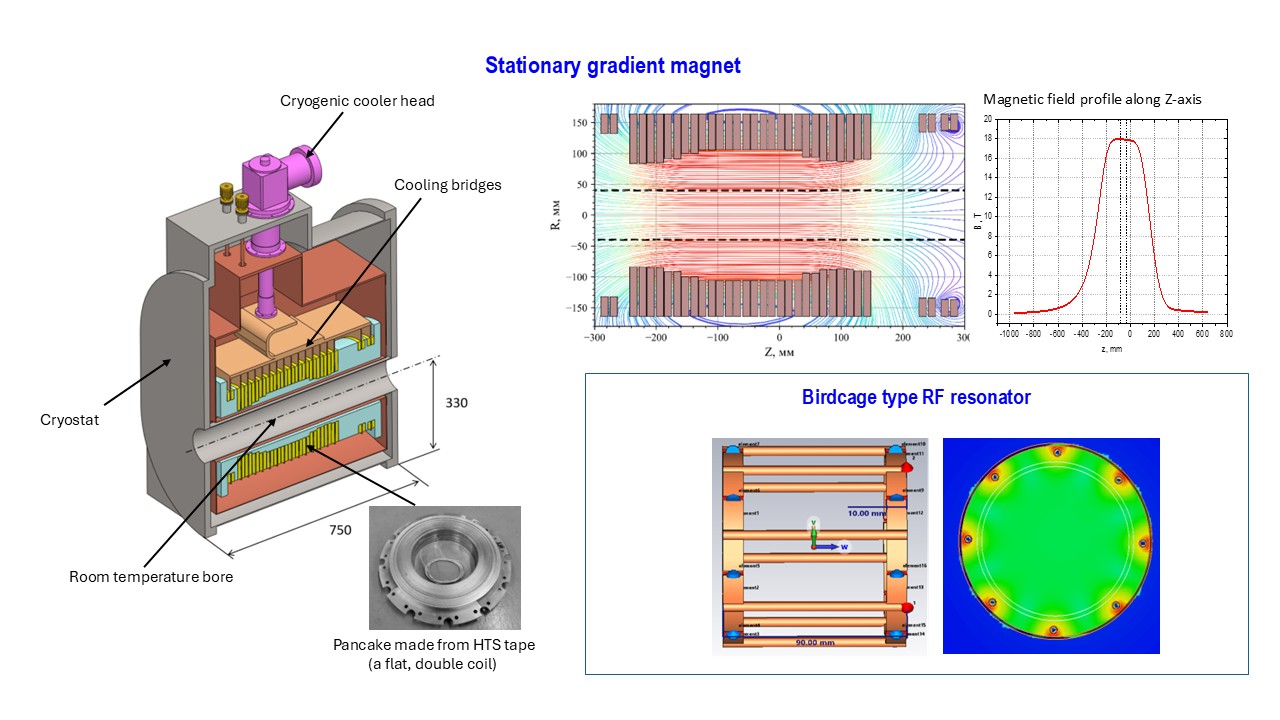
The work is devoted to the development of a conceptual design for a gradient spin flipper — neutron decelerator, which is the main component of a designed UCN source for a pulsed reactor. In close cooperation between the JINR group and SuperOx, a preliminary design of a stationary gradient magnet for the adiabatic spin flipper has been developed. A thorough calculation of the magnetic field configuration has been performed. The movement of neutrons in the magnetic field generated by the designed magnetic system has been simulated, and the deceleration time of neutrons in the spin flipper has been analyzed.
The results obtained give grounds for hope that the idea of creating a UCN source based on pulsed accumulation in a trap using non-stationary neutron deceleration is feasible.
Acknowledgements
References
[1] V. D. Ananiev, D. I. Blokhintsev, Y. M. Bulkin et al., IBR-2 — pulsed reactor for neutroninvestigations, Pribory i Tekhnika Ehksperimenta 5 (1977) 17–35, in Russian.[2] A. V. Antonov, A. I. Isakov, M. V. Kazarnovskii, V. E. Solodilov, Concerning a gas of ultracoldneutrons in a trap, Journal of Experimental and Theoretical Physics Letters 10 (1969) 241–244.[3] F. L. Shapiro, Remarks on the measurement of phases of structural amplitudes in neutron diffrac-tion and on the accumulation of neutrons, Physics of Elementary Particles and Atomic Nuclei2 (4) (1971) 975–979, in Russian.[4] F. L. Shapiro, Ultracold Neutrons, Springer US, Boston, MA, 1974, pp. 259–284.doi:10.1007/978-1-4613-4499-5_10.[5] A. I. Frank, R. Gahler, Time focusing of neutrons, Physics of Atomic Nuclei 63 (2000) 545–547.doi:10.1134/1.855665.[6] Y. Arimoto, P. Gertenbort, S. Imajo et al., Demonstration of focusing by a neutron accelerator,Physical Review A 86 (2012) 023843.doi:10.1103/PhysRevA.86.023843.[7] A. I. Frank, G. V. Kulin, N. V. Rebrova, M. A. Zakharov, On the possibility of creating a UCNsource at a periodic pulsed reactor, Physics of Particles and Nuclei 53 (1) (2022) 33–44.doi:10.1134/S1063779622010063.[8] N. N. Nesvizhevsky, A. O. Sidorin, Production of ultracold neutrons in an escaping de-celerating trap, Physics of Particles and Nuclei Letters 19 (2022) 162–175.doi:10.1134/S1547477122020066.[9] A. I. Frank, G. V. Kulin, M. A. Zakharov, On a new possibility of pulsed accumulation of ultracold neutrons in a trap, Physics of Particles and Nuclei Letters 20 (4) (2023) 664–667.doi:10.1134/S1547477123040295.[10] A. I. Frank, G. V. Kulin, M. A. Zakharov et al., To the UCN source with pulsed filling of a trap,Physics of Particles and Nuclei 56 (5) (2025), in press.arXiv:2412.06460[physics.ins-det].
[11] G. M. Drabkin, R. A. Zhitnikov, Production of polarized neutrons, Soviet Journal of Experimentaland Theoretical Physics 11 (3) (1960) 729–730.
[12] E. Kruger, Acceleration of polarized neutrons by rotating magnetic field, Nucleonika 25 (1980)889–893.
[13] B. Alefeld, G. Badurek, H. Rauch, Observation of the neutron magnetic resonance energy shift,Zeitschrift f ̈ur Physik B Condensed Matter 41 (3) (1981) 231–235.doi:10.1007/BF01294428.
[14] A. I. Egorov, V. M. Lobashov, V. A. Nazarenko et al., Production, storage, and polarization ofultracold neutrons, Soviet Journal of Nuclear Physics 19 (2) (1974) 147–152.
[15] V. I. Luschikov, Y. V. Taran, On the calculation of the neutron adiabatic spin-flipper, NuclearInstruments and Methods in Physics Research 228 (1984) 159–160.doi:10.1016/0168-9002(84)90025-1.
[16] S. V. Grigoriev, A. Okorokov, V. Runov, Peculiarities of the construction and application ofa broadband adiabatic flipper of cold neutrons, Nuclear Instruments and Methods in PhysicsResearch Section A: Accelerators, Spectrometers, Detectors and Associated Equipment 384 (1997)451–456.doi:10.1016/s0168-9002(96)00919-9.
[17] A. T. Holley, L. J. Broussard, J. L. Davis et al., A high-field adiabatic fast passage ultracoldneutron spin flipper for the UCNA experiment, Review of Scientific Instruments 83 (7) (2012)073505.doi:10.1063/1.4732822.
[18] H. Weinfurter, G. Badurek, H. Rauch, D. Schwahn, Inelastic action of a gradient radio-frequencyneutron spin flipper, Zeitschrift f ̈ur Physik B Condensed Matter 72 (2) (1988) 195–201.doi:10.1007/BF01312135.
[19] A. Molodyk, S. Samoilenkov, A. Markelov et al., Development and large volume production ofextremely high current densityYBa2Cu3O7superconducting wires for fusion, Scientific Reports11 (2021) 2084.doi:10.1038/s41598-021-81559-z.
[20] K. Baburin, E. Zapretilina, N. Hitrov et al., Design, manufacturing and tests of an All-HTS 20 Tmagnet, IEEE Transactions on Applied Superconductivity 34 (2024) 4605604.doi:10.1038/s41598-021-81559-z.
[21] P. T. Bernat, Design and simulation of a birdcage coil using CST studio suite for application at7 T, PhD thesis, UPC, Escola T`ecnica Superior d’Enginyeria de Telecomunicacio de Barcelona,Departament de Teoria del Senyal i Comunicacions, Feb. 2013,http://hdl.handle.net/2099.1/18371.