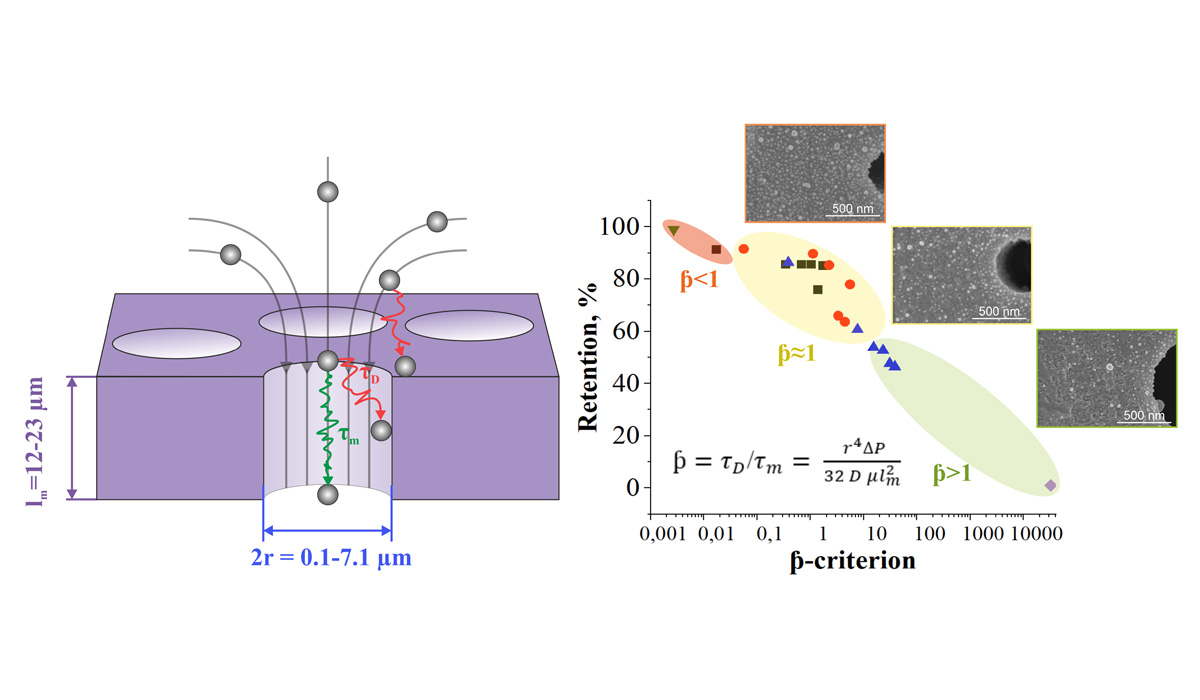
Applied Research Chemistry 70th anniversary of JINR DOI: 10.54546/NaturalSciRev.200706 Controlled immobilization of silver nanoparticles on track-etched membranes The study of the interaction of colloidal solution components with microfiltration membranes is of continuing interest, both in the development of composite porous materials and in the numerous applications of membranes for separating suspensions. This study investigates the transport of silver nanoparticles through track-etched membranes under conditions where the nanoparticles and the membrane surface possess opposite charges. The objective was to establish patterns of nanoparticle deposition based on the membranes structural parameters and the solution flow rate. A simple criterion was derived to determine nanoparticle retention efficiency by considering convection and diffusion within the pores. This criterion was tested through experiments using polyethylene terephthalate track-etched membranes with pore diameters ranging from 0.1 to 7.1 µm, while the average nanoparticle diameter was 24 nm. By varying the pressure drop, the flow rate of the colloidal solution through the membrane pores was varied. Nanoparticle retention efficiency was determined using optical spectroscopy and energy-dispersive X-ray analysis. The distribution of nanoparticles on the membrane surface was examined using scanning electron microscopy. It was found that the proposed criterion satisfactorily predicts the transition from nearly complete particle retention to complete transmission when key parameters — pore diameter, membrane thickness, and pressure drop — are varied. The obtained results provide insights into the controlled immobilization of nanoparticles on membrane surface, which is essential for creating functional nanocomposite devices, such as sensors. I. N. Fadeikina, E. V. Andreev, O. V. Kristavchuk, O. L. Orelovich, P. Yu. Apel 18.06.2026