

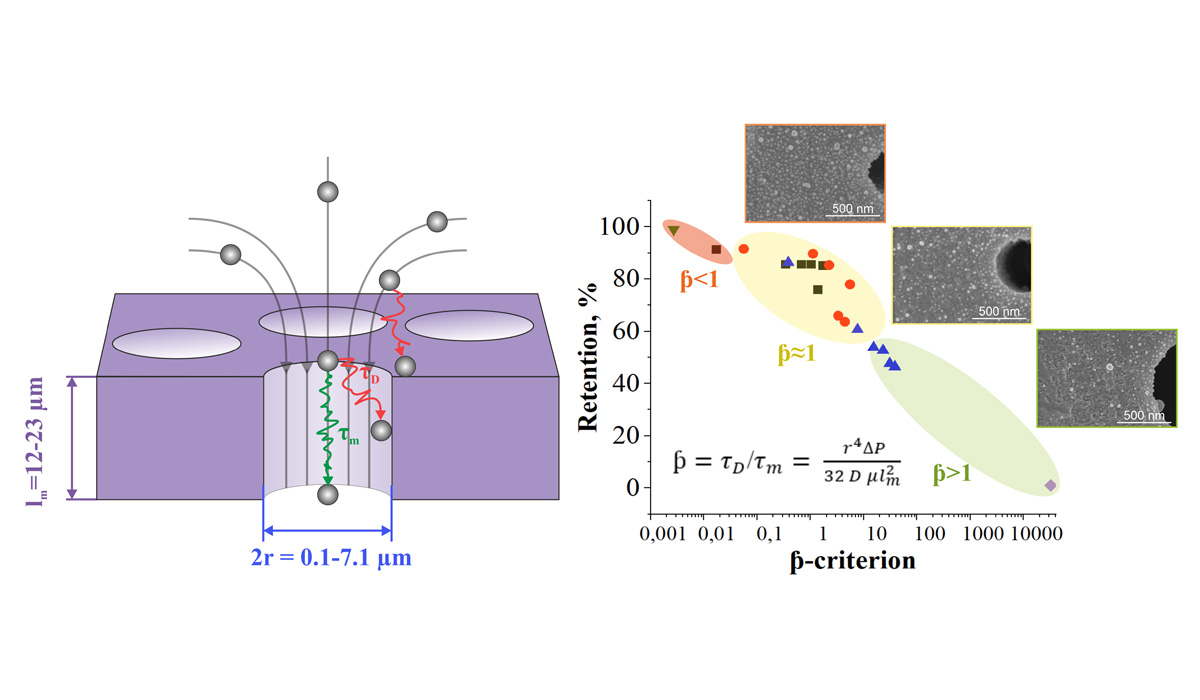
The study of the interaction of colloidal solution components with microfiltration membranes is of continuing interest, both in the development of composite porous materials and in the numerous applications of membranes for separating suspensions. This study investigates the transport of silver nanoparticles through track-etched membranes under conditions where the nanoparticles and the membrane surface possess opposite charges. The objective was to establish patterns of nanoparticle deposition based on the membranes structural parameters and the solution flow rate.
A simple criterion was derived to determine nanoparticle retention efficiency by considering convection and diffusion within the pores. This criterion was tested through experiments using polyethylene terephthalate track-etched membranes with pore diameters ranging from 0.1 to 7.1 µm, while the average nanoparticle diameter was 24 nm. By varying the pressure drop, the flow rate of the colloidal solution through the membrane pores was varied.
Nanoparticle retention efficiency was determined using optical spectroscopy and energy-dispersive X-ray analysis. The distribution of nanoparticles on the membrane surface was examined using scanning electron microscopy. It was found that the proposed criterion satisfactorily predicts the transition from nearly complete particle retention to complete transmission when key parameters — pore diameter, membrane thickness, and pressure drop — are varied.
The obtained results provide insights into the controlled immobilization of nanoparticles on membrane surface, which is essential for creating functional nanocomposite devices, such as sensors.
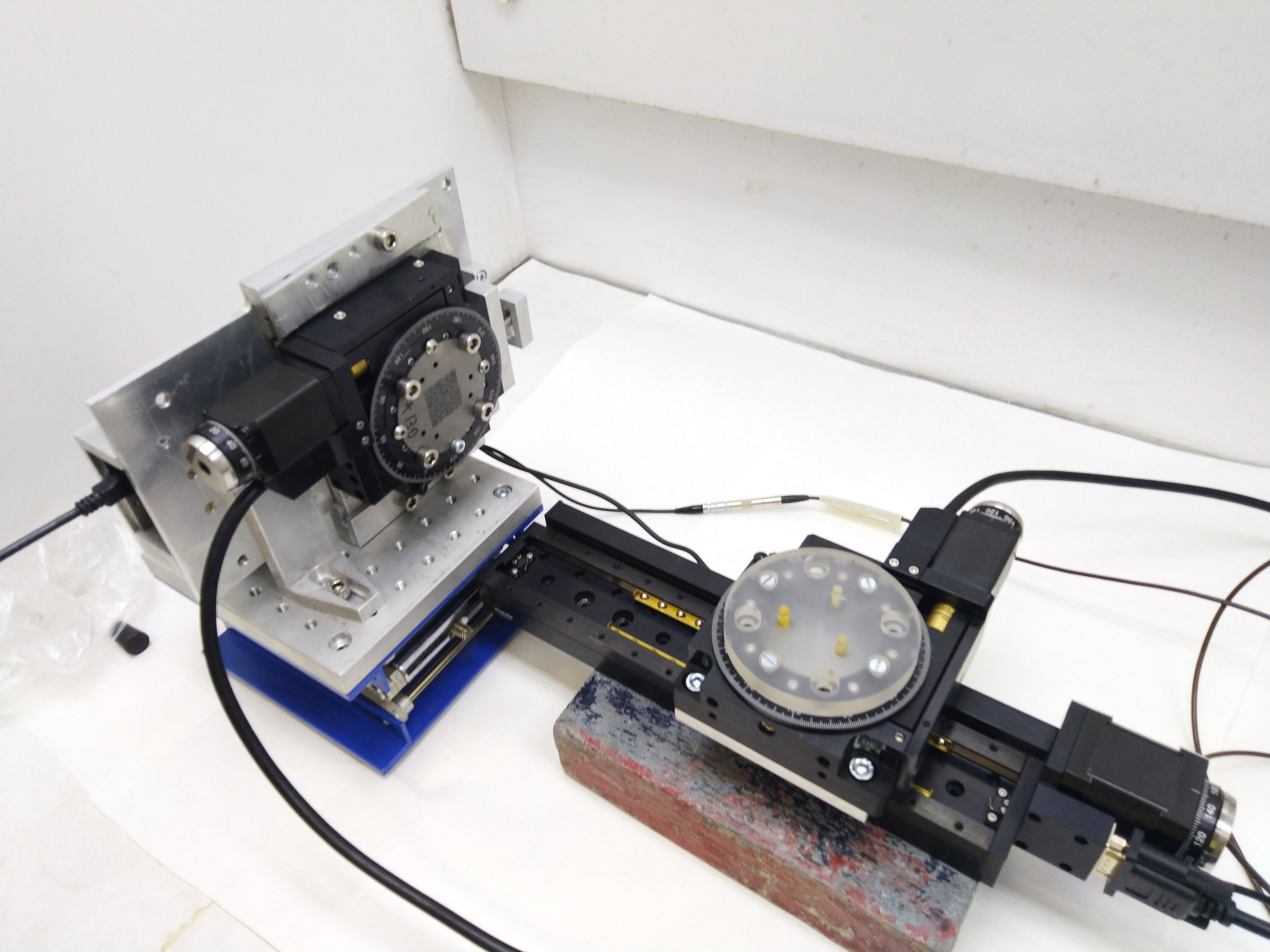
In this work, the characteristics of a prototype SPECT system based on the Timepix readout chip, with a MURA-type encoding mask, were evaluated. The setup has a small FoV and can be used in preclinical studies of drugs on small laboratory animals. Despite many existing test protocols developed and described in pertinent documents of national standard bodies and IAEA recommendations, they are not suitable for microtomographic systems based on semiconductor pixel detectors due to different detector technology, high spatial resolution and small area of interest. To measure their characteristics, special phantoms were developed, with a small “hot region”.
Such micro-SPECT parameters as spatial resolution, contrast, linearity, and system efficiency were studied using 99mTc source. The detector calibration and data preprocessing are described.
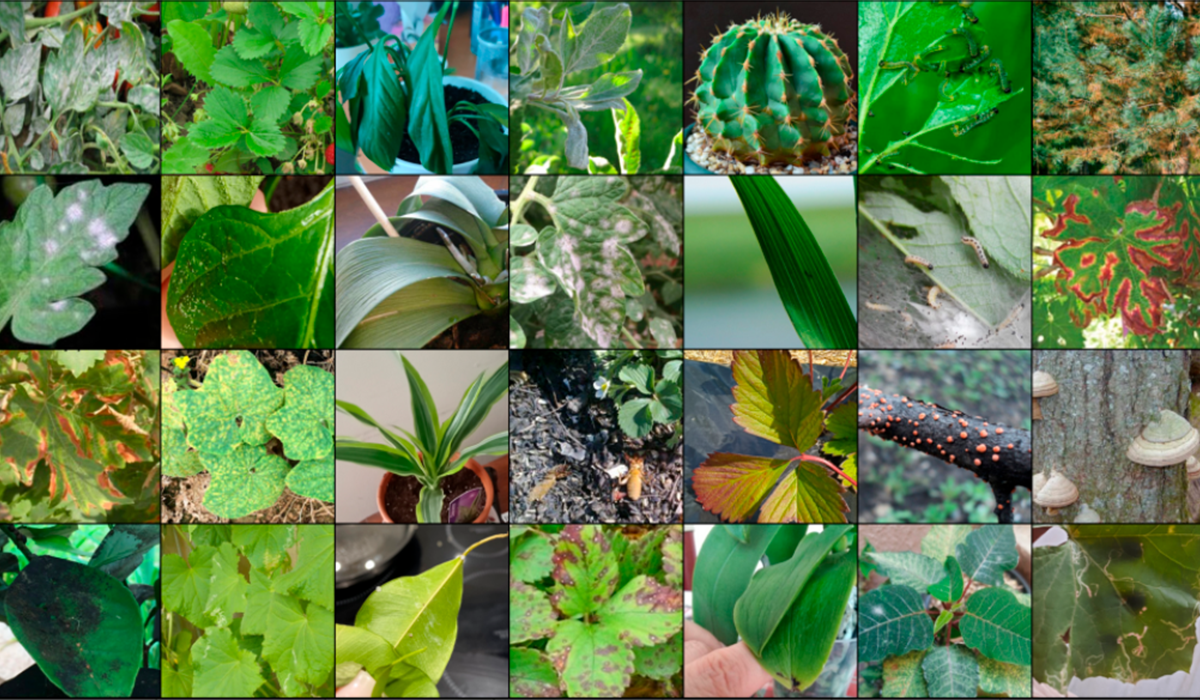
Accurate identification of disease and correct treatment policy can save and increase yield. Different deep learning methods have emerged as an effective solution to this problem. Still, the challenges posed by limited datasets and the similarities in disease symptoms make traditional methods, such as transfer learning from models pre-trained on large-scale datasets like ImageNet, less effective. In this study, a self-collected dataset from the DoctorP project, consisting of 46 distinct classes and 2615 images, was utilized. DoctorP is a multifunctional platform for plant disease detection oriented on agricultural and ornamental crop. The platform has different interfaces like mobile applications for iOS and Android, a Telegram bot, and an API for external services. Users and services send photos of the diseased plants in to the platform and can get prediction and treatment recommendation for their case. The platform supports a wide range of disease classification models. MobileNet_v2 and a Triplet loss function were previously used to create models. Extensive increase in the number of disease classes forces new experiment with architectures and training approaches. In the current research, an effective solution based on ConvNeXt architecture and Large Margin Cosine Loss is proposed to classify 46 different plant diseases. The training is executed in limited training dataset conditions. The number of images per class ranges from a minimum of 30 to a maximum of 130. The accuracy and F1-score of the suggested architecture equal to 88.35% and 0.9 that is much better than pure transfer learning or old approach based on Triplet loss. New improved pipeline has been successfully implemented in the DoctorP platform, enhancing its ability to diagnose plant diseases with greater accuracy and reliability.

