

Аннотация
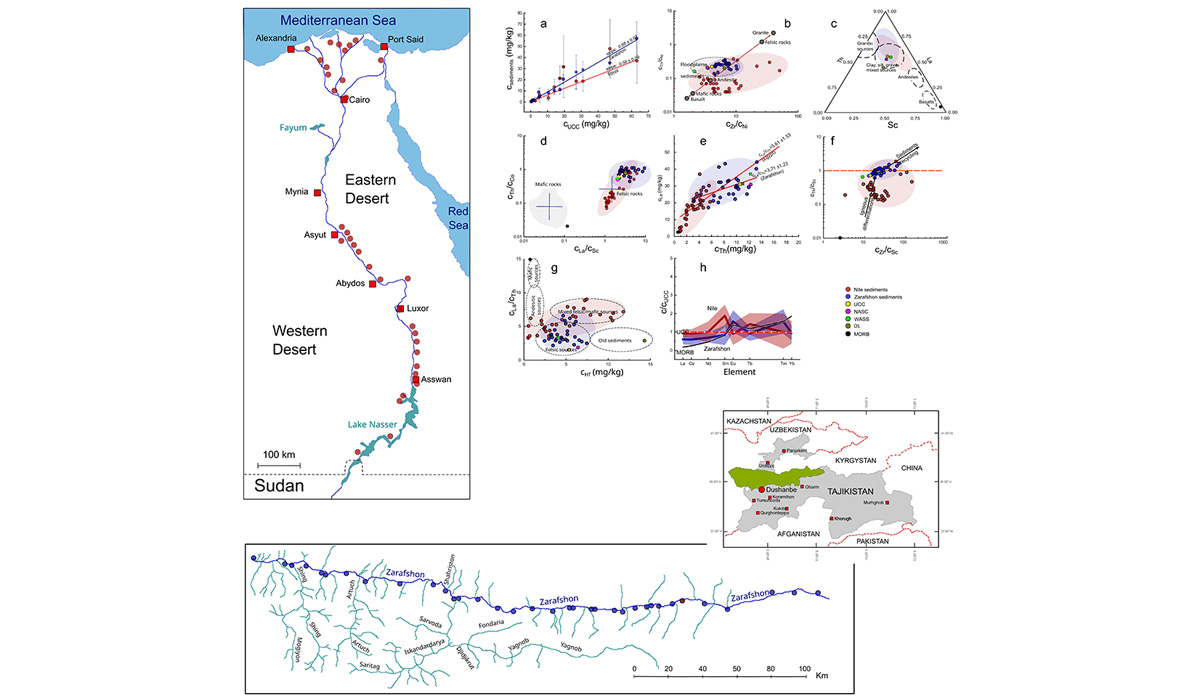
Благодаря относительно низкой подвижности в большинстве осадочных процессов высокозарядные элементы (ВЗЭ) являются одними из наиболее подходящих элементов для изучения происхождения, поскольку предоставляют информацию об исходном материале. Таким образом, распределение массовых долей двух несовместимых элементов (Co и Ni) и 13 ВЗЭ (Sc, Zr, La, Ce, Nd, Sm, Eu, Tb, Tm, Yb, Hf, Th и U) в неконсолидированных отложениях, относящихся к двум различным речным системам (египетскому участку Нила и таджикскому участку Зарафшона), свидетельствует о сходствах и различиях между осадочным материалом и их корреляции с местной геохимией. Использовался инструментальный нейтронно активационный анализ (ИНАА) в эпитермальном варианте. В общей сложности вдоль рек Нил и Зарафшон было собрано 38 и 29 образцов неконсолидированных отложений. В подавляющем большинстве случаев функции распределения массовых долей не были нормальными, как показали тесты ANOVA Шапиро-Уилка, Андерсона–Дарлинга, Лиллифорса и Жарка-Бера. Более четкие двойные и тройные диаграммы позволили лучше сравнить функции распределения рассматриваемых элементов. Все они показали относительное сходство обоих типов осадочного материала с менее переработанными кислыми породами. Несмотря на это, дальнейший детальный анализ выявил систематические различия между двумя категориями отложений. Данное открытие позволяет предположить, что на отложения Нила повлиял мафический материал, который перенесся с богатых базальтом плато Эфиопии по Голубому Нилу.
Поддерживающие организации
Библиографические ссылки
[1] H. Rowlinson, Using Geochemical Data: Evaluation, Presentation, Interpretation, Longman Scientific and Technical Publishers, New York, 1993, p. 352, ISBN 978-0582067011.
[2] S. M. McLennan, S. R. Taylor, A. Kr¨oner, Geochemical evolution of Archean shales from South Africa I. The Swaziland and Pongola Supergroups, Precambrian Research 22 (1983) 93–124. https://doi.org/10.1016/0301-9268(83)90060-8. DOI: https://doi.org/10.1016/0301-9268(83)90060-8
[3] S. Boggs, Principles of Sedimentology and Stratigraphy, 5th edition, Pearson, Chennai, India, 2016, p. 174, ISBN 978-0321745767.
[4] S. J. Parry, Handbook of Neutron Activation Analysis, Viridian Publishing, Surrey, UK, 2003, p. 243, ISBN 978-0954489113.
[5] M. V. Frontasyeva, Neutron Activation Analysis in the life sciences, Physics of Particles and Nuclei 42 (2011) 332–378. https://doi.org/10.1134/S1063779611020043. DOI: https://doi.org/10.1134/S1063779611020043
[6] Y. L. Wang, Y.-G. Liu, R. A. Schmitt, Rare earth element geochemistry of South Atlantic deep sea sediments: Ce anomaly change at ∼ 54 My, Geochimica et Cosmochimica Acta 50 (1986) 1337–1355. https://doi.org/10.1016/0016-7037(86)90310-8. DOI: https://doi.org/10.1016/0016-7037(86)90310-8
[7] N. Aota, Y. Miyamoto, S. Kosanda et al., Neutron Activation Analysis of nine GSJ sedimentary rock reference samples, Geostandard Newsletter 18 (1994) 185–193. https://doi.org/10.1111/j.1751-908X.1994.tb00516.x. DOI: https://doi.org/10.1111/j.1751-908X.1994.tb00516.x
[8] M. J. Marqu´es, A. Salvador, A. E. Morales-Rubio et al., Trace element determination in sediments: A comparative study between Neutron Activation Analysis (NAA) and Inductively Coupled Plasma-Mass Spectrometry (ICP-MS), Microchemical Journal 65 (2000) 177–187. https://doi.org/10.1016/S0026-265X(00)00051-5. DOI: https://doi.org/10.1016/S0026-265X(00)00051-5
[9] Y. Yao, C. Xiao, P. Wang et al. Instrumental Neutron Activation Analysis of Chang’E-5 lunar regolith samples, Journal of American Chemical Society 144 (2022) 5478–5484. https://doi.org/10.1021/jacs.1c13604. DOI: https://doi.org/10.1021/jacs.1c13604
[10] W. M. Arafa, W. M. Badawy, N. M. Fahmi, Geochemistry of sediments and surface soils from the Nile Delta and lower Nile Valley studied by Epithermal Neutron Activation Analysis, Journal of African Earth Sciences 107 (2015) 57—64. http://dx.doi.org/10.1016/j.jafrearsci.2015.04.004. DOI: https://doi.org/10.1016/j.jafrearsci.2015.04.004
[11] W. M. Badawy, M. Mitwalli, A. Y. Dmitriev et al., Neutron Activation Analysis for geochemical characterization of rocks from gold mines in Egypt, Applied Sciences 13 (2023) 4564. https://doi.org/10.3390/app13074564. DOI: https://doi.org/10.3390/app13074564
[12] C. Bueno, C. J. Sanders, D. I. T. Favaro et al., Accumulation patterns of rare earths and other elements in coastal lake sediments under different land uses, Journal of South American Earth Sciences 161 (2025) 105576. https://doi.org/10.1016/j.jsames.2025.105576. DOI: https://doi.org/10.1016/j.jsames.2025.105576
[13] W. M. Badawy, E. H. Ghanim, O. G. Duliu et al., Major and trace element distribution in soil and sediments from the Egyptian central Nile Valley, Journal of African Earth Sciences 131 (2017) 53–61. https://doi.org/10.1016/j.jafrearsci.2017.03.029, WOS:000403515600005. DOI: https://doi.org/10.1016/j.jafrearsci.2017.03.029
[14] W. M. Badawy, O. G. Duliu, H. El Samman et al., A review of major and trace elements in Nile River and Western Red Sea sediments: An approach of geochemistry, pollution, and associated hazards, Applied Radiation and Isotopes 170 (2021) 109595. https://doi.org/10.1016/j.apradiso.2021.109595, WOS:000637950400017. DOI: https://doi.org/10.1016/j.apradiso.2021.109595
[15] D. A. Abdushukurov, D. Abdusamadzoda, O. G. Duliu et al., On the geochemistry of major and trace elements distribution in sediments and soils of Zarafshon River Valley, Western Tajikistan, Applied Sciences 12 (2022) 2763. https://doi.org/10.3390/app12062763. DOI: https://doi.org/10.3390/app12062763
[16] R. O. Collins, The Nile, Yale University Press, Yale, CT, US, 2002, ISBN 978-0300097641.
[17] A. M. Prokhorov, Zarafshon (River in Central Asia), in: Great Soviet Encyclopedia, Vol. 30, Moscow, Russia, 1968–1978 (in Russian).
[18] K. Verner, J. S´ıma, L. Megerssa et al., A Synopsis of the Regional Geology and Hydrogeology of Ethiopia, Czech Geological Survey, Prague, 2025, ISBN 978-8076731134.
[19] M. G. Leonov, A. K. Rybin, V. Y. Batalev et al., Tectonic structure and evolution of the Hissar– Alay Mountain Domain and the Pamirs, Geotectonics 51 (2017) 566–583. https://doi.org/10.1134/S001685211706005X. DOI: https://doi.org/10.1134/S001685211706005X
[20] R. L. Rudnic, S. Gao, Composition of the Continental Crust, in: H. D. Holland, K. K. Turekian (Eds.), Treatise on Geochemistry, Vol. 3, Elsevier-Pergamon, Oxford-London, 2003, pp. 1–64, ISBN 978-0080548074. DOI: https://doi.org/10.1016/B0-08-043751-6/03016-4
[21] L. P. Gromet, R. F. Dymek, L. A. Haskin et al., The ‘North American Shale Composite’: Its compilation, major and trace element characteristics, Geochimica et Cosmochimica Acta 48 (1984) 2469–2482. https://doi.org/10.1016/0016-7037(84)90298-9. DOI: https://doi.org/10.1016/0016-7037(84)90298-9
[22] J. Viers, B. Dupr´e, J. Gaillardet, Chemical composition of suspended sediments in World Rivers: New insights from a new database, Science of the Total Environment 407 (2009) 853–868. https://doi.org/10.1016/j.scitotenv.2008.09.053. DOI: https://doi.org/10.1016/j.scitotenv.2008.09.053
[23] A. Gale, C. A. Dalton, C. H. Langmuir et al., The mean composition of ocean ridge basalts, Geochemistry, Geophysics, Geosystems 14 (2013) 489—518. https://doi.org/10.1029/2012GC004334. DOI: https://doi.org/10.1029/2012GC004334
[24] L. C. Tugulan, O. G. Duliu, A.-V. Bojar et al., On the geochemistry of the Late Quaternary loess deposits of Dobrogea (Romania), Quaternary International 399 (2016) 100–110. https://doi.org/10.1016/j.quaint.2015.06.062. DOI: https://doi.org/10.1016/j.quaint.2015.06.062
[26] D. Grozdov, V. Galustov, I. Zinicovscaia, Modernization on the REGATA facility (IBR-2 reactor) designed for Instrumental Neutron Activation Analysis, Journal of Radioanalytical and Nuclear Chemistry 334 (2025) 2435—2442. https://doi.org/10.1007/s10967-025-10014-4. DOI: https://doi.org/10.1007/s10967-025-10014-4
[27] I. Zinicovscaia, O. G. Duliu, O. A. Culicov et al., Major and trace elements distribution in Moldavian soils, Romanian Reports in Physics 70 (2018) 701. https://rrp.nipne.ro/2018/AN70701.pdf
[28] C. Reimann, P. Filzmoser, Normal and lognormal data distribution in geochemistry: Death of a myth. Consequences for the statistical treatment of geochemical and environmental data, Environmental Geology 39 (2000) 1001—1014. https://doi.org/10.1007/s002549900081. DOI: https://doi.org/10.1007/s002549900081
[29] Ø. Hammer, D. A. T. Herper, P. D. Ryan, PAST: Paleontological Statistics software package for education and data analysis, Palaeontologia Electronica 4 (2001) 1–9. http://palaeo-electronica.org/2001_1/past/issue1_01.htm.
[30] I. Farrance, R. Frenkel, Uncertainty of measurement: A review of the rules for calculating uncertainty components through functional relationships, The Clinical Biochemist Review 33 (2012) 49–75, PMID: 22896744, PMCID: PMC3387884.
[31] J. C. Norman, L. A. Haskin, The geochemistry of Sc: A comparison to the rare earths and Fe, Geochimica and Cosmochimica Acta 32 (1968) 93–108. https://doi.org/10.1016/0016-7037(68)90089-6. DOI: https://doi.org/10.1016/0016-7037(68)90089-6
[32] M. R. Bhatia, K. A. W. Crook, Trace element characteristics of greywackes and tectonic setting discrimination of sedimentary basins, Contribution to Mineralogy and Petrology 92 (1986) 181–193. https://doi.org/10.1007/BF00375292. DOI: https://doi.org/10.1007/BF00375292
[33] P. A. Floyd, B. E. Leveridge, Tectonic environment of the Devonian Gramscatho basin, south Cornwall: Framework mode and geochemical evidence from turbiditic sandstones, Journal of the Geological Society 144 (1987) 531–542. https://doi.org/10.1144/gsjgs.144.4.0531. DOI: https://doi.org/10.1144/gsjgs.144.4.0531
[34] G. Újvari, A. Varga, Z. Balogh-Brunstad, Origin, weathering, and geochemical composition of loess in southwestern Hungary, Quaternary Research 69 (2008) 421–437. https://doi.org/10.1016/j.yqres.2008.02.001. DOI: https://doi.org/10.1016/j.yqres.2008.02.001
[35] S. Marshak, Essentials of Geology, 6th edition, W. W. Norton & Company, NY, USA, 2019, ISBN 978-0393667523.
[36] S. R. Taylor, S. M. McLennan, The Continental Crust: Its Composition and Evolution: An Examination of the Geochemical Record Preserved in Sedimentary Rocks, Blackwell Scientific Publications, 1991, ISBN 978-0632011483.
[37] R. L. Cullers, Implications of elemental concentrations for provenance, redox conditions, and metamorphic studies of shales and limestones near Pueblo, CO, USA, Chemical Geology 191 (2002) 305—327. https://doi.org/10.1016/S0009-2541(02)00133-X. DOI: https://doi.org/10.1016/S0009-2541(02)00133-X
[38] S. M. McLennan, S. Hemming, C. K. McDaniel et al., Geochemical Approaches to Sedimentation, Provenance, and Tectonics, in: M. J. Johnsson, A. Basu (Eds.), Processes Controlling the Composition of Clastic Sediments, Geological Society of America Special Papers, Vol. 284, 1993, pp. 21–40. https://doi.org/10.1130/SPE284-p21. DOI: https://doi.org/10.1130/SPE284-p21
[39] W. A. Deer, R. A. Howie, J. Zussmann, Rock-Forming Minerals: Orthosilicates, Vol. 1A, Geological Society of London, 1982, pp. 418–442, ISBN 978-0-582-46526-8.
[40] Y. I. Lee, Geochemistry of shales of the Upper Cretaceous Hayang Group, SE Korea: Implications for provenance and source weathering at an active continental margin, Sedimentary Geology 215 (2009) 1–12. https://doi.org/10.1016/j.sedgeo.2008.12.004. DOI: https://doi.org/10.1016/j.sedgeo.2008.12.004
[41] R. Nagarajan, J. S. Armstrong-Altrin, F. L. Kessler et al., Provenance and tectonic setting of Miocene siliciclastic sediments, Sibuti Formation, northwestern Borneo, Arab Journal of Geosciences 8 (2015) 8549—8565. https://doi.org/10.1007/s12517-015-1833-4. DOI: https://doi.org/10.1007/s12517-015-1833-4
[42] P. Henderson (Ed.), Rare Earth Elements Geochemistry, in: Developments in Geochemistry, Vol. 2, Elsevier, 2013, ISBN 978-1483289779.
Лицензия

Это произведение доступно по лицензии Creative Commons «Attribution-NonCommercial» («Атрибуция — Некоммерческое использование») 4.0 Всемирная.