

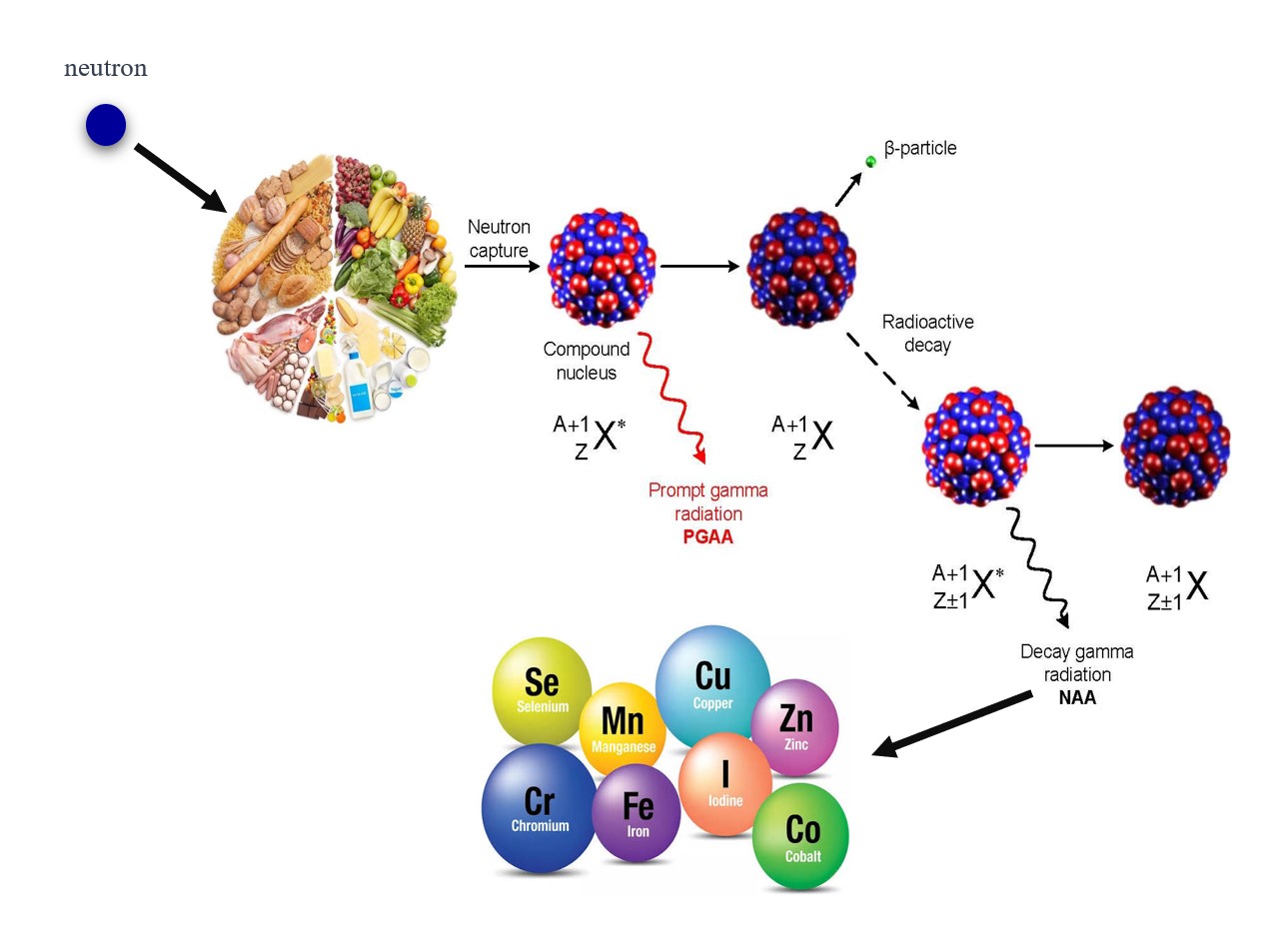
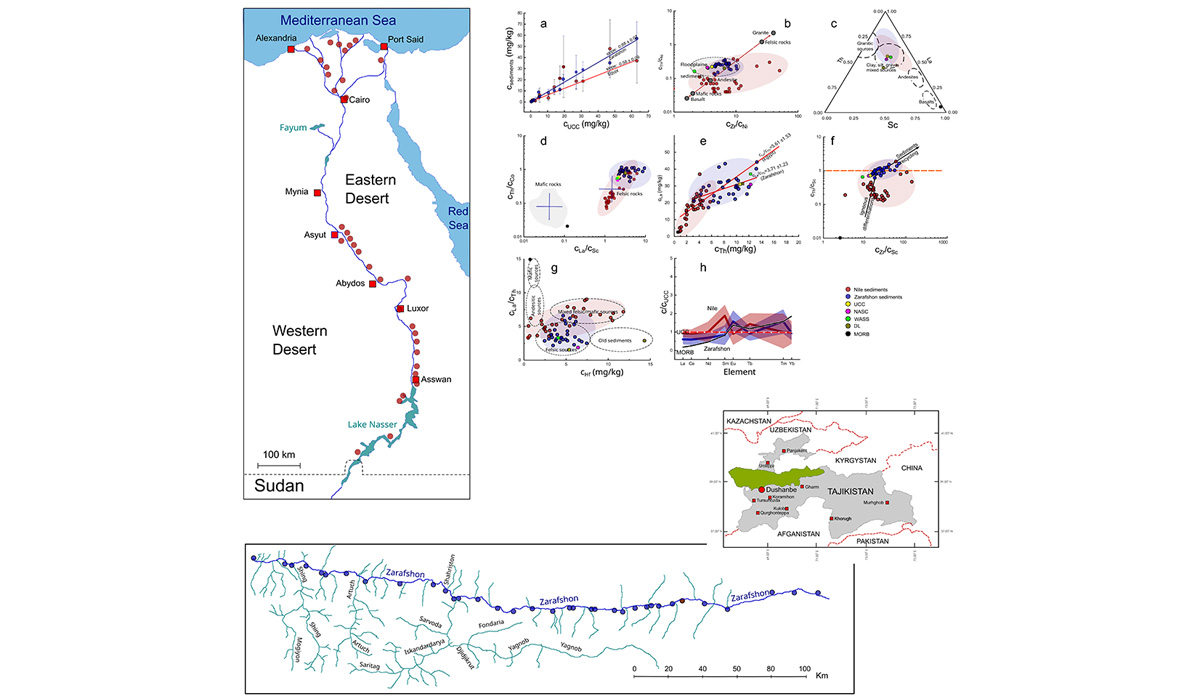
The High Field Strength Elements (HFSE), due to their relatively low mobility in the majority of sedimentary processes, are among the most suitable elements for provenance studies, as they permit collecting information on the parent material. Therefore, the distribution of the mass fractions of two incompatible elements (Co and Ni) and 13 HFSE (Sc, Zr, La, Ce, Nd, Sm, Eu, Tb, Tm, Yb, Hf, Th, and U) in unconsolidated sediments belonging to two different river systems, i.e., the Egyptian sector of the Nile River and the Tadjik sector of the Zarafshon River, evidences similarities and dissimilarities between the sedimentary materials and their correlation with the local geochemistry. The Instrumental Neutron Activation Analysis (INAA) in its Epithermal variant was used. In total, 38 and 29 samples of unconsolidated sediments were collected along the Nile and the Zarafshon rivers. In the great majority, the distribution functions of the mass fractions were not normal, as Shapiro–Wilk, Anderson–Darling, Lilliefors, and Jarque–Bera ANOVA tests proved. More discriminating bi-plots and ternary diagrams permitted a better comparison between the distribution functions of the considered elements. All of them showed, for both types of sedimentary material, a relative similarity with the less recycled felsic type of rocks. Despite this, a further detailed analysis revealed systematic differences between the two sediment categories, suggesting that the Nile sediments have been influenced by the mafic material transported from the basalt-rich plateaus of Ethiopia via the Blue Nile.
Atmospheric heavy metals are persistent, bioaccumulative, and toxic pollutants capable of long-range transport, posing significant ecological and public health risks. This review synthesizes five decades of research (1973–2024) on emission sources, transport mechanisms, deposition pathways, and monitoring approaches, supported by a bibliometric analysis of 1642 Scopus-indexed articles. Anthropogenic activities, including industrial operations, mining and smelting, vehicular emissions, and agricultural inputs, remain dominant contributors, while volcanic eruptions, geothermal activity, sea-spray aerosols, and soil-dust resuspension constitute important natural sources. Once emitted, metals associate with particulate matter (e.g., PM2.5, PM10), undergo atmospheric circulation, and are deposited through dry and wet processes, enabling transfer from urban centers to agricultural systems and remote environments. Urban areas exhibit the highest deposition loads, agricultural landscapes show substantial foliar uptake, and remote ecosystems display clear signatures of transboundary transport. Advances in analytical and biomonitoring techniques, including Atomic Absorption Spectroscopy, Inductively Coupled Plasma Mass Spectrometry, X-Ray Fluorescence, and moss-based bioindicators, have improved detection sensitivity. Mosses enhance sensitivity by acting as natural, long-term integrators of atmospheric deposition: their high surface-area-to-mass ratio, absence of cuticles and root systems, and direct uptake from precipitation and aerosols enable efficient accumulation of trace metals, revealing low-level and chronic deposition signals often missed by short-term instrumental air sampling. Bibliometric results reveal exponential growth in publications and strong collaboration networks centered in Asia, Europe, and North America, with underrepresentation in Africa, South America, and Central Asia. Key research gaps include limited long-term health assessments; insufficient real-time and low-cost monitoring technologies; low-resolution source apportionment; and minimal attention to emerging contaminants globally.

