

Abstract
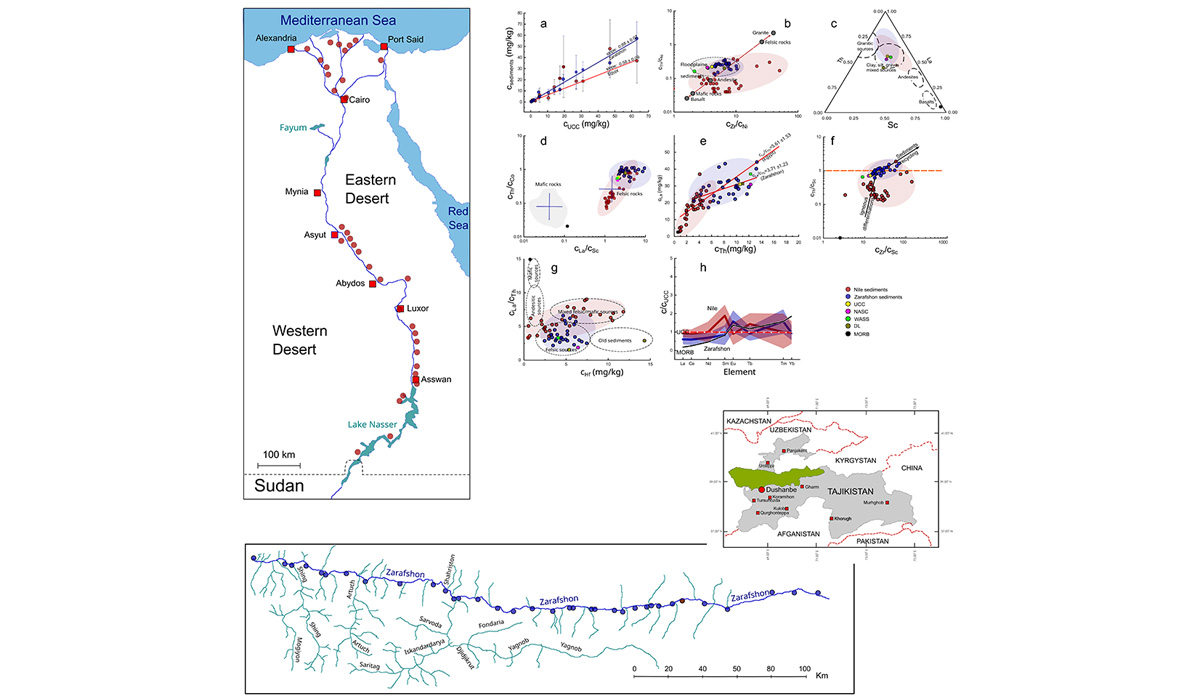
The High Field Strength Elements (HFSE), due to their relatively low mobility in the majority of sedimentary processes, are among the most suitable elements for provenance studies, as they permit collecting information on the parent material. Therefore, the distribution of the mass fractions of two incompatible elements (Co and Ni) and 13 HFSE (Sc, Zr, La, Ce, Nd, Sm, Eu, Tb, Tm, Yb, Hf, Th, and U) in unconsolidated sediments belonging to two different river systems, i.e., the Egyptian sector of the Nile River and the Tadjik sector of the Zarafshon River, evidences similarities and dissimilarities between the sedimentary materials and their correlation with the local geochemistry. The Instrumental Neutron Activation Analysis (INAA) in its Epithermal variant was used. In total, 38 and 29 samples of unconsolidated sediments were collected along the Nile and the Zarafshon rivers. In the great majority, the distribution functions of the mass fractions were not normal, as Shapiro–Wilk, Anderson–Darling, Lilliefors, and Jarque–Bera ANOVA tests proved. More discriminating bi-plots and ternary diagrams permitted a better comparison between the distribution functions of the considered elements. All of them showed, for both types of sedimentary material, a relative similarity with the less recycled felsic type of rocks. Despite this, a further detailed analysis revealed systematic differences between the two sediment categories, suggesting that the Nile sediments have been influenced by the mafic material transported from the basalt-rich plateaus of Ethiopia via the Blue Nile.
Acknowledgements
References
[1] H. Rowlinson, Using Geochemical Data: Evaluation, Presentation, Interpretation, Longman Scientific and Technical Publishers, New York, 1993, p. 352, ISBN 978-0582067011.
[2] S. M. McLennan, S. R. Taylor, A. Kr¨oner, Geochemical evolution of Archean shales from South Africa I. The Swaziland and Pongola Supergroups, Precambrian Research 22 (1983) 93–124. https://doi.org/10.1016/0301-9268(83)90060-8. DOI: https://doi.org/10.1016/0301-9268(83)90060-8
[3] S. Boggs, Principles of Sedimentology and Stratigraphy, 5th edition, Pearson, Chennai, India, 2016, p. 174, ISBN 978-0321745767.
[4] S. J. Parry, Handbook of Neutron Activation Analysis, Viridian Publishing, Surrey, UK, 2003, p. 243, ISBN 978-0954489113.
[5] M. V. Frontasyeva, Neutron Activation Analysis in the life sciences, Physics of Particles and Nuclei 42 (2011) 332–378. https://doi.org/10.1134/S1063779611020043. DOI: https://doi.org/10.1134/S1063779611020043
[6] Y. L. Wang, Y.-G. Liu, R. A. Schmitt, Rare earth element geochemistry of South Atlantic deep sea sediments: Ce anomaly change at ∼ 54 My, Geochimica et Cosmochimica Acta 50 (1986) 1337–1355. https://doi.org/10.1016/0016-7037(86)90310-8. DOI: https://doi.org/10.1016/0016-7037(86)90310-8
[7] N. Aota, Y. Miyamoto, S. Kosanda et al., Neutron Activation Analysis of nine GSJ sedimentary rock reference samples, Geostandard Newsletter 18 (1994) 185–193. https://doi.org/10.1111/j.1751-908X.1994.tb00516.x. DOI: https://doi.org/10.1111/j.1751-908X.1994.tb00516.x
[8] M. J. Marqu´es, A. Salvador, A. E. Morales-Rubio et al., Trace element determination in sediments: A comparative study between Neutron Activation Analysis (NAA) and Inductively Coupled Plasma-Mass Spectrometry (ICP-MS), Microchemical Journal 65 (2000) 177–187. https://doi.org/10.1016/S0026-265X(00)00051-5. DOI: https://doi.org/10.1016/S0026-265X(00)00051-5
[9] Y. Yao, C. Xiao, P. Wang et al. Instrumental Neutron Activation Analysis of Chang’E-5 lunar regolith samples, Journal of American Chemical Society 144 (2022) 5478–5484. https://doi.org/10.1021/jacs.1c13604. DOI: https://doi.org/10.1021/jacs.1c13604
[10] W. M. Arafa, W. M. Badawy, N. M. Fahmi, Geochemistry of sediments and surface soils from the Nile Delta and lower Nile Valley studied by Epithermal Neutron Activation Analysis, Journal of African Earth Sciences 107 (2015) 57—64. http://dx.doi.org/10.1016/j.jafrearsci.2015.04.004. DOI: https://doi.org/10.1016/j.jafrearsci.2015.04.004
[11] W. M. Badawy, M. Mitwalli, A. Y. Dmitriev et al., Neutron Activation Analysis for geochemical characterization of rocks from gold mines in Egypt, Applied Sciences 13 (2023) 4564. https://doi.org/10.3390/app13074564. DOI: https://doi.org/10.3390/app13074564
[12] C. Bueno, C. J. Sanders, D. I. T. Favaro et al., Accumulation patterns of rare earths and other elements in coastal lake sediments under different land uses, Journal of South American Earth Sciences 161 (2025) 105576. https://doi.org/10.1016/j.jsames.2025.105576. DOI: https://doi.org/10.1016/j.jsames.2025.105576
[13] W. M. Badawy, E. H. Ghanim, O. G. Duliu et al., Major and trace element distribution in soil and sediments from the Egyptian central Nile Valley, Journal of African Earth Sciences 131 (2017) 53–61. https://doi.org/10.1016/j.jafrearsci.2017.03.029, WOS:000403515600005. DOI: https://doi.org/10.1016/j.jafrearsci.2017.03.029
[14] W. M. Badawy, O. G. Duliu, H. El Samman et al., A review of major and trace elements in Nile River and Western Red Sea sediments: An approach of geochemistry, pollution, and associated hazards, Applied Radiation and Isotopes 170 (2021) 109595. https://doi.org/10.1016/j.apradiso.2021.109595, WOS:000637950400017. DOI: https://doi.org/10.1016/j.apradiso.2021.109595
[15] D. A. Abdushukurov, D. Abdusamadzoda, O. G. Duliu et al., On the geochemistry of major and trace elements distribution in sediments and soils of Zarafshon River Valley, Western Tajikistan, Applied Sciences 12 (2022) 2763. https://doi.org/10.3390/app12062763. DOI: https://doi.org/10.3390/app12062763
[16] R. O. Collins, The Nile, Yale University Press, Yale, CT, US, 2002, ISBN 978-0300097641.
[17] A. M. Prokhorov, Zarafshon (River in Central Asia), in: Great Soviet Encyclopedia, Vol. 30, Moscow, Russia, 1968–1978 (in Russian).
[18] K. Verner, J. S´ıma, L. Megerssa et al., A Synopsis of the Regional Geology and Hydrogeology of Ethiopia, Czech Geological Survey, Prague, 2025, ISBN 978-8076731134.
[19] M. G. Leonov, A. K. Rybin, V. Y. Batalev et al., Tectonic structure and evolution of the Hissar– Alay Mountain Domain and the Pamirs, Geotectonics 51 (2017) 566–583. https://doi.org/10.1134/S001685211706005X. DOI: https://doi.org/10.1134/S001685211706005X
[20] R. L. Rudnic, S. Gao, Composition of the Continental Crust, in: H. D. Holland, K. K. Turekian (Eds.), Treatise on Geochemistry, Vol. 3, Elsevier-Pergamon, Oxford-London, 2003, pp. 1–64, ISBN 978-0080548074. DOI: https://doi.org/10.1016/B0-08-043751-6/03016-4
[21] L. P. Gromet, R. F. Dymek, L. A. Haskin et al., The ‘North American Shale Composite’: Its compilation, major and trace element characteristics, Geochimica et Cosmochimica Acta 48 (1984) 2469–2482. https://doi.org/10.1016/0016-7037(84)90298-9. DOI: https://doi.org/10.1016/0016-7037(84)90298-9
[22] J. Viers, B. Dupr´e, J. Gaillardet, Chemical composition of suspended sediments in World Rivers: New insights from a new database, Science of the Total Environment 407 (2009) 853–868. https://doi.org/10.1016/j.scitotenv.2008.09.053. DOI: https://doi.org/10.1016/j.scitotenv.2008.09.053
[23] A. Gale, C. A. Dalton, C. H. Langmuir et al., The mean composition of ocean ridge basalts, Geochemistry, Geophysics, Geosystems 14 (2013) 489—518. https://doi.org/10.1029/2012GC004334. DOI: https://doi.org/10.1029/2012GC004334
[24] L. C. Tugulan, O. G. Duliu, A.-V. Bojar et al., On the geochemistry of the Late Quaternary loess deposits of Dobrogea (Romania), Quaternary International 399 (2016) 100–110. https://doi.org/10.1016/j.quaint.2015.06.062. DOI: https://doi.org/10.1016/j.quaint.2015.06.062
[26] D. Grozdov, V. Galustov, I. Zinicovscaia, Modernization on the REGATA facility (IBR-2 reactor) designed for Instrumental Neutron Activation Analysis, Journal of Radioanalytical and Nuclear Chemistry 334 (2025) 2435—2442. https://doi.org/10.1007/s10967-025-10014-4. DOI: https://doi.org/10.1007/s10967-025-10014-4
[27] I. Zinicovscaia, O. G. Duliu, O. A. Culicov et al., Major and trace elements distribution in Moldavian soils, Romanian Reports in Physics 70 (2018) 701. https://rrp.nipne.ro/2018/AN70701.pdf
[28] C. Reimann, P. Filzmoser, Normal and lognormal data distribution in geochemistry: Death of a myth. Consequences for the statistical treatment of geochemical and environmental data, Environmental Geology 39 (2000) 1001—1014. https://doi.org/10.1007/s002549900081. DOI: https://doi.org/10.1007/s002549900081
[29] Ø. Hammer, D. A. T. Herper, P. D. Ryan, PAST: Paleontological Statistics software package for education and data analysis, Palaeontologia Electronica 4 (2001) 1–9. http://palaeo-electronica.org/2001_1/past/issue1_01.htm.
[30] I. Farrance, R. Frenkel, Uncertainty of measurement: A review of the rules for calculating uncertainty components through functional relationships, The Clinical Biochemist Review 33 (2012) 49–75, PMID: 22896744, PMCID: PMC3387884.
[31] J. C. Norman, L. A. Haskin, The geochemistry of Sc: A comparison to the rare earths and Fe, Geochimica and Cosmochimica Acta 32 (1968) 93–108. https://doi.org/10.1016/0016-7037(68)90089-6. DOI: https://doi.org/10.1016/0016-7037(68)90089-6
[32] M. R. Bhatia, K. A. W. Crook, Trace element characteristics of greywackes and tectonic setting discrimination of sedimentary basins, Contribution to Mineralogy and Petrology 92 (1986) 181–193. https://doi.org/10.1007/BF00375292. DOI: https://doi.org/10.1007/BF00375292
[33] P. A. Floyd, B. E. Leveridge, Tectonic environment of the Devonian Gramscatho basin, south Cornwall: Framework mode and geochemical evidence from turbiditic sandstones, Journal of the Geological Society 144 (1987) 531–542. https://doi.org/10.1144/gsjgs.144.4.0531. DOI: https://doi.org/10.1144/gsjgs.144.4.0531
[34] G. Újvari, A. Varga, Z. Balogh-Brunstad, Origin, weathering, and geochemical composition of loess in southwestern Hungary, Quaternary Research 69 (2008) 421–437. https://doi.org/10.1016/j.yqres.2008.02.001. DOI: https://doi.org/10.1016/j.yqres.2008.02.001
[35] S. Marshak, Essentials of Geology, 6th edition, W. W. Norton & Company, NY, USA, 2019, ISBN 978-0393667523.
[36] S. R. Taylor, S. M. McLennan, The Continental Crust: Its Composition and Evolution: An Examination of the Geochemical Record Preserved in Sedimentary Rocks, Blackwell Scientific Publications, 1991, ISBN 978-0632011483.
[37] R. L. Cullers, Implications of elemental concentrations for provenance, redox conditions, and metamorphic studies of shales and limestones near Pueblo, CO, USA, Chemical Geology 191 (2002) 305—327. https://doi.org/10.1016/S0009-2541(02)00133-X. DOI: https://doi.org/10.1016/S0009-2541(02)00133-X
[38] S. M. McLennan, S. Hemming, C. K. McDaniel et al., Geochemical Approaches to Sedimentation, Provenance, and Tectonics, in: M. J. Johnsson, A. Basu (Eds.), Processes Controlling the Composition of Clastic Sediments, Geological Society of America Special Papers, Vol. 284, 1993, pp. 21–40. https://doi.org/10.1130/SPE284-p21. DOI: https://doi.org/10.1130/SPE284-p21
[39] W. A. Deer, R. A. Howie, J. Zussmann, Rock-Forming Minerals: Orthosilicates, Vol. 1A, Geological Society of London, 1982, pp. 418–442, ISBN 978-0-582-46526-8.
[40] Y. I. Lee, Geochemistry of shales of the Upper Cretaceous Hayang Group, SE Korea: Implications for provenance and source weathering at an active continental margin, Sedimentary Geology 215 (2009) 1–12. https://doi.org/10.1016/j.sedgeo.2008.12.004. DOI: https://doi.org/10.1016/j.sedgeo.2008.12.004
[41] R. Nagarajan, J. S. Armstrong-Altrin, F. L. Kessler et al., Provenance and tectonic setting of Miocene siliciclastic sediments, Sibuti Formation, northwestern Borneo, Arab Journal of Geosciences 8 (2015) 8549—8565. https://doi.org/10.1007/s12517-015-1833-4. DOI: https://doi.org/10.1007/s12517-015-1833-4
[42] P. Henderson (Ed.), Rare Earth Elements Geochemistry, in: Developments in Geochemistry, Vol. 2, Elsevier, 2013, ISBN 978-1483289779.
License

This work is licensed under a Creative Commons Attribution-NonCommercial 4.0 International License.