

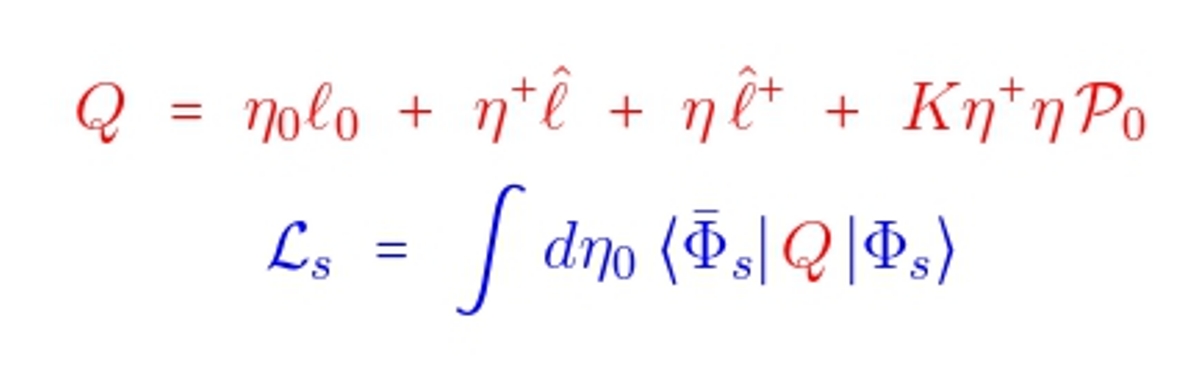
Abstract
We give a brief overview of the BRST approach to the gauge-invariant Lagrangian formulation for free massive higher-spin bosonic fields, focusing on two specific aspects. First, the theory is considered in four-dimensional flat space in terms of spin-tensor fields with two-component undotted and dotted indices. This leads to a significant simplification of the whole approach in comparison with the one where the fields with vector indices were used, since now there is no need to introduce a constraint responsible for the traces of the fields into the BRST charge. Second, we develop an extremely simple and clear procedure to eliminate all the auxiliary fields and prove that the BRST equations of motion identically reproduce the basic conditions for irreducible representations of the Poincáre group with a given mass and spin. Similar to the massless theory, the final Lagrangian for massive higher-spin fields is formulated in triplet form. The BRST formulation leads to a system of fields that are clearly subdivided into the basic spin s field, Zinoviev-like auxiliary fields, Singh–Hagen-like auxiliary fields, and special BRST auxiliary fields. The auxiliary fields can be partially eliminated by gauge fixing and/or using the equations of motion. This allows one to obtain formally different (with different numbers of auxiliary fields) but equivalent Lagrangian formulations.
References
[1] M. A. Vasiliev, Higher spin gauge theories in any dimension, Comptes Rendus Physique 5 (2004)1101.arXiv:hep-th/0409260.
[2] X. Bekaert, S. Cnockaert, C. Iazeolla, M. A. Vasiliev, Nonlinear higher spin theories in variousdimensions, in: Higher spin gauge theories: Proceedings, 1st Solvay Workshop: Brussels, Belgium,12–14 May, 2004, pp. 132–197.arXiv:hep-th/0503128.
[3] A. Fotopoulos, M. Tsulaia, Gauge-invariant Lagrangians for free and interacting higher spin fields:A review of the BRST formulation, International Journal of Modern Physics A 24 (2009) 1.arXiv:0805.1346 [hep-th].
[4] X. Bekaert, N. Boulanger, P. Sundell, How higher spin gravity surpasses the spin two barrier: No-go theorems versus yes-go examples, Reviews of Modern Physics 84 (2012) 987.arXiv:1007.0435[hep-th].
[5] V. E. Didenko, E. D. Skvortsov, Elements of Vasiliev theory.arXiv:1401.2975 [hep-th].
[6] M. A. Vasiliev, Higher-spin theory and space-time metamorphoses, Lecture Notes in Physics 892(2015) 227.arXiv:1404.1948 [hep-th].
[7] X. Bekaert, E. D. Skvortsov, Elementary particles with continuous spin, International Journal ofModern Physics A 32 (2017) 1730019.arXiv:1708.01030 [hep-th].
[8] X. Bekaert, N. Boulanger, A. Campaneoli, M. Chodaroli, D. Francia, M. Grigoriev, E. Sez-gin, E. Skvortsov, Snowmass White Paper: Higher spin gravity and higher spin symmetry.arXiv:2205.01567 [hep-th].
[9] D. Ponomarev, Basic introduction to higher-spin theories.arXiv:2206.15385 [hep-th].
[10] A. Ochirov, E. Skvortsov, Chiral approach to massive higher spins, Physical Review Letters 129(2022) 125027,arXiv:2207.14597 [hep-th].
[11] L. W. Lindwasser, Consistent actions for massive particles interacting with electromagnetism andgravity, Journal of High Energy Physics 08 (2024) 081.arXiv:2309.03901 [hep-th].
[12] J. H. Fegebank, S. M. Kuzenko, Quantisation of the gauge-invariant models for massive higher-spinbosonic fields.arXiv:2310.00951 [hep-th].
[13] E. Skvortsov, M. Tsulaia, Cubic action for spinning black holes from massive higher-spin gaugesymmetry, Journal of High Energy Physics 02 (2024) 202.arXiv:2312.08184 [hep-th].
[14] A. J. Fegebank, S. M. Kuzenko, Equivalence of gauge-invariant models for massive integer-spinfields, Physical Review D 110 (2024) 10, 105014.arXiv:2406.02573 [hep-th].
[15] W. Delplanque, E. Skvortsov, Symmetric vs. chiral approaches to massive fields with spin, Classicaland Quantum Gravity 41 (2024) 24, 245018.arXiv:2405.13706 [hep-th].[16] W. Delplanque, E. Skvortsov, Massive spin three-half field in a constant electromagnetic back-ground, Journal of High Energy Physics 08 (2024) 173,arXiv:2406.14148 [hep-th].
[17] W. Delplanque, All actions for free massive higher-spin fields, Physical Review D 111 (2025) 4.arXiv:2411.03463 [hep-th].
[18] L. F. S. Singh, C. R. Hagen, Lagrangian formulation for arbitrary spin: 1. The bosonic case,Physical Review D 9 (1974) 898.
[19] L. F. S. Singh, C. R. Hagen, Lagrangian formulation for arbitrary spin: 2. The fermionic case,Physical Review D 9 (1974) 910.
[20] J. Schwinger, Particles, Sources and Fields, Vol. 1, Addison-Wesley Publishing Company, 1970,426 pp.
[21] M. Fierz and W. Pauli, On relativistic wave equations for particles of arbitrary spin in an elec-tromagnetic field, Proceedings of the Royal Society of London A 173 (1939) 211.
[22] Yu. M. Zinoviev, Gauge invariant description of massive high spin particle, Serpukhov, Instituteof High Energy Physics, report number: IFVE-83-91,1983.
[23] S. M. Klishevich, Yu. M. Zinovev, On electromagnetic interaction of massive spin-2 particle,Physics of Atomic Nuclei 61 (1998) 1527.arXiv:hep-th/9708150.
[24] Yu. M. Zinoviev, On massive higher-spin particles in AdS.arXiv:hep-th/0108192.
[25] R. R. Metsaev, Massive totally symmetric fields in AdS(d), Physics Letters B 590 (2004) 95.arXiv:hep-th/0312297 [hep-th].
[26] R. R. Metsaev, Gauge invariant formulation of massive totally symmetric fermionic fields in (A)dSspace, Physics Letters B 643 (2006) 205.arXiv:hep-th/0609029 [hep-th].
[27] I. L. Buchbinder, V. A. Krykhtin, Gauge invariant Lagrangian construction for massive bosonichigher spin fields in D dimensions, Nuclear Physics B 727 (2005) 537.arXiv:hep-th/0505092.
[28] I. L. Buchbinder, V. A. Krykhtin, P. M. Lavrov, Gauge invariant Lagrangian formulation ofhigher spin massive bosonic field theory in AdS space, Nuclear Physics B 762 (2006) 386.arXiv:hep-th/0608005.
[29] I. L. Buchbinder, V. A. Krykhtin, H. Takata, Gauge invariant Lagrangian construction for massivebosonic mixed symmetry higher spin fields, Physics Letters B 656 (2007) 253.arXiv:0707.2181[hep-th].
[30] I. L. Buchbinder, A. V. Galajinsky, Quartet unconstrained formulation for massive higher spinfields, Journal of High Energy Physics 11 (2008) 081,arXiv:0810.2852 [hep-th].
[31] A. I. Pashnev, Composite systems and field theory for a free Regge trajectory, Theoretical andMathematical Physics 78 (1989) 272.
[32] A. Pashnev, M. Tsulaia, Dimensional reduction and the BRST approach to the description of aRegge trajectory, Modern Physics Letters A 12 (1997) 861.arXiv:hep-th/9703010.
[33] X. Bekaert, I. L. Buchbinder, A. Pashnev, M. Tsulaia, On higher spin theory: Strings, BRST,dimensional reduction, Classical and Quantum Gravity 21 (2004) S1457.arXiv:hep-th/0312252.
[34] M. A. Vasiliev, Supersymmetric higher-spin gauge theories in anydand their coupling constantswithin BRST formalism.arXiv:2503.10967 [hep-th].
[35] M. V. Khabarov, Yu. M. Zinoviev, Massive higher spin fields in the frame-like multispinor formal-ism, Nuclear Physics B 948 (2019) 11477.arXiv:1906.03438 [hep-th].
[36] I. L. Buchbinder, K. Koutrolikos, BRST analysis of the supersymmetric higher spin field models,Journal of High Energy Physics 12 (2015) 106.arXiv:1510.06569 [hep-th].
[37] I. L. Buchbinder, S. A. Fedoruk, A. P. Isaev, V. A. Krykhtin, On BRST Lagrangian formulation ofmassless higher spin fields, Russian Physics Journal 67 (2024) 1806.arXiv:2412.08298 [hep-th].
[38] I. L. Buchbinder, S. V. Kuzenko, Ideas and methods of supersymmetry and supergravity, or awalk through superspace, IOP Publishing, Bristol and Philadelphia, 1995; Revised Edition, 1998.
[39] L. D. Faddeev, S. L. Shatashvili, Realization of the Schwinger term in the Gauss law and thepossibility of correct quantization of a theory with anomalies, Physics Letters B 167 (1986) 225.
[40] I. A. Batalin, E. S. Fradkin, Operatorial quantization of dynamical systems subject to second-classconstraints, Nuclear Physics B 279 (1987) 514.
[41] I. L. Buchbinder, V. A. Krykhtin, H. Takata, BRST approach to Lagrangian construction fo