

Abstract
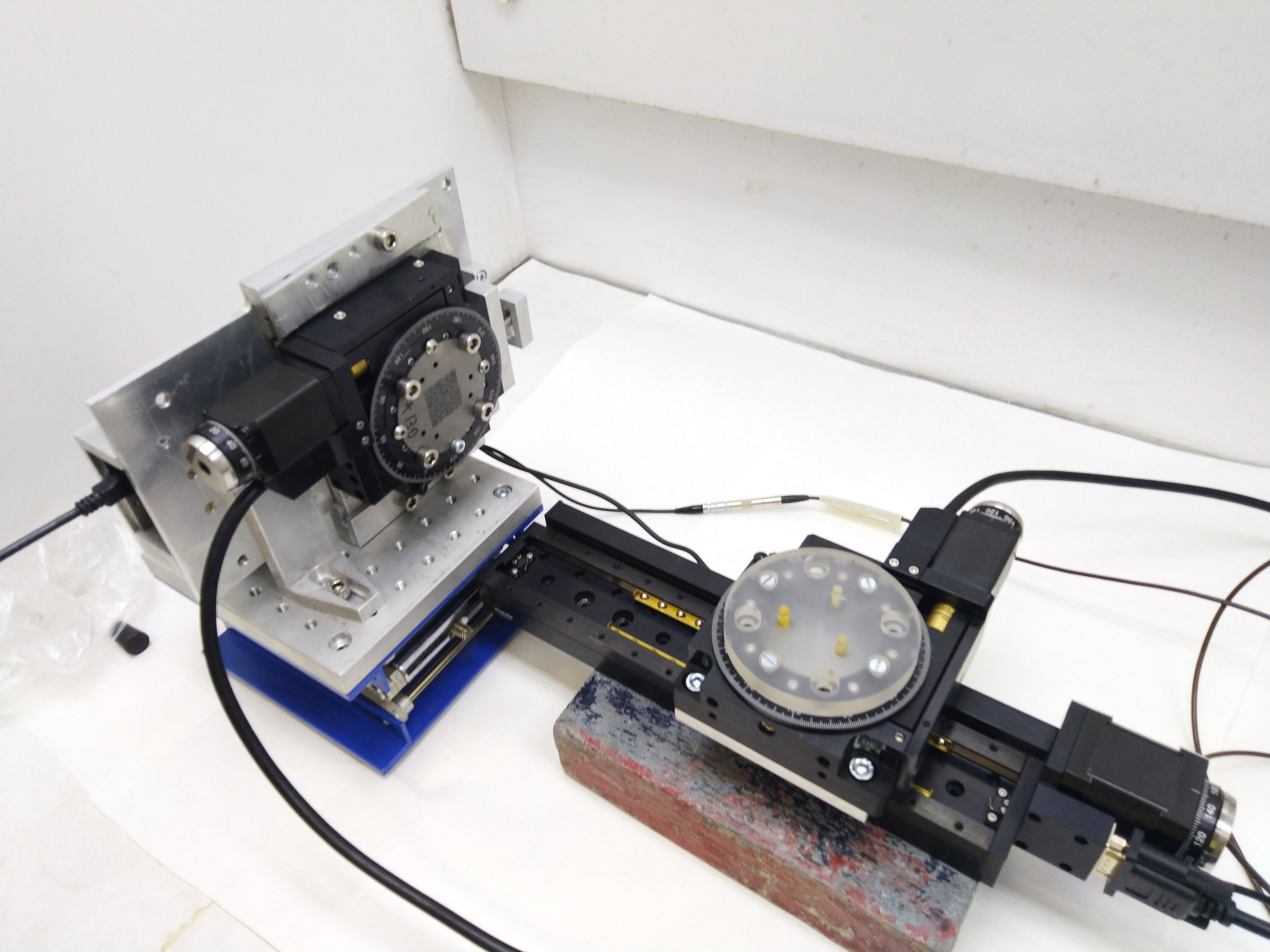
In this work, the characteristics of a prototype SPECT system based on the Timepix readout chip, with a MURA-type encoding mask, were evaluated. The setup has a small FoV and can be used in preclinical studies of drugs on small laboratory animals. Despite many existing test protocols developed and described in pertinent documents of national standard bodies and IAEA recommendations, they are not suitable for microtomographic systems based on semiconductor pixel detectors due to different detector technology, high spatial resolution and small area of interest. To measure their characteristics, special phantoms were developed, with a small “hot region”.
Such micro-SPECT parameters as spatial resolution, contrast, linearity, and system efficiency were studied using 99mTc source. The detector calibration and data preprocessing are described.
References
[1] H. O. Anger, Scintillation camera, Rev. Sci. Instrum. 29 (1958) 27–33. doi:https://doi.org/10.1063/1.1715998.
[2] MILabs, Revolutionary new pinhole technology allows simultaneous high-resolutioninvivoSPECT and PET, 2018,https://www.milabs.com/milabs-announces-revolu-tionary-new-pinhole-technology-allows-simultaneous-high-resolution-in-vivo-spect-and-pet/.
[3] M. J. Cieslak, K. A. A. Gamage, R. Glover, Coded-aperture imaging systems: Past, present andfuture development — A review, Radiat. Meas. 92 (2016) 59–71. doi:https://doi.org/10.1016/j.radmeas.2016.08.002.
[4] X. Llopart, R. Ballabriga, M. Campbell, L. Tlustos, W. Wong, Timepix, A 65k programmablepixel readout chip for arrival time, energy and/or photon counting measurements, Nucl. Instrum.Meth. A 581 (2007) 485. doi:https://doi.org/10.1016/j.nima.2007.08.079.
[5] A. P. Butler, P. H. Butler, S. T. Bell et al., Measurement of the energy resolution and calibrationof hybrid pixel detectors with GaAs:Cr sensor and Timepix readout chip, Phys. Part. Nucl. Lett.12 (2015) 97.
[6] S. Abbaspour, B. Mahmoudian, J. P. Islamian, Cadmium telluride semiconductor detector forimproved spatial and energy resolution radioisotopic imaging, World J. Nucl. Med. 16 (2017)101–107. doi:https://doi.org/10.4103/1450-1147.203079.
[7] S. R. Gottesman, E. E. Fenimore, New family of binary arrays for coded aperture imaging, Appl.Opt. 28 (1989) 4344–4352. doi:https://doi.org/10.1364/AO.28.004344.
[8] V. Kraus, M. Holik, J. Jakubek et al., FITPix — fast interface for Timepix pixel detectors, JINST6 (2011) C01079. doi:https://doi.org/10.1088/1748-0221/6/01/C01079.
[9] L. Tlustos, Performance and limitations of high granularity single photon processing X-ray imag-ing detectors. Thesis, Technische Univ. Wien, Vienna, Austria, 2005,http://inis.iaea.org/search/search.aspx?orig_q=RN:38037565.
[10] V. Rozhkov et al. Visualization of radiotracers for SPECT imaging using a Timepix detector witha coded aperture, JINST 15 (2020) P06028. doi:https://doi.org/10.1088/1748-0221/15/06/P06028.
[11] V. Rozhkov, A. Zhemchugov, A. Leyva, P. Smolyansky, Uniformity and sensitivity measurementsfor small field of view pixelated SPECT system with coded aperture, Phys. Part. Nucl. Lett. 19(2022) 594–596. doi:https://doi.org/10.1134/S1547477122050363.
[12] V. A. Rozhkov, A. S. Zhemchugov, A. Leyva, P. I. Smolyanskiy, 3D gamma source SPECTvisualization using Timepix detectors and encoding apertures, Phys. At. Nucl. 85 (2022) 1501–1504. doi:https://doi.org/10.1134/S1063778822090319.
[13] International Atomic Energy Agency, Quality assurance for SPECT systems, IAEA Human HealthSeries, No. 6, Vienna, Austria (2009), p. 263.
[14] International Atomic Energy Agency, Planning a clinical PET center, IAEA Human Health Series,No. 11, Vienna, Austria (2010), p. 160.
[15] National Electrical Manufacturers Association (NEMA), NEMA NU 1-2018, 2018,https://www.techstreet.com/nema/standards/nema-nu-1-2018?product_id=2073744.
[16] National Electrical Manufacturers Association (NEMA), NEMA NU 2-2018, 2018,https://www.techstreet.com/nema/standards/nema-nu-2-2018?product_id=2017225.
[17] Md. R. Hasan, Md. H. R. Khan, Md. R. Rahman, Md. S. Parvez, Md. R. Islam, A. K. Paul,Quality control of gamma camera with SPECT systems, IJMPCERO, 6 (2017) 225–232. doi:10.4236/ijmpcero.2017.63021.
[18] Lu Tianhuan et al., An accurate centroiding algorithm for PSF reconstruction, Astron. J., 156(2018) 14. doi:10.3847/1538-3881/aac5f7.
[19] G. A. Fedorov, S. A. Tereshchenko, Integrating encoding systems for recording ionizing radiation.Meas. Tech. 40 (1997) 164–174. doi:https://doi.org/10.1007/BF02504042.
[20] T. Meissner, V. Rozhkov, J. Hesser, W. Nahm, N. Loew, Quantitative comparison of planar codedaperture imaging reconstruction methods, JINST 18 (2023) P01006. doi:https://doi.org/10.1088/1748-0221/18/01/P01006.