

Abstract
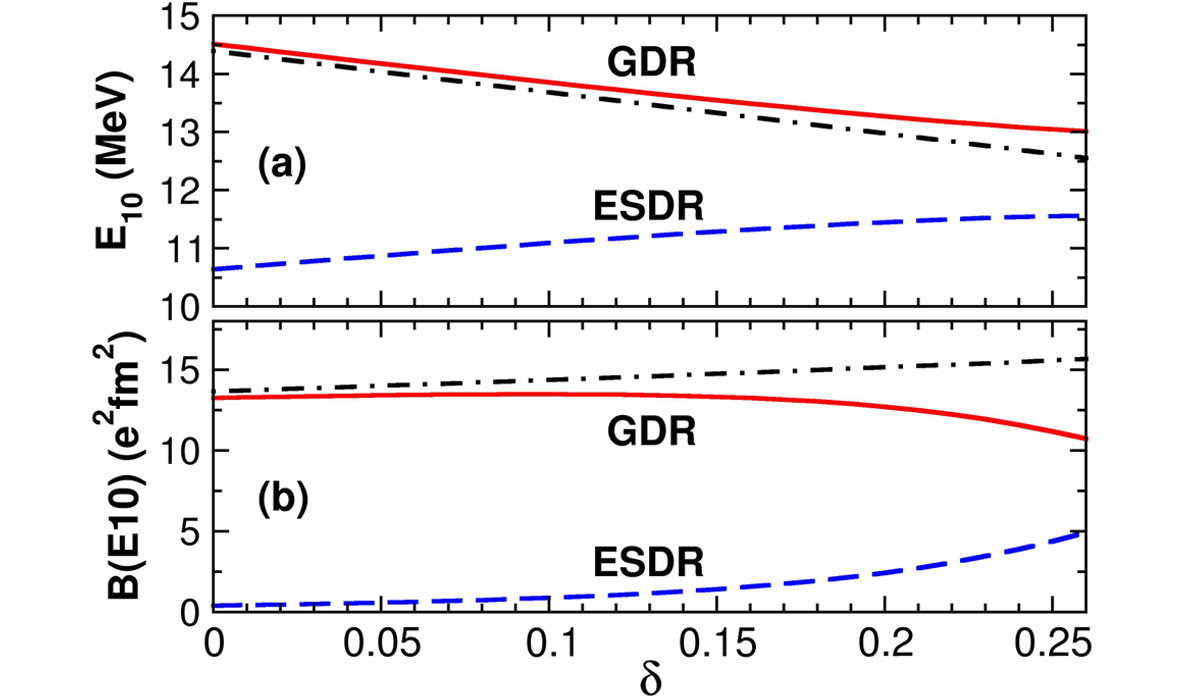
The time-dependent Hartree–Fock equation is solved by the Wigner function moments method taking into account spin degrees of freedom. Energies and reduced transition probabilities of Kπ = 0−, 1− and 2− excitations are calculated taking 164Dy as an example. The spin degrees of freedom give rise to the electric spin dipole resonance. Its properties and interplay with the giant dipole resonance are investigated. The deformation-induced splitting of the spin M2 resonance is discussed. The results of calculations are compared with the experimental data and other theoretical studies.
Acknowledgements
References
[1] E. B. Balbutsev and P. Schuck, The nuclear scissors mode in a solvable model, Nucl. Phys. A 720 (2003) 293–336 [Erratum ibid. 728 (2003) 471–479]. https://doi.org/10.1016/S0375-9474(03) 01078-9. DOI: https://doi.org/10.1016/j.nuclphysa.2003.08.026
[2] E. B. Balbutsev and P. Schuck, The nuclear scissors mode from various aspects, Ann. Phys. 322 (2007) 489–529. https://doi.org/10.1134/1.2053333. DOI: https://doi.org/10.1016/j.aop.2006.04.014
[3] E. B. Balbutsev, I. V. Molodtsova, and P. Schuck, Spin scissors mode and the fine structure of M1 states in nuclei, Nucl. Phys. A 872 (2011) 42–68. https://doi.org/10.1016/j.nuclphysa.2011.09.013. DOI: https://doi.org/10.1016/j.nuclphysa.2011.09.013
[4] E. B. Balbutsev, I. V. Molodtsova, and P. Schuck, New type of nuclear collective motion: The spin scissors mode, Phys. Rev. C 88 (2013) 014306-(1–18), https://doi.org/10.1103/PhysRevC.88. 014306. DOI: https://doi.org/10.1103/PhysRevC.88.014306
[5] E. B. Balbutsev, I. V. Molodtsova, and P. Schuck, Orbital and spin scissors modes in superfluid nuclei, Phys. Rev. C 91 (2015) 064312-(1–20). https://doi.org/10.1103/PhysRevC.91.064312. DOI: https://doi.org/10.1103/PhysRevC.91.064312
[6] E. B. Balbutsev, I. V. Molodtsova, and P. Schuck, Experimental status of the nuclear spin scissors mode, Phys. Rev. C 97 (2018) 044316-(1–14). https://doi.org/10.1103/PhysRevC.97.044316. DOI: https://doi.org/10.1103/PhysRevC.97.044316
[7] E. B. Balbutsev, I. V. Molodtsova, A. V. Sushkov, N. Yu. Shirikova, and P. Schuck, Spin-isospin structure of the nuclear scissors mode, Phys. Rev. C 105 (2022) 044323-(1–20). https://doi.org/10.1103/PhysRevC.105.044323. DOI: https://doi.org/10.1103/PhysRevC.105.044323
[8] E. B. Balbutsev and I. V. Molodtsova, Scissors mode in transuranium elements, Eur. Phys. J. A 60 (2024) 185-(1–15). https://doi.org/10.1140/epja/s10050-024-01386-4. DOI: https://doi.org/10.1140/epja/s10050-024-01386-4
[9] B. L. Berman and S. C. Fultz, Measurements of the giant dipole resonance with monoenergetic photons, Rev. Mod. Phys. 47 (1975) 713–761. https://doi.org/10.1103/RevModPhys.47.713. DOI: https://doi.org/10.1103/RevModPhys.47.713
[10] A. V. Varlamov, V. V. Varlamov, D. S. Rudenko, and M. E. Stepanov, Atlas of Giant Dipole Resonances, Parameters and Graphs of Photonuclear Reaction Cross Sections, INDC, Vienna, 1999.
[11] H. P. Morsch, P. Decowski, and W. Benenson, Fine structure in the giant resonance region and the collective dipole spin-flip excitation in 208Pb, Nucl. Phys. A 297 (1978) 317–334. https://doi.org/10.1016/0375-9474(78)90279-8. DOI: https://doi.org/10.1016/0375-9474(78)90279-8
[12] H. Sagawa and B. Castel, The giant-dipole and spin-dipole resonances: A coexistence problem, Nucl. Phys. A 435 (1985) 1–6. https://doi.org/10.1016/0375-9474(85)90298-2. DOI: https://doi.org/10.1016/0375-9474(85)90298-2
[13] B. Castel and L. Zamick, New spin excitation modes in nuclei, Phys. Rep. 148 (1987) 217–247. https://doi.org/10.1016/0370-1573(87)90027-5. DOI: https://doi.org/10.1016/0370-1573(87)90027-5
[14] B. Castel and I. Hamamoto, Giant spin resonances and effective Mλg-factors, Phys. Lett. B 65 (1976) 27–30. https://doi.org/10.1016/0370-2693(76)90526-8. DOI: https://doi.org/10.1016/0370-2693(76)90526-8
[15] J. Kvasil, N. Lo Iudice, V. O. Nesterenko, A. Mackov´a, and P. Alexa, Orbital and spin magnetic quadrupole response in heavy nuclei, Phys. Rev. C 63 (2001) 054305-(1–11). https://doi.org/10.1103/PhysRevC.63.054305. DOI: https://doi.org/10.1103/PhysRevC.63.054305
[16] G. Kružić, T. Oishi, and N. Paar, Magnetic quadrupole transitions in the relativistic energy density functional theory, Eur. Phys. J. A 59 (2023) 50-(1–14). https://doi.org/10.1140/epja/s10050-023-00958-0. DOI: https://doi.org/10.1140/epja/s10050-023-00958-0
[17] E. B. Balbutsev, J. Piperova, M. Durand, I. V. Molodtsova, and A. V. Unzhakova, Giant dipole resonance and other 1− excitations, Nucl. Phys. A 571 (1994) 413–426. https://doi.org/10.1016/0375-9474(94)90219-4. DOI: https://doi.org/10.1016/0375-9474(94)90219-4
[18] E. B. Balbutsev, I. V. Molodtsova, and A. V. Unzhakova, Compressional and toroidal dipole excitations of atomic nuclei, Europhys. Lett. 26 (1994) 499–504. https://doi.org/10.1209/0295-5075/26/7/004. DOI: https://doi.org/10.1209/0295-5075/26/7/004
[19] E.B. Balbutsev, I. V. Molodtsova, and J. Piperova, Collective 3− and 2− excitations with Skyrme forces, Sov. J. Nucl. Phys. 53 (1991) 670–679.
[20] E. B. Balbutsev and I. V. Molodtsova, Giant dipole and spin magnetic quadrupole resonances within Wigner function moments method, Int. J. Mod. Phys. E 35 (2026) 2641007-(1–12). https://doi.org/10.1142/S0218301326410077. DOI: https://doi.org/10.1142/S0218301326410077
[21] P. Ring and P. Schuck, The Nuclear Many-Body Problem, Springer, Berlin, 1980. DOI: https://doi.org/10.1007/978-3-642-61852-9
[22] V. G. Soloviev, Theory of Complex Nuclei, Pergamon Press, Oxford, 1976.
[23] E. B. Balbutsev, L. A. Malov, P. Schuck, M. Urban, and X. Vi˜nas, Nuclear scissors mode with pairing, Phys. At. Nucl. 71 (2008) 1012–1030. https://doi.org/10.1134/S1063778808060057. DOI: https://doi.org/10.1134/S1063778808060057
[24] D. A. Varshalovitch, A. N. Moskalev, and V. K. Khersonski, Quantum Theory of Angular Momentum, World Scientific, Singapore, 1988. DOI: https://doi.org/10.1142/0270
[25] A. Bohr and B. R. Mottelson, Nuclear Structure, Vol. II, Benjamin, New York, 1975.
[26] T. Suzuki and D. J. Rowe, The splitting of giant multipole states of deformed nuclei, Nucl. Phys. A 289 (1977) 461–474. https://doi.org/10.1016/0375-9474(77)90046-X. DOI: https://doi.org/10.1016/0375-9474(77)90046-X
[27] J. Wambach and B. Schwesinger, Damping of highly excited vibrations in heavy nuclei, J. de Phys. 45 (1984) C4-281–C4-296. https://doi.org/10.1051/jphyscol:1984421. DOI: https://doi.org/10.1051/jphyscol:1984421
[28] P. von Neumann-Cosel, N. Neumeyer, S. Nishizaki, V. Yu. Ponomarev, C. Rangacharyulu, B. Reitz, A. Richter, G. Schrieder, D. I. Sober, T. Waindzoch, and J. Wambach, Spin and orbital magnetic quadrupole resonances in 48Ca and 90Zr from 180◦ electron scattering, Phys. Rev. Lett. 82 (1999) 1105–1108. https://doi.org/10.1103/PhysRevLett.82.1105. DOI: https://doi.org/10.1103/PhysRevLett.82.1105
[29] I. Gheorghe, S. Goriely, N. Wagner, T. Aumann, M. Baumann, P. van Beek, P. Kuchenbrod, H. Scheit, D. Symochko, T. Ari-izumi, F. L. Bello Garrote, T. Eriksen, W. Paulsen, L. G. Pedersen, F. Reaz, V. W. Ingeberg, S. Belyshev, S. Miyamoto, and H. Utsunomiya, Photoneutron cross section measurements on 208Pb in the giant dipole resonance region, Phys. Rev. C 110 (2024) 014619-(1–19). https://doi.org/10.1103/PhysRevC.110.014619. DOI: https://doi.org/10.1103/PhysRevC.110.014619
[30] B. Wasilewska, M. Kmiecik, M. Ciema la, A. Maj, F. C. L. Crespi, A. Bracco, M. N. Harakeh, P. Bednarczyk, S. Bottoni, et al., γ decay to the ground state from the excitations above the neutron threshold in the 208Pb(p, p′γ) reaction at 85 MeV, Phys. Rev. C 105 (2022) 014310-(1–7). https://doi.org/10.1103/PhysRevC.105.014310. DOI: https://doi.org/10.1103/PhysRevC.105.014310
[31] A. M. Lane, Nuclear Theory, Benjamin, New York, 1964.
License

This work is licensed under a Creative Commons Attribution-NonCommercial 4.0 International License.