

Abstract
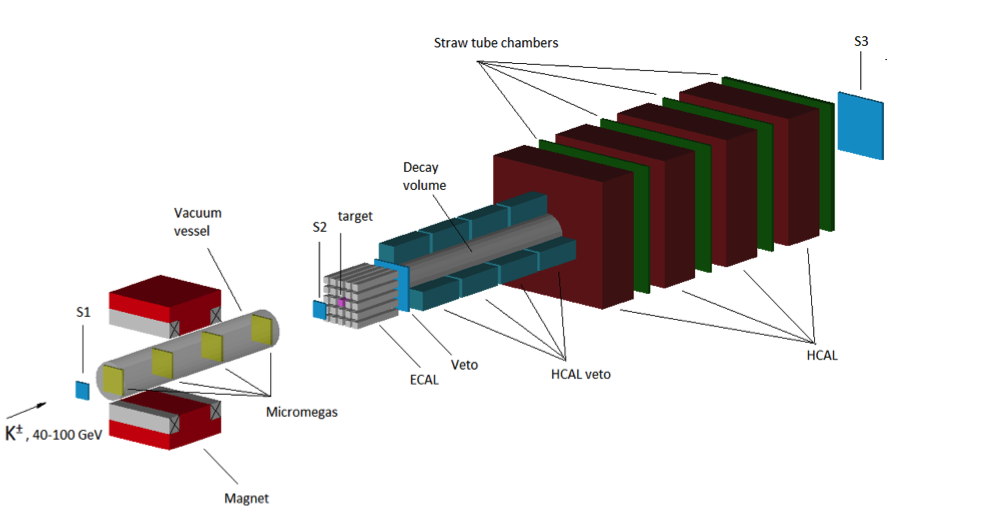
The decays KS,L → invisible have never been experimentally tested. In the Standard Model (SM), their branching ratios for the decay into two neutrinos are predicted to be extremely small, Br (KS,L → νν̄) ≲ 10−16. We consider several natural extensions of the SM, such as two-Higgs-doublet (2HDM), 2HDM and light scalar, and dark mirror sector models, that allow one to enhance the Br (KS,L → invisible) up to a measurable level. We briefly discuss the possible search for KS,L → invisible decays and KS,L oscillations into the dark sector at the NA64 experiment at CERN with the sensitivity to Br (KS,L → invisible) ≲ 10−7−10−5.
Acknowledgements
References
[1] R. L. Workman et al. (Particle Data Group), Progress of Theoretical and Experimental Physics2022 (2022) 083C01.
[2] L. Gan, B. Kubis, E. Passemar, and S. Tulin, Physics Reports 945 (2022) 1.
[3] J. F. Kamenik and C. Smith, Journal of High Energy Physics 03 (2012) 090.
[4] S. N. Gninenko, Physical Review D 91 (2015) 015004.
[5] S. N. Gninenko and N. V. Krasnikov, Physical Review D 92 (2015) 034009.
[6] S. N. Gninenko and N. V. Krasnikov, Modern Physics Letters A 31 (2016) 1650142.
[7] D. Barducci, M. Fabbrichesi, and E. Gabrielli, Physical Review D 98 (2018) 035049.
[8] M. Hostert, K. Kaneta, and M. Pospelov, Physical Review D 102 (2020) 055016.
[9] J. Elam et al. (REDTOP Collaboration), arXiv:2203.07651.
[10] P. Schuster, N. Toro, and K. Zhou, Physical Review D 105 (2022) 035036.
[11] A. S. Zhevlakov, D. V. Kirpichnikov, S. N. Gninenko, S. V. Kuleshov, and V. E. Lyubovitskij,Physical Review D 108 (2023) 115005.
[12] S. N. Gninenko, D. V. Kirpichnikov, S. V. Kuleshov, V. E. Lyubovitskij, and A. S. Zhevlakov,arXiv: 2407.01181.
[13] S. N. Gninenko, D. V. Kirpichnikov, S. V. Kuleshov, V. E. Lyubovitskij, and A. S. Zhevlakov,Physical Review D 109 (2024) 075021.
[14] I. V. Voronchikhin, D. V. Kirpichnikov, Physical Review D 107 (2023) 115034; Physical ReviewD 106 (2022) 115041. arXiv: 2409.12748.
[15] A. V. Artamonov et al. (E949 Collaboration), Physical Review D 72 (2005) 091102.
[16] E. Cortina Gil et al. (NA62 Collaboration), Journal of High Energy Physics 05 (2019) 182.
[17] M. Ablikim et al. (BES Collaboration), Physical Review 87 (2013) 012009.
[18] Yu. M. Andreev et al. (NA64 Collaboration), Physical Review Letters 133 (2024) 121803.
[19] C. L. Hsu et al. (Belle Collaboration), Physical Review D 86 (2012) 032002.
[20] B. Aubert et al. (BaBar Collaboration), Physical Review Letters 93 (2004) 091802.
[21] M. Ablikim et al. (BES Collaboration), Physical Review Letters 100 (2008) 192001.
[22] P. Rubin et al. (CLEO Collaboration), Physical Review D 75 (2007) 031104.
[23] S. N. Ahmed et al. (SNO Collaboration), Physical Review Letters 92 (2004) 102004.[24] H. O. Back et al. (Borexino Collaboration), Physics Letters B 563 (2003) 23.
[25] T. Araki et al., Physical Review Letters 96 (2006) 101802.
[26] V. I. Tretyak, V. Yu. Denisov, and Yu. G. Zdesenko, Journal of Experimental and TheoreticalPhysics Letters 79 (2004) 106; Pis’ma v Zhurnal Eksperimentalnoi i Teoreticheskoi Fiziki 79 (2004)136. nucl-ex/0401022.
[27] H. V. Klapdor-Kleingrothaus, I. V. Krivosheina, and I. V. Titkova, Physics Letters B 644 (2007)109.
[28] G. Banet et al., Physical Review Letters 99 (2007) 161603.
[29] N. J. Ayres et al., Symmetry 14 (2022) 503.
[30] A. P. Serebrov et al., Physics Letters B 663 (2008) 181.
[31] M. Sarrazin, G. Pignol, F. Petit, and V. V. Nesvizhevsky, Physics Letters B 712 (2012) 213.
[32] S. N. Gninenko, N. V. Krasnikov, and A. Rubbia, Physical Review D 67 (2003) 075012.
[33] A. Badertscher, P. Crivelli, U. Gendotti, S. N. Gninenko, V. Postoev, A. Rubbia, V. Samoylenko,and D. Sillou, Physical Review D 75 (2007) 032004.
[34] P. Crivelli, A. Belov, U. Gendotti, S. Gninenko, and A. Rubbia, Journal of Instrumentation 5(2010) P08001. arXiv:1005.4802 [hep-ex];C. Vigo et al., Physical Review D 97 (2018) 092008; Physical Review Letters 124 (2020) 101803.
[35] S. N. Gninenko, N. V. Krasnikov, and V. A. Matveev, Physical Review D 87 (2013) 015016.arXiv:1209.0060 [hep-ph].
[36] S. N. Gninenko, Physical Review D 76 (2007) 055004.
[37] W. J. Marciano and Z. Parsa, Physical Review D 53 (1996) R1.
[38] D.-N. Gao, Physical Review D 98 (2018) 113006.
[39] A. J. Buras and J. Girrbach, Reports on Progress in Physics 77 (2014) 086201.
[40] V. Cirigliano, G. Ecker, H. Neufeld, A. Pich, and J. Portoles, Reviews of Modern Physics 84(2012) 399.
[41] D. Bryman, W. J. Marciano, R. Tschirhart, and T. Yamanaka, Annual Review of Nuclear andParticle Science 61 (2011) 331.
[42] T. K. Komatsubara, Progress in Particle and Nuclear Physics 67 (2012) 995.
[43] M. Blanke, arXiv:1305.5671(2013).
[44] L. G. Landsberg, Physics–Uspekhi 46 (2003) 995; Uspekhi Fizicheskikh Nauk 46 (2003) 1025.
[45] J. S. Bell and J. Steinberger, in: Oxford International Symposium Conference on ElementaryParticles, Oxford, England, September 19–25, 1965, edited by L. Wolfenstein, Rutherford HighEnergy Laboratory, Chilton, 1965, p. 42.
[46] J. Steinberger,K0Decay and CP Violation, CERN 70-1, 1970.
[47] M. Antonelli, G. D’Ambrosio, and M. S. Sozzi, CPT Invariance Tests in Neutral Kaon Decay,p. 871, in Ref. [1].
[48] L. Maiani, in: The Second DAPHNE Physics Handbook, two volumes, edited by L. Maiani,G. Pancheri, and N. Paver, INFN, Frascati, 1995, 1202 p.
[49] G. D’Ambrosio, G. Isidori, and A. Pugliese, in: The Second DAPHNE Physics Handbook, twovolumes, edited by L. Maiani, G. Pancheri, and N. Paver, INFN, Frascati, 1995, 1202 p.
[50] P. Bloch and L. Tauscher, Annual Review of Nuclear and Particle Science 53 (2003) 123.
[51] F. Ambrosino et al. (KLOE Collaboration), Journal of High Energy Physics 0612 (2006) 011.arXiv:hep-ex/0610034.
[52] A. Angelopoulosetal et al. (CPLEAR Collaboration), Physics Letters B 471 (1999) 332.
[53] K. R. Schubert, L. Li Gioi, A. J. Bevan, and A. Di Domenico, arXiv:1401.6938 [hep-ex].
[54] J. N. Butler et al., arXiv:1311.1076(2013).
[55] V. Rubakov and D. Gorbunov, Introduction to the Theory of the Early Universe, 1st Edition,World Scientific Publishing Co., Singapore, 2017.[56] E. W. Kolb and M. S. Turner, The Early Universe, FERMILAB-BOOK-1990-01, 1990.[57] T. D. Lee and C. N. Yang, Physical Review 104 (1956) 254;I. Kobzarev, L. Okun, and I. Pomeranchuk, Soviet Journal of Nuclear Physics 3 (1966) 837.
[58] S. I. Blinnikov and M. Yu. Khlopov, Soviet Journal of Nuclear Physics 36 (1982) 472; SovietAstronomy AJ 27 (1982) 371;R. Foot, H. Lew, and R. R. Volkas, Physics Letters B 272 (1991) 67;Z. Berezhiani and R. Mohapatra, Physical Review D 62 (1995) 6607;L. B. Okun, Physics–Uspekhi 50 (2007) 380; Uspekhi Fizicheskikh Nauk 177 (2007) 397.
[59] R. Foot, International Journal of Modern Physics A 29 (2014) 1430013.
[60] A. Yu. Ignatiev and R. R. Volkas, Physics Letters B 487 (2000) 294;B. Patt and F. Wilczek, arXiv: hep-ph/0605188.
[61] S. L. Glashow, Physics Letters B 167 (1986) 35;S. N. Gninenko, Physics Letters B 326 (1994) 317;R. Foot and S. N. Gninenko, Physics Letters B 480 (2000) 171.
[62] Z. Berezhiani and L. Bento, Physical Review Letters 96 (2006) 081801;Z. Berezhiani, European Physical Journal C 64 (2009) 421.
[63] N. N. Nikolaev and L. B. Okun, Physics Letters 27B (1968) 226.
[64] S. N. Gninenko, N. V. Krasnikov, and V. A. Matveev, Physics of Particles and Nuclei 51 (2020)829.
[65] S. N. Gninenko, N. V. Krasnikov, and V. A. Matveev, Uspekhi Fizicheskikh Nauk 191 (2021)1361.
[66] S. N. Gninenko, Physical Review D 89 (2014) 075008. arXiv:1308.6521 [hep-ph].
[67] S. Andreas et al., arXiv:1312.3309 [hep-ex], CERN-SPSC-2013-034/SPSC-P-348.[68] http://sba.web.cern.ch/sba/.
[69] S. Agostinelli et al. (GEANT4 Collaboration), Nuclear Instruments and Methods in Physics Re-search, Section A 506 (2003) 250;J. Allison et al. (GEANT4 Collaboration), IEEE Transactions on Nuclear Science 53 (2006) 270.
[70] G. A. Alekseev et al., Nuclear Instruments and Methods in Physics Research, Section A 461 (2001)381.
[71] F. Binon et al., Il Nuovo Cimento A 64 (1981) 89.
[72] V. N. Bolotov et al., Nuclear Physics B 85 (1975) 158.
[73] F. Binon et al., Zeitschrift für Physik C 9 (1981) 109.