
Temperature-dependent conformational changes of amyloid-β42 in DPPC bilayers
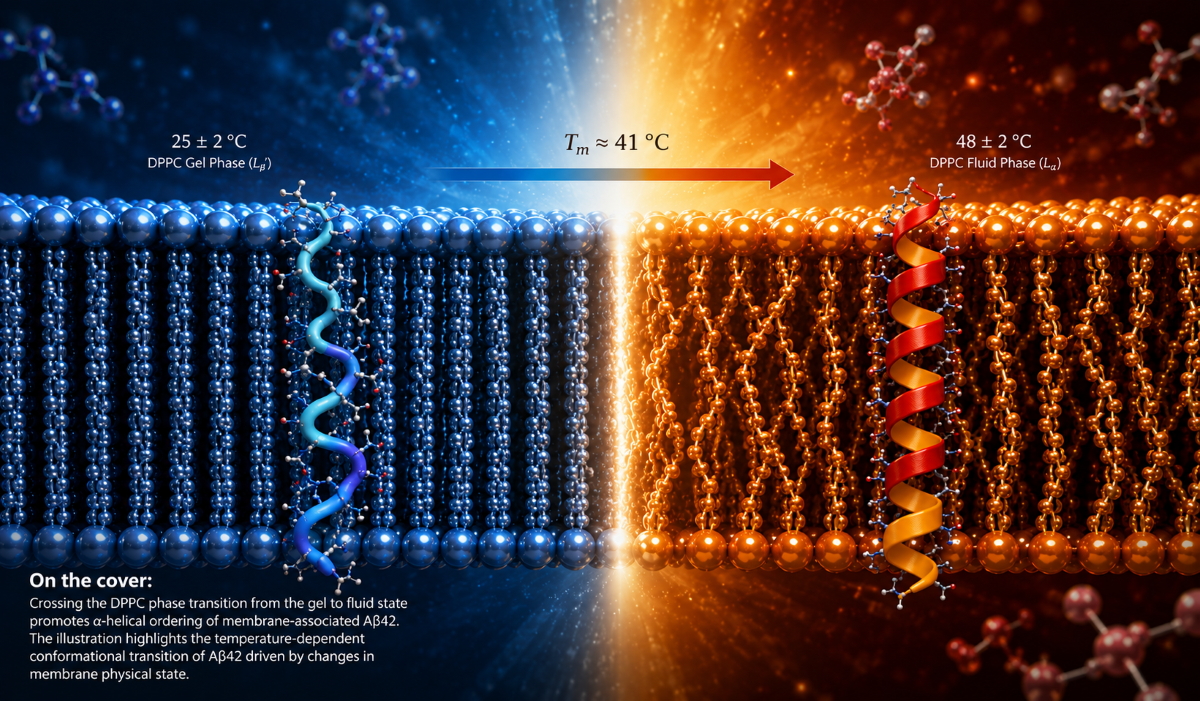
The conformational behavior of the amyloid- β 42 (A β 42) peptide is strongly influenced by the physical state of its surrounding lipid environment. The effect of temperature on the A β 42 structure within dipalmitoylphosphatidylcholine (DPPC) bilayers was investigated using circular dichroism (CD), Raman spectroscopy, and molecular dynamics (MD) simulations. The study examined two thermal phases: room temperature (RT =∼ (25±2)◦C), corresponding to the gel phase of DPPC, and (48±2)◦C, representing the fluid phase above the lipid transition temperature . The CD spectroscopy measurements indicated a clear temperature-dependent structural transition of the peptide. At RT, A β 42 exhibited a conformation enriched in β structures, while at (48±2)◦C, the spectra revealed a notable increase in α -helical content, reflecting enhanced backbone organization under fluid-phase conditions. Raman spectral analysis supported this trend by demonstrating an increased contribution of α -helical components accompanied by a reduction in β -strand features upon heating. Minor variations in lipid vibrational markers further suggested greater acyl-chain flexibility and bilayer fluidity in the high-temperature state. Furthermore, MD simulations revealed enhanced α-helical content and deeper peptide insertion within the disordered bilayer compared with the ordered gel phase. The findings from experimental and computational investigations demonstrate that membrane fluidization above the DPPC phase transition favors α-helical stabilization of A β 42, emphasizing temperature as a key parameter governing peptide–lipid conformational equilibria. The results obtained provide a fundamental framework for understanding how thermal conditions modulate amyloid-membrane interactions, which is essential for elucidating the early molecular events associated with amyloid-related pathologies.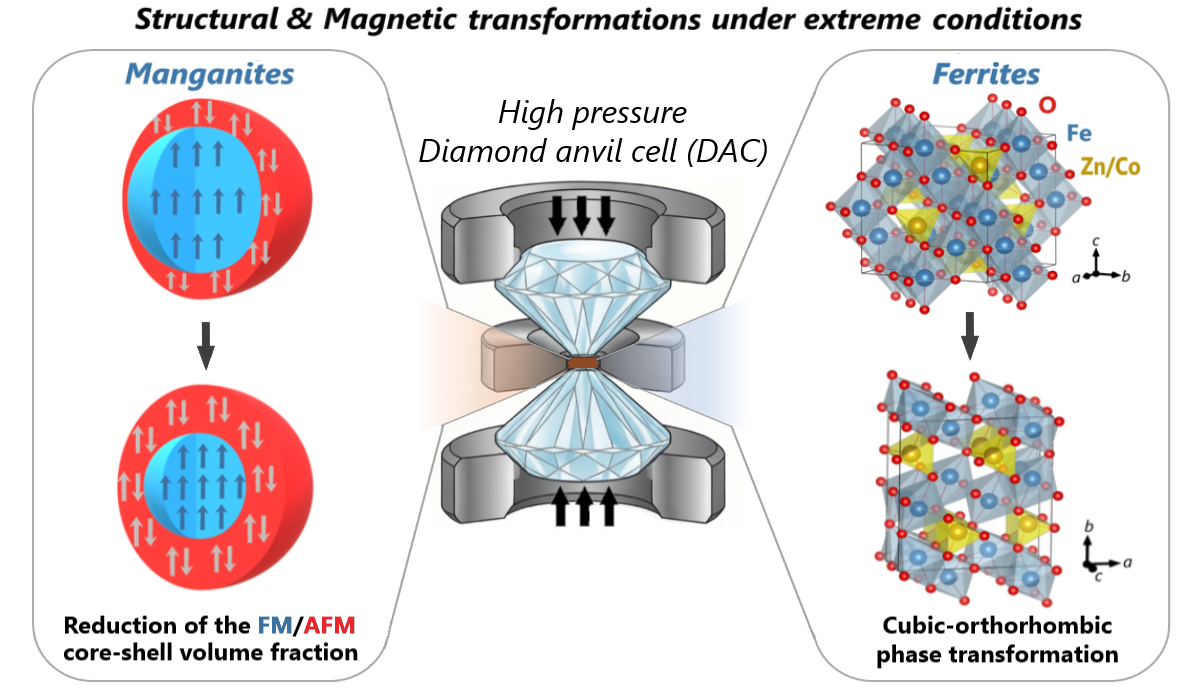
Structural, magnetic states and pressure-induced phenomena in complex nanosized magnetic oxides
The results of the recent investigations of the crystal and magnetic structure of complex nanosized manganese and iron oxides using neutron diffraction, X-ray diffraction and other techniques over a wide range of thermodynamic parameters (temperature and pressure) are considered. In the nanostructured manganites La 1-x Sr x MnO 3 ( x = 0.28−0.47), the coexistence of the ferromagnetic (FM) and A-type antiferromagnetic (AFM) states has been evidenced, implying the production of core-shell nanoparticles with distinctive structural and magnetic properties of ordering of internal and external components. Application of high pressure significantly modifies the ratio of FM and AFM components. For the nanostructured Zn 0.34 Fe 2.53 O 4 ferrite, a distribution of Zn and Fe atoms in the crystal structure, as well as the parameters of crystal and magnetic structures, have been estimated. The oxygen vacancies were detected and their amount was estimated. The gradual transition of the structural phase from the initial cubic spinel phase to the orthorhombic post spinel phase was observed at high pressures in this material, relevant to CoFe 2 O 4 ferrite. In the latter case, the phase transition is also accompanied by suppression of the ordered magnetic moments. Surprisingly, in the most cases, the properties of structural and magnetic states of the studied nanosized manganites and ferrites are notably different from those for the relevant bulk forms of these materials. The microscopic mechanisms responsible for this distinction have been discussed in detail. Corrected: 24 April 2026 (the incorrect order of the authors and the affiliation of one of them were corrected)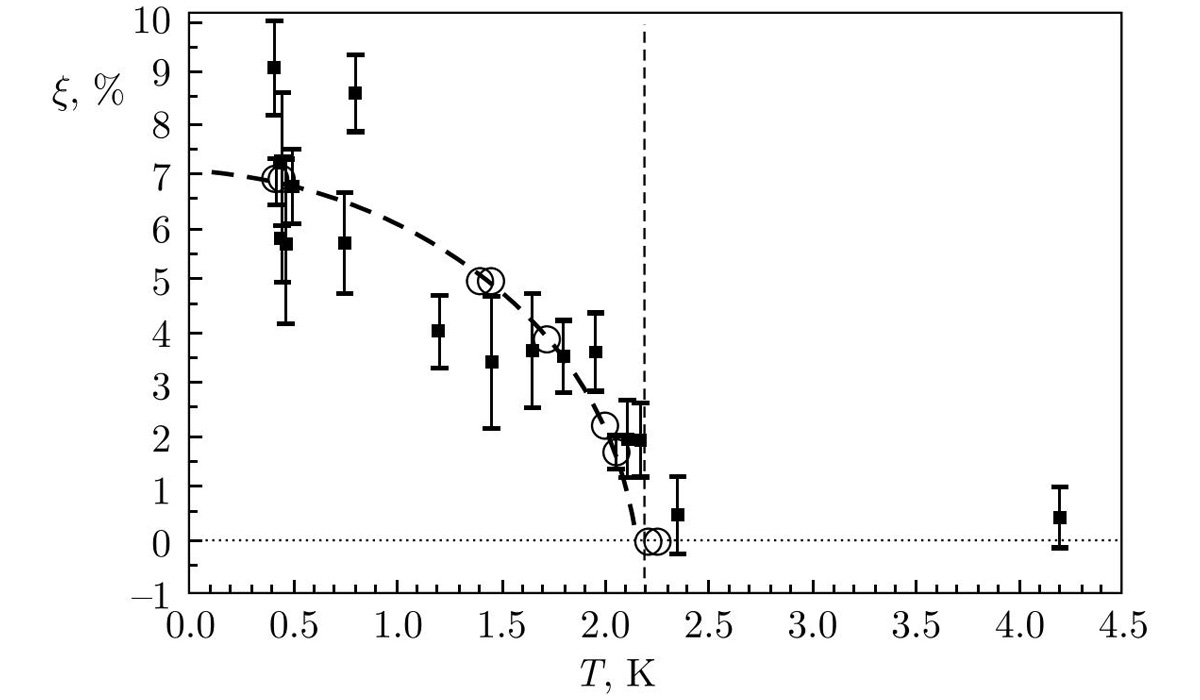
A century of the Bose–Einstein condensation concept and half a century of the JINR experiments for observation of condensate in superfluid 4He (He II)
This short review is devoted to the celebration of two major events in quantum physics. The first one is the birth of the concept of Bose–Einstein condensation (1925) and the second is the experimental proof that it does exist and appears in liquid 4 He simultaneously with superfluidity below the λ-point (1975). Both of these events are tightly related to the Bogoliubov theory of superfluidity (1947). The existence of condensate in the system of interacting bosons is the key ansatz of this theory. Therefore, the experiments started at JINR-Dubna in 1975 confirmed this prediction of the Bogoliubov theory that superfluidity of liquid 4 He (He II) should emerge at the same time as the Bose–Einstein condensation. Corrected: 13 November 2025 (the captions to Figures 1 and 2 were changed) 26 November 2025 (changes were made in formulas (53) and (55))