

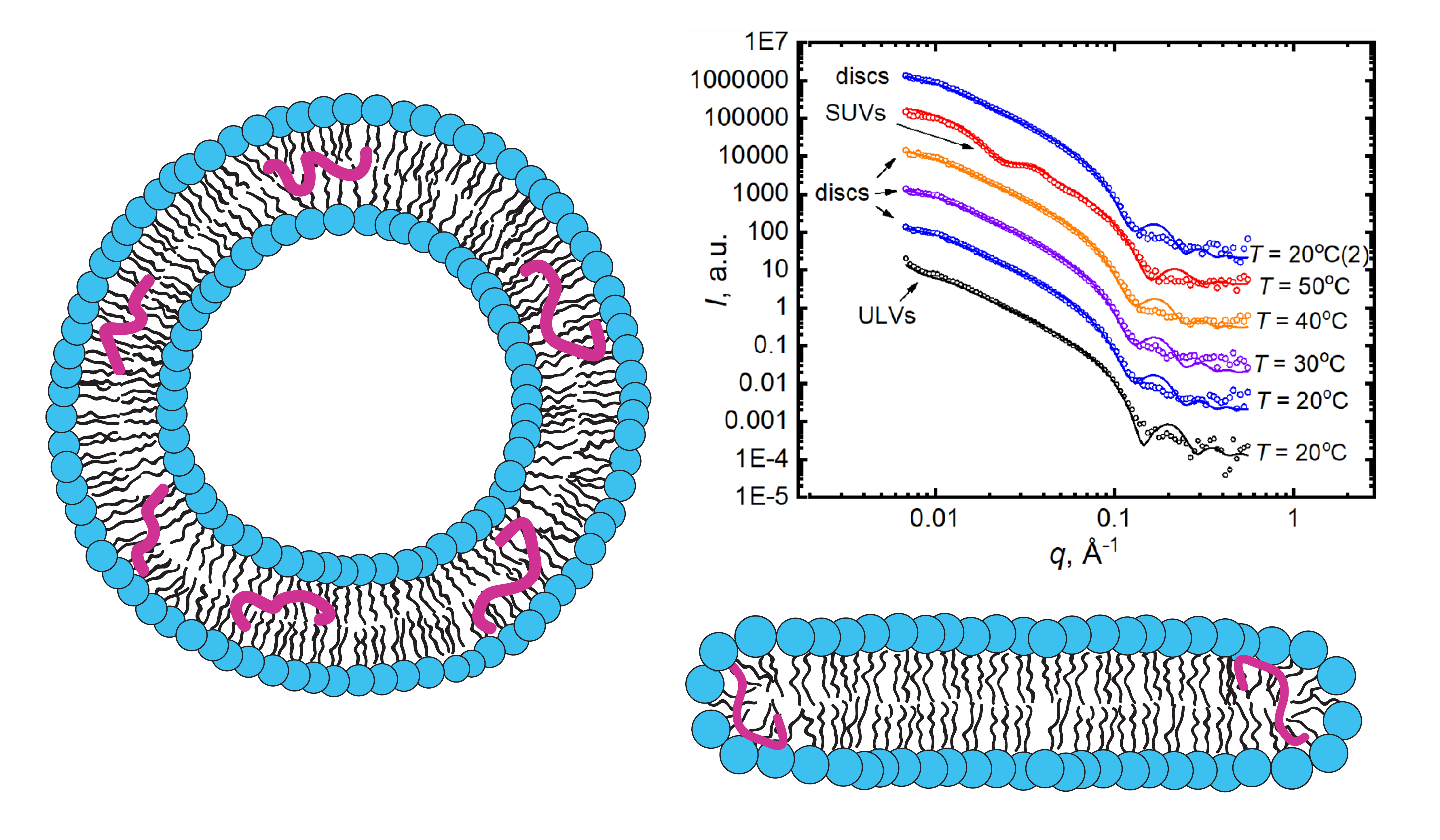
Abstract
The amyloid-beta peptide (Aβ peptide) is proposed to play a central role in the onset of Alzheimer’s disease (AD). The pathology is associated with the fast accumulation of neurotoxic amyloid aggregates in brain tissues, though the fundamentals of the disease’s progression remain unsolved. It is noted that the preclinical stage of AD may play a crucial role in its further irreversible development. Namely, interactions between lipid membranes and Aβ-peptide molecules incorporated therein at relatively low concentrations should be under a close attention. In this review, we discuss recent works devoted to studying the lipid peptide interactions with a specific focus on the lipid membrane reorganizations caused by Aβ (25–35) peptide in the preclinical AD mimicking conditions. The interactions observed are believed to be important in understanding the mechanisms of the Aβ-peptide destructive effects on lipid membranes and the corresponding onset of the disease. The methods of applied nuclear physics have proven remarkably relevant in such research. The scattering methods provided instrumental information on a level of supramolecular assemblies, while spectrometry allowed obtaining information on the molecular level. Finally, molecular dynamics simulations provided details unachievable by experimental approaches, though the validation role of the latter cannot be undermined. Altogether, the recent advances in research results prove these complementary approaches the most appropriate for tackling the complex issues of biomembrane interactions.
Acknowledgements
References
[1] M. A. DeTure, D. W. Dickson, The neuropathological diagnosis of Alzheimer’s disease, MolecularNeurodegeneration 14 (2019).https://doi.org/10.1186/s13024-019-0333-5.
[2] C. P. Ferri, M. Prince, C. Brayne, H. Brodaty, L. Fratiglioni, M. Ganguli, K. Hall, K. Hasegawa,H. Hendrie, Y. Huang, A. Jorm, C. Mathers, P. R. Menezes, E. Rimmer, M. Scazufca, Globalprevalence of dementia: A Delphi consensus study, The Lancet 366 (2005) 2112–2117.https://doi.org/10.1016/S0140-6736(05)67889-0.
[3] P. T. Francis, A. M. Palmer, M. Snape, G. K. Wilcock, The cholinergic hypothesis of Alzheimer’sdisease: A review of progress, Journal of Neurology, Neurosurgery & Psychiatry 66 (1999).https://doi.org/10.1136/jnnp.66.2.137.
[4] B. Frost, R. L. Jacks, M. I. Diamond, Propagation of tau misfolding from the outside to theinside of a cell, Journal of Biological Chemistry 284 (2009) 12845–12852.https://doi.org/10.1074/jbc.M808759200.
[5] J. A. Hardy, G. A. Higgins, Alzheimer’s disease: The amyloid cascade hypothesis, Science 256(1992) 184–185.https://doi.org/doi:10.1126/science.1566067.
[6] J. Hardy, D. Allsop, Amyloid deposition as the central event in the aetiology of Alzheimer’sdisease, Trends in Pharmacological Sciences 12 (1991) 383–388.https://doi.org/10.1016/0165-6147(91)90609-V.
[7] Y. Yang, D. Arseni, W. Zhang, M. Huang, S. L ̈ovestam, M. Schweighauser, A. Kotecha,A. G. Murzin, S. Y. Peak-Chew, J. Macdonald, I. Lavenir, H. J. Garringer, E. Gelpi, K. L. Newell,G. G. Kovacs, R. Vidal, B. Ghetti, B. Ryskeldi-Falcon, S. H. W. Scheres, M. Goedert, Cryo-EM structures of amyloid-β42 filaments from human brains, Science 375 (2022) 167–172.https://doi.org/10.1126/science.abm7285.
[8] Y. Yang, A. G. Murzin, S. Peak-Chew, C. Franco, H. J. Garringer, K. L. Newell, B. Ghetti,M. Goedert, S. H. W. Scheres, Cryo-EM structures of Aβ40 filaments from the leptomeningesof individuals with Alzheimer’s disease and cerebral amyloid angiopathy, Acta NeuropathologicaCommunications 11 (2023) 191.https://doi.org/10.1186/s40478-023-01694-8
[9] M. Kollmer, W. Close, L. Funk, J. Rasmussen, A. Bsoul, A. Schierhorn, M. Schmidt, C. J. Sigurd-son, M. Jucker, M. F ̈andrich, Cryo-EM structure and polymorphism of Aβamyloid fibrils purifiedfrom Alzheimer’s brain tissue, Nature Communications 10 (2019) 4760.https://doi.org/10.1038/s41467-019-12683-8.
[10] P. B. Pfeiffer, M. Ugrina, N. Schwierz, C. J. Sigurdson, M. Schmidt, M. F ̈andrich, Cryo-EManalysis of the effect of seeding with brain-derived Aβamyloid fibrils, Journal of MolecularBiology 436 (2024) 168422.https://doi.org/10.1016/j.jmb.2023.168422.
[11] B. Frieg, M. Han, K. Giller, C. Dienemann, D. Riedel, S. Becker, L. B. Andreas, C. Griesinger,G. F. Schr ̈oder, Cryo-EM structures of lipidic fibrils of amyloid-β(1–40), Nature Communications15 (2024) 1297.https://doi.org/10.1038/s41467-023-43822-x.
[12] L. Gremer, D. Sch ̈olzel, C. Schenk, E. Reinartz, J. Labahn, R. B. G. Ravelli, M. Tusche, C. Lopez-Iglesias, W. Hoyer, H. Heise, D. Willbold, G. F. Schr ̈oder, Fibril structure of amyloid-β(1–42)by cryo-electron microscopy, Science 358 (2017) 116–119.https://doi.org/10.1126/science.aao2825.
[13] M. P. Lambert, A. K. Barlow, B. A. Chromy, C. Edwards, R. Freed, M. Liosatos, T. E. Mor-gan, I. Rozovsky, B. Trommer, K. L. Viola, P. Wals, C. Zhang, C. E. Finch, G. A. Krafft,W. L. Klein, Diffusible, nonfibrillar ligands derived from Aβ1−42are potent central nervoussystem neurotoxins, Proceedings of the National Academy of Sciences 95 (1998) 6448–6453.https://doi.org/10.1073/pnas.95.11.6448.
[14] U. Sengupta, A. N. Nilson, R. Kayed, The role of amyloid-βoligomers in toxicity, propagation,and immunotherapy, eBioMedicine 6 (2016) 42–49.https://doi.org/10.1016/j.ebiom.2016.03.035.
[15] E. Y. Hayden, D. B. Teplow, Amyloidβ-protein oligomers and Alzheimer’s disease, Alzheimer’sResearch & Therapy 5 (2013) 60.https://doi.org/10.1186/alzrt226.
[16] S. Ghosh, R. Ali, S. Verma, Aβ-oligomers: A potential therapeutic target for Alzheimer’s disease,International Journal of Biological Macromolecules 239 (2023) 124231.https://doi.org/10.1016/j.ijbiomac.2023.124231.
[17] U. C. M ̈uller, T. Deller, M. Korte, Not just amyloid: Physiological functions of the amyloidprecursor protein family, Nature Reviews Neuroscience 18 (2017) 281–298.https://doi.org/10.1038/nrn.2017.29.
[18] G. Thinakaran, E. H. Koo, Amyloid precursor protein trafficking, processing, and function,Journal of Biological Chemistry 283 (2008) 29615–29619.https://doi.org/10.1074/jbc.R800019200.
[19] A. Martel, L. Antony, Y. Gerelli, L. Porcar, A. Fluitt, K. Hoffmann, I. Kiesel, M. Vivaudou,G. Fragneto, J. J. de Pablo, Membrane permeation versus amyloidogenicity: A multitechniquestudy of islet amyloid polypeptide interaction with model membranes, Journal of the AmericanChemical Society 139 (2017) 137–148.https://doi.org/10.1021/jacs.6b06985.
[20] T. Kubo, S. Nishimura, Y. Kumagae, I. Kaneko, In vivo conversion of racemizedβ-amyloid([D-Ser 26]Aβ1–40) to truncated and toxic fragments ([D-Ser 26]Aβ25–35/40) and fragmentpresence in the brains of Alzheimer’s patients, Journal of Neuroscience Research 70 (2002) 474–483.https://doi.org/10.1002/jnr.10391.
[21] G.-f. Chen, T.-H. Xu, Y. Yan, Y.-R. Zhou, Y. Jiang, K. Melcher, H. E. Xu, Amyloid beta:Structure, biology and structure-based therapeutic development, Acta Pharmacologica Sinica 38(2017) 1205–1235.https://doi.org/10.1038/aps.2017.28.
[22] L. Millucci, R. Raggiaschi, D. Franceschini, G. Terstappen, A. Santucci, Rapid aggregation andassembly in aqueous solution of Aβ(25–35) peptide, Journal of Biosciences 34 (2009) 293–303.https://doi.org/10.1007/s12038-009-0033-3.
[23] A. Cardinale, M. Racaniello, S. Saladini, G. De Chiara, C. Mollinari, M. C. de Stefano,M. Pocchiari, E. Garaci, D. Merlo, Sublethal doses ofβ-amyloid peptide abrogate DNA-dependent protein kinase activity, Journal of Biological Chemistry 287 (2012) 2618–2631.https://doi.org/10.1074/jbc.M111.276550.
[24] R. L. Frozza, A. P. Horn, J. B. Hoppe, F. Sim ̃ao, D. Gerhardt, R. A. Comiran, C. G. Sal-bego, A comparative study ofβ-amyloid peptides Aβ1–42 and Aβ25–35 toxicity in organotypichippocampal slice cultures, Neurochemical Research 34 (2009) 295–303.https://doi.org/10.1007/s11064-008-9776-8.
[25] R. Ren, Y. Zhang, B. Li, Y. Wu, B. Li, Effect ofβ-amyloid (25–35) on mitochondrial function andexpression of mitochondrial permeability transition pore proteins in rat hippocampal neurons,Journal of Cellular Biochemistry 112 (2011) 1450–1457.https://doi.org/10.1002/jcb.23062.
[26] J. Kang, H.-G. Lemaire, A. Unterbeck, J. M. Salbaum, C. L. Masters, K.-H. Grzeschik,G. Multhaup, K. Beyreuther, B. M ̈uller-Hill, The precursor of Alzheimer’s disease amyloid A4protein resembles a cell-surface receptor, Nature 325 (1987) 733–736.https://doi.org/10.1038/325733a0.
[27] L. Millucci, L. Ghezzi, G. Bernardini, A. Santucci, Conformations and biological activities ofamyloid beta peptide 25–35, Current Protein & Peptide Science 11 (2010) 54–67.http://dx.doi.org/10.2174/138920310790274626.
[28] C. J. Pike, D. Burdick, A. J. Walencewicz, C. G. Glabe, C. W. Cotman, Neurodegenerationinduced by beta-amyloid peptides in vitro: The role of peptide assembly state, The Journal ofNeuroscience 13 (1993) 1676.https://doi.org/10.1523/JNEUROSCI.13-04-01676.1993.
[29] M. Naldi, J. Fiori, M. Pistolozzi, A. F. Drake, C. Bertucci, R. Wu, K. Mlynarczyk, S. Filipek,A. De Simone, V. Andrisano, Amyloidβ-peptide 25–35 self-assembly and its inhibition: A modelundecapeptide system to gain atomistic and secondary structure details of the Alzheimer’s diseaseprocess and treatment, ACS Chemical Neuroscience 3 (2012) 952–962.https://doi.org/10.1021/cn3000982.
[30] J. Liu, J. Yang, Mitochondria-associated membranes: A hub for neurodegenerative diseases,Biomedicine & Pharmacotherapy 149 (2022) 112890.https://doi.org/10.1016/j.biopha.2022.112890.
[31] M. F. M. Sciacca, C. La Rosa, D. Milardi, Amyloid-mediated mechanisms of membrane disrup-tion, Biophysica 1 (2021) 137–156.https://doi.org/10.3390/biophysica1020011.
[32] J. M. Sanderson, The association of lipids with amyloid fibrils, Journal of Biological Chemistry298 (2022).https://doi.org/10.1016/j.jbc.2022.102108.
[33] T. Heimburg, Mechanical aspects of membrane thermodynamics. Estimation of the mechanicalproperties of lipid membranes close to the chain melting transition from calorimetry, Biochimicaet Biophysica Acta (BBA) — Biomembranes 1415 (1998) 147–162.https://doi.org/10.1016/S0005-2736(98)00189-8.
[34] M. R. Krause, S. L. Regen, The structural role of cholesterol in cell membranes: From condensedbilayers to lipid rafts, Accounts of Chemical Research 47 (2014) 3512–3521.https://doi.org/10.1021/ar500260t.
[35] E. Drolle, N. Kuˇcerka, M. I. Hoopes, Y. Choi, J. Katsaras, M. Karttunen, Z. Leonenko, Effectof melatonin and cholesterol on the structure of DOPC and DPPC membranes, Biochimica etBiophysica Acta (BBA) — Biomembranes 1828 (2013) 2247–2254.https://doi.org/10.1016/j.bbamem.2013.05.015.
[36] T. Kondela, E. Dushanov, M. Vorobyeva, K. Mamatkulov, E. Drolle, D. Soloviov, P. Hrubovˇc ́ak,K. Kholmurodov, G. Arzumanyan, Z. Leonenko, N. Kuˇcerka, Investigating the competitive effectsof cholesterol and melatonin in model lipid membranes, Biochimica et Biophysica Acta (BBA) —Biomembranes 1863 (2021) 183651.https://doi.org/10.1016/j.bbamem.2021.183651.
[37] D. Uhr ́ıkov ́a, N. Kuˇcerka, J. Teixeira, V. Gordeliy, P. Balgavy, Structural changes in dipalmi-toylphosphatidylcholine bilayer promoted by Ca2+ions: A small-angle neutron scattering study,Chemistry and Physics of Lipids 155 (2008) 80–89.https://doi.org/10.1016/j.chemphyslip.2008.07.010.
[38] N. Kuˇcerka, E. Ermakova, E. Dushanov, K. T. Kholmurodov, S. Kurakin, K.ˇZelinsk ́a,D. Uhr ́ıkov ́a, Cation–zwitterionic lipid interactions are affected by the lateral area per lipid,Langmuir 37 (2021) 278–288.https://doi.org/10.1021/acs.langmuir.0c02876.
[39] H. Binder, O. Zschornig, The effect of metal cations on the phase behavior and hydrationcharacteristics of phospholipid membranes, Chemistry and Physics of Lipids 115 (2002) 39–61.https://doi.org/10.1016/s0009-3084(02)00005-1
[40] H.-T. Cheng, Megha, E. London, Preparation and properties of asymmetric vesicles that mimiccell membranes, Journal of Biological Chemistry 284 (2009) 6079–6092.https://doi.org/10.1074/jbc.M806077200.
[41] T. Hornemann, Mini review: Lipids in peripheral nerve disorders, Neuroscience Letters 740(2021) 135455.https://doi.org/10.1016/j.neulet.2020.135455.
[42] P. R. Cullis, M. J. Hope, Chapter 1: Physical properties and functional roles of lipids in mem-branes, in: D. E. Vance, J. E. Vance (Eds.), New Comprehensive Biochemistry, Elsevier, 1991,pp. 1–41.https://doi.org/10.1016/S0167-7306(08)60329-4.
[43] M. S ̈oderberg, C. Edlund, K. Kristensson, G. Dallner, Fatty acid composition of brain phos-pholipids in aging and in Alzheimer’s disease, Lipids 26 (1991) 421–425.https://doi.org/10.1007/bf02536067.
[44] M. Mart ́ınez, I. Mougan, Fatty acid composition of human brain phospholipids during normaldevelopment, Journal of Neurochemistry 71 (1998) 2528–2533.https://doi.org/10.1046/j.1471-4159.1998.71062528.x.
[45] M. Neuringer, G. J. Anderson, W. E. Connor, The essentiality of N-3 fatty acids for the de-velopment and function of the retina and brain, Annual Review of Nutrition 8 (1988) 517–541.https://doi.org/10.1146/annurev.nu.08.070188.002505.
[46] Z. Z. Guan, M. S ̈oderberg, P. Sindelar, C. Edlund, Content and fatty acid composition of cardi-olipin in the brain of patients with Alzheimer’s disease, Neurochemistry International 25 (1994)295–300.https://doi.org/10.1016/0197-0186(94)90073-6.
[47] Y.-C. Kao, P.-C. Ho, Y.-K. Tu, I.-M. Jou, K.-J. Tsai, Lipids and Alzheimer’s disease, Interna-tional Journal of Molecular Sciences 21 (2020) 1505.https://doi.org/10.3390/ijms21041505.
[48] K. Simons, D. Toomre, Lipid rafts and signal transduction, Nature Reviews Molecular CellBiology 1 (2000) 31–39.https://doi.org/10.1038/35036052.
[49] C. Fabiani, S. S. Antollini, Alzheimer’s disease as a membrane disorder: Spatial cross-talk amongbeta-amyloid peptides, nicotinic acetylcholine receptors and lipid rafts, Frontiers in CellularNeuroscience 13 (2019) 13:309.https://doi.org/10.3389/fncel.2019.00309.
[50] S. Grassi, P. Giussani, L. Mauri, S. Prioni, S. Sonnino, A. Prinetti, Lipid rafts and neurode-generation: Structural and functional roles in physiologic aging and neurodegenerative diseases,Journal of Lipid Research 61 (2020) 636–654.https://doi.org/10.1194/jlr.TR119000427.
[51] V. Rudajev, J. Novotny, Cholesterol as a key player in amyloidβ-mediated toxicity in Alzheimer’sdisease, Frontiers in Molecular Neuroscience 15 (2022) 15:937056.https://doi.org/10.3389/fnmol.2022.937056.
[52] M. D ́ıaz, N. Fabelo, I. Ferrer, R. Mar ́ın, “Lipid raft aging” in the human frontal cortex during non-pathological aging: Gender influences and potential implications in Alzheimer’s disease, Neurobi-ology of Aging 67 (2018) 42–52.https://doi.org/10.1016/j.neurobiolaging.2018.02.022.
[53] M. D ́ıaz, N. Fabelo, V. Mart ́ın, I. Ferrer, T. G ́omez, R. Mar ́ın, Biophysical alterations in lipidrafts from human cerebral cortex associate with increased BACE1/AβPP interaction in earlystages of Alzheimer’s disease, Journal of Alzheimer’s Disease 43 (2015) 1185–1198.https://doi.org/10.3233/jad-141146.
[54] M. Cerasuolo, I. Di Meo, M. C. Auriemma, G. Paolisso, M. Papa, M. R. Rizzo, Exploring thedynamic changes of brain lipids, lipid rafts, and lipid droplets in aging and Alzheimer’s disease,Biomolecules 14 (2024) 1362.https://doi.org/10.3390/biom14111362.
[55] A. E. Abdallah, Review on anti-Alzheimer drug development: Approaches, challenges and per-spectives, RSC Advances 14 (2024) 11057–11088.https://doi.org/10.1039/D3RA08333K.
[56] M. Jung, S. Lee, S. Park, J. Hong, C. Kim, I. Cho, H. S. Sohn, K. Kim, I. W. Park, S. Yoon,S. Kwon, J. Shin, D. Lee, M. Kang, S. Go, S. Moon, Y. Chung, Y. Kim, B.-S. Kim, A therapeuticnanovaccine that generates anti-amyloid antibodies and amyloid-specific regulatory T cells forAlzheimer’s disease, Advanced Materials 35 (2023) 2207719.https://doi.org/10.1002/adma.202207719.
[57] C. H. van Dyck, Anti-amyloid-βmonoclonal antibodies for Alzheimer’s disease: Pitfalls andpromise, Biological Psychiatry 83 (2018) 311–319.https://doi.org/10.1016/j.biopsych.2017.08.010.
[58] H. Yang, S.-Y. Park, H. Baek, C. Lee, G. Chung, X. Liu, J. H. Lee, B. Kim, M. Kwon, H. Choi,H. J. Kim, J. Y. Kim, Y. Kim, Y.-S. Lee, G. Lee, S. K. Kim, J. S. Kim, Y.-T. Chang, W. S. Jung,K. H. Kim, H. Bae, Adoptive therapy with amyloid-βspecific regulatory T cells alleviatesAlzheimer’s disease, Theranostics 12 (2022) 7668–7680.https://doi.org/10.7150/thno.75965.
[59] F. Mantile, A. Prisco, Vaccination againstβ-amyloid as a strategy for the prevention ofAlzheimer’s disease, Biology 9 (2020) 425.https://doi.org/10.3390/biology9120425.
[60] D. Lee, G. Lee, D. S. Yoon, Anti-Aβdrug candidates in clinical trials and plasmonic nanoparticle-based drug-screen for Alzheimer’s disease, Analyst 143 (2018) 2204–2212.https://doi.org/10.1039/C7AN02013A.
[61] K. Hou, J. Zhao, H. Wang, B. Li, K. Li, X. Shi, K. Wan, J. Ai, J. Lv, D. Wang, Q. Huang,H. Wang, Q. Cao, S. Liu, Z. Tang, Chiral gold nanoparticles enantioselectively rescue memorydeficits in a mouse model of Alzheimer’s disease, Nature Communications 11 (2020) 4790.https://doi.org/10.1038/s41467-020-18525-2.
[62] K. Z. Mamatkulov, H. A. Esawii, G. M. Arzumanyan, Photon and neutron-based techniquesfor studying membrane dynamics and protein aggregation in lipid–protein interactions, NaturalScience Review 1 (2024).https://nsr-jinr.ru/index.php/nsr/article/view/20.
[63] A. Buchsteiner, T. Hauβ, S. Dante, N. A. Dencher, Alzheimer’s disease amyloid-βpeptideanalogue alters the ps-dynamics of phospholipid membranes, Biochimica et Biophysica Acta(BBA) — Biomembranes 1798 (2010) 1969–1976.https://doi.org/10.1016/j.bbamem.2010.06.024.
[64] A. Buchsteiner, T. Hauß, N. A. Dencher, Influence of amyloid-βpeptides with different lengthsand amino acid sequences on the lateral diffusion of lipids in model membranes, Soft Matter 8(2012) 424–429.https://doi.org/10.1039/C1SM06823G.
[65] S. Dante, T. Hauß, A. Brandt, N. A. Dencher, Membrane fusogenic activity of the Alzheimer’speptide Aβ(1–42) demonstrated by small-angle neutron scattering, Journal of Molecular Biology376 (2008) 393–404.https://doi.org/10.1016/j.jmb.2007.11.076.
[66] T. Kohno, K. Kobayashi, T. Maeda, K. Sato, A. Takashima, Three-dimensional structures ofthe amyloidβpeptide (25–35) in membrane-mimicking environment, Biochemistry 35 (1996)16094–16104.https://doi.org/10.1021/bi961598j.
[67] R. P. Mason, J. D. Estermyer, J. F. Kelly, P. E. Mason, Alzheimer’s disease amyloidβpeptide25–35 is localized in the membrane hydrocarbon core: X-ray diffraction analysis, Biochemicaland Biophysical Research Communications 222 (1996) 78–82.https://doi.org/10.1006/bbrc.1996.0699.
[68] S. Dante, T. Hauss, N.A. Dencher, Insertion of externally administered amyloidβpeptide 25–35and perturbation of lipid bilayers, Biochemistry 42 (2003) 13667–13672.https://doi.org/10.1021/bi035056v.
[69] A. K. Smith, D. K. Klimov, Binding of cytotoxic Aβ25–35 peptide to the dimyristoylphos-phatidylcholine lipid bilayer, Journal of Chemical Information and Modeling 58 (2018) 1053–1065.https://doi.org/10.1021/acs.jcim.8b00045.
[70] E. Terzi, G. Hoelzemann, J. Seelig, Alzheimerβ-amyloid peptide 25–35: Electrostatic interactionswith phospholipid membranes, Biochemistry 33 (1994) 7434–7441.https://doi.org/10.1021/bi00189a051.
[71] H. Dies, L. Toppozini, M. C. Rheinst ̈adter, The interaction between amyloid-βpeptides andanionic lipid membranes containing cholesterol and melatonin, PLOS ONE 9 (2014) e99124.https://doi.org/10.1371/journal.pone.0099124.
[72] I. Ermilova, A. P. Lyubartsev, Modelling of interactions between Aβ(25–35) peptide and phos-pholipid bilayers: Effects of cholesterol and lipid saturation, RSC Advances 10 (2020) 3902–3915.https://doi.org/10.1039/C9RA06424A.
[73] T.-L. Lau, J. D. Gehman, J. D. Wade, K. Perez, C. L. Masters, K. J. Barnham, F. Separovic,Membrane interactions and the effect of metal ions of the amyloidogenic fragment Aβ(25–35) incomparison to Aβ(1–42), Biochimica et Biophysica Acta (BBA) — Biomembranes 1768 (2007)2400–2408.https://doi.org/10.1016/j.bbamem.2007.05.004.
[74] H.-H. G. Tsai, J.-B. Lee, Y.-C. Shih, L. Wan, F.-K. Shieh, C.-Y. Chen, Location and conformationof amyloidβ(25–35) peptide and its sequence-shuffled peptides within membranes: Implicationsfor aggregation and toxicity in PC12 cells, ChemMedChem 9 (2014) 1002–1011.https://doi.org/10.1002/cmdc.201400062.
[75] A. Cuco, A. P. Serro, J. P. Farinha, B. Saramago, A. G. da Silva, Interaction of the AlzheimerAβ(25–35) peptide segment with model membranes, Colloids and Surfaces B: Biointerfaces 141(2016) 10–18.https://doi.org/10.1016/j.colsurfb.2016.01.015.
[76] M. S. Saponetti, M. Grimaldi, M. Scrima, C. Albonetti, S. L. Nori, A. Cucolo, F. Bobba,A. M. D’Ursi, Aggregation of Aβ(25–35) on DOPC and DOPC/DHA bilayers: An atomic forcemicroscopy study, PLOS ONE 9 (2015) e115780.https://doi.org/10.1371/journal.pone.0115780.
[79] C. Peters, D. Bascu ̃n ́an, C. Opazo, L. G. Aguayo, Differential membrane toxicity of amyloid-βfragments by pore forming mechanisms, Journal of Alzheimer’s Disease 51 (2016) 689–699.https://doi.org/10.3233/jad-150896.
[80] M.-c. A. Lin, B. L. Kagan, Electrophysiologic properties of channels induced by Aβ25−35in pla-nar lipid bilayers, Peptides 23 (2002) 1215–1228.https://doi.org/10.1016/S0196-9781(02)00057-8.
[81] C. Di Scala, H. Chahinian, N. Yahi, N. Garmy, J. Fantini, Interaction of Alzheimer’sβ-amyloidpeptides with cholesterol: Mechanistic insights into amyloid pore formation, Biochemistry 53(2014) 4489–4502.https://doi.org/10.1021/bi500373k.
[82] N. Kandel, J. O. Matos, S. A. Tatulian, Structure of amyloidβ25−35in lipid environment andcholesterol-dependent membrane pore formation, Scientific Reports 9 (2019) 2689.https://doi.org/10.1038/s41598-019-38749-7.
[83] J. F. Nagle, S. Tristram-Nagle, Structure of lipid bilayers, Biochimica et Biophysica Acta 1469(2000) 159–195.https://doi.org/10.1016/s0304-4157(00)00016-2.
[84] O. Ivankov, T. N. Murugova, E. V. Ermakova, T. Kondela, D. R. Badreeva, P. Hrubovˇc ́ak,D. Soloviov, A. Tsarenko, A. Rogachev, A. I. Kuklin, N. Kuˇcerka, Amyloid-beta peptide (25–35)triggers a reorganization of lipid membranes driven by temperature changes, Scientific Reports11 (2021) 21990.https://doi.org/10.1038/s41598-021-01347-7.
[85] N. Kuˇcerka, J. Pencer, J. N. Sachs, J. F. Nagle, J. Katsaras, Curvature effect on the structure ofphospholipid bilayers, Langmuir 23 (2007) 1292–1299.https://doi.org/10.1021/la062455t.
[86] H. Schmiedel, L. Alm ́asy, G. Klose, Multilamellarity, structure and hydration of extruded POPCvesicles by SANS, European Biophysics Journal 35 (2006) 181–189.https://doi.org/10.1007/s00249-005-0015-9.
[87] S. Kurakin, O. Ivankov, E. Dushanov, T. Murugova, E. Ermakova, S. Efimov, T. Mukhamet-zyanov, S. Smerdova, V. Klochkov, A. Kuklin, N. Kuˇcerka, Calcium ions do not influencethe Aβ(25–35) triggered morphological changes of lipid membranes, Biophysical Chemistry 313(2024) 107292.https://doi.org/10.1016/j.bpc.2024.107292.
[88] M. N. Triba, D. E. Warschawski, P. F. Devaux, Reinvestigation by phosphorus NMR of lipiddistribution in bicelles, Biophysical Journal 88 (2005) 1887–1901.https://doi.org/10.1529/biophysj.104.055061.
[89] S. Mahabir, D. Small, M. Li, W. Wan, N. Kuˇcerka, K. Littrell, J. Katsaras, M.-P. Nieh, Growthkinetics of lipid-based nanodiscs to unilamellar vesicles — A time-resolved small angle neutronscattering (SANS) study, Biochimica et Biophysica Acta (BBA) — Biomembranes 1828 (2013)1025–1035.https://doi.org/10.1016/j.bbamem.2012.11.002.
[90] D. Otten, L. L ̈obbecke, K. Beyer, Stages of the bilayer-micelle transition in the systemphosphatidylcholine-C12E8 as studied by deuterium- and phosphorous-NMR, light scatter-ing, and calorimetry, Biophysical Journal 68 (1995) 584–597.https://doi.org/10.1016/S0006-3495(95)80220-1.
[91] S. S. Funari, B. Nuscher, G. Rapp, K. Beyer, Detergent-phospholipid mixed micelles with acrystalline phospholipid core, Proceedings of the National Academy of Sciences 98 (2001) 8938–8943.https://doi.org/10.1073/pnas.161160998.
[92] C. Dargel, Y. Hannappel, T. Hellweg, Heating-induced DMPC/glycyrrhizin bicelle-to-vesicletransition: A X-ray contrast variation study, Biophysical Journal 118 (2020) 2411–2425.https://doi.org/10.1016/j.bpj.2020.03.022.
[93] C. Dargel, L. H. Moleiro, A. Radulescu, T. J. Stank, T. Hellweg, Decomposition of mixed DMPC-aescin vesicles to bicelles is linked to the lipid’s main phase transition: A direct evidence by usingchain-deuterated lipid, Journal of Colloid and Interface Science 679 (2025) 209–220.https://doi.org/10.1016/j.jcis.2024.10.074.
[77] J. Tang, R. J. Alsop, M. Backholm, H. Dies, A.-C. Shi, M. C. Rheinst ̈adter, Amyloid-β25−35peptides aggregate into cross-βsheets in unsaturated anionic lipid membranes at high peptideconcentrations, Soft Matter 12 (2016) 3165–3176.https://doi.org/10.1039/C5SM02619A.
[78] A. Khondker, R. J. Alsop, S. Himbert, J. Tang, A.-C. Shi, A. P. Hitchcock, M. C. Rheinst ̈adter,Membrane-modulating drugs can affect the size of amyloid-β25−35aggregates in anionic mem-branes, Scientific Reports 8 (2018) 12367.https://doi.org/10.1038/s41598-018-30431-8.
[94] E. J. Dufourc, J.-F. Faucon, G. Fourche, J. Dufourcq, T. Gulik-Krzywicki, M. le Maire, Re-versible disc-to-vesicle transition of melittin-DPPC complexes triggered by the phospholipid acylchain melting, FEBS Letters 201 (1986) 205–209.https://doi.org/10.1016/0014-5793(86)80609-3.
[95] J. Dufourcq, J.-F. Faucon, G. Fourche, J.-L. Dasseux, M. Le Maire, T. Gulik-Krzywicki, Mor-phological changes of phosphatidylcholine bilayers induced by melittin: Vesicularization, fusion,discoidal particles, Biochimica et Biophysica Acta (BBA) — Biomembranes 859 (1986) 33–48.https://doi.org/10.1016/0005-2736(86)90315-9.
[96] T. Pott, E. J. Dufourc, Action of melittin on the DPPC-cholesterol liquid-ordered phase: A solidstate2H- and31P-NMR study, Biophysical Journal 68 (1995) 965–977.https://doi.org/10.1016/S0006-3495(95)80272-9.
[97] T. Pott, M. Paternostre, E. J. Dufourc, A comparative study of the action of melittin on sphin-gomyelin and phosphatidylcholine bilayers, European Biophysics Journal 27 (1998) 237–245.https://doi.org/10.1007/s002490050130.
[98] T. Wang, M. Hong, Investigation of the curvature induction and membrane localization of theinfluenza virus M2 protein using static and off-magic-angle spinning solid-state nuclear magneticresonance of oriented bicelles, Biochemistry 54 (2015) 2214–2226.https://doi.org/10.1021/acs.biochem.5b00127.
[99] C. Anada, K. Ikeda, A. Egawa, T. Fujiwara, H. Nakao, M. Nakano, Temperature- andcomposition-dependent conformational transitions of amphipathic peptide–phospholipid nan-odiscs, Journal of Colloid and Interface Science 588 (2021) 522–530.https://doi.org/10.1016/j.jcis.2020.12.090.
[100] Y. Miyazaki, W. Shinoda, Cooperative antimicrobial action of melittin on lipid membranes:A coarse-grained molecular dynamics study, Biochimica et Biophysica Acta (BBA) — Biomem-branes 1864 (2022) 183955.https://doi.org/10.1016/j.bbamem.2022.183955.
[101] S. J. Soscia, J. E. Kirby, K. J. Washicosky, S. M. Tucker, M. Ingelsson, B. Hyman, M. A. Burton,L. E. Goldstein, S. Duong, R. E. Tanzi, R. D. Moir, The Alzheimer’s disease-associated amyloidβ-protein is an antimicrobial peptide, PLOS ONE 5 (2010) e9505.https://doi.org/10.1371/journal.pone.0009505.
[102] A. Surguchov,α-Synuclein and mechanisms of epigenetic regulation, Brain Sciences 13 (2023)150.https://doi.org/10.3390/brainsci13010150.
[103] J. F. Nagle, Theory of the main lipid bilayer phase transition, Annual Review of Physical Chem-istry 31 (1980) 157–196.https://doi.org/10.1146/annurev.pc.31.100180.001105.
[104] R. Koynova, M. Caffrey, Phases and phase transitions of the phosphatidylcholines, Biochimicaet Biophysica Acta 1376 (1998) 91–145.https://doi.org/10.1016/s0304-4157(98)00006-9.
[105] R. Koynova, B. Tenchov, Phase transitions and phase behavior of lipids, in: G. C. K. Roberts(Ed.), Encyclopedia of Biophysics, Springer, Berlin, Heidelberg, 2013, pp. 1841–1854.https://doi.org/10.1007/978-3-642-16712-6_542.
[106] W. J. Sun, S. Tristram-Nagle, R. M. Suter, J. F. Nagle, Structure of the ripple phase in lecithinbilayers, Proceedings of the National Academy of Sciences 93 (1996) 7008–7012.https://doi.org/10.1073/pnas.93.14.7008.
[107] T. Heimburg, A model for the lipid pretransition: Coupling of ripple formation with thechain-melting transition, Biophysical Journal 78 (2000) 1154–1165.https://doi.org/10.1016/S0006-3495(00)76673-2.[108] K. Akabori, J. F. Nagle, Structure of the DMPC lipid bilayer ripple phase, Soft Matter 11 (2015)918–926.https://doi.org/10.1039/C4SM02335H.
[109] M. Davies, A.D. Reyes-Figueroa, A. A. Gurtovenko, D. Frankel, M. Karttunen, Elucidating lipidconformations in the ripple phase: Machine learning reveals four lipid populations, BiophysicalJournal 122 (2023) 442–450.https://doi.org/10.1016/j.bpj.2022.11.024.
[110] M. Yoda, T. Miura, H. Takeuchi, Non-electrostatic binding and self-association of amyloidβ-peptide on the surface of tightly packed phosphatidylcholine membranes, Biochemical and Bio-physical Research Communications 376 (2008) 56–59.https://doi.org/10.1016/j.bbrc.2008.08.093.
[111] D. M. Walsh, D. M. Hartley, Y. Kusumoto, Y. Fezoui, M. M. Condron, A. Lomakin, G. B. Bene-dek, D. J. Selkoe, D. B. Teplow, Amyloid beta-protein fibrillogenesis: Structure and biologicalactivity of protofibrillar intermediates, Journal of Biological Chemistry 274 (1999) 25945–25952.https://doi.org/10.1074/jbc.274.36.25945.
[112] M. D. Kirkitadze, M. M. Condron, D. B. Teplow, Identification and characterization of key kineticintermediates in amyloidβ-protein fibrillogenesis, Edited by F. Cohen, Journal of MolecularBiology 312 (2001) 1103–1119.https://doi.org/10.1006/jmbi.2001.4970.
[113] E. Khayat, D. K. Klimov, A. K. Smith, Phosphorylation promotes Aβ25–35 peptide aggregationwithin the DMPC bilayer, ACS Chemical Neuroscience 11 (2020) 3430–3441.https://doi.org/10.1021/acschemneuro.0c00541.
[114] E. Khayat, C. Lockhart, B. M. Delfing, A. K. Smith, D. K. Klimov, Met35 oxidation hindersAβ25–35 peptide aggregation within the dimyristoylphosphatidylcholine bilayer, ACS ChemicalNeuroscience 12 (2021) 3225–3236.https://doi.org/10.1021/acschemneuro.1c00407.
[115] K. J. Korshavn, A. Bhunia, M. H. Lim, A. Ramamoorthy, Amyloid-βadopts a conserved, par-tially folded structure upon binding to zwitterionic lipid bilayers prior to amyloid formation,Chemical Communications 52 (2016) 882–885.https://doi.org/10.1039/C5CC08634E.
[116] H. Fatafta, B. Kav, B. F. Bundschuh, J. Loschwitz, B. Strodel, Disorder-to-order transition ofthe amyloid-βpeptide upon lipid binding, Biophysical Chemistry 280 (2022) 106700.https://doi.org/10.1016/j.bpc.2021.106700.
[117] P. T. Lansbury, Evolution of amyloid: What normal protein folding may tell us about fibril-logenesis and disease, Proceedings of the National Academy of Sciences 96 (1999) 3342–3344.https://doi.org/10.1073/pnas.96.7.3342.
[118] M.-A. Sani, F. Separovic, How membrane-active peptides get into lipid membranes, Accounts ofChemical Research 49 (2016) 1130–1138.https://doi.org/10.1021/acs.accounts.6b00074.
[119] H. M. Brothers, M. L. Gosztyla, S. R. Robinson, The physiological roles of amyloid-βpeptidehint at new ways to treat Alzheimer’s disease, Frontiers in Aging Neuroscience 10 (2018).https://doi.org/10.3389/fnagi.2018.00118.
[120] H. A. Pearson, C. Peers, Physiological roles for amyloidβpeptides, The Journal of Physiology575 (2006) 5–10.https://doi.org/10.1113/jphysiol.2006.111203.
[121] A. E. Roher, C. L. Esh, T. A. Kokjohn, E. M. Casta ̃no, G. D. Van Vickle, W. M. Kalback,R. L. Patton, D. C. Luehrs, I. D. Daugs, Y.-M. Kuo, M. R. Emmerling, H. Soares, J. F. Quinn,J. Kaye, D. J. Connor, N. B. Silverberg, C. H. Adler, J. D. Seward, T. G. Beach, M. N. Sabbagh,Amyloid beta peptides in human plasma and tissues and their significance for Alzheimer’s disease,Alzheimer’s & Dementia 5 (2009) 18–29.https://doi.org/10.1016/j.jalz.2008.10.004.
[122] V. Dubois, D. Serrano, S. Seeger, Amyloid-βpeptide–lipid bilayer interaction investigated bysupercritical angle fluorescence, ACS Chemical Neuroscience 10 (2019) 4776–4786.https://doi.org/10.1021/acschemneuro.9b00264.
[123] R. van Deventer, Y. L. Lyubchenko, Damage of the phospholipid bilayer by Aβ42 at physiolog-ically relevant peptide concentrations, ACS Chemical Neuroscience (2024).https://doi.org/10.1021/acschemneuro.4c00647.
[124] A. G. Lee, How lipids affect the activities of integral membrane proteins, Biochimica et BiophysicaActa (BBA) — Biomembranes 1666 (2004) 62–87.https://doi.org/10.1016/j.bbamem.2004.05.012.
[125] P. Xie, H. Zhang, Y. Qin, H. Xiong, C. Shi, Z. Zhou, Membrane proteins and membrane curva-ture: Mutual interactions and a perspective on disease treatments, Biomolecules 13 (2023) 1772.https://doi.org/10.3390/biom13121772.
[126] H. T. McMahon, J. L. Gallop, Membrane curvature and mechanisms of dynamic cell membraneremodelling, Nature 438 (2005) 590–596.https://doi.org/10.1038/nature04396.
[127] N. C. Kegulian, S. Sankhagowit, M. Apostolidou, S. A. Jayasinghe, N. Malmstadt, P. C. But-ler, R. Langen, Membrane curvature-sensing and curvature-inducing activity of islet amyloidpolypeptide and its implications for membrane disruption, Journal of Biological Chemistry 290(2015) 25782–25793.https://doi.org/10.1074/jbc.M115.659797.
[128] S. Kurakin, D. Badreeva, E. Dushanov, A. Shutikov, S. Efimov, A. Timerova, T. Mukhamet-zyanov, T. Murugova, O. Ivankov, K. Mamatkulov, G. Arzumanyan, V. Klochkov, N. Kuˇcerka,Arrangement of lipid vesicles and bicelle-like structures formed in the presence of Aβ(25–35) peptide, Biochimica et Biophysica Acta (BBA) — Biomembranes 1866 (2024) 184237.https://doi.org/10.1016/j.bbamem.2023.184237.
[129] J. Schiller, M. Muller, B. Fuchs, K. Arnold, D. Huster, 31P NMR spectroscopy of phospholipids:From micelles to membranes, Current Analytical Chemistry 3 (2007) 283–301.http://dx.doi.org/10.2174/157341107782109635.
[130] D. Huster, Solid-state NMR spectroscopy to study protein–lipid interactions, Biochimica et Bio-physica Acta (BBA) — Molecular and Cell Biology of Lipids 1841 (2014) 1146–1160.https://doi.org/10.1016/j.bbalip.2013.12.002.
[131] H. S. Cho, J. L. Dominick, M. M. Spence, Lipid domains in bicelles containing unsaturated lipidsand cholesterol, The Journal of Physical Chemistry B 114 (2010) 9238–9245.https://doi.org/10.1021/jp100276u.
[132] K. Yamamoto, P. Pearcy, A. Ramamoorthy, Bicelles exhibiting magnetic alignment for a broaderrange of temperatures: A solid-state NMR study, Langmuir 30 (2014) 1622–1629.https://doi.org/10.1021/la404331t.
[133] F. Hagn, M. Etzkorn, T. Raschle, G. Wagner, Optimized phospholipid bilayer nanodiscs facilitatehigh-resolution structure determination of membrane proteins, Journal of the American ChemicalSociety 135 (2013) 1919–1925.https://doi.org/10.1021/ja310901f.
[134] T. Ravula, J. Kim, D.-K. Lee, A. Ramamoorthy, Magnetic alignment of polymer nanodiscsprobed by solid-state NMR spectroscopy, Langmuir 36 (2020) 1258–1265.https://doi.org/10.1021/acs.langmuir.9b03538.
[135] T. Ravula, S. K. Ramadugu, G. Di Mauro, A. Ramamoorthy, Bioinspired, size-tunable self-assembly of polymer–lipid bilayer nanodiscs, Angewandte Chemie International Edition 56 (2017)11466–11470.https://doi.org/10.1002/anie.201705569.
[136] E. J. Dufourc, Bicelles and nanodiscs for biophysical chemistry, Biochimica et BiophysicaActa (BBA) — Biomembranes 1863 (2021) 183478.https://doi.org/10.1016/j.bbamem.2020.183478.
[137] I. G. Denisov, S. G. Sligar, Nanodiscs for the study of membrane proteins, Current Opinion inStructural Biology 87 (2024) 102844.https://doi.org/10.1016/j.sbi.2024.102844.
[138] A. Liwo, C. Czaplewski, A. K. Sieradzan, A. G. Lipska, S. A. Samsonov, R. K. Murarka,Theory and practice of coarse-grained molecular dynamics of biologically important systems,Biomolecules 11 (2021) 1347.https://doi.org/10.3390/biom11091347.
[139] S. J. Marrink, A. H. de Vries, A. E. Mark, Coarse grained model for semiquantitative lipidsimulations, The Journal of Physical Chemistry B 108 (2004) 750–760.https://doi.org/10.1021/jp036508g.
[140] N. Kuˇcerka, J. F. Nagle, S. E. Feller, P. Balgav ́y, Models to analyze small-angle neutron scatteringfrom unilamellar lipid vesicles, Physical Review E 69 (2004) 051903.https://doi.org/10.1103/PhysRevE.69.051903.
[141] J.-z. Wang, Z.-f. Wang, Role of melatonin in Alzheimer-like neurodegeneration, Acta Pharmaco-logica Sinica 27 (2006) 41–49.https://doi.org/10.1111/j.1745-7254.2006.00260.x.
[142] Y.-H. Wu, D. F. Swaab, The human pineal gland and melatonin in aging and Alzheimer’s disease,Journal of Pineal Research 38 (2005) 145–152.https://doi.org/10.1111/j.1600-079X.2004.00196.x.
[143] M. Karasek, Melatonin, human aging, and age-related diseases, Experimental Gerontology 39(2004) 1723–1729.https://doi.org/10.1016/j.exger.2004.04.012.
[144] J. M. Olcese, C. Cao, T. Mori, M. B. Mamcarz, A. Maxwell, M. J. Runfeldt, L. Wang, C. Zhang,X. Lin, G. Zhang, G. W. Arendash, Protection against cognitive deficits and markers of neu-rodegeneration by long-term oral administration of melatonin in a transgenic model of Alzheimerdisease, Journal of Pineal Research 47 (2009) 82–96.https://doi.org/10.1111/j.1600-079X.2009.00692.x.
[145] D. K. Lahiri, D. Chen, Y.-W. Ge, S. C. Bondy, E. H. Sharman, Dietary supplementation withmelatonin reduces levels of amyloid beta-peptides in the murine cerebral cortex, Journal of PinealResearch 36 (2004) 224–231.https://doi.org/10.1111/j.1600-079X.2004.00121.x.
[146] R. Chrast, G. Saher, K.-A. Nave, M. H. G. Verheijen, Lipid metabolism in myelinating glial cells:Lessons from human inherited disorders and mouse models, Journal of Lipid Research 52 (2011)419–434.https://doi.org/10.1194/jlr.R009761.
[147] A. Zampelas, E. Magriplis, New insights into cholesterol functions: A friend or an enemy?,Nutrients 11 (2019) 1645.https://doi.org/10.3390/nu11071645.
[148] J. Cipolla-Neto, F. G. Amaral, S. C. Afeche, D. X. Tan, R. J. Reiter, Melatonin, energymetabolism, and obesity: A review, Journal of Pineal Research 56 (2014) 371–381.https://doi.org/10.1111/jpi.12137.
[149] A. C. R. G. Fonseca, R. Resende, C. R. Oliveira, C. M. F. Pereira, Cholesterol and statins inAlzheimer’s disease: Current controversies, Experimental Neurology 223 (2010) 282–293.https://doi.org/10.1016/j.expneurol.2009.09.013.
[150] L. Puglielli, R. E. Tanzi, D. M. Kovacs, Alzheimer’s disease: The cholesterol connection, NatureNeuroscience 6 (2003) 345–351.https://doi.org/10.1038/nn0403-345.
[151] G. Di Paolo, T.-W. Kim, Linking lipids to Alzheimer’s disease: Cholesterol and beyond, NatureReviews Neuroscience 12 (2011) 284–296.https://doi.org/10.1038/nrn3012.[152] W. G. Wood, L. Li, W. E. M ̈uller, G. P. Eckert, Cholesterol as a causative factor in Alzheimer’sdisease: A debatable hypothesis, Journal of Neurochemistry 129 (2014) 559–572.https://doi.org/10.1111/jnc.12637.
[153] Y. Oku, K. Murakami, K. Irie, J. Hoseki, Y. Sakai, Synthesized Aβ42 caused intracellular oxida-tive damage, leading to cell death, via lysosome rupture, Cell Structure and Function 42 (2017)71–79.https://doi.org/10.1247/csf.17006.
[154] E. Evangelisti, M. Zampagni, R. Cascella, M. Becatti, C. Fiorillo, A. Caselli, S. Bagnoli,B. Nacmias, C. Cecchi, Plasma membrane injury depends on bilayer lipid composition inAlzheimer’s disease, Journal of Alzheimer’s Disease 41 (2014) 289–300.https://doi.org/10.3233/jad-131406.
[155] C. Di Scala, N. Yahi, C. Leli`evre, N. Garmy, H. Chahinian, J. Fantini, Biochemical identificationof a linear cholesterol-binding domain within Alzheimer’sβamyloid peptide, ACS ChemicalNeuroscience 4 (2013) 509–517.https://doi.org/10.1021/cn300203a.
[156] S. Devanathan, Z. Salamon, G. Lindblom, G. Gr ̈obner, G. Tollin, Effects of sphingomyelin,cholesterol and zinc ions on the binding, insertion and aggregation of the amyloid Aβ1–40 peptidein solid-supported lipid bilayers, The FEBS Journal 273 (2006) 1389–1402.https://doi.org/10.1111/j.1742-4658.2006.05162.x.
[157] G. D’Errico, G. Vitiello, O. Ortona, A. Tedeschi, A. Ramunno, A. M. D’Ursi, Interaction betweenAlzheimer’s Aβ(25–35) peptide and phospholipid bilayers: The role of cholesterol, Biochimica etBiophysica Acta (BBA) — Biomembranes 1778 (2008) 2710–2716.https://doi.org/10.1016/j.bbamem.2008.07.014.
[158] E. J. X. Costa, R. H. Lopes, M. T. Lamy-Freund, Permeability of pure lipid bilayers to melatonin,Journal of Pineal Research 19 (1995) 123–126.https://doi.org/10.1111/j.1600-079X.1995.tb00180.x.
[159] D. Bongiorno, L. Ceraulo, M. Ferrugia, F. Filizzola, A. Ruggirello, V. T. Liveri, Localizationand interactions of melatonin in dry cholesterol/lecithin mixed reversed micelles used as cellmembrane models, Journal of Pineal Research 38 (2005) 292–298.https://doi.org/10.1111/j.1600-079X.2005.00211.x.
[160] A. Filippov, G. Or ̈add, G. Lindblom, The effect of cholesterol on the lateral diffusion of phos-pholipids in oriented bilayers, Biophysical Journal 84 (2003) 3079–3086.https://doi.org/10.1016/S0006-3495(03)70033-2.
[161] A. Filippov, G. Or ̈add, G. Lindblom, Influence of cholesterol and water content on phospho-lipid lateral diffusion in bilayers, Langmuir 19 (2003) 6397–6400.https://doi.org/10.1021/la034222x.
[162] O. Ivankov, T. Kondela, E. B. Dushanov, E. V. Ermakova, T. N. Murugova, D. Soloviov,A. I. Kuklin, N. Kuˇcerka, Cholesterol and melatonin regulated membrane fluidity does not affectthe membrane breakage triggered by amyloid-beta peptide, Biophysical Chemistry 298 (2023)107023.https://doi.org/10.1016/j.bpc.2023.107023.
[163] N. Xu, M. Francis, D. L. Cioffi, T. Stevens, Studies on the resolution of subcellular freecalcium concentrations: A technological advance. Focus on “Detection of differentially regu-lated subsarcolemmal calcium signals activated by vasoactive agonists in rat pulmonary arterysmooth muscle cells”, American Journal of Physiology — Cell Physiology 306 (2014) C636–C638.https://doi.org/10.1152/ajpcell.00046.2014.
[164] J. A. Beto, The role of calcium in human aging, Clinical Nutrition Research 4 (2015) 1–8.https://doi.org/10.7762/cnr.2015.4.1.1.
[165] C. O. Brostrom, M. A. Brostrom, Calcium-dependent regulation of protein synthesis in intactmammalian cells, Annual Review of Physiology 52 (1990) 577–590.https://doi.org/10.1146/annurev.ph.52.030190.003045.
[166] N. Kuˇcerka, E. Dushanov, K. T. Kholmurodov, J. Katsaras, D. Uhr ́ıkov ́a, Calcium and zincdifferentially affect the structure of lipid membranes, Langmuir 33 (2017) 3134–3141.https://doi.org/10.1021/acs.langmuir.6b03228.
[167] S. Kurakin, O. Ivankov, V. Skoi, A. Kuklin, D. Uhr ́ıkov ́a, N. Kuˇcerka, Cations do not alterthe membrane structure of POPC — A lipid with an intermediate area, Frontiers in MolecularBiosciences 9 (2022) 926591.https://doi.org/10.3389/fmolb.2022.926591.
[168] S. A. Kurakin, E. V. Ermakova, A. I. Ivankov, S. G. Smerdova, N. Kuˇcerka, The effect ofdivalent ions on the structure of bilayers in the dimyristoylphosphatidylcholine vesicles, Journalof Surface Investigation: X-Ray, Synchrotron and Neutron Techniques 15 (2021) 211–220.https://doi.org/10.1134/S1027451021020075.
[169] A. Filippov, G. Or ̈add, G. Lindblom, Effect of NaCl and CaCl2on the lateral diffusion ofzwitterionic and anionic lipids in bilayers, Chemistry and Physics of Lipids 159 (2009) 81–87.https://doi.org/10.1016/j.chemphyslip.2009.03.007.
[170] A. Melcrov ́a, S. Pokorna, S. Pullanchery, M. Kohagen, P. Jurkiewicz, M. Hof, P. Jungwirth,P. S. Cremer, L. Cwiklik, The complex nature of calcium cation interactions with phospholipidbilayers, Scientific Reports 6 (2016) 38035.https://doi.org/10.1038/srep38035.
[171] M. Javanainen, W. Hua, O. Tichacek, P. Delcroix, L. Cwiklik, H. C. Allen, Structural effects ofcation binding to DPPC monolayers, Langmuir 36 (2020) 15258–15269.https://doi.org/10.1021/acs.langmuir.0c02555.
[172] I. Slutsky, S. Sadeghpour, B. Li, G. Liu, Enhancement of synaptic plasticity through chronicallyreduced Ca2+flux during uncorrelated activity, Neuron 44 (2004) 835–849.https://doi.org/10.1016/j.neuron.2004.11.013.
[173] E. Smorodina, B. Kav, H. Fatafta, B. Strodel, Effects of ion type and concentration on thestructure and aggregation of the amyloid peptide Aβ16−22, Proteins: Structure, Function, andBioinformatics (2023) 1–14.https://doi.org/10.1002/prot.26635.
[174] A. Itkin, V. Dupres, Y. F. Dufrˆene, B. Bechinger, J.-M. Ruysschaert, V. Raussens, Calciumions promote formation of amyloidβ-peptide (1–40) oligomers causally implicated in neuronaltoxicity of Alzheimer’s disease, PLOS ONE 6 (2011) e18250:18251–18210.https://doi.org/10.1371/journal.pone.0018250.
[175] K. N. Green, F. M. LaFerla, Linking calcium to Aβand Alzheimer’s disease, Neuron 59 (2008)190–194.https://doi.org/10.1016/j.neuron.2008.07.013.
[176] M. F. M. Sciacca, D. Milardi, G. M. L. Messina, G. Marletta, J. R. Brender, A. Ramamoorthy,C. La Rosa, Cations as switches of amyloid-mediated membrane disruption mechanisms: Calciumand IAPP, Biophysical Journal 104 (2013) 173–184.https://doi.org/10.1016/j.bpj.2012.11.3811.
[177] M. F. M. Sciacca, I. Monaco, C. La Rosa, D. Milardi, The active role of Ca2+ions in Aβ-mediated membrane damage, Chemical Communications 54 (2018) 3629–3631.https://doi.org/10.1039/C8CC01132J.
[178] C. Lockhart, D. K. Klimov, Calcium enhances binding of Aβmonomer to DMPC lipid bilayer,Biophysical Journal 108 (2015) 1807–1818.https://doi.org/10.1016/j.bpj.2015.03.001.
[179] S. Boopathi, R. Gardu ̃no-Ju ́arez, Calcium inhibits penetration of Alzheimer’s Aβ1–42 monomersinto the membrane, Proteins: Structure, Function, and Bioinformatics 90 (2022) 2124–2143.https://doi.org/10.1002/prot.26403.
[180] S. J. Martin, C. P. Reutelingsperger, A. J. McGahon, J. A. Rader, R. C. van Schie, D. M. LaFace,D. R. Green, Early redistribution of plasma membrane phosphatidylserine is a general featureof apoptosis regardless of the initiating stimulus: Inhibition by overexpression of Bcl-2 and Abl,Journal of Experimental Medicine 182 (1995) 1545–1556.https://doi.org/10.1084/jem.182.5.1545.
[181] V. A. Fadok, D. L. Bratton, S. C. Frasch, M. L. Warner, P. M. Henson, The role of phos-phatidylserine in recognition of apoptotic cells by phagocytes, Cell Death & Differentiation 5(1998) 551–562.https://doi.org/10.1038/sj.cdd.4400404.
[182] Y. Sugiura, K. Ikeda, M. Nakano, High membrane curvature enhances binding, conformationalchanges, and fibrillation of amyloid-βon lipid bilayer surfaces, Langmuir 31 (2015) 11549–11557.https://doi.org/10.1021/acs.langmuir.5b03332.
[183] M. Bokvist, F. Lindstr ̈om, A. Watts, G. Gr ̈obner, Two types of Alzheimer’sβ-amyloid (1–40) peptide membrane interactions: Aggregation preventing transmembrane anchoring versusaccelerated surface fibril formation, Journal of Molecular Biology 335 (2004) 1039–1049.https://doi.org/10.1016/j.jmb.2003.11.046.
[184] K. Matsuzaki, Physicochemical interactions of amyloidβ-peptide with lipid bilayers, Biochimicaet Biophysica Acta (BBA) — Biomembranes 1768 (2007) 1935–1942.https://doi.org/10.1016/j.bbamem.2007.02.009.
[185] J. Robinson, N. K. Sarangi, T. E. Keyes, Role of phosphatidylserine in amyloid-beta oligomer-ization at asymmetric phospholipid bilayers, Physical Chemistry Chemical Physics 25 (2023)7648–7661.https://doi.org/10.1039/D2CP03344E.
[186] O. Ivankov, D. R. Badreeva, E. V. Ermakova, T. Kondela, T. N. Murugova, N. Kuˇcerka, Anioniclipids modulate little the reorganization effect of amyloid-beta peptides on membranes, GeneralPhysiology and Biophysics 42 (2023) 59–66.https://doi.org/10.4149/gpb_2022052.