
Pulsed fast reactors
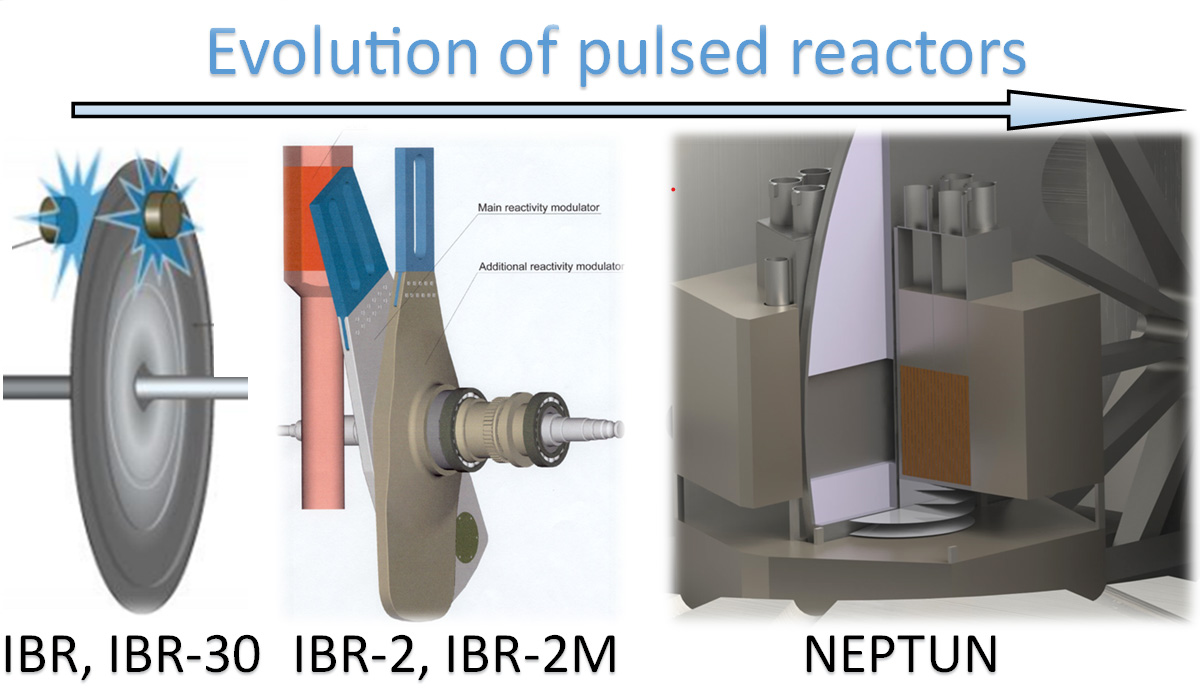
In 1960, the world’s first pulsed fast nuclear reactor (IBR) was created at JINR. The second-generation IBR-2 reactor has been in operation since 1984. An analysis of the distinctive characteristics of the IBR-type reactors is presented, the main one of which is related to the instabilities of power fluctuations. A description of the conceptual design of a third-generation NEPTUN reactor is proposed, which solves the problem of instabilities and opens up new possibilities for neutron beam research.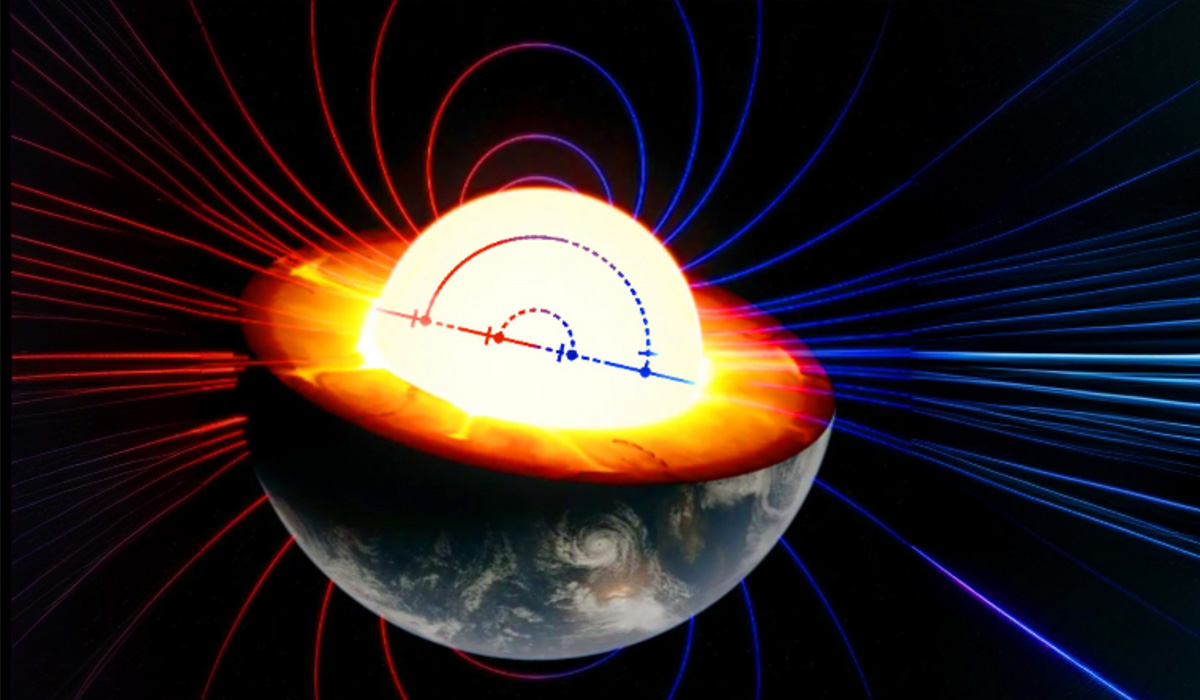
Statistical field theory of forced magnetohydrodynamic turbulence
We review the results of applying the statistical field-theoretic approach to the problem of fully developed turbulence in nonrelativistic three-dimensional magnetohydrodynamics (MHD), which have been obtained over the past forty years. The review covers both general aspects of the physics of MHD turbulence and the necessary mathematical machinery of statistical field theory, including elements of renormalization theory and the renormalization-group (RG) method. The approach is illustrated using a stochastic model of stationary, locally homogeneous, fully developed three-dimensional MHD turbulence in the general case of a medium with broken spatial parity (helical MHD). In this model, RG techniques make it possible to establish the existence of several infrared-stable scaling regimes and to calculate the critical dimensions of various composite operators, the infrared asymptotics of correlation functions, and the amplitude factors in scaling laws, as well as to incorporate the effects of compressibility, anisotropy, etc. For an important class of helical MHD systems, the field-theoretic approach provides an elegant formulation of the fundamental problem of large-scale turbulent dynamo action — namely, the generation of a large-scale magnetic field ⟨ b ⟩ = B (where b denotes magnetic fluctuations) at the expense of the energy of turbulent fluctuations — via the decay of the initial unstable vacuum state ⟨ b ⟩ = 0 as a result of dynamical spontaneous symmetry breaking in the spirit of the Coleman-Weinberg mechanism, followed by stabilization of the theory in the vicinity of the new ground state ⟨ b ⟩ = B (the dynamo regime). The field-theoretic formulation we developed, together with a generalization of the standard Feynman diagrammatic technique to the dynamo regime, not only makes it possible to treat within a unified framework the existing theoretical approaches to helical magnetohydrodynamics (kinematic MHD, large-scale dynamo theory), but also extends the RG formalism to the dynamo regime, which — unlike closure procedures still common in dynamo theory — is particularly well suited for studying statistically stationary turbulent states. The richness of MHD physics in the dynamo regime is illustrated both in the emergence of new effects (Goldstone-type corrections to Alfvén waves, anisotropic corrections associated with the transport of the large-scale field) and in the theoretically predicted strong dependence of the magnetic energy-spectrum slope on the degree of mirror-symmetry breaking.
ZFITTER: Theoretical calculations and precision tests of the Standard Model
The development of the ZFITTER computer code is described in the context of high-precision tests of the Standard Model during the LEP era. The features of the code that allowed it to become a standard tool for the theoretical interpretation of electroweak observables are analyzed. Prospects for further development of ZFITTER and its contribution to research projects at future electron–positron colliders are discussed. Numerical illustrations are provided of the effects of parameter shifts and the addition of new results for higher-order radiative corrections.