

Abstract
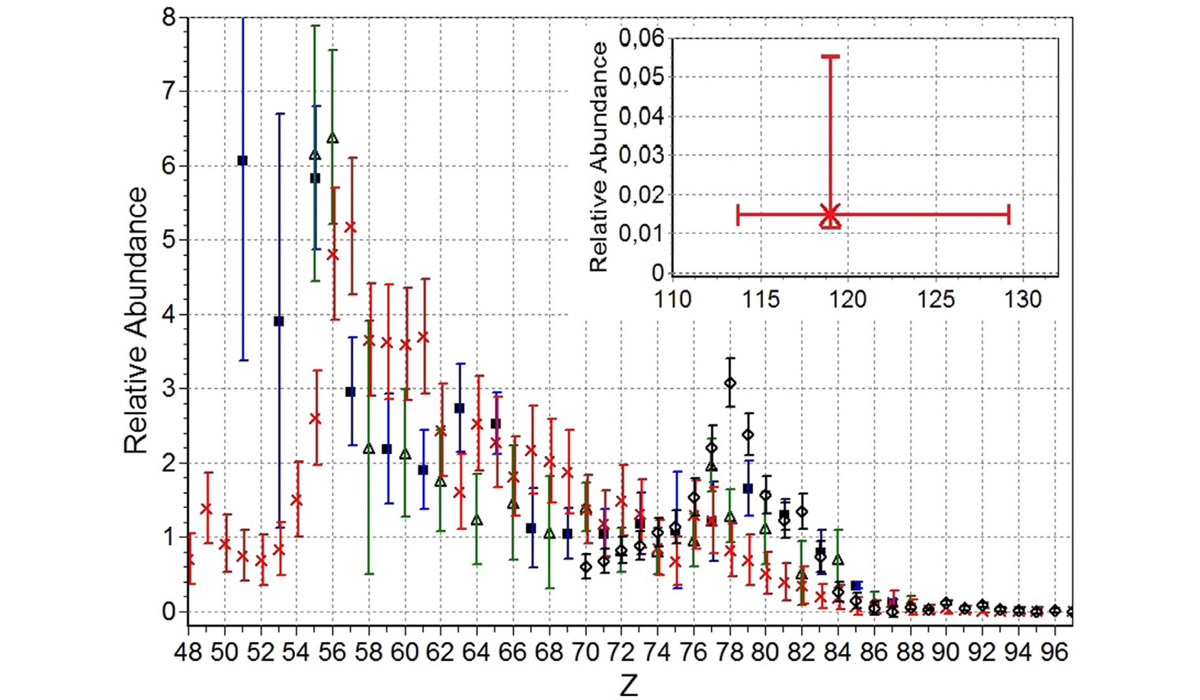
The results of the research partnership between the Flerov Laboratory of Nuclear Reactions of the Joint Institute for Nuclear Research (FLNR JINR) and the Laboratory of Fundamental Particles of the Lebedev Physical Institute (LFP LPI) are presented. The publication focuses on two areas: the search for tracks of superheavy nuclei in pallasite meteorites (OLIMPIYA experiment) and testing of various dielectric materials (glasses and micas) as detectors of heavy charged particles.
References
[1] M. Goeppert Mayer, The shell model, Science 145 (1964) 999–1006. https://doi.org/10.1126/science.145.3636.999. DOI: https://doi.org/10.1126/science.145.3636.999
[2] S. G. Nilsson, S. G. Thompson, C. F. Tsang, Stability of superheavy nuclei and their possible occurrence in nature, Phys. Lett. B 28 (1969) 458–461. https://doi.org/10.1016/0370-2693(69)90514-0. DOI: https://doi.org/10.1016/0370-2693(69)90514-0
[3] D. J. Dean, Beyond the nuclear shell model, Phys. Today 60 (2007) 48–53. https://doi.org/10.1063/1.2812123. DOI: https://doi.org/10.1063/1.2812123
[4] Yu. Ts. Oganessian, K. Rykaczewski, A beachhead on the island of stability, Phys. Today 68 (2015) 32–38. https://doi.org/10.1063/PT.3.2880. DOI: https://doi.org/10.1063/PT.3.2880
[5] Yu. Ts. Oganessian et al., Synthesis of superheavy nuclei in the 48Ca + 244Pu reaction: 288114, Phys. Rev. C 62 (2000) 041604. https://doi.org/10.1103/PhysRevC.62.041604. DOI: https://doi.org/10.1103/PhysRevC.62.041604
[6] S. Dmitriev, M. Itkis, Yu. Oganessian, Status and perspectives of the Dubna Superheavy Element Factory, EPJ Web Conf. 131 (2016) 08001. https://doi.org/10.1051/epjconf/201613108001. DOI: https://doi.org/10.1051/epjconf/201613108001
[7] V. L. Ginzburg, What problems of physics and astrophysics seem now to be especially important and interesting (thirty years later, already on the verge of XXI century)?, Phys. Usp. 42 (1999) 353–373. https://doi.org/10.1070/PU1999v042n04ABEH000562. DOI: https://doi.org/10.1070/PU1999v042n04ABEH000562
[8] V. L. Ginzburg, E. L. Feinberg, N. G. Polukhina, N. I. Starkov, V. A. Tsarev, Problems and horizons of the search for tracks of heavy and superheavy nuclei in olivine crystals from meteorites (OLIMPIYA project), Doklady Phys. 50 (2005) 283–285. https://doi.org/10.1134/1.1958116. DOI: https://doi.org/10.1134/1.1958116
[9] L. Ahrens, Origin and distribution of the elements: International Series of Monographs in Earth Sciences, 1st Edition, Elsevier, Pergamon, London, 2015.
[10] E. Pian et al., Spectroscopic identification of r-process nucleosynthesis in a double neutron-star merger, Nature 551 (2017) 67–70. https://doi.org/10.1038/nature24298. DOI: https://doi.org/10.1038/nature24298
[11] D. Kasen, B. Metzger, J. Barnes, E. Quataert, E. Ramirez-Ruiz, Origin of the heavy elements in binary neutron-star mergers from a gravitational wave event, Nature 551 (2017) 80–84. https://doi.org/10.1038/nature24453. DOI: https://doi.org/10.1038/nature24453
[12] S. A. Gorbunov, A. I. Malakhov, R. A. Rymzhanov, A. E. Volkov, Model of wet chemical etching of swift heavy ions tracks, J. Phys. D: Appl. Phys. 50 (2017) 395306. https://doi.org/10.1088/1361-6463/aa8153. DOI: https://doi.org/10.1088/1361-6463/aa8153
[13] S. Gorbunov, R. Rymzhanov, A. Volkov, Dependence of track etching kinetics on chemical reactivity around the ion path, Sci. Rep. 9 (2019) 15325. https://doi.org/10.1038/s41598-019-51748-y. DOI: https://doi.org/10.1038/s41598-019-51748-y
[14] P. Horn, M. Maurette, W. Von Oertzen, A study of the registration of arsenic and iodine ions in olivine and hypersthene crystals, Z. Naturforsch. A 22 (1967) 1793–1798. https://doi.org/10.1515/zna-1967-1117. DOI: https://doi.org/10.1515/zna-1967-1117
[15] V. K. Egorov, L. L. Kashkarov, N. G. Polukhina, V. A. Tsarev, On some structural features of olivine crystals from the Marjalahti meteorite, in: Proc. of the International Mineralogical Seminar “Structure and diversity of mineral world”, Syktyvkar, Russian Federation, June 17–19, 2008, Geoprint Institute of Geology, Komi Scientific Research Center, Ural Branch of the Russian Academy of Sciences, Russian Federation, 2008, pp. 139–140 (in Russian).
[16] A. V. Bagulya et al., Charge spectrum of superheavy nuclei of Galactic cosmic rays obtained in the OLIMPIYA experiment, Bull. Lebedev Phys. Inst. 42 (2015) 152–156. https://doi.org/10.3103/S1068335615050073. DOI: https://doi.org/10.3103/S1068335615050073
[17] K. Lodders, H. Palme, H.-P. Gail, Abundances of the elements in the Solar System, in: Astronomy and Astrophysics, Landolt-Bornstein, New Series, Vol. VI/4B, Chap. 4.4, Ed. J. E. Trümper, Springer-Verlag, Berlin, Germany, 2009, pp. 560–630. https://doi.org/10.1007/978-3-540-88055-4_34. DOI: https://doi.org/10.1007/978-3-540-88055-4_34
[18] A. B. Aleksandrov et al., Simulation of passage of Galactic cosmic ray nuclei in meteorite–pallasite substance, Bull. Lebedev Phys. Inst. 40 (2013) 126–131. https://doi.org/10.3103/S1068335613050059. DOI: https://doi.org/10.3103/S1068335613050059
[19] M. Maurette, P. Pellas, R. M. Walker, Cosmic-ray-induced particle tracks in a meteorite, Nature 204 (1964) 821–823. https://doi.org/10.1038/204821a0. DOI: https://doi.org/10.1038/204821a0
[20] O. Otgonsuren, V. P. Perelygin, S. G. Stetsenko, N. N. Gavrilova, C. Fieni, P. Pellas, Abundances of Z > 52 nuclei in Galactic cosmic rays: Long-term averages based on studies of pallasites, Astrophys. J. 210 (1976) 258–266. https://doi.org/10.1086/154826. DOI: https://doi.org/10.1086/154826
[21] V. P. Perelygin, Yu. V. Bondar, R. Brandt, W. Ensinger, R. L. Fleischer, L. I. Kravets, M. Rebetez, R. Spohr, P. Vater, S. G. Stetsenko, On search and identification of relatively short-lived superheavy nuclei (Z ⩾ 110) by fossil track studies of meteoritic and lunar olivine crystals, Phys. Atom. Nucl. 66 (2003) 1569–1573. https://doi.org/10.1134/1.1601767. DOI: https://doi.org/10.1134/1.1601767
[22] A. Alexandrov, N. Konovalova, N. Okateva, N. Polukhina, N. Starkov, T. Shchedrina, Upgrade and new applications of the automated high-tech scanning facility PAVICOM for data processing of track detectors, Measurement 187 (2022) 110244. https://doi.org/10.1016/j.measurement.2021.110244. DOI: https://doi.org/10.1016/j.measurement.2021.110244
[23] R. L. Fleischer, P. B. Price, R. M. Walker, Nuclear tracks in solids, California Press, Berkeley, 1973.
[24] A. B. Aleksandrov et al., Calibration measurements of the characteristics of tracks from superheavy nuclei in olivine crystals from meteorites, Instrum. Exp. Tech. 52 (2009) 187–190. https://doi.org/10.1134/S0020441209020079. DOI: https://doi.org/10.1134/S0020441209020079
[25] N. Medvedev, A. E. Volkov, R. Rymzhanov, F. Akhmetov, S. Gorbunov, R. Voronkov, P. Babaev, Frontiers, challenges, and solutions in modeling of swift heavy ion effects in materials, J. Appl. Phys. 133 (2023) 100701. https://doi.org/10.1063/5.0128774. DOI: https://doi.org/10.1063/5.0128774
[26] A. Alexandrov et al., History of heavy r-process elements in Galactic cosmic rays from nuclei tracks in meteorite olivine, Adv. Space Res. 70 (2022) 2674–2684. https://doi.org/10.1016/j.asr.2022.06.055. DOI: https://doi.org/10.1016/j.asr.2022.06.055
[27] J. A. Johnson, Populating the periodic table: Nucleosynthesis of the elements, Science 363 (2019) 474–478. https://doi.org/10.1126/science.aau9540. DOI: https://doi.org/10.1126/science.aau9540
[28] D. L. Burris, C. A. Pilachowski, T. E. Armandroff, C. Sneden, J. J. Cowan, H. Roe, Neutroncapture elements in the Early Galaxy: Insights from a large sample of metal-poor giants, Astrophys. J. 544 (2000) 302–319. https://doi.org/10.1086/317172. DOI: https://doi.org/10.1086/317172
[29] N. Gehrels, Confidence limits for small numbers of events in astrophysical data, Astrophys. J. 303 (1986) 336–346. https://doi.org/10.1086/164079. DOI: https://doi.org/10.1086/164079
[30] V. Alexeev et al., Charge spectrum of heavy and superheavy components of Galactic cosmic rays: Results of the OLIMPIYA experiment, Astrophys. J. 829 (2016) 120. https://doi.org/10.3847/0004-637X/829/2/120. DOI: https://doi.org/10.3847/0004-637X/829/2/120
[31] Yu. Ts. Oganessian, A. Sobiczewski, G. M. Ter-Akopian, Superheavy nuclei: From predictions to discovery, Phys. Scr. 92 (2017) 023003. https://doi.org/10.1088/1402-4896/aa53c1. DOI: https://doi.org/10.1088/1402-4896/aa53c1
[32] Yu. Ts. Oganessian, V. K. Utyonkov, Super-heavy element research, Rep. Prog. Phys. 78 (2015) 036301. https://doi.org/10.1088/0034-4885/78/3/036301. DOI: https://doi.org/10.1088/0034-4885/78/3/036301
[33] I. Zvára, The Inorganic radiochemistry of heavy elements: Methods for studying gaseous compounds, Springer Dordrecht, Netherlands, 2008. https://doi.org/10.1007/978-1-4020-6602-3. DOI: https://doi.org/10.1007/978-1-4020-6602-3
[34] B. L. Zhuikov, Methods of separation of volatile elements and oxides in the search for superheavy elements and in the production of radioisotopes, Synopsis of PhD Thesis, Moscow University Press, Moscow, Russian Federation, 1982 (in Russian).
[35] R. Eichler et al., Chemical characterization of element 112, Nature 447 (2007) 72–75. https://doi.org/10.1038/nature05761. DOI: https://doi.org/10.1002/chin.200732020
[36] B. L. Zhuikov, Theoretical calculation of the deposition temperature in thermochromatography from the thermodynamic data, Radiochemistry 61 (2019) 541–553. https://doi.org/10.1134/S1066362219050059. DOI: https://doi.org/10.1134/S1066362219050059
[37] P. Yu. Apel et al., Study of etching features of quartz glass irradiated with xenon ions, Bull. Lebedev Phys. Inst. 51 (2024) 117–123. https://doi.org/10.3103/S1068335624600062. DOI: https://doi.org/10.3103/S1068335624600062
[38] E. Andreev et al., Thermal properties of glass detectors for heavy ion registration, Techn. Phys. 70 (2025) 174–182. https://doi.org/10.61011/TP.2025.01.60524.272-24.
[39] E. V. Andreev et al., Testing natural and synthetic micas as detectors of accelerated heavy ions, Techn. Phys. 71 (2026) 180–190. https://doi.org/10.61011/TP.2026.01.62856.106-25.
[40] J. F. Ziegler, SRIM-2003, Nucl. Instrum. Meth. Phys. Res. B 219–220 (2004) 1027–1036. https://doi.org/10.1016/j.nimb.2004.01.208. DOI: https://doi.org/10.1016/j.nimb.2004.01.208
[41] N. Agafonova et al., The detection of neutrino interactions in the emulsion/lead target of the OPERA experiment, JINST 4 (2009) P06020. https://doi.org/10.1088/1748-0221/4/06/P06020. DOI: https://doi.org/10.1088/1748-0221/4/06/P06020
[42] D. Abbaneo et al., Results and perspectives from the first two years of neutrino physics at the LHC by the SND@LHC experiment, Symmetry (Switzerland) 16 (2024) 702. https://doi.org/10.3390/sym16060702. DOI: https://doi.org/10.3390/sym16060702
[43] A. Alexandrov et al., Muography of geometrically complex cultural heritage sites: Challenges and solutions on the example of searching for hidden anomalies on the ancient monastery territory in the Vologda Region, Phys. At. Nucl. 88 (2025) 616–632. https://doi.org/10.1134/s106377882570053x. DOI: https://doi.org/10.1134/S106377882570053X
License

This work is licensed under a Creative Commons Attribution-NonCommercial 4.0 International License.