

Abstract
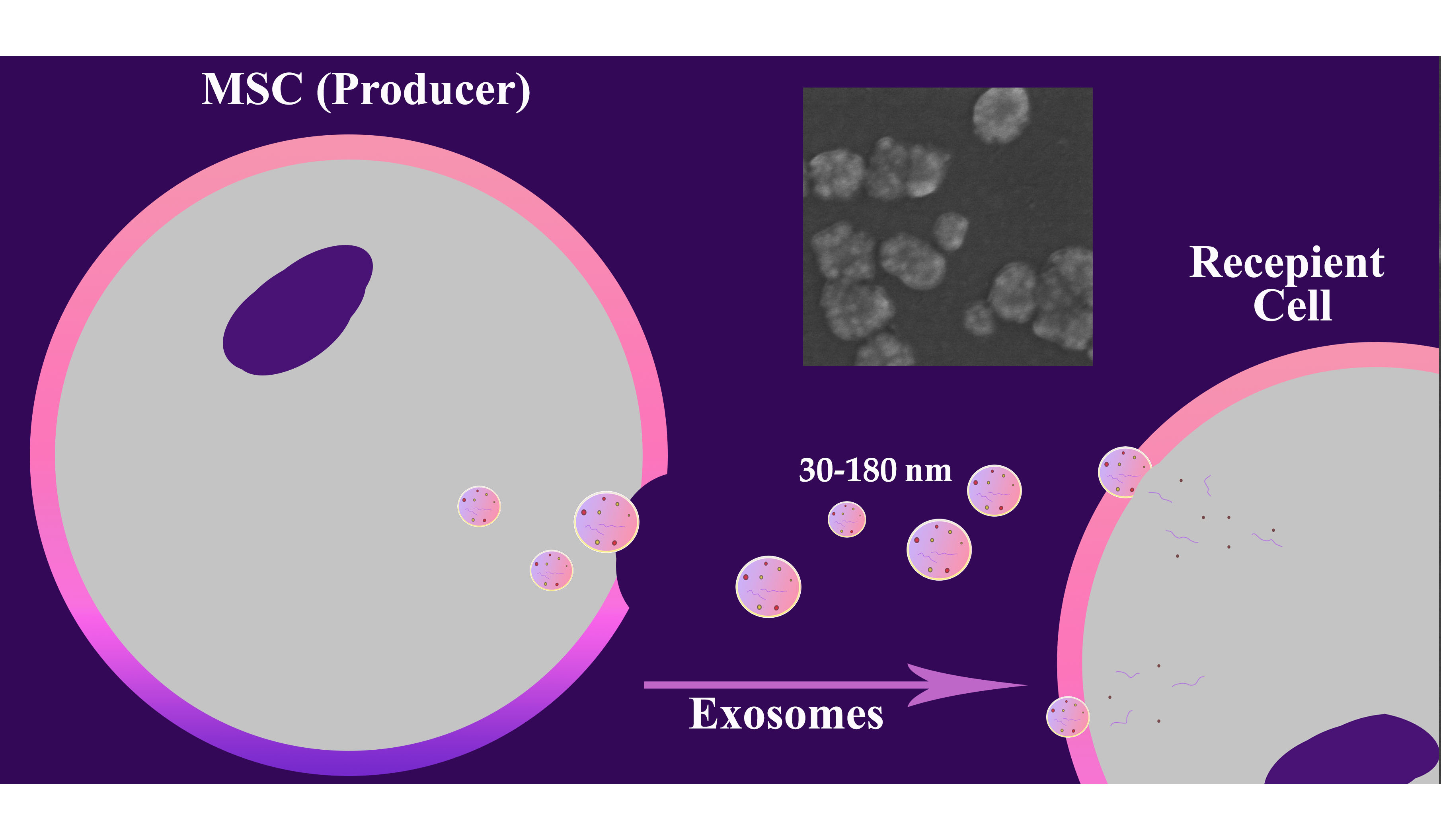
This study provides a comparative analysis of various components of mesenchymal stem cells (MSC) conditioned media (CM) obtained using serum-containing and serum-free culture methods, revealing significant differences in their composition and potential clinical applicability. Serum-containing CM exhibits significantly higher levels of total protein, non-vesicular RNA, exosomes, and nanoparticles compared to serum-free CM, reflecting the contribution of both the MSC secretome and residual fetal bovine serum components. Ultrafiltration-based fractionation (0.2 µm–50 kDa) allows the isolation of fraction enriched in exosomes and proteins, preserving the functionally significant components of the MSC secretome. This strategy effectively captures small vesicles and mid-sized proteins while excluding larger or smaller biomolecules, enhancing utility for targeted analyses. The presented data underscore the need for context-driven CM selection and provide information for choosing the optimal strategy for obtaining the MSC secretome balancing yield, purity, and regulatory demands in MSC research and therapy.
Acknowledgements
References
[1] Y. Seo, T. H. Shin, H. S. Kim, Current strategies to enhance adipose stem cell function: Anupdate, Int. J. Mol. Sci. (2019).https://doi.org/10.3390/ijms20153827.
[2] A. Gonz ́alez-Gonz ́alez, D. Garc ́ıa-S ́anchez, M. Dotta, J. C. Rodr ́ıguez-Rey, F. M. P ́erez-Campo,Mesenchymal stem cells secretome: The cornerstone of cell-free regenerative medicine, World J.Stem Cells (2020).https://doi.org/10.4252/wjsc.v12.i12.1529.
[3] X. L. Fan, Y. Zhang, X. Li, Q. L. Fu, Mechanisms underlying the protective effects of mes-enchymal stem cell-based therapy, Cell. Mol. Life Sci. (2020).https://doi.org/10.1007/s00018-020-03454-6.
[4] G. Yang, X. Fan, Y. Liu, P. Jie, M. Mazhar, Y. Liu, N. Dechsupa, L. Wang, Immunomodulatorymechanisms and therapeutic potential of mesenchymal stem cells, Stem Cell Rev. Rep. (2023).https://doi.org/10.1007/s12015-023-10539-9.
[5] T. R. Doeppner, J. Herz, A. G ̈orgens, J. Schlechter, A.-K. Ludwig, S. Radtke, K. de Miroschedji,P. A. Horn, B. Giebel, D. M. Hermann, Extracellular vesicles improve post-stroke neurore-generation and prevent postischemic immunosuppression, Stem Cells Transl. Med. (2015).https://doi.org/10.5966/sctm.2015-0078.
[6] R. Tutuianu, A. M. Rosca, D. M. Iacomi, M. Simionescu, I. Titorencu, Human mesenchymalstromal cell-derived exosomes promotein vitrowound healing by modulating the biological prop-erties of skin keratinocytes and fibroblasts and stimulating angiogenesis, Int. J. Mol. Sci. (2021).https://doi.org/10.3390/ijms22126239.
[7] A. Shabbir, A. Cox, L. Rodriguez-Menocal, M. Salgado, E. Van Badiavas, Mesenchymal stem cellexosomes induce proliferation and migration of normal and chronic wound fibroblasts, and enhanceangiogenesisin vitro, Stem Cells Dev. (2015).https://doi.org/10.1089/scd.2014.0316.
[8] Y. Slama, F. Ah-Pine, M. Khettab, A. Arcambal, M. Begue, F. Dutheil, P. Gasque, The dual roleof mesenchymal stem cells in cancer pathophysiology: Pro-tumorigenic effects versus therapeuticpotential, Int. J. Mol. Sci. (2023).https://doi.org/10.3390/ijms241713511.
[9] C. Th ́ery, K. W. Witwer, E. Aikawa, M. J. Alcaraz, J. D. Anderson, R. Andriantsitohaina,A. Antoniou, T. Arab, F. Archer, G. K. Atkin-Smith, D. C. Ayre, J. M. Bach, D. Bachurski,H. Baharvand, L. Balaj, S. Baldacchino, N. N. Bauer, A. A. Baxter, M. Bebawy, C. Beckham,A. Bedina Zavec, A. Benmoussa, A. C. Berardi, P. Bergese, E. Bielska, C. Blenkiron, S. Bobis-Wozowicz, E. Boilard, W. Boireau, A. Bongiovanni, F. E. Borr`as, S. Bosch, C. M. Boulanger,X. Breakefield, A. M. Breglio, M. Brennan, D. R. Brigstock, A. Brisson, M. L. D. Broekman,J. F. Bromberg, P. Bryl-G ́orecka, S. Buch, A. H. Buck, D. Burger, S. Busatto, D. Buschmann,B. Bussolati, E. I. Buz ́as, J. B. Byrd, G. Camussi, D. R. F. Carter, S. Caruso, L. W. Chamley,Y. T. Chang, A. D. Chaudhuri, C. Chen, S. Chen, L. Cheng, A. R. Chin, A. Clayton, S. P. Clerici,A. Cocks, E. Cocucci, R. J. Coffey, A. Cordeiro-da-Silva, Y. Couch, F. A. W. Coumans, B. Coyle,R. Crescitelli, M. F. Criado, C. D’Souza-Schorey, S. Das, P. de Candia, E. F. De Santana,O. De Wever, H. A. del Portillo, T. Demaret, S. Deville, A. Devitt, B. Dhondt, D. Di Vizio,L. C. Dieterich, V. Dolo, A. P. Dominguez Rubio, M. Dominici, M. R. Dourado, T. A. P. Driedonks,F. V. Duarte, H. M. Duncan, R. M. Eichenberger, K. Ekstr ̈om, S. El Andaloussi, C. Elie-Caille,U. Erdbr ̈ugger, J. M. Falc ́on-P ́erez, F. Fatima, J. E. Fish, M. Flores-Bellver, A. F ̈ors ̈onits,A. Frelet-Barrand, F. Fricke, G. Fuhrmann, S. Gabrielsson, A. G ́amez-Valero, C. Gardiner,K. G ̈artner, R. Gaudin, Y. S. Gho, B. Giebel, C. Gilbert, M. Gimona, I. Giusti, D. C. I. Gob-erdhan, A. G ̈orgens, S. M. Gorski, D. W. Greening, J. C. Gross, A. Gualerzi, G. N. Gupta,D. Gustafson, A. Handberg, R. A. Haraszti, P. Harrison, H. Hegyesi, A. Hendrix, A. F. Hill,F. H. Hochberg, K. F. Hoffmann, B. Holder, H. Holthofer, B. Hosseinkhani, G. Hu, Y. Huang,V. Huber, S. Hunt, A. G. E. Ibrahim, T. Ikezu, J. M. Inal, M. Isin, A. Ivanova, H. K. Jackson,S. Jacobsen, S. M. Jay, M. Jayachandran, G. Jenster, L. Jiang, S. M. Johnson, J. C. Jones, A. Jong,T. Jovanovic-Talisman, S. Jung, R. Kalluri, S. ichi Kano, S. Kaur, Y. Kawamura, E. T. Keller,D. Khamari, E. Khomyakova, A. Khvorova, P. Kierulf, K. P. Kim, T. Kislinger, M. Klingeborn,D. J. Klinke, M. Kornek, M. M. Kosanovi ́c, ́A. F. Kov ́acs, E. M. Kr ̈amer-Albers, S. Krasemann,M. Krause, I. V. Kurochkin, G. D. Kusuma, S. Kuypers, S. Laitinen, S. M. Langevin, L. R. Lan-guino, J. Lannigan, C. L ̈asser, L. C. Laurent, G. Lavieu, E. L ́azaro-Ib ́a ̃nez, S. Le Lay, M. S. Lee,Y. X. F. Lee, D. S. Lemos, M. Lenassi, A. Leszczynska, I. T. S. Li, K. Liao, S. F. Libregts, E. Ligeti,R. Lim, S. K. Lim, A. Lin ̄e, K. Linnemannst ̈ons, A. Llorente, C. A. Lombard, M. J. Lorenowicz, ́A. M. L ̈orincz, J. L ̈otvall, J. Lovett, M. C. Lowry, X. Loyer, Q. Lu, B. Lukomska, T. R. Lunavat,S. L. N. Maas, H. Malhi, A. Marcilla, J. Mariani, J. Mariscal, E. S. Martens-Uzunova, L. Martin-Jaular, M. C. Martinez, V. R. Martins, M. Mathieu, S. Mathivanan, M. Maugeri, L. K. McGinnis,M. J. McVey, D. G. Meckes, K. L. Meehan, I. Mertens, V. R. Minciacchi, A. M ̈oller, M. MøllerJørgensen, A. Morales-Kastresana, J. Morhayim, F. Mullier, M. Muraca, L. Musante, V. Mussack,D. C. Muth, K. H. Myburgh, T. Najrana, M. Nawaz, I. Nazarenko, P. Nejsum, C. Neri, T. Neri,R. Nieuwland, L. Nimrichter, J. P. Nolan, E. N. M. Nolte-’t Hoen, N. Noren Hooten, L. O’Driscoll,T. O’Grady, A. O’Loghlen, T. Ochiya, M. Olivier, A. Ortiz, L. A. Ortiz, X. Osteikoetxea, O. Os-tegaard, M. Ostrowski, J. Park, D. M. Pegtel, H. Peinado, F. Perut, M. W. Pfaffl, D. G. Phin-ney, B. C. H. Pieters, R. C. Pink, D. S. Pisetsky, E. Pogge von Strandmann, I. Polakovicova,I. K. H. Poon, B. H. Powell, I. Prada, L. Pulliam, P. Quesenberry, A. Radeghieri, R. L. Raffai,S. Raimondo, J. Rak, M. I. Ramirez, G. Raposo, M. S. Rayyan, N. Regev-Rudzki, F. L. Rick-lefs, P. D. Robbins, D. D. Roberts, S. C. Rodrigues, E. Rohde, S. Rome, K. M. A. Rouschop,A. Rughetti, A. E. Russell, P. Sa ́a, S. Sahoo, E. Salas-Huenuleo, C. S ́anchez, J. A. Saugstad,M. J. Saul, R. M. Schiffelers, R. Schneider, T. H. Schøyen, A. Scott, E. Shahaj, S. Sharma, O. Shatnyeva, F. Shekari, G. V. Shelke, A. K. Shetty, K. Shiba, P. R. M. Siljander, A. M. Silva,A. Skowronek, O. L. Snyder, R. P. Soares, B. W. S ́odar, C. Soekmadji, J. Sotillo, P. D. Stahl,W. Stoorvogel, S. L. Stott, E. F. Strasser, S. Swift, H. Tahara, M. Tewari, K. Timms, S. Tiwari,R. Tixeira, M. Tkach, W. S. Toh, R. Tomasini, A. C. Torrecilhas, J. P. Tosar, V. Toxavidis, L. Ur-banelli, P. Vader, B. W. M. van Balkom, S. G. van der Grein, J. Van Deun, M. J. C. van Herwij-nen, K. Van Keuren-Jensen, G. van Niel, M. E. van Royen, A. J. van Wijnen, M. H. Vasconcelos,I. J. Vechetti, T. D. Veit, L. J. Vella, ́E. Velot, F. J. Verweij, B. Vestad, J. L. Vi ̃nas, T. Vis-novitz, K. V. Vukman, J. Wahlgren, D. C. Watson, M. H. M. Wauben, A. Weaver, J. P. Webber,V. Weber, A. M. Wehman, D. J. Weiss, J. A. Welsh, S. Wendt, A. M. Wheelock, Z. Wiener,L. Witte, J. Wolfram, A. Xagorari, P. Xander, J. Xu, X. Yan, M. Y ́a ̃nez-M ́o, H. Yin, Y. Yuana,V. Zappulli, J. Zarubova, V.ˇZ ̇ekas, J. Ye Zhang, Z. Zhao, L. Zheng, A. R. Zheutlin, A. M. Zickler,P. Zimmermann, A. M. Zivkovic, D. Zocco, E. K. Zuba-Surma, Minimal information for studiesof extracellular vesicles 2018 (MISEV2018): A position statement of the International Societyfor Extracellular Vesicles and update of the MISEV2014 guidelines, J. Extracell. Vesicles (2018).https://doi.org/10.1080/20013078.2018.1535750.
[10] C. Gardiner, D. Di Vizio, S. Sahoo, C. Th ́ery, K. W. Witwer, M. Wauben, A. F. Hill, Techniquesused for the isolation and characterization of extracellular vesicles: Results of a worldwide survey,J. Extracell. Vesicles (2016).https://doi.org/10.3402/jev.v5.32945.
[11] A. N. B ̈oing, E. van der Pol, A. E. Grootemaat, F. A. W. Coumans, A. Sturk, R. Nieuwland, Single-step isolation of extracellular vesicles by size-exclusion chromatography, J. Extracell. Vesicles(2014).https://doi.org/10.3402/jev.v3.23430.
[12] N. Garc ́ıa-Romero, R. Madurga, G. Rackov, I. Palac ́ın-Aliana, R. N ́u ̃nez-Torres, A. Asensi-Puig,J. Carri ́on-Navarro, S. Esteban-Rubio, H. Peinado, A. Gonz ́alez-Neira, V. Gonz ́alez-Rumayor,C. Belda-Iniesta, A. Ayuso-Sacido, Polyethylene glycol improves current methods for circulatingextracellular vesicle-derived DNA isolation, J. Transl. Med. (2019).https://doi.org/10.1186/s12967-019-1825-3.
[13] E. Serrano-Pertierra, M. Oliveira-Rodr ́ıguez, M. Rivas, P. Oliva, J. Villafani, A. Navarro,M. C. Blanco-L ́opez, E. Cernuda-Moroll ́on, Characterization of plasma-derived extracellular vesi-cles isolated by different methods: A comparison study, Bioengineering (2019).https://doi.org/10.3390/bioengineering6010008.
[14] B. J. Tauro, D. W. Greening, R. A. Mathias, H. Ji, S. Mathivanan, A. M. Scott, R. J. Simp-son, Comparison of ultracentrifugation, density gradient separation, and immunoaffinity capturemethods for isolating human colon cancer cell line LIM1863-derived exosomes, Methods (2012).https://doi.org/10.1016/j.ymeth.2012.01.002.
[15] M. Y. Konoshenko, E. A. Lekchnov, A. V. Vlassov, P. P. Laktionov, Isolation of extracellularvesicles: General methodologies and latest trends, BioMed Res. Int. (2018).https://doi.org/10.1155/2018/8545347.
[16] Y. Zhang, J. Bi, J. Huang, Y. Tang, S. Du, P. Li, Exosome: A review of its classification, isola-tion techniques, storage, diagnostic and targeted therapy applications, Int. J. Nanomed. (2020).https://doi.org/10.2147/IJN.S264498.
[17] R. Skovronova, E. Scaccia, S. Calcat-i-Cervera, B. Bussolati, T. O’Brien, K. Bieback, Adiposestromal cells bioproducts as cell-free therapies: Manufacturing and therapeutic dose determinein vitrofunctionality, J. Transl. Med. (2023).https://doi.org/10.1186/s12967-023-04602-9.
[18] T. Lener, M. Gimona, L. Aigner, V. B ̈orger, E. Buzas, G. Camussi, N. Chaput, D. Chatter-jee, F. A. Court, H. A. del Portillo, L. O’Driscoll, S. Fais, J. M. Falcon-Perez, U. Felderhoff-Mueser, L. Fraile, Y. S. Gho, A. G ̈orgens, R. C. Gupta, A. Hendrix, D. M. Hermann, A. F. Hill,F. Hochberg, P. A. Horn, D. de Kleijn, L. Kordelas, B. W. Kramer, E. M. Kr ̈amer-Albers, S. Laner-Plamberger, S. Laitinen, T. Leonardi, M. J. Lorenowicz, S. K. Lim, J. L ̈otvall, C. A. Maguire,A. Marcilla, I. Nazarenko, T. Ochiya, T. Patel, S. Pedersen, G. Pocsfalvi, S. Pluchino, P. Quesenberry, I. G. Reischl, F. J. Rivera, R. Sanzenbacher, K. Schallmoser, I. Slaper-Cortenbach,D. Strunk, T. Tonn, P. Vader, B. W. M. van Balkom, M. Wauben, S. El Andaloussi, C. Th ́ery,E. Rohde, B. Giebel, Applying extracellular vesicles based therapeutics in clinical trials —An ISEV position paper, J. Extracell. Vesicles (2015).https://doi.org/10.3402/jev.v4.30087.
[19] B. M. Lehrich, Y. Liang, P. Khosravi, H. J. Federoff, M. S. Fiandaca, Fetal bovine serum-derived extracellular vesicles persist within vesicle-depleted culture media, Int. J. Mol. Sci. (2018).https://doi.org/10.3390/ijms19113538.
[20] B. M. Lehrich, Y. Liang, M. S. Fiandaca, Foetal bovine serum influence onin vitroextracellularvesicle analyses, J. Extracell. Vesicles (2021).https://doi.org/10.1002/jev2.12061.
[21] H. P. Erickson, Size and shape of protein molecules at the nanometer level determined by sedi-mentation, gel filtration, and electron microscopy, Biol. Proced. Online (2009).https://doi.org/10.1007/s12575-009-9008-x.
[22] Z. Wei, A. O. Batagov, D. R. F. Carter, A. M. Krichevsky, Fetal bovine serum RNA interfereswith the cell culture derived extracellular RNA, Sci. Rep. (2016).https://doi.org/10.1038/srep31175.
[23] G. V. Shelke, C. L ̈asser, Y. S. Gho, J. L ̈otvall, Importance of exosome depletion protocols to eliminate functional and RNA-containing extracellular vesicles from fetal bovine serum, J. Extracell.Vesicles (2014).https://doi.org/10.3402/jev.v3.24783.
[24] B. S. Joshi, M. A. de Beer, B. N. G. Giepmans, I. S. Zuhorn, Endocytosis of extracellular vesi-cles and release of their cargo from endosomes, ACS Nano (2020).https://doi.org/10.1021/acsnano.9b10033.
[25] J. Wei, T. Qi, C. Hao, S. Zong, Z. Wang, Y. Cui, Optical microscopic and spectroscopic detectionof exosomes, TrAC — Trends Anal. Chem. (2023).https://doi.org/10.1016/j.trac.2023.117077.[26] J. L ̈otvall, A. F. Hill, F. Hochberg, E. I. Buz ́as, D. Di Vizio, C. Gardiner, Y. S. Gho, I. V. Kuroch-kin, S. Mathivanan, P. Quesenberry, S. Sahoo, H. Tahara, M. H. Wauben, K. W. Witwer, C. Th ́ery,Minimal experimental requirements for definition of extracellular vesicles and their functions:A position statement from the International Society for Extracellular Vesicles, J. Extracell. Vesicles(2014).https://doi.org/10.3402/jev.v3.26913.
[27] M. Colombo, G. Raposo, C. Th ́ery, Biogenesis, secretion, and intercellular interactions of exosomesand other extracellular vesicles, Annu. Rev. Cell Dev. Biol. (2014).https://doi.org/10.1146/annurev-cellbio-101512-122326.
[28] M. Malenica, M. Vukomanovi ́c, M. Kurtjak, V. Masciotti, S. Dal Zilio, S. Greco, M. Lazzarino,V. Kruˇsi ́c, M. Perˇci ́c, I. J. Badovinac, K. Wechtersbach, I. Vidovi ́c, V. Bariˇcevi ́c, S. Vali ́c, P. Luˇcin,N. Kojc, K. Grabuˇsi ́c, Perspectives of microscopy methods for morphology characterisation ofextracellular vesicles from human biofluids, Biomedicines (2021).https://doi.org/10.3390/biomedicines9060603.
[29] Z. Song, J. Mao, R. A. Barrero, P. Wang, F. Zhang, T. Wang, Development of a CD63 aptamer forefficient cancer immunochemistry and immunoaffinity-based exosome isolation, Molecules (2020).https://doi.org/10.3390/molecules25235585.
[30] M. Mathieu, N. N ́evo, M. Jouve, J. I. Valenzuela, M. Maurin, F. J. Verweij, R. Palmulli, D. Lankar,F. Dingli, D. Loew, E. Rubinstein, G. Boncompain, F. Perez, C. Th ́ery, Specificities of exosomeversus small ectosome secretion revealed by live intracellular tracking of CD63 and CD9, Nat.Commun. (2021).https://doi.org/10.1038/s41467-021-24384-2.
[31] X. Yu, L. He, M. Pentok, H. Yang, Y. Yang, Z. Li, N. He, Y. Deng, S. Li, T. Liu, X. Chen, H. Luo,An aptamer-based new method for competitive fluorescence detection of exosomes, Nanoscale(2019).https://doi.org/10.1039/c9nr04050a.15
[32] Q. Zhou, A. Rahimian, K. Son, D. S. Shin, T. Patel, A. Revzin, Development of an aptasensorfor electrochemical detection of exosomes, Methods (2016).https://doi.org/10.1016/j.ymeth.2015.10.012.
[33] W. Zhang, Z. Tian, S. Yang, J. Rich, S. Zhao, M. Klingeborn, P. H. Huang, Z. Li, A. Stout,Q. Murphy, E. Patz, S. Zhang, G. Liu, T. J. Huang, Electrochemical micro-aptasensors for exosomedetection based on hybridization chain reaction amplification, Microsystems Nanoeng. (2021).https://doi.org/10.1038/s41378-021-00293-8.
[34] L. Zhuang, Q. You, X. Su, Z. Chang, M. Ge, Q. Mei, L. Yang, W. Dong, L. Li, High-perfor-mance detection of exosomes based on synergistic amplification of amino-functionalized Fe3O4nanoparticles and two-dimensional MXene nanosheets, Sensors (2023).https://doi.org/10.3390/s23073508.
[35] J. L. Zhang, M. H. Chang, X. Shi, X. Zhou, Exo-III enzyme based colorimetric small extracellularvesicles (sEVs) detection via G-quadruplex-based signal quenching strategy, Microchem. J. (2022).https://doi.org/10.1016/j.microc.2022.107419.
[36] H. Chen, L. Yuan, W. Song, Z. Wu, D. Li, Biocompatible polymer materials: Role of protein-surface interactions, Prog. Polym. Sci. (2008).https://doi.org/10.1016/j.progpolymsci.2008.07.006.
[37] M. Zarubin, E. Andreev, E. Kravchenko, U. Pinaeva, A. Nechaev, P. Apel, Developing tardigrade-inspired material: Track membranes functionalized with Dsup protein for cell-free DNA isolation.Biotechnol. Prog. (2024).https://doi.org/10.1002/BTPR.3478.
[38] L. P. Kristensen, L. Chen, M. O. Nielsen, D. W. Qanie, I. Kratchmarova, M. Kassem, J. S. Ander-sen, Temporal profiling and pulsed SILAC labeling identify novel secreted proteins duringex vivoosteoblast differentiation of human stromal stem cells, Mol. Cell. Proteom. (2012).https://doi.org/10.1074/mcp.M111.012138.