

Abstract
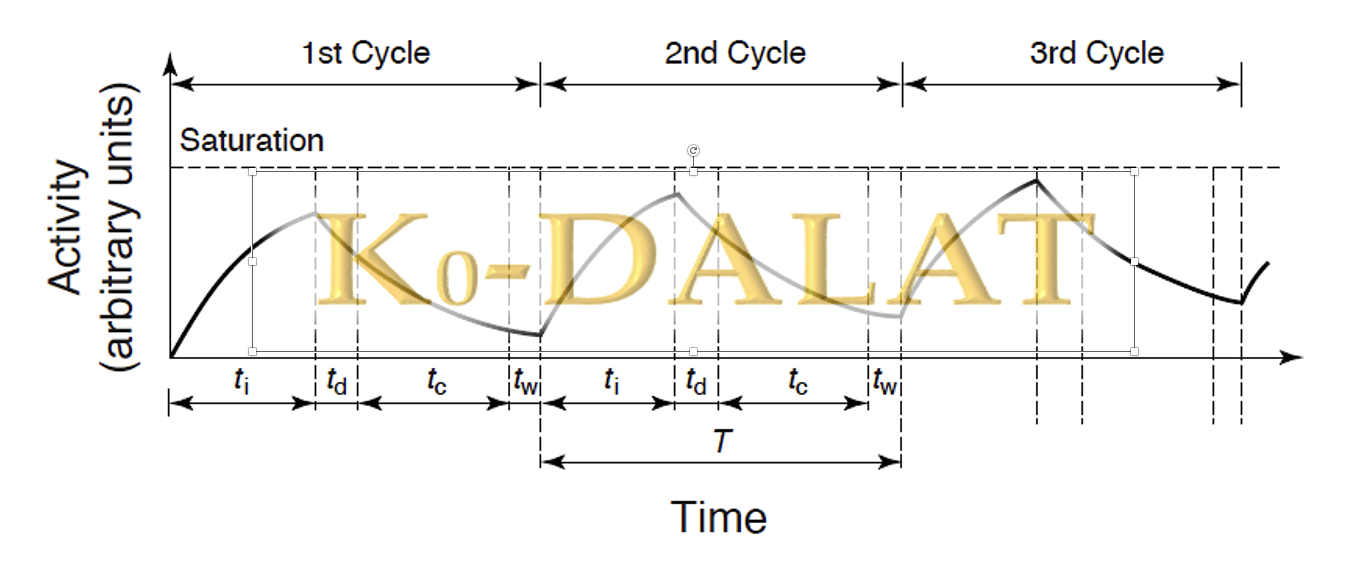
An optimized k0-standardized neutron activation analysis method incorporating cyclic irradiations (k0-CNAA) for short-lived radionuclides (SLRNs) has been developed at the Dalat research reactor. This paper highlights precise reactor parameter characterization using a cyclic irradiation system, simple sample preparation, and advanced calibration of HPGe detector-based gamma-ray spectrometry for SLRNs’ rapid multielement determination. By targeting SLRNs such as 77mSe, 110Ag, 20F, 179mHf, 52V, and 46mSc, with half-lives from seconds to minutes, the method enables quantification of elements essential for biological and environmental research. The in-house developed “k0-Dalat” software, featuring high automation, supports complete analysis. Method accuracy was validated using certified reference materials (SMELS-I, NIST-SRM-1566b, NIST-SRM-2711a), achieving deviations under 8% from certified values. Detection limits ranged from 0.1 to 1.9 mg/kg for target elements in biological samples, confirming the method’s high sensitivity and suitability for similar matrices.
Acknowledgements
References
[1] V. P. Guinn, D. A. Miller, Recent instrumental neutron activation analysis studies utilizing veryshort-lived activities, Journal of Radioanalytical Chemistry 37 (1) (1977) 313–324.
[2] R. Dams, Selection of short-lived isotopes for activation analysis with respect to sensitivity, Journalof Radioanalytical Chemistry 61 (1–2) (1981) 13–36.
[3] IAEA-TECDOC-2055, Neutron Activation Analysis Using Short Half-Life Radionuclides, Inter-national Atomic Energy Agency (IAEA), Vienna, Austria, 2024.https://www-pub.iaea.org/MTCD/Publications/PDF/TE-2055web.pdf.
[4] J. Versieck, Neutron activation analysis for the determination of trace elements in biologicalMaterials, Biological Trace Element Research 9 (1994) 407–413.
[5] G. L. Moln ́ar, Zs. R ́evay, L. Szentmikl ́osi, New perspectives for very short-lived neutron activationanalysis, Journal of Radioanalytical and Nuclear Chemistry 262 (1) (2004) 157–163.
[6] A. Chatt, K. N. Desilva, J. Holzbecher, D. C. Stuart, R. E. Tout, D. E. Ryan, Cyclic neutronactivation analysis of biological and metallurgical samples, Canadian Journal of Chemistry 59(1981) 1660.
[7] N. M. Spyrou, Cyclic activation analysis — A review, Journal of Radioanalytical Chemistry 61(1–2) (1981) 211–242.
[8] H. Zhang, Z. F. Chai, W. Y. Qing, H. C. Chen, Cyclic neutron activation analysis for determinationof selenium in food samples using77mSe, Journal of Radioanalytical and Nuclear Chemistry 281(2009) 23–26.
[9] Y. Shi, E. E. Suww, J. Holzbecher, A. Chatt, Determination of selenium in Canadian food items bycyclic instrumental neutron activation analysis, Biological Trace Element Research 71–72 (1999)377–386.[10] N. D. Nguyen, B. V. Luong, V. V. Le, V. D. Duong, X. H. Nguyen, N. S. Pham, D. V. Cao, Resultsof operation and utilization of the Dalat nuclear research reactor, Journal of Nuclear Science andTechnology 4 (1) (2014) 1–9.[11] A. Simonits, F. De Corte, J. Hoste, Single-comparator methods in reactor neutron activationanalysis, Journal of Radioanalytical and Nuclear Chemistry 24 (1) (1975) 31–46.[12] F. De Corte, Thek0Standardization Method — A Move to the Optimization of NAA, Rijksuni-versiteit Gent, Belgium, 1987.[13] H. M. Dung, P. D. Hien, The application and development ofk0-standardization method of neu-tron activation analysis at the Dalat research reactor, Journal of Radioanalytical and NuclearChemistry 257 (3) (2003) 643–647.[14] B. Smodiˇs, R. Ja ́cimovi ́c, S. Jovanovi ́c, P. Stegnar, Determination of trace elements in standardreference materials by thek0-standardization method, Biological Trace Element Research 26–27(1) (1990) 43–51.[15] H. M. Dung, M. Blaauw, D. Beasley, M. D. C. Freitas, Development of thek0-based cyclic neutronactivation analysis for short-lived radionuclides, Journal of Radioanalytical and Nuclear Chemistry291 (2) (2011) 485–492.
[16] R. Acharya, K. B. Dasari, D. Chandra Shekhar, T. P. Chaturvedi, P. K. Pujari, Performance ofdigital gamma ray spectrometer for loss free counting and its application to NAA using short-livedradionuclides, Journal of Radioanalytical and Nuclear Chemistry 302 (3) (2014) 1333–1337.
[17] M. Blaauw, R. F. Fleming, R. Keyser, Digital signal processing and zero-dead-time counting,Journal of Radioanalytical and Nuclear Chemistry 248 (2) (2001) 309–313.
[18] V. D. Ho, M. D. Ho, T. V. Ha, Q. T. Tran, D. V. Cao, The upgrading of the cyclic neutronactivation analysis facility at the Dalat research reactor, Journal of Radioanalytical and NuclearChemistry 315 (3) (2017) 703–709.
[19] V. D. Ho, M. D. Ho, Q. T. Tran, T. S. Nguyen, N. D. Nguyen, Combination and optimization ofthe cyclic NAA modes at the Dalat research reactor for determination of selenium in biologicalmaterials using77mSe, Journal of Radioanalytical and Nuclear Chemistry 309 (1) (2016) 185–188.
[20] P. Vermaercke, P. Robouch, M. Eguskiza, F. De Corte, G. Kennedy, B. Smodiˇs, R. Ja ́cimovi ́c,C. Yonezawa, H. Matsue, X. Lin, M. Blaauw, J. Kuˇcera, Characterisation of synthetic multi-element standards (SMELS) used for the validation ofk0-NAA, Nuclear Instruments and Methodsin Physics Research A 564 (2) (2006) 675–682.
[21] F. De Corte, A. Simonits, Recommended nuclear data for use in thek0standardization of neutronactivation analysis, Atomic Data Nuclear Data Tables 85 (1) (2003) 47–67.
[22] H. M. Dung, S. Y. Cho, A simple method for alpha determination, Journal of Radioanalyticaland Nuclear Chemistry 257 (3) (2003) 573–575.
[23] H. M. Dung, T. Q. Thien, H. V. Doanh,et al., A dual method using SMELS for neutron fluxself-monitoring and quality control ink0-NAA, Journal of Radioanalytical and Nuclear Chemistry334 (2025) 49–56.
[24] IAEA TECDOC-2026, Intercomparison ofk0-NAA Software Packages, International Atomic En-ergy Agency (IAEA), Vienna, Austria, 2023.https://www-pub.iaea.org/MTCD/Publications/PDF/TE-2026_web.pdf.
[25] H. M. Dung, T. Q. Thien, H. V. Doanh, T. T. Son, P. Lathdavong, Development of a PC programfor thek0-based epithermal neutron activation analysis, Journal of Radioanalytical and NuclearChemistry 332 (8) (2022) 3469–3474.
[26] S. Pomm ́e, Dead Time, Pile-Up, and Counting Statistics,in: Applied Modeling and Computationsin Nuclear Science, ACS Symposium Series 945, American Chemical Society, Washington, D. C.,2006, pp. 218–233.
[27] L. A. Currie, Limits for qualitative detection and quantitative determination: Application toradiochemistry, Analytical Chemistry 40 (3) (1968) 586–593.
[28] S. Sudar, TrueCoinc, a Software Utility for Calculation of the True Coincidence Correction,in:IAEA-TECDOC-1275 (2002) 37–48.
[29] S. Jovanovi ́c, A. Dlabaˇc, N. Mihaljevi ́c, P. Vukoti ́c, ANGLE: A PC-code for semiconductordetector efficiency calculations, Journal of Radioanalytical and Nuclear Chemistry 218 (1997)13–20.