

Abstract
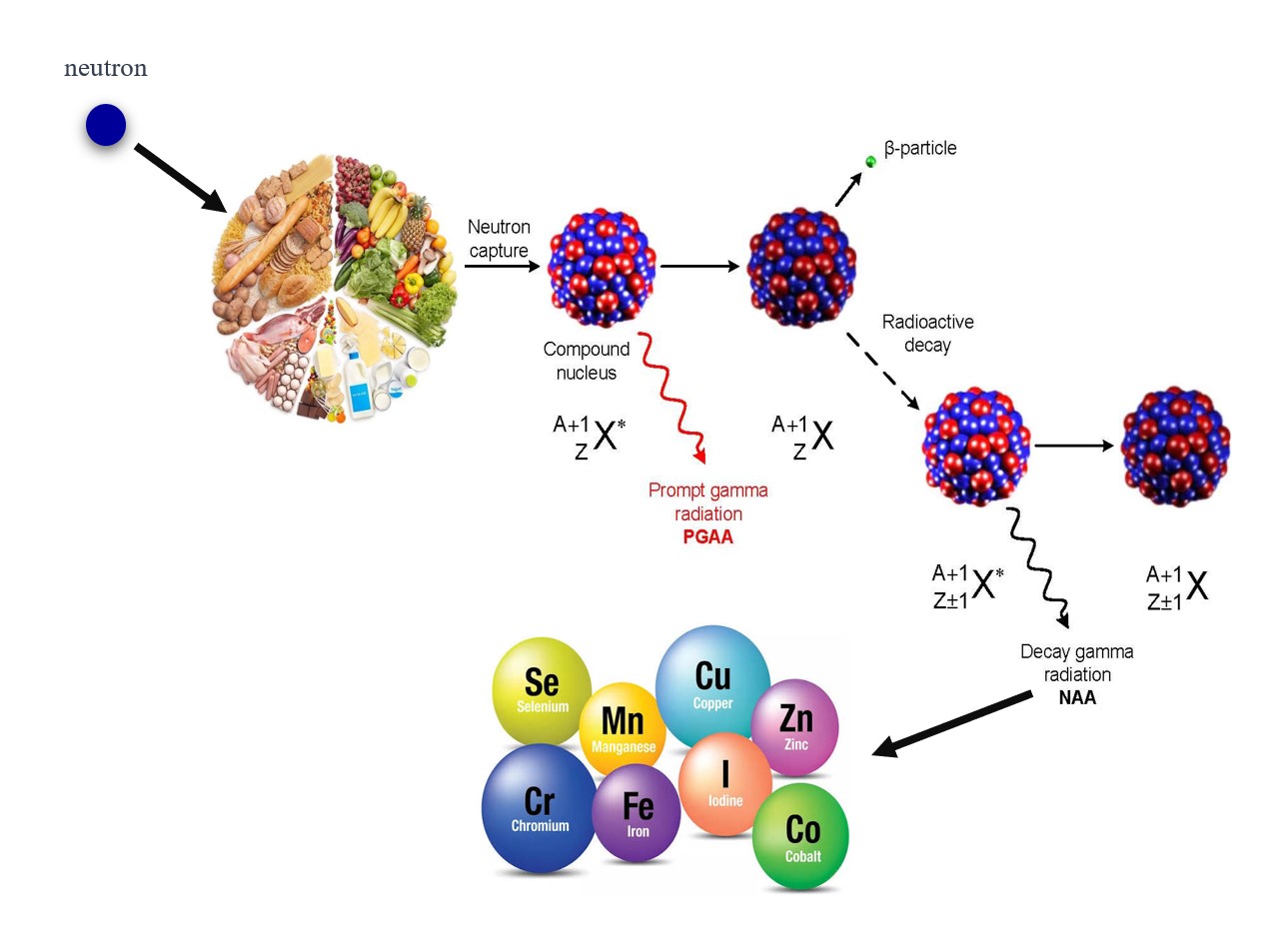
As a high-priority issue for sustainable global development, food security requires attention to both the quantity and quality of food. Trace elements pose a complex challenge for food security in this context; they can be beneficial as essential micronutrients or harmful as toxic contaminants that compromise food safety and public health. Consequently, advanced analytical tools, particularly elemental analysis, are employed to verify food quality, authenticity, and traceability. Since its first application in 1936 neutron activation analysis has proven to be a powerful analytical technique for determining the elemental composition of a wide variety of samples. The method's widespread adoption is due to its numerous benefits, including its multi-element character, non-destructive nature, high sensitivity and precision, ultra-low detection limits, and simple sample preparation. These advantages have led to its use in critical fields such as food safety, agriculture, and environmental monitoring. The paper provides an introduction to the biological role and toxicity of trace elements, discusses the fundamental principles, strengths, and limitations of neutron activation analysis, and presents an overview of NAA applications in food analysis, along with a summary of key findings.
References
[1] O. A. Anani, R. R. Mishra, P. Mishra, J. O. Olomukoro, T. O. T. Imoobe, C. O. Adetunji, Influence of heavy metal on food security: Recent advances, Innovations in Food Technology: Current Perspectives and Future Goals, 2020, pp. 257–267. https://doi.org/10.1007/978-981-15-6121-4_18. DOI: https://doi.org/10.1007/978-981-15-6121-4_18
[2] А. P. Avtsyn, A. A. Zhavoronkov, M. A. Rish, L. С. Strochkova, Human microelementosis: Etiology, classification, organopathology, Moscow: Medicine, 1991. https://cyberleninka.ru/article/n/mikroelementozy-cheloveka-i-puti-korrektsii-ih-defitsita (accessed June 27, 2026).
[3] D. Cannas, E. Loi, M. Serra, D. Firinu, P. Valera, P. Zavattari, Relevance of essential trace elements in nutrition and drinking water for human health and autoimmune disease risk, Nutrients 12 (2020) 2074. https://doi.org/10.3390/NU12072074. DOI: https://doi.org/10.3390/nu12072074
[4] D. J. Swaine, Why trace elements are important, Fuel Process. Technol. 65–66 (2000) 21–33. https://doi.org/10.1016/S0378-3820(99)00073-9. DOI: https://doi.org/10.1016/S0378-3820(99)00073-9
[5] B. M. Sharma, K. Komprdov´a, K. L¨orinczov´a, J. Kuta, P. Pˇribylov´a, M. Scheringer, L. ˇSebejov´a, P. Piler, M. Zvonaˇr, J. Kl´anov´a, Human biomonitoring of essential and toxic trace elements (heavy metals and metalloids) in urine of children, teenagers, and young adults from a Central European cohort in the Czech Republic, J. Expos. Sci. Environ. Epidemiol. 2024 (2024) 1–16. https://doi.org/10.1038/s41370-024-00724-4. DOI: https://doi.org/10.1038/s41370-024-00724-4
[6] World Health Organization. Trace elements in human nutrition and health, 1996.
[7] K. Jomova, M. Makova, S. Y. Alomar, S. H. Alwasel, E. Nepovimova, K. Kuca, C. J. Rhodes, M. Valko, Essential metals in health and disease, Chem. Biol. Interact. 367 (2022) 110173. https://doi.org/10.1016/J.CBI.2022.110173. DOI: https://doi.org/10.1016/j.cbi.2022.110173
[8] M. K. Anke, Essential and toxic effects of macro, trace, and ultratrace elements in the nutrition of man, Elements and Their Compounds in the Environment (2004) 343–367. https://doi.org/10.1002/9783527619634.CH16. DOI: https://doi.org/10.1002/9783527619634.ch16
[9] S. Tan, Y. Yang, Z. Chen, L. Zhao, Z. Yang, H. Dai, W. He, M. Jiang, Y. Yao, K. Huang, L. Li,P. Zhu, S. Xu, M. Zhao, M. Yang, Evaluation of essential and toxic elements in the blood of 0–14-year-old children in Hunan, China from 2013 to 2019: A retrospective analysis, Front. PublicHealth 10 (2022) 739880. https://doi.org/10.3389/FPUBH.2022.739880/BIBTEX. DOI: https://doi.org/10.3389/fpubh.2022.739880
[10] J. H. Swain, S. Minisola, M. S. Razzaque, S. J. Wimalawansa, Minerals and human health: Fromdeficiency to toxicity, Nutrients 17 (2025) 454. https://doi.org/10.3390/NU17030454. DOI: https://doi.org/10.3390/nu17030454
[11] N. Abbaspour, R. Hurrell, R. Kelishadi, Review on iron and its importance for human health,J. Res. Med. Sci. 19 (2014) 164–177. https://pmc.ncbi.nlm.nih.gov/articles/PMC3999603/(accessed August 6, 2025).
[12] S. Elmrayed, S. C. Mottaz, L. Dainelli, H. Salib, H. A. Ghaffar, Y. G. El Gendy, Value for health:How fortified infant cereals provide cost-effective solutions to iron deficiency anaemia in Egypt,Front. Nutr. 12 (2025). https://doi.org/10.3389/FNUT.2025.1570683. DOI: https://doi.org/10.3389/fnut.2025.1570683
[13] Q. Ru, Y. Li, L. Chen, Y. Wu, J. Min, F. Wang, Iron homeostasis and ferroptosis in human diseases:mechanisms and therapeutic prospects, Signal Transduction and Targeted Therapy 9 (2024)1–64. https://doi.org/10.1038/s41392-024-01969-z. DOI: https://doi.org/10.1038/s41392-024-01969-z
[14] W. Maret, Zinc in cellular regulation: The nature and significance of “zinc signals,” Int. J. Mol.Sci. 18 (2017). https://doi.org/10.3390/IJMS18112285. DOI: https://doi.org/10.3390/ijms18112285
[15] M. Maywald, L. Rink, Zinc in human health and infectious diseases, Biomolecules 12 (2022) 1748.https://doi.org/10.3390/BIOM12121748. DOI: https://doi.org/10.3390/biom12121748
[16] A. Mehri, Trace elements in human nutrition (II) — An update, Int. J. Prev. Med. 11 (2020) 2.https://doi.org/10.4103/IJPVM.IJPVM_48_19. DOI: https://doi.org/10.4103/ijpvm.IJPVM_48_19
[17] M. Bost, S. Houdart, M. Oberli, E. Kalonji, J. F. Huneau, I. Margaritis, Dietary copper and humanhealth: Current evidence and unresolved issues, J. Trace Elem. Med. Biol. 35 (2016) 107–115.https://doi.org/10.1016/J.JTEMB.2016.02.006. DOI: https://doi.org/10.1016/j.jtemb.2016.02.006
[18] Copper — Health Professional Fact Sheet (2020). https://ods.od.nih.gov/factsheets/Copper-HealthProfessional/ (accessed August 6, 2025).
[19] R. R. Mendel, F. Bittner, Cell biology of molybdenum, Biochim. Biophys. Acta (BBA) — MolecularCell Research 1763 (2006) 621–635. https://doi.org/10.1016/J.BBAMCR.2006.03.013. DOI: https://doi.org/10.1016/j.bbamcr.2006.03.013
[20] M. Williams, G. D. Todd, N. Roney, J. Crawford, C. Coles, P. R. McClure, J. D. Garey,K. Zaccaria, M. Citra, Health effects, 2012. https://www.ncbi.nlm.nih.gov/books/NBK158868/(accessed August 6, 2025).
[21] S. K. Obeng, M. Kulh´anek, J. Bal´ık, J. ˇCern´y, O. Sedl´aˇr, Manganese: From soil to human health — A comprehensive overview of its biological and environmental significance, Nutrients16 (2024) 3455. https://doi.org/10.3390/NU16203455. DOI: https://doi.org/10.3390/nu16203455
[22] World Health Organization. 10 chemicals of public health concern, 2020. https://www.who.int/news-room/photo-story/detail/10-chemicals-of-public-health-concern (accessed August6, 2025).
[23] R. Kaur, A. Garkal, L. Sarode, P. Bangar, T. Mehta, D. P. Singh, R. Rawal, Understanding arsenictoxicity: Implications for environmental exposure and human health, J. Hazard. Mater.Lett. 5 (2024) 100090. https://doi.org/10.1016/J.HAZL.2023.100090. DOI: https://doi.org/10.1016/j.hazl.2023.100090
[24] M. Kuivenhoven, K. Mason, Arsenic Toxicity, StatPearls, 2023. https://www.ncbi.nlm.nih.gov/books/NBK541125/ (accessed August 9, 2025).
[25] D. D. Das, N. Sharma, P. A. Chawla, Neutron Activation analysis: An excellent nondestructiveanalytical technique for trace metal analysis, Crit. Rev. Anal. Chem. 54 (2024) 2450–2466. https://doi.org/10.1080/10408347.2023.2178841. DOI: https://doi.org/10.1080/10408347.2023.2178841
[26] R. J. C. Brown, M. J. T. Milton, Analytical techniques for trace element analysis: An overview,TrAC Trends in Anal. Chem. 24 (2005) 266–274. https://doi.org/10.1016/J.TRAC.2004.11.010. DOI: https://doi.org/10.1016/j.trac.2004.11.010
[27] E. Bulska, A. Ruszczyсska, Analytical techniques for trace element determination, Phys. Sci. Rev.2 (2017). https://doi.org/10.1515/PSR-2017-8002/MACHINEREADABLECITATION/RIS. DOI: https://doi.org/10.1515/9783110366730-003
[28] B. J. Bolann, R. Rahil-Khazen, H. Henriksen, R. Isrenn, R. J. Ulvik, Evaluation of methods fortrace-element determination with emphasis on their usability in the clinical routine laboratory,Scand. J. Clin. Lab. Invest. 67 (2007) 353–366. https://doi.org/10.1080/00365510601095281. DOI: https://doi.org/10.1080/00365510601095281
[29] A. Dutra Neto, M. A. Maria, A. C. Oliveira Pelaes, R. Ja´cimovi c, Automatic sample changer forneutron activation analysis at CDTN, Brazil, J. Radioanal. Nucl. Chem. 315 (2018) 689–694.https://doi.org/10.1007/S10967-017-5672-5/TABLES/1. DOI: https://doi.org/10.1007/s10967-017-5672-5
[30] Y. Yao, C. Xiao, X. Jin, L. Hua, P. Wang, B. Ni, A multi-detector integrated automation systemof routine INAA, J. Radioanal. Nucl. Chem. 311 (2017) 1265–1269. https://doi.org/10.1007/S10967-016-4992-1/FIGURES/6. DOI: https://doi.org/10.1007/s10967-016-4992-1
[31] S. Landsberger, Discovery of neutron activation analysis, Appl. Radiat. Isot. 189 (2022) 110422.https://doi.org/10.1016/J.APRADISO.2022.110422. DOI: https://doi.org/10.1016/j.apradiso.2022.110422
[32] IAEA. Development of an integrated approach to routine automation of neutron activation analysis,1996. https://www.iaea.org/projects/crp/f12025 (accessed August 8, 2025).
[33] D. R. Smith, M. Nordberg, General chemistry, sampling, analytical methods, and speciation,Handbook on the Toxicology of Metals (2015) 15–44. https://doi.org/10.1016/B978-0-444-59453-2.00002-0. DOI: https://doi.org/10.1016/B978-0-444-59453-2.00002-0
[34] R. R. Greenberg, P. Bode, E. A. De Nadai Fernandes, Neutron activation analysis: A primarymethod of measurement, Spectrochim. Acta Part B At. Spectrosc. 66 (2011) 193–241. https://doi.org/10.1016/J.SAB.2010.12.011. DOI: https://doi.org/10.1016/j.sab.2010.12.011
[35] M. V. Frontasyeva, Neutron activation analysis in the life sciences, Phys. Part. Nucl. 42 (2011)332–378. https://doi.org/10.1134/S1063779611020043. DOI: https://doi.org/10.1134/S1063779611020043
[36] C. S. Munita, M. D. Glascock, R. Hazenfratz, Neutron Activation Analysis: An Overview (2019)179–227. https://doi.org/10.2174/9781681085722119030007. DOI: https://doi.org/10.2174/9781681085722119030007
[37] L. Hamidatou, H. Slamene, T. Akhal, B. Zouranen, L. Hamidatou, H. Slamene, T. Akhal,B. Zouranen, Concepts, instrumentation and techniques of neutron activation analysis, imagingand radioanalytical techniques in interdisciplinary research — Fundamentals and cutting edgeapplications, 2013. https://doi.org/10.5772/53686. DOI: https://doi.org/10.5772/53686
[38] IAE Agency, Quality aspects of research reactor operations for instrumental neutronactivation analysis (2001) 1–60. https://www.iaea.org/publications/6257/quality-aspects-of-research-reactor-operations-for-instrumental-neutron-activation-analysis(accessed August 8, 2025).
[39] M. D. Glascock, An overview of neutron activation analysis, 2003.
[40] V. D. Ho, M. D. Ho, T. V. Ha, Q. T. Tran, D. V. Cao, The upgrading of the cyclic neutron activationanalysis facility at the Dalat research reactor, J. Radioanal. Nucl. Chem. 315 (2018) 703–709.https://doi.org/10.1007/S10967-017-5673-4/TABLES/4. DOI: https://doi.org/10.1007/s10967-017-5673-4
[41] Y. Yonggang, X. Caijin, H. Long, J. Xiangchun, W. Xinghua, L. Jue, Z. Guiying, C. Lei,W. Pingsheng, N. Bangfa, Development of INAA automation at CARR, J. Radioanal. Nucl. Chem.307 (2016) 1651–1656. https://doi.org/10.1007/S10967-015-4557-8/FIGURES/8. DOI: https://doi.org/10.1007/s10967-015-4557-8
[42] D. Grozdov, V. Galustov, I. Zinicovscaia, Modernization on the Regata facility (IBR-2 reactor)designed for instrumental neutron activation analysis, J. Radioanal. Nucl. Chem. 334 (2025) 2435–2442. https://doi.org/10.1007/S10967-025-10014-4. DOI: https://doi.org/10.1007/s10967-025-10014-4
[43] J. Versieck, Neutron activation analysis for the determination of trace elements in biologicalmaterials, Biol. Trace Elem. Res. 43 (1994) 407–413. https://doi.org/10.1007/BF02917342/METRICS. DOI: https://doi.org/10.1007/BF02917342
[44] N. Shirai, S. Sekimoto, M. Ebihara, An evaluation of three halogens (Cl, Br, and I) data from ageological survey of Japan geochemical reference materials by radiochemical neutron activationanalysis, Minerals 14 (2024). https://doi.org/10.3390/MIN14030213/S1. DOI: https://doi.org/10.3390/min14030213
[45] H. A. Saputra, D. Aji, B. T. I. Ali, Asranudin, Emerging analytical techniques for rare earthelement study: Basic principles and cutting-edge developments, Analytica 6 (2025). https://doi.org/10.3390/ANALYTICA6030035. DOI: https://doi.org/10.3390/analytica6030035
[46] P. Kruger, I. J. Gruverman, Neutron activation analysis of homogenized chicken, Int. J. Appl.Radiat. Isot. 13 (1962) 106–110. https://doi.org/10.1016/0020-708X(62)90183-7. DOI: https://doi.org/10.1016/0020-708X(62)90183-7
[47] W. C. Cunningham, W. B. Stroube, Application of an instrumental neutron activation analysisprocedure to analysis of food, Sci. Total Environ. 63 (1987) 29–43. https://doi.org/10.1016/0048-9697(87)90034-9. DOI: https://doi.org/10.1016/0048-9697(87)90034-9
[48] A. Chatt, H. S. Dang, B. B. Fong, C. K. Jayawickreme, L. S. McDowell, D. L. Pegg, Determinationof trace elements in food by neutron activation analysis, J. Radioanal. Nucl. Chem. 124(1988) 65–77. https://doi.org/10.1007/BF02035506/METRICS. DOI: https://doi.org/10.1007/BF02035506
[49] S. Ahmad, M. S. Chaudhary, A. Mannan, I. H. Qureshi, Determination of toxic elements in tea,leaves by instrumental neutron activation analysis, J. Radioanal. Chem. 78 (1983) 375–383. https://doi.org/10.1007/BF02530448/METRICS. DOI: https://doi.org/10.1007/BF02530448
[50] M. Kasrai, M. J. Shoushtarian, M. H. Bozorgzadeh, Determination of trace elements in tea leavesby neutron activation analysis, J. Radioanal. Chem. 41 (1977) 73–79. https://doi.org/10.1007/BF02518043/METRICS. DOI: https://doi.org/10.1007/BF02518043
[51] K. Fujinaga, K. Kudo, Multi-element analysis of Japanese tea leaves by neutron activation analysisand the single comparator method, Anal. Chim. Acta (1979) 75–79. https://doi.org/10.1016/S0003-2670(01)83531-5. DOI: https://doi.org/10.1016/S0003-2670(01)83531-5
[52] M. Chiba, V. Iyengar, R. R. Greenberg, T. Gills, Determination of tin in biological materials byatomic absorption spectrophotometry and neutron activation analysis, Sci. Total Environ. 148(1994) 39–44. https://doi.org/10.1016/0048-9697(94)90371-9. DOI: https://doi.org/10.1016/0048-9697(94)90371-9
[53] M. Dermelj, V. Stibilj, A. R. Byrne, L. Benedik, Z. ˇSlejkovec, R. Ja´cimovi´c, Applicability of neutronactivation analysis (NAA) in quantitative determination of some essential and toxic traceelements in food articles, Z. Lebensm. Unters. Forsch. 202 (1996) 447–450. https://doi.org/10.1007/BF01197263. DOI: https://doi.org/10.1007/BF01197263
[54] V. P. Guinn, M. Gavrilas, Instrumental neutron activation analysis of biological samples, Biol.Trace Elem. Res. 26–27 (1990) 9–16. https://doi.org/10.1007/BF02992653. DOI: https://doi.org/10.1007/BF02992653
[55] F. Grass, M. Bichler, J. Dorner, H. Holzner, A. Ritschel, A. Ramadan, G. P. Westphal,R. Gwozdz, Application of short-lived radionuclides in neutron activation analysis of biologicaland environmental samples, Biol. Trace Elem. Res. 43–45 (1994) 33–46. https://doi.org/10.1007/BF02917297. DOI: https://doi.org/10.1007/BF02917297
[56] E. A. De Nadai Fernandes, G. N. Furlan, R. C. Lima, M. A. Bacchi, S. R. V. Sarri´es, G. A. Sarri´es,Elemental profile of dietary supplements and agricultural byproducts evaluated by neutron activationanalysis, J. Radioanal. Nucl. Chem. 331 (2022) 5487–5492. https://doi.org/10.1007/S10967-022-08662-X/FIGURES/2. DOI: https://doi.org/10.1007/s10967-022-08662-x
[57] V. Zaichick, Instrumental neutron activation analysis of minor and trace elements in food in theRussian region that suffered from the Chernobyl disaster, Food Nutr. Bull. 23 (2002) 191–194.https://doi.org/10.1177/15648265020233s137. DOI: https://doi.org/10.1177/15648265020233S137
[58] I. Zinicovscaia, R. Sturza, I. Gurmeza, K. Vergel, S. Gundorina, G. Duca, Metal bioaccumulationin the soil–leaf–fruit system determined by neutron activation analysis, J. Food Meas. Charact.13 (2019) 592–601. https://doi.org/10.1007/S11694-018-9972-4/TABLES/3. DOI: https://doi.org/10.1007/s11694-018-9972-4
[59] I. Zinicovscaia, R. Sturza, O. Duliu, D. Grozdov, S. Gundorina, A. Ghendov-Mosanu, G. Duca,Major and trace elements in Moldavian orchard soil and fruits: Assessment of anthropogeniccontamination, Intern. J. Environ. Res. Public Health, 17 (2020) 7112. https://doi.org/10.3390/IJERPH17197112. DOI: https://doi.org/10.3390/ijerph17197112
[60] G. De Matuoka, E. Chiocchetti, E. A. De Nadai Fernandes, M. A. Bacchi, R. A. Pazim,S. R. V. Sarri´es, T. M. Tom´e, Mineral composition of fruit by-products evaluated by neutron activationanalysis, J. Radioanal. Nucl. Chem. 297 (2013) 399–404. https://doi.org/10.1007/S10967-012-2392-8/TABLES/5. DOI: https://doi.org/10.1007/s10967-012-2392-8
[61] B. Kuldjanov, N. Osinskaya, E. Danilova, Study of essential and toxic elements in dried fruitsof the Tashkent Region using the method of neutron activation analysis, AIP Conf. Proc. 3020(2024). https://doi.org/10.1063/5.0192796. DOI: https://doi.org/10.1063/5.0192796
[62] A. Michenaud-Rague, S. Robinson, S. Landsberger, Trace elements in 11 fruits widely-consumedin the USA as determined by neutron activation analysis, J. Radioanal. Nucl. Chem. 291 (2012)237–240. https://doi.org/10.1007/S10967-011-1266-9/TABLES/5. DOI: https://doi.org/10.1007/s10967-011-1266-9
[63] S. Waheed, N. Siddique, Evaluation of dietary status with respect to trace element intake fromdry fruits consumed in Pakistan: A study using instrumental neutron activation analysis, Int. J.Food Sci. Nutr. 60 (2009) 333–343. https://doi.org/10.1080/09637480801987641. DOI: https://doi.org/10.1080/09637480801987641
[64] Determination of chromium in some selected foods and vegetables in Zaria, Nigeria, WhitesScience Journal. https://www.whitesscience.com/product/determination-of-chromium-in-someselected-foods-and-vegetables-in-zaria-nigeria/ (accessed September 19, 2025).
[65] S. Said, H. Bounouira, H. Amsil, I. Aarab, A. Badague, S. El Basraoui, A. Moussaif,B. Benazzouz, Major and trace elements determination in organic and conventional Moroccanvegetables using the k0-standardisation method of neutron activation analysis, Nucl. Anal. 3(2024) 100127. https://doi.org/10.1016/J.NUCANA.2024.100127. DOI: https://doi.org/10.1016/j.nucana.2024.100127
[66] P. Nekhoroshkov, J. Bezuidenhout, R. le Roux, I. Zinicovscaia, N. Yushin, M. Frontasyeva, Temporaltrends of risks in consumption of wild and farmed mussels in 2013–2019 in the SaldanhaBay area (South Africa), J. Food Compos. Anal. 131 (2024) 106193. https://doi.org/10.1016/J.JFCA.2024.106193. DOI: https://doi.org/10.1016/j.jfca.2024.106193
[67] P. Nekhoroshkov, I. Zinicovscaia, K. Vergel, D. Grozdov, O. Chaligava, A. Kravtsova, Macro- andmicroelements and radionuclides in the mussel Mytilus galloprovincialis from recreational andharbor sites of the Crimean Peninsula (the Black Sea), Hydrobiology 1 (2022) 304–316. https://doi.org/10.3390/HYDROBIOLOGY1030022/S1. DOI: https://doi.org/10.3390/hydrobiology1030022
[68] P. Nekhoroshkov, J. Bezuidenhout, I. Zinicovscaia, N. Yushin, K. Vergel, M. Frontasyeva, Levelsof elements in typical mussels from the southern coast of Africa (Namibia, South Africa, Mozambique):Safety aspect, Water 13 (2021) 3238. https://doi.org/10.3390/W13223238. DOI: https://doi.org/10.3390/w13223238
[69] M. B. Alamin, A. M. Bejey, J. Kuˇcera, J. Mizera, Determination of mercury and selenium in consumedfood items in Libya using instrumental and radiochemical NAA, J. Radioanal. Nucl. Chem.270 (2006) 143–146. https://doi.org/10.1007/S10967-006-0321-4/METRICS. DOI: https://doi.org/10.1007/s10967-006-0321-4
[70] C. Galinha, M. C. Freitas, A. M. G. Pacheco, J. Kamen´ık, J. Kuˇcera, H. M. Anawar, J. Coutinho, B. Ma¸c˜as, A. S. Almeida, Selenium determination in cereal plants and cultivation soils by radiochemicalneutron activation analysis, J. Radioanal. Nucl. Chem. 294 (2012) 349–354. https://doi.org/10.1007/S10967-011-1510-3/FIGURES/2. DOI: https://doi.org/10.1007/s10967-011-1510-3
[71] Elemental evaluation of local cereal by instrumental neutron activation analysis using NIRR-1facility. https://www.researchgate.net/publication/259744487_Elemental_evaluation_of_local_cereal_by_instrumental_neutron_activation_analysis_using_NIRR-1_facility(accessed September 19, 2025).
[72] M. J. A. Armelin, M. J. A. Armelin, V. A. Maihara, S. M. F. Cozzolino, P. S. C. Silva, M. Saiki,Concentrations of Se, Ba, Zn and Mn in Brazil nuts, Braz. J. Radiat. Sci. 7 (2019). https://doi.org/10.15392/bjrs.v7i2A.701. DOI: https://doi.org/10.15392/bjrs.v7i2A.701
[73] L. Zote, B. Kakki, A. Buragohain, K. Lalrammawia, Lalrinhlupuii, Malsawmtluangi, N. Marak,R. B. Muthukumaran, L. Jahau, B. Khiangte, J. Ralte, N. Yushin, P. Nekhoroshkov, D. Grozdov,I. Zinicovscaia, O. G. Duliu, Essential and presumably contaminating trace elements in Indianareca (Areca catechu L.) nut and their potential health effect, Rom. Rep. Phys. 77 (2025). https://doi.org/10.59277/ROMREPPHYS.2025.77.701. DOI: https://doi.org/10.59277/RomRepPhys.2025.77.701
[74] A. Pantelica, A. Ene, I. I. Georgescu, Instrumental neutron activation analysis of some fish speciesfrom Danube River in Romania, Microchem. J. 103 (2012) 142–147. https://doi.org/10.1016/J.MICROC.2012.02.005. DOI: https://doi.org/10.1016/j.microc.2012.02.005
[75] L. Zikovsky, K. Soliman, Neutron activation analysis of cheese, eggs, fish, fowl and meats, J.Radioanal. Nucl. Chem. 251 (2002) 507–509. https://doi.org/10.1023/A:1014811031616. DOI: https://doi.org/10.1023/A:1014811031616
[76] E. Avigliano, C. Lozano, R. R. Pl´a, A. V. Volpedo, Toxic element determination in fish fromParan´a River delta (Argentina) by neutron activation analysis: Tissue distribution and accumulationand health risk assessment by direct consumption, J. Food Compos. Anal. 54 (2016)27–36. https://doi.org/10.1016/J.JFCA.2016.09.011. DOI: https://doi.org/10.1016/j.jfca.2016.09.011
[77] S. Waheed, S. Rahman, K. P. Gill, INAA and AAS of different products from sugar cane industryin Pakistan: Toxic trace elements for nutritional safety, J. Radioanal. Nucl. Chem. 279 (2009)725–731. https://doi.org/10.1007/S10967-008-7332-2. DOI: https://doi.org/10.1007/s10967-008-7332-2
[78] I. Zinicovscaia, O. G. Duliu, O. A. Culicov, R. Sturza, C. Bilici, S. Gundorina, Geographical originidentification of Moldavian wines by neutron activation analysis, Food Anal. Meth. 10 (2017)3523–3530. https://doi.org/10.1007/S12161-017-0913-3/FIGURES/2. DOI: https://doi.org/10.1007/s12161-017-0913-3
[79] T. Stafilov, Determination of major and trace elements in wine by k0-instrumental neutron activationanalysis. https://www.academia.edu/14936880/Determination_of_major_and_trace_elements_in_wine_by_k_sub_0_instrumental_neutron_activation_analysis (accessedSeptember 19, 2025).
[80] R. A. Lagad, D. Alamelu, R. Acharya, S. K. Aggarwal, Instrumental neutron activation analysisfor multi-elemental determination in Indian tea samples, J. Radioanal. Nucl. Chem. 288 (2011)613–620. https://doi.org/10.1007/S10967-010-0978-6. DOI: https://doi.org/10.1007/s10967-010-0978-6
[81] B. S. Jooybari, H. Rezaei, M. K. Saadi, Essential and non-essential elements analysis in black teasand their extraction efficiency using neutron activation analysis, Asian J. Chem. 37 (2025) 1331–1338. https://doi.org/10.14233/AJCHEM.2025.33709. DOI: https://doi.org/10.14233/ajchem.2025.33709
[82] L. de Lima, E. A. De Nadai Fernandes, S. R. V. Sarri´es, M. A. Bacchi, R. C. de Lima,G. R. Moreira, Neutron activation analysis for development of organic coffee leaves referencematerial, J. Radioanal. Nucl. Chem. 333 (2024) 6707–6714. https://doi.org/10.1007/S10967-024-09745-7. DOI: https://doi.org/10.1007/s10967-024-09745-7
[83] M. Messaoudi, S. Begaa, L. Hamidatou, M. Salhi, H. Ouakouak, M. Mouzai, A. Hassani, Neutronactivation analysis of major and trace elements in Arabica and Robusta coffee beans samplesconsumed in Algeria, Radiochim. Acta 106 (2018) 525–533. https://doi.org/10.1515/RACT-2017-2875. DOI: https://doi.org/10.1515/ract-2017-2875
License

This work is licensed under a Creative Commons Attribution-NonCommercial 4.0 International License.