

Аннотация
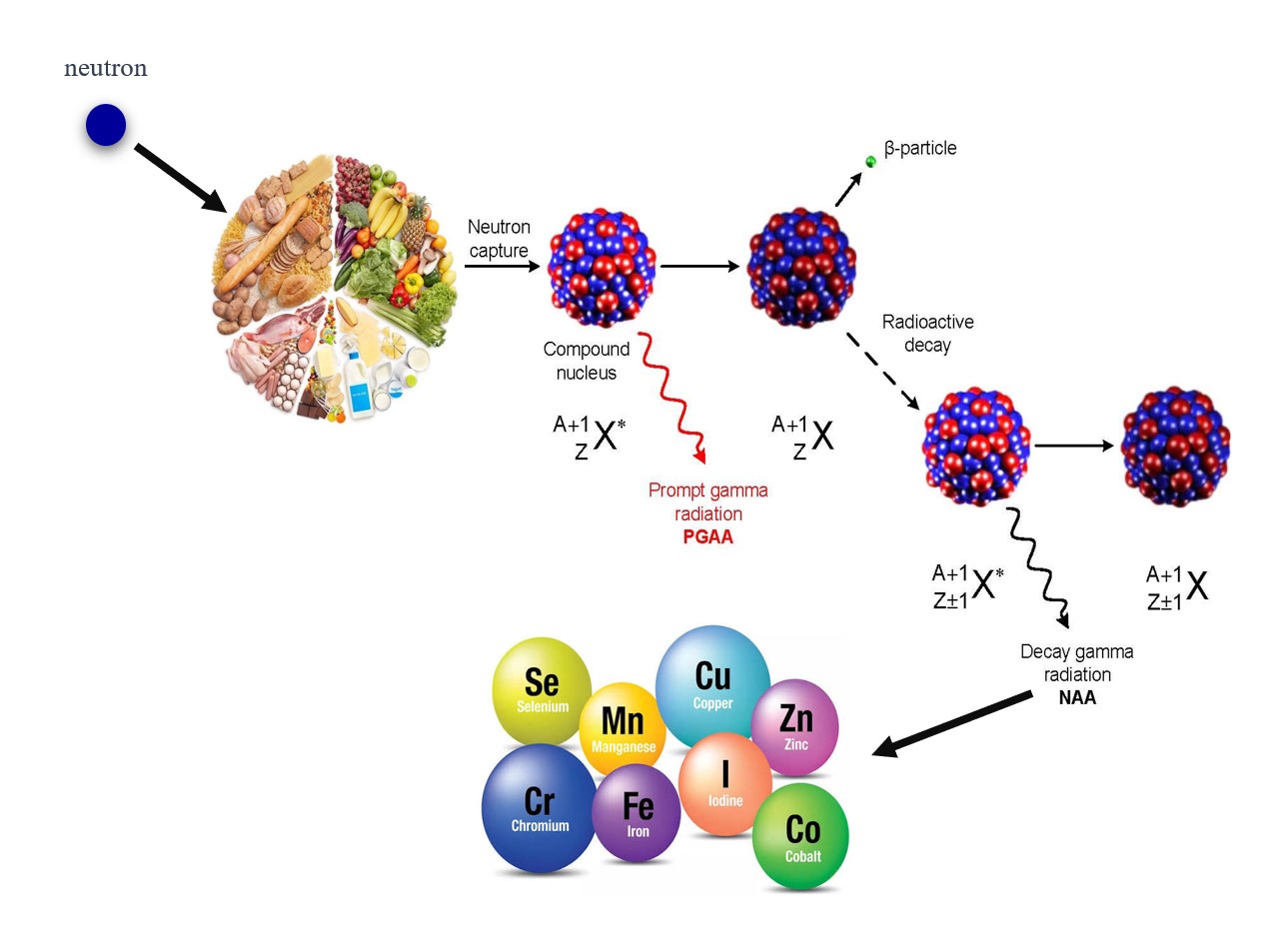
Являясь одной из приоритетных задач устойчивого глобального развития, продовольственная безопасность требует внимания как к количеству, так и к качеству пищевых продуктов. В данном контексте микроэлементы представляют сложную проблему для продовольственной безопасности: они могут быть полезны как эссенциальные микронутриенты или вредны как токсичные загрязнители, ставящие под угрозу безопасность продуктов питания и здоровье населения. Следовательно, для проверки качества, подлинности и прослеживаемости продуктов питания используются передовые аналитические инструменты, в частности элементный анализ. С момента первого применения в 1936 году нейтронно-активационный анализ зарекомендовал себя как мощный аналитический метод для определения элементного состава самых разнообразных образцов. Широкое распространение метода обусловлено его многочисленными преимуществами, включая многоэлементность, неразрушающий характер, высокую чувствительность и точность, сверхнизкие пределы обнаружения и простую пробоподготовку. Эти преимущества обусловили его использование в таких ключевых областях, как безопасность пищевых продуктов, сельское хозяйство и экологический мониторинг. В статье представлено введение в биологическую роль и токсичность микроэлементов, обсуждаются основные принципы, преимущества и ограничения нейтронно-активационного анализа, а также дан обзор применений НАА в анализе пищевых продуктов, наряду с кратким изложением основных результатов.
Библиографические ссылки
[1] O. A. Anani, R. R. Mishra, P. Mishra, J. O. Olomukoro, T. O. T. Imoobe, C. O. Adetunji, Influence of heavy metal on food security: Recent advances, Innovations in Food Technology: Current Perspectives and Future Goals, 2020, pp. 257–267. https://doi.org/10.1007/978-981-15-6121-4_18. DOI: https://doi.org/10.1007/978-981-15-6121-4_18
[2] А. P. Avtsyn, A. A. Zhavoronkov, M. A. Rish, L. С. Strochkova, Human microelementosis: Etiology, classification, organopathology, Moscow: Medicine, 1991. https://cyberleninka.ru/article/n/mikroelementozy-cheloveka-i-puti-korrektsii-ih-defitsita (accessed June 27, 2026).
[3] D. Cannas, E. Loi, M. Serra, D. Firinu, P. Valera, P. Zavattari, Relevance of essential trace elements in nutrition and drinking water for human health and autoimmune disease risk, Nutrients 12 (2020) 2074. https://doi.org/10.3390/NU12072074. DOI: https://doi.org/10.3390/nu12072074
[4] D. J. Swaine, Why trace elements are important, Fuel Process. Technol. 65–66 (2000) 21–33. https://doi.org/10.1016/S0378-3820(99)00073-9. DOI: https://doi.org/10.1016/S0378-3820(99)00073-9
[5] B. M. Sharma, K. Komprdov´a, K. L¨orinczov´a, J. Kuta, P. Pˇribylov´a, M. Scheringer, L. ˇSebejov´a, P. Piler, M. Zvonaˇr, J. Kl´anov´a, Human biomonitoring of essential and toxic trace elements (heavy metals and metalloids) in urine of children, teenagers, and young adults from a Central European cohort in the Czech Republic, J. Expos. Sci. Environ. Epidemiol. 2024 (2024) 1–16. https://doi.org/10.1038/s41370-024-00724-4. DOI: https://doi.org/10.1038/s41370-024-00724-4
[6] World Health Organization. Trace elements in human nutrition and health, 1996.
[7] K. Jomova, M. Makova, S. Y. Alomar, S. H. Alwasel, E. Nepovimova, K. Kuca, C. J. Rhodes, M. Valko, Essential metals in health and disease, Chem. Biol. Interact. 367 (2022) 110173. https://doi.org/10.1016/J.CBI.2022.110173. DOI: https://doi.org/10.1016/j.cbi.2022.110173
[8] M. K. Anke, Essential and toxic effects of macro, trace, and ultratrace elements in the nutrition of man, Elements and Their Compounds in the Environment (2004) 343–367. https://doi.org/10.1002/9783527619634.CH16. DOI: https://doi.org/10.1002/9783527619634.ch16
[9] S. Tan, Y. Yang, Z. Chen, L. Zhao, Z. Yang, H. Dai, W. He, M. Jiang, Y. Yao, K. Huang, L. Li,P. Zhu, S. Xu, M. Zhao, M. Yang, Evaluation of essential and toxic elements in the blood of 0–14-year-old children in Hunan, China from 2013 to 2019: A retrospective analysis, Front. PublicHealth 10 (2022) 739880. https://doi.org/10.3389/FPUBH.2022.739880/BIBTEX. DOI: https://doi.org/10.3389/fpubh.2022.739880
[10] J. H. Swain, S. Minisola, M. S. Razzaque, S. J. Wimalawansa, Minerals and human health: Fromdeficiency to toxicity, Nutrients 17 (2025) 454. https://doi.org/10.3390/NU17030454. DOI: https://doi.org/10.3390/nu17030454
[11] N. Abbaspour, R. Hurrell, R. Kelishadi, Review on iron and its importance for human health,J. Res. Med. Sci. 19 (2014) 164–177. https://pmc.ncbi.nlm.nih.gov/articles/PMC3999603/(accessed August 6, 2025).
[12] S. Elmrayed, S. C. Mottaz, L. Dainelli, H. Salib, H. A. Ghaffar, Y. G. El Gendy, Value for health:How fortified infant cereals provide cost-effective solutions to iron deficiency anaemia in Egypt,Front. Nutr. 12 (2025). https://doi.org/10.3389/FNUT.2025.1570683. DOI: https://doi.org/10.3389/fnut.2025.1570683
[13] Q. Ru, Y. Li, L. Chen, Y. Wu, J. Min, F. Wang, Iron homeostasis and ferroptosis in human diseases:mechanisms and therapeutic prospects, Signal Transduction and Targeted Therapy 9 (2024)1–64. https://doi.org/10.1038/s41392-024-01969-z. DOI: https://doi.org/10.1038/s41392-024-01969-z
[14] W. Maret, Zinc in cellular regulation: The nature and significance of “zinc signals,” Int. J. Mol.Sci. 18 (2017). https://doi.org/10.3390/IJMS18112285. DOI: https://doi.org/10.3390/ijms18112285
[15] M. Maywald, L. Rink, Zinc in human health and infectious diseases, Biomolecules 12 (2022) 1748.https://doi.org/10.3390/BIOM12121748. DOI: https://doi.org/10.3390/biom12121748
[16] A. Mehri, Trace elements in human nutrition (II) — An update, Int. J. Prev. Med. 11 (2020) 2.https://doi.org/10.4103/IJPVM.IJPVM_48_19. DOI: https://doi.org/10.4103/ijpvm.IJPVM_48_19
[17] M. Bost, S. Houdart, M. Oberli, E. Kalonji, J. F. Huneau, I. Margaritis, Dietary copper and humanhealth: Current evidence and unresolved issues, J. Trace Elem. Med. Biol. 35 (2016) 107–115.https://doi.org/10.1016/J.JTEMB.2016.02.006. DOI: https://doi.org/10.1016/j.jtemb.2016.02.006
[18] Copper — Health Professional Fact Sheet (2020). https://ods.od.nih.gov/factsheets/Copper-HealthProfessional/ (accessed August 6, 2025).
[19] R. R. Mendel, F. Bittner, Cell biology of molybdenum, Biochim. Biophys. Acta (BBA) — MolecularCell Research 1763 (2006) 621–635. https://doi.org/10.1016/J.BBAMCR.2006.03.013. DOI: https://doi.org/10.1016/j.bbamcr.2006.03.013
[20] M. Williams, G. D. Todd, N. Roney, J. Crawford, C. Coles, P. R. McClure, J. D. Garey,K. Zaccaria, M. Citra, Health effects, 2012. https://www.ncbi.nlm.nih.gov/books/NBK158868/(accessed August 6, 2025).
[21] S. K. Obeng, M. Kulh´anek, J. Bal´ık, J. ˇCern´y, O. Sedl´aˇr, Manganese: From soil to human health — A comprehensive overview of its biological and environmental significance, Nutrients16 (2024) 3455. https://doi.org/10.3390/NU16203455. DOI: https://doi.org/10.3390/nu16203455
[22] World Health Organization. 10 chemicals of public health concern, 2020. https://www.who.int/news-room/photo-story/detail/10-chemicals-of-public-health-concern (accessed August6, 2025).
[23] R. Kaur, A. Garkal, L. Sarode, P. Bangar, T. Mehta, D. P. Singh, R. Rawal, Understanding arsenictoxicity: Implications for environmental exposure and human health, J. Hazard. Mater.Lett. 5 (2024) 100090. https://doi.org/10.1016/J.HAZL.2023.100090. DOI: https://doi.org/10.1016/j.hazl.2023.100090
[24] M. Kuivenhoven, K. Mason, Arsenic Toxicity, StatPearls, 2023. https://www.ncbi.nlm.nih.gov/books/NBK541125/ (accessed August 9, 2025).
[25] D. D. Das, N. Sharma, P. A. Chawla, Neutron Activation analysis: An excellent nondestructiveanalytical technique for trace metal analysis, Crit. Rev. Anal. Chem. 54 (2024) 2450–2466. https://doi.org/10.1080/10408347.2023.2178841. DOI: https://doi.org/10.1080/10408347.2023.2178841
[26] R. J. C. Brown, M. J. T. Milton, Analytical techniques for trace element analysis: An overview,TrAC Trends in Anal. Chem. 24 (2005) 266–274. https://doi.org/10.1016/J.TRAC.2004.11.010. DOI: https://doi.org/10.1016/j.trac.2004.11.010
[27] E. Bulska, A. Ruszczyсska, Analytical techniques for trace element determination, Phys. Sci. Rev.2 (2017). https://doi.org/10.1515/PSR-2017-8002/MACHINEREADABLECITATION/RIS. DOI: https://doi.org/10.1515/9783110366730-003
[28] B. J. Bolann, R. Rahil-Khazen, H. Henriksen, R. Isrenn, R. J. Ulvik, Evaluation of methods fortrace-element determination with emphasis on their usability in the clinical routine laboratory,Scand. J. Clin. Lab. Invest. 67 (2007) 353–366. https://doi.org/10.1080/00365510601095281. DOI: https://doi.org/10.1080/00365510601095281
[29] A. Dutra Neto, M. A. Maria, A. C. Oliveira Pelaes, R. Ja´cimovi c, Automatic sample changer forneutron activation analysis at CDTN, Brazil, J. Radioanal. Nucl. Chem. 315 (2018) 689–694.https://doi.org/10.1007/S10967-017-5672-5/TABLES/1. DOI: https://doi.org/10.1007/s10967-017-5672-5
[30] Y. Yao, C. Xiao, X. Jin, L. Hua, P. Wang, B. Ni, A multi-detector integrated automation systemof routine INAA, J. Radioanal. Nucl. Chem. 311 (2017) 1265–1269. https://doi.org/10.1007/S10967-016-4992-1/FIGURES/6. DOI: https://doi.org/10.1007/s10967-016-4992-1
[31] S. Landsberger, Discovery of neutron activation analysis, Appl. Radiat. Isot. 189 (2022) 110422.https://doi.org/10.1016/J.APRADISO.2022.110422. DOI: https://doi.org/10.1016/j.apradiso.2022.110422
[32] IAEA. Development of an integrated approach to routine automation of neutron activation analysis,1996. https://www.iaea.org/projects/crp/f12025 (accessed August 8, 2025).
[33] D. R. Smith, M. Nordberg, General chemistry, sampling, analytical methods, and speciation,Handbook on the Toxicology of Metals (2015) 15–44. https://doi.org/10.1016/B978-0-444-59453-2.00002-0. DOI: https://doi.org/10.1016/B978-0-444-59453-2.00002-0
[34] R. R. Greenberg, P. Bode, E. A. De Nadai Fernandes, Neutron activation analysis: A primarymethod of measurement, Spectrochim. Acta Part B At. Spectrosc. 66 (2011) 193–241. https://doi.org/10.1016/J.SAB.2010.12.011. DOI: https://doi.org/10.1016/j.sab.2010.12.011
[35] M. V. Frontasyeva, Neutron activation analysis in the life sciences, Phys. Part. Nucl. 42 (2011)332–378. https://doi.org/10.1134/S1063779611020043. DOI: https://doi.org/10.1134/S1063779611020043
[36] C. S. Munita, M. D. Glascock, R. Hazenfratz, Neutron Activation Analysis: An Overview (2019)179–227. https://doi.org/10.2174/9781681085722119030007. DOI: https://doi.org/10.2174/9781681085722119030007
[37] L. Hamidatou, H. Slamene, T. Akhal, B. Zouranen, L. Hamidatou, H. Slamene, T. Akhal,B. Zouranen, Concepts, instrumentation and techniques of neutron activation analysis, imagingand radioanalytical techniques in interdisciplinary research — Fundamentals and cutting edgeapplications, 2013. https://doi.org/10.5772/53686. DOI: https://doi.org/10.5772/53686
[38] IAE Agency, Quality aspects of research reactor operations for instrumental neutronactivation analysis (2001) 1–60. https://www.iaea.org/publications/6257/quality-aspects-of-research-reactor-operations-for-instrumental-neutron-activation-analysis(accessed August 8, 2025).
[39] M. D. Glascock, An overview of neutron activation analysis, 2003.
[40] V. D. Ho, M. D. Ho, T. V. Ha, Q. T. Tran, D. V. Cao, The upgrading of the cyclic neutron activationanalysis facility at the Dalat research reactor, J. Radioanal. Nucl. Chem. 315 (2018) 703–709.https://doi.org/10.1007/S10967-017-5673-4/TABLES/4. DOI: https://doi.org/10.1007/s10967-017-5673-4
[41] Y. Yonggang, X. Caijin, H. Long, J. Xiangchun, W. Xinghua, L. Jue, Z. Guiying, C. Lei,W. Pingsheng, N. Bangfa, Development of INAA automation at CARR, J. Radioanal. Nucl. Chem.307 (2016) 1651–1656. https://doi.org/10.1007/S10967-015-4557-8/FIGURES/8. DOI: https://doi.org/10.1007/s10967-015-4557-8
[42] D. Grozdov, V. Galustov, I. Zinicovscaia, Modernization on the Regata facility (IBR-2 reactor)designed for instrumental neutron activation analysis, J. Radioanal. Nucl. Chem. 334 (2025) 2435–2442. https://doi.org/10.1007/S10967-025-10014-4. DOI: https://doi.org/10.1007/s10967-025-10014-4
[43] J. Versieck, Neutron activation analysis for the determination of trace elements in biologicalmaterials, Biol. Trace Elem. Res. 43 (1994) 407–413. https://doi.org/10.1007/BF02917342/METRICS. DOI: https://doi.org/10.1007/BF02917342
[44] N. Shirai, S. Sekimoto, M. Ebihara, An evaluation of three halogens (Cl, Br, and I) data from ageological survey of Japan geochemical reference materials by radiochemical neutron activationanalysis, Minerals 14 (2024). https://doi.org/10.3390/MIN14030213/S1. DOI: https://doi.org/10.3390/min14030213
[45] H. A. Saputra, D. Aji, B. T. I. Ali, Asranudin, Emerging analytical techniques for rare earthelement study: Basic principles and cutting-edge developments, Analytica 6 (2025). https://doi.org/10.3390/ANALYTICA6030035. DOI: https://doi.org/10.3390/analytica6030035
[46] P. Kruger, I. J. Gruverman, Neutron activation analysis of homogenized chicken, Int. J. Appl.Radiat. Isot. 13 (1962) 106–110. https://doi.org/10.1016/0020-708X(62)90183-7. DOI: https://doi.org/10.1016/0020-708X(62)90183-7
[47] W. C. Cunningham, W. B. Stroube, Application of an instrumental neutron activation analysisprocedure to analysis of food, Sci. Total Environ. 63 (1987) 29–43. https://doi.org/10.1016/0048-9697(87)90034-9. DOI: https://doi.org/10.1016/0048-9697(87)90034-9
[48] A. Chatt, H. S. Dang, B. B. Fong, C. K. Jayawickreme, L. S. McDowell, D. L. Pegg, Determinationof trace elements in food by neutron activation analysis, J. Radioanal. Nucl. Chem. 124(1988) 65–77. https://doi.org/10.1007/BF02035506/METRICS. DOI: https://doi.org/10.1007/BF02035506
[49] S. Ahmad, M. S. Chaudhary, A. Mannan, I. H. Qureshi, Determination of toxic elements in tea,leaves by instrumental neutron activation analysis, J. Radioanal. Chem. 78 (1983) 375–383. https://doi.org/10.1007/BF02530448/METRICS. DOI: https://doi.org/10.1007/BF02530448
[50] M. Kasrai, M. J. Shoushtarian, M. H. Bozorgzadeh, Determination of trace elements in tea leavesby neutron activation analysis, J. Radioanal. Chem. 41 (1977) 73–79. https://doi.org/10.1007/BF02518043/METRICS. DOI: https://doi.org/10.1007/BF02518043
[51] K. Fujinaga, K. Kudo, Multi-element analysis of Japanese tea leaves by neutron activation analysisand the single comparator method, Anal. Chim. Acta (1979) 75–79. https://doi.org/10.1016/S0003-2670(01)83531-5. DOI: https://doi.org/10.1016/S0003-2670(01)83531-5
[52] M. Chiba, V. Iyengar, R. R. Greenberg, T. Gills, Determination of tin in biological materials byatomic absorption spectrophotometry and neutron activation analysis, Sci. Total Environ. 148(1994) 39–44. https://doi.org/10.1016/0048-9697(94)90371-9. DOI: https://doi.org/10.1016/0048-9697(94)90371-9
[53] M. Dermelj, V. Stibilj, A. R. Byrne, L. Benedik, Z. ˇSlejkovec, R. Ja´cimovi´c, Applicability of neutronactivation analysis (NAA) in quantitative determination of some essential and toxic traceelements in food articles, Z. Lebensm. Unters. Forsch. 202 (1996) 447–450. https://doi.org/10.1007/BF01197263. DOI: https://doi.org/10.1007/BF01197263
[54] V. P. Guinn, M. Gavrilas, Instrumental neutron activation analysis of biological samples, Biol.Trace Elem. Res. 26–27 (1990) 9–16. https://doi.org/10.1007/BF02992653. DOI: https://doi.org/10.1007/BF02992653
[55] F. Grass, M. Bichler, J. Dorner, H. Holzner, A. Ritschel, A. Ramadan, G. P. Westphal,R. Gwozdz, Application of short-lived radionuclides in neutron activation analysis of biologicaland environmental samples, Biol. Trace Elem. Res. 43–45 (1994) 33–46. https://doi.org/10.1007/BF02917297. DOI: https://doi.org/10.1007/BF02917297
[56] E. A. De Nadai Fernandes, G. N. Furlan, R. C. Lima, M. A. Bacchi, S. R. V. Sarri´es, G. A. Sarri´es,Elemental profile of dietary supplements and agricultural byproducts evaluated by neutron activationanalysis, J. Radioanal. Nucl. Chem. 331 (2022) 5487–5492. https://doi.org/10.1007/S10967-022-08662-X/FIGURES/2. DOI: https://doi.org/10.1007/s10967-022-08662-x
[57] V. Zaichick, Instrumental neutron activation analysis of minor and trace elements in food in theRussian region that suffered from the Chernobyl disaster, Food Nutr. Bull. 23 (2002) 191–194.https://doi.org/10.1177/15648265020233s137. DOI: https://doi.org/10.1177/15648265020233S137
[58] I. Zinicovscaia, R. Sturza, I. Gurmeza, K. Vergel, S. Gundorina, G. Duca, Metal bioaccumulationin the soil–leaf–fruit system determined by neutron activation analysis, J. Food Meas. Charact.13 (2019) 592–601. https://doi.org/10.1007/S11694-018-9972-4/TABLES/3. DOI: https://doi.org/10.1007/s11694-018-9972-4
[59] I. Zinicovscaia, R. Sturza, O. Duliu, D. Grozdov, S. Gundorina, A. Ghendov-Mosanu, G. Duca,Major and trace elements in Moldavian orchard soil and fruits: Assessment of anthropogeniccontamination, Intern. J. Environ. Res. Public Health, 17 (2020) 7112. https://doi.org/10.3390/IJERPH17197112. DOI: https://doi.org/10.3390/ijerph17197112
[60] G. De Matuoka, E. Chiocchetti, E. A. De Nadai Fernandes, M. A. Bacchi, R. A. Pazim,S. R. V. Sarri´es, T. M. Tom´e, Mineral composition of fruit by-products evaluated by neutron activationanalysis, J. Radioanal. Nucl. Chem. 297 (2013) 399–404. https://doi.org/10.1007/S10967-012-2392-8/TABLES/5. DOI: https://doi.org/10.1007/s10967-012-2392-8
[61] B. Kuldjanov, N. Osinskaya, E. Danilova, Study of essential and toxic elements in dried fruitsof the Tashkent Region using the method of neutron activation analysis, AIP Conf. Proc. 3020(2024). https://doi.org/10.1063/5.0192796. DOI: https://doi.org/10.1063/5.0192796
[62] A. Michenaud-Rague, S. Robinson, S. Landsberger, Trace elements in 11 fruits widely-consumedin the USA as determined by neutron activation analysis, J. Radioanal. Nucl. Chem. 291 (2012)237–240. https://doi.org/10.1007/S10967-011-1266-9/TABLES/5. DOI: https://doi.org/10.1007/s10967-011-1266-9
[63] S. Waheed, N. Siddique, Evaluation of dietary status with respect to trace element intake fromdry fruits consumed in Pakistan: A study using instrumental neutron activation analysis, Int. J.Food Sci. Nutr. 60 (2009) 333–343. https://doi.org/10.1080/09637480801987641. DOI: https://doi.org/10.1080/09637480801987641
[64] Determination of chromium in some selected foods and vegetables in Zaria, Nigeria, WhitesScience Journal. https://www.whitesscience.com/product/determination-of-chromium-in-someselected-foods-and-vegetables-in-zaria-nigeria/ (accessed September 19, 2025).
[65] S. Said, H. Bounouira, H. Amsil, I. Aarab, A. Badague, S. El Basraoui, A. Moussaif,B. Benazzouz, Major and trace elements determination in organic and conventional Moroccanvegetables using the k0-standardisation method of neutron activation analysis, Nucl. Anal. 3(2024) 100127. https://doi.org/10.1016/J.NUCANA.2024.100127. DOI: https://doi.org/10.1016/j.nucana.2024.100127
[66] P. Nekhoroshkov, J. Bezuidenhout, R. le Roux, I. Zinicovscaia, N. Yushin, M. Frontasyeva, Temporaltrends of risks in consumption of wild and farmed mussels in 2013–2019 in the SaldanhaBay area (South Africa), J. Food Compos. Anal. 131 (2024) 106193. https://doi.org/10.1016/J.JFCA.2024.106193. DOI: https://doi.org/10.1016/j.jfca.2024.106193
[67] P. Nekhoroshkov, I. Zinicovscaia, K. Vergel, D. Grozdov, O. Chaligava, A. Kravtsova, Macro- andmicroelements and radionuclides in the mussel Mytilus galloprovincialis from recreational andharbor sites of the Crimean Peninsula (the Black Sea), Hydrobiology 1 (2022) 304–316. https://doi.org/10.3390/HYDROBIOLOGY1030022/S1. DOI: https://doi.org/10.3390/hydrobiology1030022
[68] P. Nekhoroshkov, J. Bezuidenhout, I. Zinicovscaia, N. Yushin, K. Vergel, M. Frontasyeva, Levelsof elements in typical mussels from the southern coast of Africa (Namibia, South Africa, Mozambique):Safety aspect, Water 13 (2021) 3238. https://doi.org/10.3390/W13223238. DOI: https://doi.org/10.3390/w13223238
[69] M. B. Alamin, A. M. Bejey, J. Kuˇcera, J. Mizera, Determination of mercury and selenium in consumedfood items in Libya using instrumental and radiochemical NAA, J. Radioanal. Nucl. Chem.270 (2006) 143–146. https://doi.org/10.1007/S10967-006-0321-4/METRICS. DOI: https://doi.org/10.1007/s10967-006-0321-4
[70] C. Galinha, M. C. Freitas, A. M. G. Pacheco, J. Kamen´ık, J. Kuˇcera, H. M. Anawar, J. Coutinho, B. Ma¸c˜as, A. S. Almeida, Selenium determination in cereal plants and cultivation soils by radiochemicalneutron activation analysis, J. Radioanal. Nucl. Chem. 294 (2012) 349–354. https://doi.org/10.1007/S10967-011-1510-3/FIGURES/2. DOI: https://doi.org/10.1007/s10967-011-1510-3
[71] Elemental evaluation of local cereal by instrumental neutron activation analysis using NIRR-1facility. https://www.researchgate.net/publication/259744487_Elemental_evaluation_of_local_cereal_by_instrumental_neutron_activation_analysis_using_NIRR-1_facility(accessed September 19, 2025).
[72] M. J. A. Armelin, M. J. A. Armelin, V. A. Maihara, S. M. F. Cozzolino, P. S. C. Silva, M. Saiki,Concentrations of Se, Ba, Zn and Mn in Brazil nuts, Braz. J. Radiat. Sci. 7 (2019). https://doi.org/10.15392/bjrs.v7i2A.701. DOI: https://doi.org/10.15392/bjrs.v7i2A.701
[73] L. Zote, B. Kakki, A. Buragohain, K. Lalrammawia, Lalrinhlupuii, Malsawmtluangi, N. Marak,R. B. Muthukumaran, L. Jahau, B. Khiangte, J. Ralte, N. Yushin, P. Nekhoroshkov, D. Grozdov,I. Zinicovscaia, O. G. Duliu, Essential and presumably contaminating trace elements in Indianareca (Areca catechu L.) nut and their potential health effect, Rom. Rep. Phys. 77 (2025). https://doi.org/10.59277/ROMREPPHYS.2025.77.701. DOI: https://doi.org/10.59277/RomRepPhys.2025.77.701
[74] A. Pantelica, A. Ene, I. I. Georgescu, Instrumental neutron activation analysis of some fish speciesfrom Danube River in Romania, Microchem. J. 103 (2012) 142–147. https://doi.org/10.1016/J.MICROC.2012.02.005. DOI: https://doi.org/10.1016/j.microc.2012.02.005
[75] L. Zikovsky, K. Soliman, Neutron activation analysis of cheese, eggs, fish, fowl and meats, J.Radioanal. Nucl. Chem. 251 (2002) 507–509. https://doi.org/10.1023/A:1014811031616. DOI: https://doi.org/10.1023/A:1014811031616
[76] E. Avigliano, C. Lozano, R. R. Pl´a, A. V. Volpedo, Toxic element determination in fish fromParan´a River delta (Argentina) by neutron activation analysis: Tissue distribution and accumulationand health risk assessment by direct consumption, J. Food Compos. Anal. 54 (2016)27–36. https://doi.org/10.1016/J.JFCA.2016.09.011. DOI: https://doi.org/10.1016/j.jfca.2016.09.011
[77] S. Waheed, S. Rahman, K. P. Gill, INAA and AAS of different products from sugar cane industryin Pakistan: Toxic trace elements for nutritional safety, J. Radioanal. Nucl. Chem. 279 (2009)725–731. https://doi.org/10.1007/S10967-008-7332-2. DOI: https://doi.org/10.1007/s10967-008-7332-2
[78] I. Zinicovscaia, O. G. Duliu, O. A. Culicov, R. Sturza, C. Bilici, S. Gundorina, Geographical originidentification of Moldavian wines by neutron activation analysis, Food Anal. Meth. 10 (2017)3523–3530. https://doi.org/10.1007/S12161-017-0913-3/FIGURES/2. DOI: https://doi.org/10.1007/s12161-017-0913-3
[79] T. Stafilov, Determination of major and trace elements in wine by k0-instrumental neutron activationanalysis. https://www.academia.edu/14936880/Determination_of_major_and_trace_elements_in_wine_by_k_sub_0_instrumental_neutron_activation_analysis (accessedSeptember 19, 2025).
[80] R. A. Lagad, D. Alamelu, R. Acharya, S. K. Aggarwal, Instrumental neutron activation analysisfor multi-elemental determination in Indian tea samples, J. Radioanal. Nucl. Chem. 288 (2011)613–620. https://doi.org/10.1007/S10967-010-0978-6. DOI: https://doi.org/10.1007/s10967-010-0978-6
[81] B. S. Jooybari, H. Rezaei, M. K. Saadi, Essential and non-essential elements analysis in black teasand their extraction efficiency using neutron activation analysis, Asian J. Chem. 37 (2025) 1331–1338. https://doi.org/10.14233/AJCHEM.2025.33709. DOI: https://doi.org/10.14233/ajchem.2025.33709
[82] L. de Lima, E. A. De Nadai Fernandes, S. R. V. Sarri´es, M. A. Bacchi, R. C. de Lima,G. R. Moreira, Neutron activation analysis for development of organic coffee leaves referencematerial, J. Radioanal. Nucl. Chem. 333 (2024) 6707–6714. https://doi.org/10.1007/S10967-024-09745-7. DOI: https://doi.org/10.1007/s10967-024-09745-7
[83] M. Messaoudi, S. Begaa, L. Hamidatou, M. Salhi, H. Ouakouak, M. Mouzai, A. Hassani, Neutronactivation analysis of major and trace elements in Arabica and Robusta coffee beans samplesconsumed in Algeria, Radiochim. Acta 106 (2018) 525–533. https://doi.org/10.1515/RACT-2017-2875. DOI: https://doi.org/10.1515/ract-2017-2875
Лицензия

Это произведение доступно по лицензии Creative Commons «Attribution-NonCommercial» («Атрибуция — Некоммерческое использование») 4.0 Всемирная.