

Аннотация
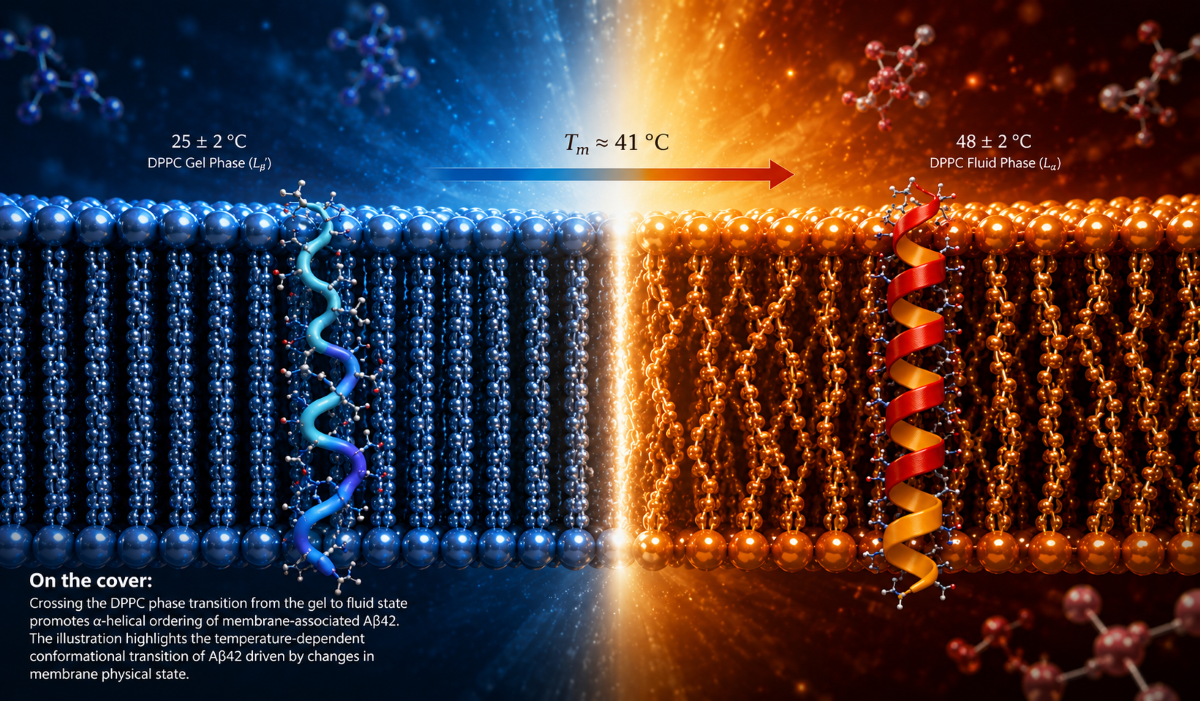
На конформационное поведение пептида амилоида-β42 (Aβ42) существенное влияние оказывает физическое состояние окружающего его липидного окружения. Влияние температуры на структуру Aβ42 в бислоях дипальмитоилфосфатидилхолина (DPPC) исследовалось с использованием методов кругового дихроизма (КД), рамановской спектроскопии и молекулярной динамики (МД). В исследовании рассматривались две температурные фазы: комнатная температура (RT ≈ (25±2)°C), соответствующая гель-фазе DPPC, и (48±2)°C, отвечающая жидкокристаллической фазе, выше температуры фазового перехода липидов. Измерения методом КД-спектроскопии показали явный температурно-зависимый структурный переход пептида. При комнатной температуре пептид Aβ42 характеризовался конформацией, обогащенной β-структурами, тогда как при температуре (48±2)°C спектры указывали на заметное увеличение доли α-спиралей, что свидетельствует об усилении упорядоченности полипептидной цепи в условиях жидкофазного состояния. Рамановский спектральный анализ подтвердил эту тенденцию, продемонстрировав увеличение вклада α-спиральных компонентов, сопровождающееся уменьшением доли β-структур при нагревании. Незначительные изменения колебательных маркеров липидов также указывали на повышенную гибкость ацильных цепей и возросшую текучесть бислоя в высокотемпературном состоянии. Кроме того, МД-моделирование выявило увеличение содержания α-спиральных структур и более глубокое внедрение пептидов в неупорядоченный бислой по сравнению с упорядоченной гелевой фазой. Результаты экспериментальных и вычислительных исследований показывают, что текучесть мембраны выше фазового перехода DPPC способствует стабилизации α-спиральной структуры Aβ42. Также подчёркивается важность температуры как ключевого параметра, который определяет конформационное равновесие между пептидами и липидами. Полученные результаты обеспечивают фундаментальную основу для понимания того, как температурные условия модулируют взаимодействия амилоида с мембраной, что важно для выяснения ранних молекулярных событий, связанных с патологиями, вызванными амилоидом.
Поддерживающие организации
Библиографические ссылки
[1] D. J. Selkoe, J. Hardy, The amyloid hypothesis of Alzheimer’s disease at 25 years, EMBO Mol. Med. 8 (2016) 595. DOI: https://doi.org/10.15252/emmm.201606210
[2] F. Chiti, C. M. Dobson, Protein misfolding, amyloid formation, and human disease: A summary of progress over the last decade, Ann. Rev. Biochem. 86 (2017) 27. DOI: https://doi.org/10.1146/annurev-biochem-061516-045115
[3] N. G. Sgourakis, Y. Yan, S. A. McCallum, C. Wang, A. E. Garcia, The Alzheimer’s peptides Abeta40 and 42 adopt distinct conformations in water: A combined MD/NMR study, J. Mol. Biol. 368 (2007) 1448. DOI: https://doi.org/10.1016/j.jmb.2007.02.093
[4] S. Chakraborty, P. Das, Emergence of alternative structures in amyloid beta 1–42 monomeric landscape by N-terminal hexapeptide amyloid inhibitors, Sci. Rep. 7 (2017) 9941. DOI: https://doi.org/10.1038/s41598-017-10212-5
[5] L. Tran, N. Basdevant, C. Prévost, T. Ha-Duong, Structure of ring-shaped Aβ42 oligomers determined by conformational selection, Sci. Rep. 6 (2016) 21429. DOI: https://doi.org/10.1038/srep21429
[6] S. De, D. C. Wirthensohn, P. Flagmeier, C. Hughes, F. A. Aprile, F. S. Ruggeri, D. R. Whiten, D. Emin, Z. Xia, J. A. Varela, P. Sormanni, F. Kundel, T. P. J. Knowles, C. M. Dobson, C. Bryant, M. Vendruscolo, D. Klenerman, Different soluble aggregates of Aβ42 can give rise to cellular toxicity through different mechanisms, Nat. Commun. 10 (2019) 1541. DOI: https://doi.org/10.1038/s41467-019-09477-3
[7] I. V. J. Murray, L. Liu, H. Komatsu, K. Uryu, G. Xiao, J. A. Lawson, P. H. Axelsen, Membranemediated amyloidogenesis and the promotion of oxidative lipid damage by amyloid beta proteins, J. Biol. Chem. 282 (2007) 9335. DOI: https://doi.org/10.1074/jbc.M608589200
[8] V. Corradi, B. I. Sejdiu, H. Mesa-Galloso, H. Abdizadeh, S. Y. Noskov, S. J. Marrink, D. P. Tieleman, Emerging diversity in lipid–protein interactions, Chem. Rev. 119 (2019) 5775. DOI: https://doi.org/10.1021/acs.chemrev.8b00451
[9] M. P. Muller, T. Jiang, C. Sun, M. Lihan, S. Pant, P. Mahinthichaichan, A. Trifan, E. Tajkhorshid, Characterization of lipid–protein interactions and lipid-mediated modulation of membrane protein function through molecular simulation, Chem. Rev. 119 (2019) 6086. DOI: https://doi.org/10.1021/acs.chemrev.8b00608
[10] S. Ciudad, E. Puig, T. Botzanowski, M. Meigooni, A. S. Arango, J. Do, M. Mayzel, M. Bayoumi, S. Chaignepain, G. Maglia, S. Cianferani, V. Orekhov, E. Tajkhorshid, B. Bardiaux, N. Carulla, Aβ(1–42) tetramer and octamer structures reveal edge conductivity pores as a mechanism for membrane damage, Nat. Commun. 11 (2020) 3014. DOI: https://doi.org/10.1038/s41467-020-16566-1
[11] M. F. M. Sciacca, C. La Rosa, D. Milardi, Amyloid-Mediated Mechanisms of Membrane Disruption, in: Biophysica, 2021, p. 137. DOI: https://doi.org/10.3390/biophysica1020011
[12] O. Crescenzi, S. Tomaselli, R. Guerrini, S. Salvadori, A. M. D’Ursi, P. A. Temussi, D. Picone, Solution structure of the Alzheimer amyloid β-peptide (1–42) in an apolar microenvironment, Eur. J. Biochem. 269 (2002) 5642. DOI: https://doi.org/10.1046/j.1432-1033.2002.03271.x
[13] T. R. Molugu, R. L. Thurmond, T. M. Alam, T. P. Trouard, M. F. Brown, Phospholipid headgroups govern area per lipid and emergent elastic properties of bilayers, Biophys. J. 121 (2022) 4205. DOI: https://doi.org/10.1016/j.bpj.2022.09.005
[14] P. Maleš, Z. Brkljača, I. Crnolatac, D. Petrov, D. Bakarić, Phase-dependent adsorption of myelin basic protein to phosphatidylcholine lipid bilayers, Membranes (Basel) 14 (2024). DOI: https://doi.org/10.3390/membranes14010015
[15] J. F. Nagle, S. Tristram-Nagle, Structure of lipid bilayers, Biochim. Biophys. Acta 1469 (2000) 159. DOI: https://doi.org/10.1016/S0304-4157(00)00016-2
[16] W. Chen, F. Duša, J. Witos, S.-K. Ruokonen, S. K. Wiedmer, Determination of the main phase transition temperature of phospholipids by nanoplasmonic sensing, Sci. Rep. 8 (2018) 14815. DOI: https://doi.org/10.1038/s41598-018-33107-5
[17] N. Kučerka, M. P. Nieh, J. Katsaras, Fluid phase lipid areas and bilayer thicknesses of commonly used phosphatidylcholines as a function of temperature, Biochim. Biophys. Acta 1808 (2011) 2761. DOI: https://doi.org/10.1016/j.bbamem.2011.07.022
[18] G. Neunert, J. Tomaszewska-Gras, A. Baj, M. Gauza-W lodarczyk, S. Witkowski, K. Polewski, Phase transitions and structural changes in DPPC liposomes induced by a 1-carba alphatocopherol analogue, Molecules 26 (2021). DOI: https://doi.org/10.3390/molecules26102851
[19] R. N. Lewis, R. N. McElhaney, Fourier transform infrared spectroscopy in the study of lipid phase transitions in model and biological membranes: Practical considerations, Methods Mol. Biol. 400 (2007) 207. DOI: https://doi.org/10.1007/978-1-59745-519-0_14
[20] D. A. Pink, S. McNeil, B. Quinn, M. J. Zuckermann, A model of hydrogen bond formation in phosphatidylethanolamine bilayers, Biochim. Biophys. Acta 1368 (1998) 289. DOI: https://doi.org/10.1016/S0005-2736(97)00196-X
[21] V. A. Lorenz-Fonfria, Infrared difference spectroscopy of proteins: From bands to bonds, Chem. Rev. 120 (2020) 3466. DOI: https://doi.org/10.1021/acs.chemrev.9b00449
[22] S. M. Kelly, T. J. Jess, N. C. Price, How to study proteins by circular dichroism, Biochim. Biophys. Acta 1751 (2005) 119. DOI: https://doi.org/10.1016/j.bbapap.2005.06.005
[23] S. U. Sane, S. M. Cramer, T. M. Przybycien, A holistic approach to protein secondary structure characterization using Amide I band Raman spectroscopy, Anal. Biochem. 269 (1999) 255. DOI: https://doi.org/10.1006/abio.1999.4034
[24] N. J. Greenfield, Using circular dichroism spectra to estimate protein secondary structure, Nat. Protoc. 1 (2006) 2876. DOI: https://doi.org/10.1038/nprot.2006.202
[25] P. S. Kumagai, A. P. U. Araujo, J. L. S. Lopes, Going deep into protein secondary structure with synchrotron radiation circular dichroism spectroscopy, Biophys. Rev. 9 (2017) 517. DOI: https://doi.org/10.1007/s12551-017-0314-2
[26] Z. D. Schultz, I. W. Levin, Vibrational spectroscopy of biomembranes, Ann. Rev. Anal. Chem. (Palo Alto Calif) 4 (2011) 343. DOI: https://doi.org/10.1146/annurev-anchem-061010-114048
[27] P. N. Jemmett, D. C. Milan, R. J. Nichols, T. Howitt, A. L. Martin, T. Arnold, J. L. Rawle, C. L. Nicklin, T. R. Dafforn, L. R. Cox, S. L. Horswell, Influence of the lipid backbone on electrochemical phase behavior, Langmuir 38 (2022) 14290. DOI: https://doi.org/10.1021/acs.langmuir.2c02370
[28] A. Botan, F. Favela-Rosales, P. F. J. Fuchs, M. Javanainen, M. Kanduč, W. Kulig, A. Lamberg, C. Loison, A. Lyubartsev, M. S. Miettinen, L. Monticelli, J. Määttä, O. H. S. Ollila, M. Retegan, T. R´og, H. Santuz, J. Tynkkynen, Toward atomistic resolution structure of phosphatidylcholine headgroup and glycerol backbone at different ambient conditions, J. Phys. Chem. B 119 (2015) 15075. DOI: https://doi.org/10.1021/acs.jpcb.5b04878
[29] J. A. Lemkul, D. R. Bevan, Destabilizing Alzheimer’s beta(42) protofibrils with morin: Mechanistic insights from molecular dynamics simulations, Biochem. 49 (2010) 3935. DOI: https://doi.org/10.1021/bi1000855
[30] N. Sreerama, R. W. Woody, A self-consistent method for the analysis of protein secondary structure from circular dichroism, Anal. Biochem. 209 (1993) 32. DOI: https://doi.org/10.1006/abio.1993.1079
[31] S. W. Provencher, J. Gl¨ockner, Estimation of globular protein secondary structure from circular dichroism, Biochem. 20 (1981) 33. DOI: https://doi.org/10.1021/bi00504a006
[32] N. Sreerama, R. W. Woody, Estimation of protein secondary structure from circular dichroism spectra: Comparison of CONTIN, SELCON, and CDSSTR methods with an expanded reference set, Anal. Biochem. 287 (2000) 252. DOI: https://doi.org/10.1006/abio.2000.4880
[33] S. Jo, T. Kim, V. G. Iyer, W. Im, CHARMM-GUI: A web-based graphical user interface for CHARMM, J. Comput. Chem. 29 (2008) 1859. DOI: https://doi.org/10.1002/jcc.20945
[34] S. Tomaselli, V. Esposito, P. Vangone, N. A. J. van Nuland, A. M. J. J. Bonvin, R. Guerrini, T. Tancredi, P. A. Temussi, D. Picone, The α-to-β conformational transition of Alzheimer’s Aβ-(1–42) peptide in aqueous media is reversible: A step by step conformational analysis suggests the location of β conformation seeding, ChemBioChem 7 (2006) 257. DOI: https://doi.org/10.1002/cbic.200500223
[35] W. L. Jorgensen, J. Chandrasekhar, J. D. Madura, R. W. Impey, M. L. Klein, Comparison of simple potential functions for simulating liquid water, J. Chem. Phys. 79 (1983) 926. DOI: https://doi.org/10.1063/1.445869
[36] J. Huang, A. D. MacKerell, Jr. CHARMM36 all-atom additive protein force field: Validation based on comparison to NMR data, J. Comput. Chem. 34 (2013) 2135. DOI: https://doi.org/10.1002/jcc.23354
[37] K. A. A. Abdeljawaad, Y. Arynbek, K. Mamatkulov, H. Duc Le, M. A. A. Ibrahim, G. A. H. Mekhemer, G. Arzumanyan, pH modulates amyloid-β42 conformation in lipid membranes: Evidence from circular dichroism, Raman spectroscopy, and molecular dynamics simulations, J. Biomol. Struct. Dyn. (2025) 1. DOI: https://doi.org/10.1080/07391102.2025.2572296
[38] M. J. Abraham, T. Murtola, R. Schulz, S. P´all, J. C. Smith, B. Hess, E. Lindahl, GROMACS: High performance molecular simulations through multi-level parallelism from laptops to supercomputers, SoftwareX 1–2 (2015) 19. DOI: https://doi.org/10.1016/j.softx.2015.06.001
[39] M. Parrinello, A. Rahman, Polymorphic transitions in single crystals: A new molecular dynamics method, J. Appl. Phys. 52 (1981) 7182. DOI: https://doi.org/10.1063/1.328693
[40] T. Darden, D. York, L. Pedersen, Particle mesh Ewald: An N · log (N) method for Ewald sums in large systems, J. Chem. Phys. 98 (1993) 10089. DOI: https://doi.org/10.1063/1.464397
[41] W. Humphrey, A. Dalke, K. Schulten, VMD: Visual molecular dynamics, J. Mol. Graph. 14 (1996) 33. DOI: https://doi.org/10.1016/0263-7855(96)00018-5
[42] S. Zavatski, H. Bandarenka, L. Hetma´nczyk, J. Hetma´nczyk, M. Vorobyeva, Y. Arynbek, K. Mamatkulov, G. Arzumanyan, Model phospholipid interaction with cholesterol and melatonin: Raman spectroscopy and density functional theory study, J. Raman Spectrosc. 53 (2022) 1540. DOI: https://doi.org/10.1002/jrs.6409
[43] S. Kint, P. H. Wermer, J. R. Scherer, Raman spectra of hydrated phospholipid bilayers. 2. Water and head-group interactions, J. Phys. Chem. 96 (1992) 446. DOI: https://doi.org/10.1021/j100180a082
[44] A. Lörincz, J. Mihály, C. Németh, A. Wacha, A. Bóta, A. Effects of ursolic acid on the structural and morphological behaviours of dipalmitoyl lecithin vesicles, Biochim. Biophys. Acta (BBA) — Biomembr. 1848 (2015) 1092. DOI: https://doi.org/10.1016/j.bbamem.2015.01.010
[45] A. Fasanella, K. Cosentino, A. Beneduci, G. Chidichimo, E. Cazzanelli, R. C. Barberi, M. Castriota, Thermal structural evolutions of DMPC-water biomimetic systems investigated by Raman spectroscopy, Biochim. Biophys. Acta (BBA) — Biomembr. 1860 (2018) 1253. DOI: https://doi.org/10.1016/j.bbamem.2018.02.021
[46] R. Gharib, A. Najjar, L. Auezova, C. Charcosset, H. Greige-Gerges, Interaction of selected phenylpropenes with dipalmitoylphosphatidylcholine membrane and their relevance to antibacterial activity, J. Membr. Biol. 250 (2017) 259. DOI: https://doi.org/10.1007/s00232-017-9957-y
[47] T. Kondela, E. Dushanov, M. Vorobyeva, K. Mamatkulov, E. Drolle, D. Soloviov, P. Hrubovčák, K. Kholmurodov, G. Arzumanyan, Z. Leonenko, N. Kuˇcerka, Investigating the competitive effects of cholesterol and melatonin in model lipid membranes, Biochim. Biophys. Acta (BBA)— Biomembr. 1863 (2021) 183651. DOI: https://doi.org/10.1016/j.bbamem.2021.183651
[48] Y. V. Zaytseva, S. V. Adichtchev, N. V. Surovtsev, Raman study of temperature-induced hydrocarbon chain disorder in saturated phosphatidylcholines, Chem. Phys. Lipids 230 (2020) 104926. DOI: https://doi.org/10.1016/j.chemphyslip.2020.104926
[49] R. N. A. H. Lewis, R. N. McElhaney, Membrane lipid phase transitions and phase organization studied by Fourier transform infrared spectroscopy, Biochim. Biophys. Acta (BBA— Biomembr. 1828 (2013) 2347. DOI: https://doi.org/10.1016/j.bbamem.2012.10.018
[50] S. Kurakin, D. Badreeva, E. Dushanov, A. Shutikov, S. Efimov, A. Timerova, T. Mukhametzyanov, T. Murugova, O. Ivankov, K. Mamatkulov, G. Arzumanyan, V. Klochkov, N. Kuˇcerka, Arrangement of lipid vesicles and bicelle-like structures formed in the presence of Aβ(25–35) peptide, Biochim. Biophys. Acta (BBA) — Biomembr. 1866 (2024) 184237. DOI: https://doi.org/10.1016/j.bbamem.2023.184237
[51] Z. Movasaghi, S. Rehman, I. U. Rehman, Raman spectroscopy of biological tissues, Appl. Spectrosc. Rev. 42 (2007) 493. DOI: https://doi.org/10.1080/05704920701551530
[52] A. V. Veluthandath, W. Ahmed, J. Madsen, H. W. Clark, A. D. Postle, J. S. Wilkinson, G. S. Murugan, Quantification of lung surfactant lipid (dipalmitoylphosphatidylcholine/sphingomyelin) ratio in binary liposomes using Raman spectroscopy, J. Raman Spectrosc. 55 (2024) 386. DOI: https://doi.org/10.1002/jrs.6631
[53] H. A. Esawii, K. Mamatkulov, H. A. Mahran, G. Arzumanyan, N. Mohamed, Investigation into Alzheimer’s-related amyloid-β conformational transformations and stability influenced by green iron oxide nanoparticles (GIONP), Intern. J. Biol. Macromol. 298 (2025) 140124. DOI: https://doi.org/10.1016/j.ijbiomac.2025.140124
[54] S. Rivas-Arancibia, E. Rodriguez-Martinez, I. Badillo-Ramirez, U. Lopez-Gonzalez, J. M. Saniger, Structural changes of amyloid beta in hippocampus of rats exposed to ozone: A Raman spectroscopy study, Front. Mol. Neurosci. 10 (2017) 137. DOI: https://doi.org/10.3389/fnmol.2017.00137
[55] C. Mensch, P. Bultinck, C. Johannessen, The effect of protein backbone hydration on the amide vibrations in Raman and Raman optical activity spectra, Phys. Chem. Chem. Phys. 21 (2019) 1988. DOI: https://doi.org/10.1039/C8CP06423G
[56] S. Ramos, J. C. Lee, Raman spectroscopy in the study of amyloid formation and phase separation, Biochem. Soc. Trans. 52 (2024) 1121. DOI: https://doi.org/10.1042/BST20230599
[57] S.-Y. Lin, H.-L. Chu, H.-L. Wei, Secondary conformations and temperature effect on structural transformation of amyloid β(1–28), (1–40) and (1–42) peptides, J. Biomol. Struct. Dyn. 20 (2003) 595. DOI: https://doi.org/10.1080/07391102.2003.10506876
[58] N. C. Maiti, M. M. Apetri, M. G. Zagorski, P. R. Carey, V. E. Anderson, Raman spectroscopic characterization of secondary structure in natively unfolded proteins: α-synuclein, J. Am. Chem. Soc. 126 (2004) 2399. DOI: https://doi.org/10.1021/ja0356176
[59] A. Sadat, I. J. Joye, Peak Fitting Applied to Fourier transform infrared and Raman spectroscopic analysis of proteins, in: Appl. Sci., 2020. DOI: https://doi.org/10.3390/app10175918
[60] S. Ngarize, H. Herman, A. Adams, N. Howell, Comparison of changes in the secondary structure of unheated, heated, and high-pressure-treated β-lactoglobulin and qvalbumin proteins using Fourier transform Raman spectroscopy and self-deconvolution, J. Agric. Food Chem. 51 (2004) 6470. DOI: https://doi.org/10.1021/jf030649y
[61] F. Tofoleanu, N.-V. Buchete, Alzheimer Aβ peptide interactions with lipid membranes, Prion 6 (2012) 339. DOI: https://doi.org/10.4161/pri.21022
[62] H. Ahyayauch, M. E. Masserini, A. Alonso, F. M. Go˜ni, Understanding Aβ peptide binding to lipid membranes: A biophysical perspective, in: Intern. J. Mol. Sci., 2024. DOI: https://doi.org/10.20944/preprints202404.1947.v1
[63] M. Yang, K. Wang, J. Lin, L. Wang, F. Wei, J. Zhu, W. Zheng, L. Shen, Gel phase membrane retards amyloid β-peptide (1–42) fibrillation by restricting slaved diffusion of peptides on lipid bilayers, Langmuir 34 (2018) 8408. DOI: https://doi.org/10.1021/acs.langmuir.8b01315
[64] C. Poojari, A. Kukol, B. Strodel, How the amyloid-β peptide and membranes affect each other: An extensive simulation study, Biochim. Biophys. Acta (BBA) — Biomembr. 1828 (2013) 327. DOI: https://doi.org/10.1016/j.bbamem.2012.09.001
[65] B. Shivu, S. Seshadri, J. Li, K. A. Oberg, V. N. Uversky, A. L. Fink, Distinct β-sheet structure in protein aggregates determined by ATR–FTIR spectroscopy, Biochem. 52 (2013) 5176. DOI: https://doi.org/10.1021/bi400625v
[66] M. Suzuki, T. Miura, Effect of amyloid β-peptide on the fluidity of phosphatidylcholine membranes: Uses and limitations of diphenylhexatriene fluorescence anisotropy, Biochim. Biophys. Acta (BBA) — Biomembr. 1848 (2015) 753.
[67] M. Inayathullah, D. B. Teplow, Structural dynamics of the ΔE22 (Osaka) familial Alzheimer’s disease-linked amyloid β-protein, Amyloid 18 (2011) 98. DOI: https://doi.org/10.3109/13506129.2011.580399
[68] M. Suzuki, T. Miura, Effect of amyloid β-peptide on the fluidity of phosphatidylcholine membranes: Uses and limitations of diphenylhexatriene fluorescence anisotropy, Biochim. Biophys. Acta 1848 (2015) 753. DOI: https://doi.org/10.1016/j.bbamem.2014.12.003
Лицензия

Это произведение доступно по лицензии Creative Commons «Attribution-NonCommercial» («Атрибуция — Некоммерческое использование») 4.0 Всемирная.