

Abstract
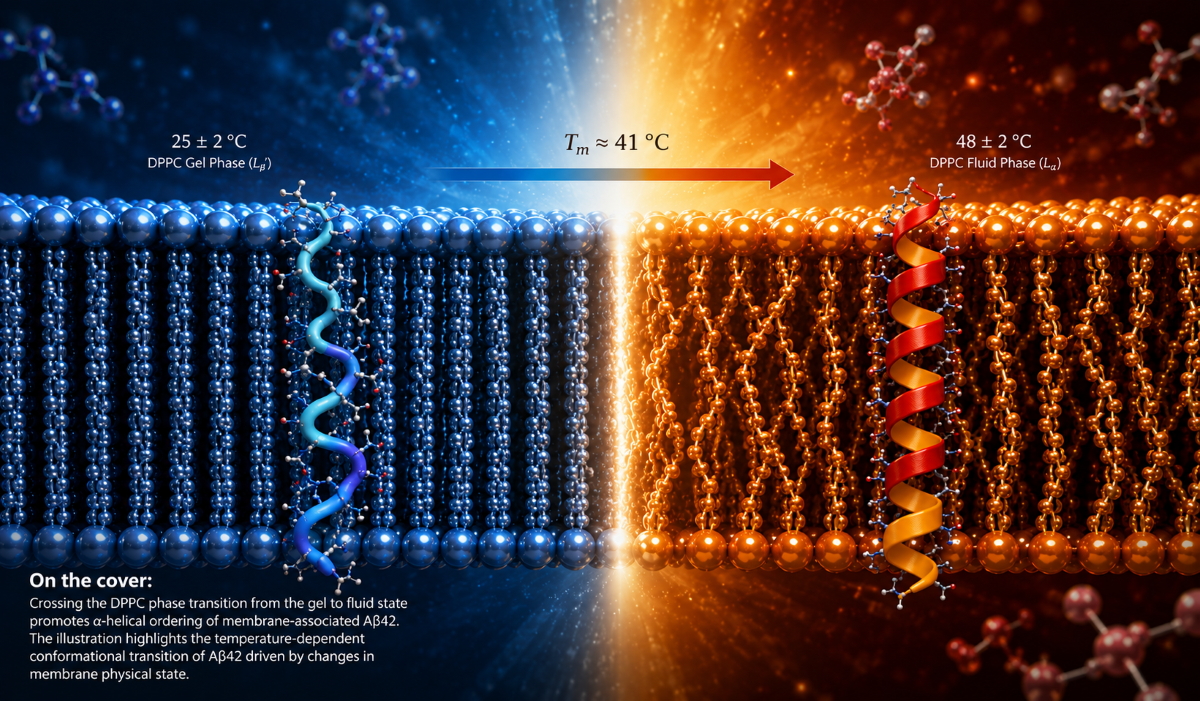
The conformational behavior of the amyloid-β42 (Aβ42) peptide is strongly influenced by the physical state of its surrounding lipid environment. The effect of temperature on the Aβ42 structure within dipalmitoylphosphatidylcholine (DPPC) bilayers was investigated using circular dichroism (CD), Raman spectroscopy, and molecular dynamics (MD) simulations. The study examined two thermal phases: room temperature (RT =∼ (25±2)◦C), corresponding to the gel phase of DPPC, and (48±2)◦C, representing the fluid phase above the lipid transition temperature. The CD spectroscopy measurements indicated a clear temperature-dependent structural transition of the peptide. At RT, Aβ42 exhibited a conformation enriched in β structures, while at (48±2)◦C, the spectra revealed a notable increase in α-helical content, reflecting enhanced backbone organization under fluid-phase conditions. Raman spectral analysis supported this trend by demonstrating an increased contribution of α-helical components accompanied by a reduction in β-strand features upon heating. Minor variations in lipid vibrational markers further suggested greater acyl-chain flexibility and bilayer fluidity in the high-temperature state. Furthermore, MD simulations revealed enhanced α-helical content and deeper peptide insertion within the disordered bilayer compared with the ordered gel phase. The findings from experimental and computational investigations demonstrate that membrane fluidization above the DPPC phase transition favors α-helical stabilization of Aβ42, emphasizing temperature as a key parameter governing peptide–lipid conformational equilibria. The results obtained provide a fundamental framework for understanding how thermal conditions modulate amyloid-membrane interactions, which is essential for elucidating the early molecular events associated with amyloid-related pathologies.
Acknowledgements
References
[1] D. J. Selkoe, J. Hardy, The amyloid hypothesis of Alzheimer’s disease at 25 years, EMBO Mol. Med. 8 (2016) 595. DOI: https://doi.org/10.15252/emmm.201606210
[2] F. Chiti, C. M. Dobson, Protein misfolding, amyloid formation, and human disease: A summary of progress over the last decade, Ann. Rev. Biochem. 86 (2017) 27. DOI: https://doi.org/10.1146/annurev-biochem-061516-045115
[3] N. G. Sgourakis, Y. Yan, S. A. McCallum, C. Wang, A. E. Garcia, The Alzheimer’s peptides Abeta40 and 42 adopt distinct conformations in water: A combined MD/NMR study, J. Mol. Biol. 368 (2007) 1448. DOI: https://doi.org/10.1016/j.jmb.2007.02.093
[4] S. Chakraborty, P. Das, Emergence of alternative structures in amyloid beta 1–42 monomeric landscape by N-terminal hexapeptide amyloid inhibitors, Sci. Rep. 7 (2017) 9941. DOI: https://doi.org/10.1038/s41598-017-10212-5
[5] L. Tran, N. Basdevant, C. Prévost, T. Ha-Duong, Structure of ring-shaped Aβ42 oligomers determined by conformational selection, Sci. Rep. 6 (2016) 21429. DOI: https://doi.org/10.1038/srep21429
[6] S. De, D. C. Wirthensohn, P. Flagmeier, C. Hughes, F. A. Aprile, F. S. Ruggeri, D. R. Whiten, D. Emin, Z. Xia, J. A. Varela, P. Sormanni, F. Kundel, T. P. J. Knowles, C. M. Dobson, C. Bryant, M. Vendruscolo, D. Klenerman, Different soluble aggregates of Aβ42 can give rise to cellular toxicity through different mechanisms, Nat. Commun. 10 (2019) 1541. DOI: https://doi.org/10.1038/s41467-019-09477-3
[7] I. V. J. Murray, L. Liu, H. Komatsu, K. Uryu, G. Xiao, J. A. Lawson, P. H. Axelsen, Membranemediated amyloidogenesis and the promotion of oxidative lipid damage by amyloid beta proteins, J. Biol. Chem. 282 (2007) 9335. DOI: https://doi.org/10.1074/jbc.M608589200
[8] V. Corradi, B. I. Sejdiu, H. Mesa-Galloso, H. Abdizadeh, S. Y. Noskov, S. J. Marrink, D. P. Tieleman, Emerging diversity in lipid–protein interactions, Chem. Rev. 119 (2019) 5775. DOI: https://doi.org/10.1021/acs.chemrev.8b00451
[9] M. P. Muller, T. Jiang, C. Sun, M. Lihan, S. Pant, P. Mahinthichaichan, A. Trifan, E. Tajkhorshid, Characterization of lipid–protein interactions and lipid-mediated modulation of membrane protein function through molecular simulation, Chem. Rev. 119 (2019) 6086. DOI: https://doi.org/10.1021/acs.chemrev.8b00608
[10] S. Ciudad, E. Puig, T. Botzanowski, M. Meigooni, A. S. Arango, J. Do, M. Mayzel, M. Bayoumi, S. Chaignepain, G. Maglia, S. Cianferani, V. Orekhov, E. Tajkhorshid, B. Bardiaux, N. Carulla, Aβ(1–42) tetramer and octamer structures reveal edge conductivity pores as a mechanism for membrane damage, Nat. Commun. 11 (2020) 3014. DOI: https://doi.org/10.1038/s41467-020-16566-1
[11] M. F. M. Sciacca, C. La Rosa, D. Milardi, Amyloid-Mediated Mechanisms of Membrane Disruption, in: Biophysica, 2021, p. 137. DOI: https://doi.org/10.3390/biophysica1020011
[12] O. Crescenzi, S. Tomaselli, R. Guerrini, S. Salvadori, A. M. D’Ursi, P. A. Temussi, D. Picone, Solution structure of the Alzheimer amyloid β-peptide (1–42) in an apolar microenvironment, Eur. J. Biochem. 269 (2002) 5642. DOI: https://doi.org/10.1046/j.1432-1033.2002.03271.x
[13] T. R. Molugu, R. L. Thurmond, T. M. Alam, T. P. Trouard, M. F. Brown, Phospholipid headgroups govern area per lipid and emergent elastic properties of bilayers, Biophys. J. 121 (2022) 4205. DOI: https://doi.org/10.1016/j.bpj.2022.09.005
[14] P. Maleš, Z. Brkljača, I. Crnolatac, D. Petrov, D. Bakarić, Phase-dependent adsorption of myelin basic protein to phosphatidylcholine lipid bilayers, Membranes (Basel) 14 (2024). DOI: https://doi.org/10.3390/membranes14010015
[15] J. F. Nagle, S. Tristram-Nagle, Structure of lipid bilayers, Biochim. Biophys. Acta 1469 (2000) 159. DOI: https://doi.org/10.1016/S0304-4157(00)00016-2
[16] W. Chen, F. Duša, J. Witos, S.-K. Ruokonen, S. K. Wiedmer, Determination of the main phase transition temperature of phospholipids by nanoplasmonic sensing, Sci. Rep. 8 (2018) 14815. DOI: https://doi.org/10.1038/s41598-018-33107-5
[17] N. Kučerka, M. P. Nieh, J. Katsaras, Fluid phase lipid areas and bilayer thicknesses of commonly used phosphatidylcholines as a function of temperature, Biochim. Biophys. Acta 1808 (2011) 2761. DOI: https://doi.org/10.1016/j.bbamem.2011.07.022
[18] G. Neunert, J. Tomaszewska-Gras, A. Baj, M. Gauza-W lodarczyk, S. Witkowski, K. Polewski, Phase transitions and structural changes in DPPC liposomes induced by a 1-carba alphatocopherol analogue, Molecules 26 (2021). DOI: https://doi.org/10.3390/molecules26102851
[19] R. N. Lewis, R. N. McElhaney, Fourier transform infrared spectroscopy in the study of lipid phase transitions in model and biological membranes: Practical considerations, Methods Mol. Biol. 400 (2007) 207. DOI: https://doi.org/10.1007/978-1-59745-519-0_14
[20] D. A. Pink, S. McNeil, B. Quinn, M. J. Zuckermann, A model of hydrogen bond formation in phosphatidylethanolamine bilayers, Biochim. Biophys. Acta 1368 (1998) 289. DOI: https://doi.org/10.1016/S0005-2736(97)00196-X
[21] V. A. Lorenz-Fonfria, Infrared difference spectroscopy of proteins: From bands to bonds, Chem. Rev. 120 (2020) 3466. DOI: https://doi.org/10.1021/acs.chemrev.9b00449
[22] S. M. Kelly, T. J. Jess, N. C. Price, How to study proteins by circular dichroism, Biochim. Biophys. Acta 1751 (2005) 119. DOI: https://doi.org/10.1016/j.bbapap.2005.06.005
[23] S. U. Sane, S. M. Cramer, T. M. Przybycien, A holistic approach to protein secondary structure characterization using Amide I band Raman spectroscopy, Anal. Biochem. 269 (1999) 255. DOI: https://doi.org/10.1006/abio.1999.4034
[24] N. J. Greenfield, Using circular dichroism spectra to estimate protein secondary structure, Nat. Protoc. 1 (2006) 2876. DOI: https://doi.org/10.1038/nprot.2006.202
[25] P. S. Kumagai, A. P. U. Araujo, J. L. S. Lopes, Going deep into protein secondary structure with synchrotron radiation circular dichroism spectroscopy, Biophys. Rev. 9 (2017) 517. DOI: https://doi.org/10.1007/s12551-017-0314-2
[26] Z. D. Schultz, I. W. Levin, Vibrational spectroscopy of biomembranes, Ann. Rev. Anal. Chem. (Palo Alto Calif) 4 (2011) 343. DOI: https://doi.org/10.1146/annurev-anchem-061010-114048
[27] P. N. Jemmett, D. C. Milan, R. J. Nichols, T. Howitt, A. L. Martin, T. Arnold, J. L. Rawle, C. L. Nicklin, T. R. Dafforn, L. R. Cox, S. L. Horswell, Influence of the lipid backbone on electrochemical phase behavior, Langmuir 38 (2022) 14290. DOI: https://doi.org/10.1021/acs.langmuir.2c02370
[28] A. Botan, F. Favela-Rosales, P. F. J. Fuchs, M. Javanainen, M. Kanduč, W. Kulig, A. Lamberg, C. Loison, A. Lyubartsev, M. S. Miettinen, L. Monticelli, J. Määttä, O. H. S. Ollila, M. Retegan, T. R´og, H. Santuz, J. Tynkkynen, Toward atomistic resolution structure of phosphatidylcholine headgroup and glycerol backbone at different ambient conditions, J. Phys. Chem. B 119 (2015) 15075. DOI: https://doi.org/10.1021/acs.jpcb.5b04878
[29] J. A. Lemkul, D. R. Bevan, Destabilizing Alzheimer’s beta(42) protofibrils with morin: Mechanistic insights from molecular dynamics simulations, Biochem. 49 (2010) 3935. DOI: https://doi.org/10.1021/bi1000855
[30] N. Sreerama, R. W. Woody, A self-consistent method for the analysis of protein secondary structure from circular dichroism, Anal. Biochem. 209 (1993) 32. DOI: https://doi.org/10.1006/abio.1993.1079
[31] S. W. Provencher, J. Gl¨ockner, Estimation of globular protein secondary structure from circular dichroism, Biochem. 20 (1981) 33. DOI: https://doi.org/10.1021/bi00504a006
[32] N. Sreerama, R. W. Woody, Estimation of protein secondary structure from circular dichroism spectra: Comparison of CONTIN, SELCON, and CDSSTR methods with an expanded reference set, Anal. Biochem. 287 (2000) 252. DOI: https://doi.org/10.1006/abio.2000.4880
[33] S. Jo, T. Kim, V. G. Iyer, W. Im, CHARMM-GUI: A web-based graphical user interface for CHARMM, J. Comput. Chem. 29 (2008) 1859. DOI: https://doi.org/10.1002/jcc.20945
[34] S. Tomaselli, V. Esposito, P. Vangone, N. A. J. van Nuland, A. M. J. J. Bonvin, R. Guerrini, T. Tancredi, P. A. Temussi, D. Picone, The α-to-β conformational transition of Alzheimer’s Aβ-(1–42) peptide in aqueous media is reversible: A step by step conformational analysis suggests the location of β conformation seeding, ChemBioChem 7 (2006) 257. DOI: https://doi.org/10.1002/cbic.200500223
[35] W. L. Jorgensen, J. Chandrasekhar, J. D. Madura, R. W. Impey, M. L. Klein, Comparison of simple potential functions for simulating liquid water, J. Chem. Phys. 79 (1983) 926. DOI: https://doi.org/10.1063/1.445869
[36] J. Huang, A. D. MacKerell, Jr. CHARMM36 all-atom additive protein force field: Validation based on comparison to NMR data, J. Comput. Chem. 34 (2013) 2135. DOI: https://doi.org/10.1002/jcc.23354
[37] K. A. A. Abdeljawaad, Y. Arynbek, K. Mamatkulov, H. Duc Le, M. A. A. Ibrahim, G. A. H. Mekhemer, G. Arzumanyan, pH modulates amyloid-β42 conformation in lipid membranes: Evidence from circular dichroism, Raman spectroscopy, and molecular dynamics simulations, J. Biomol. Struct. Dyn. (2025) 1. DOI: https://doi.org/10.1080/07391102.2025.2572296
[38] M. J. Abraham, T. Murtola, R. Schulz, S. P´all, J. C. Smith, B. Hess, E. Lindahl, GROMACS: High performance molecular simulations through multi-level parallelism from laptops to supercomputers, SoftwareX 1–2 (2015) 19. DOI: https://doi.org/10.1016/j.softx.2015.06.001
[39] M. Parrinello, A. Rahman, Polymorphic transitions in single crystals: A new molecular dynamics method, J. Appl. Phys. 52 (1981) 7182. DOI: https://doi.org/10.1063/1.328693
[40] T. Darden, D. York, L. Pedersen, Particle mesh Ewald: An N · log (N) method for Ewald sums in large systems, J. Chem. Phys. 98 (1993) 10089. DOI: https://doi.org/10.1063/1.464397
[41] W. Humphrey, A. Dalke, K. Schulten, VMD: Visual molecular dynamics, J. Mol. Graph. 14 (1996) 33. DOI: https://doi.org/10.1016/0263-7855(96)00018-5
[42] S. Zavatski, H. Bandarenka, L. Hetma´nczyk, J. Hetma´nczyk, M. Vorobyeva, Y. Arynbek, K. Mamatkulov, G. Arzumanyan, Model phospholipid interaction with cholesterol and melatonin: Raman spectroscopy and density functional theory study, J. Raman Spectrosc. 53 (2022) 1540. DOI: https://doi.org/10.1002/jrs.6409
[43] S. Kint, P. H. Wermer, J. R. Scherer, Raman spectra of hydrated phospholipid bilayers. 2. Water and head-group interactions, J. Phys. Chem. 96 (1992) 446. DOI: https://doi.org/10.1021/j100180a082
[44] A. Lörincz, J. Mihály, C. Németh, A. Wacha, A. Bóta, A. Effects of ursolic acid on the structural and morphological behaviours of dipalmitoyl lecithin vesicles, Biochim. Biophys. Acta (BBA) — Biomembr. 1848 (2015) 1092. DOI: https://doi.org/10.1016/j.bbamem.2015.01.010
[45] A. Fasanella, K. Cosentino, A. Beneduci, G. Chidichimo, E. Cazzanelli, R. C. Barberi, M. Castriota, Thermal structural evolutions of DMPC-water biomimetic systems investigated by Raman spectroscopy, Biochim. Biophys. Acta (BBA) — Biomembr. 1860 (2018) 1253. DOI: https://doi.org/10.1016/j.bbamem.2018.02.021
[46] R. Gharib, A. Najjar, L. Auezova, C. Charcosset, H. Greige-Gerges, Interaction of selected phenylpropenes with dipalmitoylphosphatidylcholine membrane and their relevance to antibacterial activity, J. Membr. Biol. 250 (2017) 259. DOI: https://doi.org/10.1007/s00232-017-9957-y
[47] T. Kondela, E. Dushanov, M. Vorobyeva, K. Mamatkulov, E. Drolle, D. Soloviov, P. Hrubovčák, K. Kholmurodov, G. Arzumanyan, Z. Leonenko, N. Kuˇcerka, Investigating the competitive effects of cholesterol and melatonin in model lipid membranes, Biochim. Biophys. Acta (BBA)— Biomembr. 1863 (2021) 183651. DOI: https://doi.org/10.1016/j.bbamem.2021.183651
[48] Y. V. Zaytseva, S. V. Adichtchev, N. V. Surovtsev, Raman study of temperature-induced hydrocarbon chain disorder in saturated phosphatidylcholines, Chem. Phys. Lipids 230 (2020) 104926. DOI: https://doi.org/10.1016/j.chemphyslip.2020.104926
[49] R. N. A. H. Lewis, R. N. McElhaney, Membrane lipid phase transitions and phase organization studied by Fourier transform infrared spectroscopy, Biochim. Biophys. Acta (BBA— Biomembr. 1828 (2013) 2347. DOI: https://doi.org/10.1016/j.bbamem.2012.10.018
[50] S. Kurakin, D. Badreeva, E. Dushanov, A. Shutikov, S. Efimov, A. Timerova, T. Mukhametzyanov, T. Murugova, O. Ivankov, K. Mamatkulov, G. Arzumanyan, V. Klochkov, N. Kuˇcerka, Arrangement of lipid vesicles and bicelle-like structures formed in the presence of Aβ(25–35) peptide, Biochim. Biophys. Acta (BBA) — Biomembr. 1866 (2024) 184237. DOI: https://doi.org/10.1016/j.bbamem.2023.184237
[51] Z. Movasaghi, S. Rehman, I. U. Rehman, Raman spectroscopy of biological tissues, Appl. Spectrosc. Rev. 42 (2007) 493. DOI: https://doi.org/10.1080/05704920701551530
[52] A. V. Veluthandath, W. Ahmed, J. Madsen, H. W. Clark, A. D. Postle, J. S. Wilkinson, G. S. Murugan, Quantification of lung surfactant lipid (dipalmitoylphosphatidylcholine/sphingomyelin) ratio in binary liposomes using Raman spectroscopy, J. Raman Spectrosc. 55 (2024) 386. DOI: https://doi.org/10.1002/jrs.6631
[53] H. A. Esawii, K. Mamatkulov, H. A. Mahran, G. Arzumanyan, N. Mohamed, Investigation into Alzheimer’s-related amyloid-β conformational transformations and stability influenced by green iron oxide nanoparticles (GIONP), Intern. J. Biol. Macromol. 298 (2025) 140124. DOI: https://doi.org/10.1016/j.ijbiomac.2025.140124
[54] S. Rivas-Arancibia, E. Rodriguez-Martinez, I. Badillo-Ramirez, U. Lopez-Gonzalez, J. M. Saniger, Structural changes of amyloid beta in hippocampus of rats exposed to ozone: A Raman spectroscopy study, Front. Mol. Neurosci. 10 (2017) 137. DOI: https://doi.org/10.3389/fnmol.2017.00137
[55] C. Mensch, P. Bultinck, C. Johannessen, The effect of protein backbone hydration on the amide vibrations in Raman and Raman optical activity spectra, Phys. Chem. Chem. Phys. 21 (2019) 1988. DOI: https://doi.org/10.1039/C8CP06423G
[56] S. Ramos, J. C. Lee, Raman spectroscopy in the study of amyloid formation and phase separation, Biochem. Soc. Trans. 52 (2024) 1121. DOI: https://doi.org/10.1042/BST20230599
[57] S.-Y. Lin, H.-L. Chu, H.-L. Wei, Secondary conformations and temperature effect on structural transformation of amyloid β(1–28), (1–40) and (1–42) peptides, J. Biomol. Struct. Dyn. 20 (2003) 595. DOI: https://doi.org/10.1080/07391102.2003.10506876
[58] N. C. Maiti, M. M. Apetri, M. G. Zagorski, P. R. Carey, V. E. Anderson, Raman spectroscopic characterization of secondary structure in natively unfolded proteins: α-synuclein, J. Am. Chem. Soc. 126 (2004) 2399. DOI: https://doi.org/10.1021/ja0356176
[59] A. Sadat, I. J. Joye, Peak Fitting Applied to Fourier transform infrared and Raman spectroscopic analysis of proteins, in: Appl. Sci., 2020. DOI: https://doi.org/10.3390/app10175918
[60] S. Ngarize, H. Herman, A. Adams, N. Howell, Comparison of changes in the secondary structure of unheated, heated, and high-pressure-treated β-lactoglobulin and qvalbumin proteins using Fourier transform Raman spectroscopy and self-deconvolution, J. Agric. Food Chem. 51 (2004) 6470. DOI: https://doi.org/10.1021/jf030649y
[61] F. Tofoleanu, N.-V. Buchete, Alzheimer Aβ peptide interactions with lipid membranes, Prion 6 (2012) 339. DOI: https://doi.org/10.4161/pri.21022
[62] H. Ahyayauch, M. E. Masserini, A. Alonso, F. M. Go˜ni, Understanding Aβ peptide binding to lipid membranes: A biophysical perspective, in: Intern. J. Mol. Sci., 2024. DOI: https://doi.org/10.20944/preprints202404.1947.v1
[63] M. Yang, K. Wang, J. Lin, L. Wang, F. Wei, J. Zhu, W. Zheng, L. Shen, Gel phase membrane retards amyloid β-peptide (1–42) fibrillation by restricting slaved diffusion of peptides on lipid bilayers, Langmuir 34 (2018) 8408. DOI: https://doi.org/10.1021/acs.langmuir.8b01315
[64] C. Poojari, A. Kukol, B. Strodel, How the amyloid-β peptide and membranes affect each other: An extensive simulation study, Biochim. Biophys. Acta (BBA) — Biomembr. 1828 (2013) 327. DOI: https://doi.org/10.1016/j.bbamem.2012.09.001
[65] B. Shivu, S. Seshadri, J. Li, K. A. Oberg, V. N. Uversky, A. L. Fink, Distinct β-sheet structure in protein aggregates determined by ATR–FTIR spectroscopy, Biochem. 52 (2013) 5176. DOI: https://doi.org/10.1021/bi400625v
[66] M. Suzuki, T. Miura, Effect of amyloid β-peptide on the fluidity of phosphatidylcholine membranes: Uses and limitations of diphenylhexatriene fluorescence anisotropy, Biochim. Biophys. Acta (BBA) — Biomembr. 1848 (2015) 753.
[67] M. Inayathullah, D. B. Teplow, Structural dynamics of the ΔE22 (Osaka) familial Alzheimer’s disease-linked amyloid β-protein, Amyloid 18 (2011) 98. DOI: https://doi.org/10.3109/13506129.2011.580399
[68] M. Suzuki, T. Miura, Effect of amyloid β-peptide on the fluidity of phosphatidylcholine membranes: Uses and limitations of diphenylhexatriene fluorescence anisotropy, Biochim. Biophys. Acta 1848 (2015) 753. DOI: https://doi.org/10.1016/j.bbamem.2014.12.003
License

This work is licensed under a Creative Commons Attribution-NonCommercial 4.0 International License.