

Аннотация
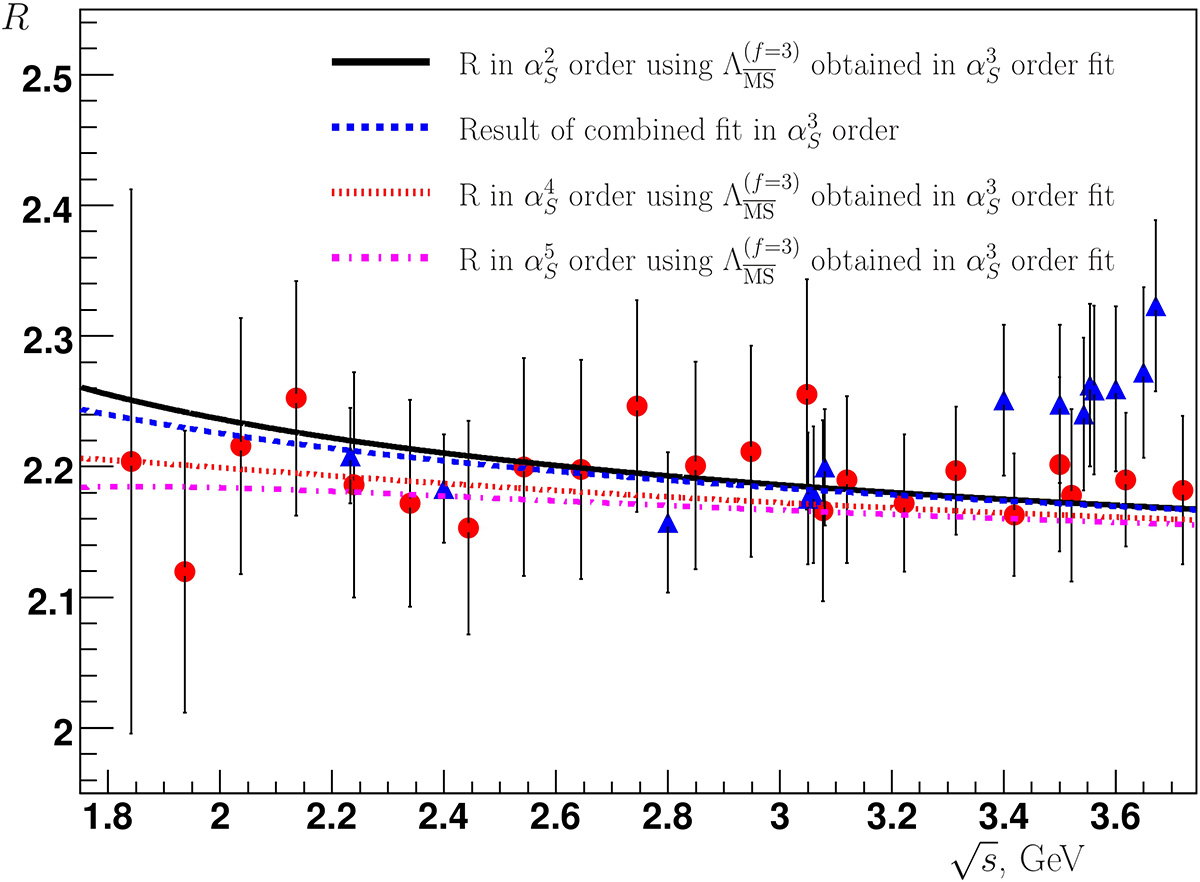
Экспериментальные данные, полученные коллаборациями KEDR и BESIII при энергиях ниже порогов рождения очарованных кварков, сравниваются с выражениями квантовой хромодинамики (КХД) для безмассового случая (отношение \(R\) в процессе \(e^+e^-\)-аннигиляции), обрезанными на различных порядках теории возмущений. Результаты фитирования демонстрируют зависимость определяемых значений \(\alpha_s(M_Z)\) от порядка обрезания соответствующих приближений. Аппроксимация объединенных данных KEDR и BESIII (с учетом обрезания на масштабе массы \(J/\psi\)-мезона) в приближениях следующего за главным (NLO), следующего за следующим за главным (NNLO) и следующего за следующим за следующим за главным (N3LO) порядков дает следующие результаты: \(\alpha_s(M_Z)=0.1151_{-0.0069}^{+0.0052}\), \(\alpha_s(M_Z)=0.1190_{-0.0081}^{+0.0064}\) и \(\alpha_s(M_Z)=0.1283_{-0.0075}^{+0.0028}\). Наблюдаемая тенденция к росту значений \(\alpha_s(M_Z)\) при повышении порядка приближения связана с влиянием кинематических вкладов типа \(\pi^2\) в коэффициенты отношения \(R\) (не полностью контролируемых в рамках асимптотических разложений теории возмущений), которые возникают вследствие аналитического продолжения из области пространственно-подобных энергий в область времени-подобных энергий. Обсуждаются вопросы применения разложений теории возмущений фиксированного порядка и учета эффектов аналитического продолжения.
Исправлено:
28 июля 2026 (внесены изменения в уравнения (12)–(14), также после них было добавлено ещё одно уравнение)
Поддерживающие организации
Библиографические ссылки
[1] J. Gao, Review of different colliders, Int. J. Mod. Phys. A 36 (22) (2021) 2142002. doi:10.1142/S0217751X21420021.
[2] I. B. Logashenko and S. I. Eidelman, Anomalous magnetic moment of the muon, Phys. Usp. 61 (5) (2018) 480–510. doi:10.3367/UFNe.2018.02.038312.
[3] F. Jegerlehner, The Role of σ(e+e− → hadrons) in precision tests of the Standard Model, Nucl. Phys. B Proc. Suppl. 131 (2004) 213–222. doi:10.1016/j.nuclphysbps.2004.02.028, arXiv:hep-ph/0312372.
[4] S. Navas et al. (Particle Data Group), Review of particle physics, Phys. Rev. D 110 (3) (2024) 030001. doi:10.1103/PhysRevD.110.030001.
[5] A. Deur, S. J. Brodsky and G. F. de Teramond, The QCD running coupling, Nucl. Phys. 90 (2016) 1. doi:10.1016/j.ppnp.2016.04.003, arXiv:1604.08082.
[6] G. P. Salam, The strong coupling: A theoretical perspective, In: From My Vast Repertoire...: Guido Altarelli’s Legacy, World Scientific, 2019, Eds. S. Forte, A. Levy and G. Ridolfi. doi:10.1142/9789813238053_0007, arXiv:1712.05165.
[7] A. Pich, Precision physics with inclusive QCD processes, Prog. Part. Nucl. Phys. 117 (2021) 103846. doi:10.1016/j.ppnp.2020.103846, arXiv:2012.04716.
[8] D. d’Enterria, S. Kluth, G. Zanderighi, C. Ayala, M. A. Benitez-Rathgeb, J. Bluemlein, D. Boito, N. Brambilla, D. Britzger, S. Camarda, et al. The strong coupling constant: State of the art and the decade ahead, J. Phys. G 51 (9) (2024) 090501. doi:10.1088/1361-6471/ad1a78,
arXiv:2203.08271.
[9] A. De Rujula and H. Georgi, Counting quarks in e+e− annihilation, Phys. Rev. D 13 (1976) 1296–1301. doi:10.1103/PhysRevD.13.1296.
[10] A. Zee, Electron positron annihilation in stagnant field theories, Phys. Rev. D 8 (1973) 4038–4041. doi:10.1103/PhysRevD.8.4038.
[11] T. Appelquist and H. Georgi, e+e?− annihilation in gauge theories of strong interactions, Phys. Rev. D 8 (1973) 4000–4002. doi:10.1103/PhysRevD.8.4000.
[12] S. I. Eidelman, L. M. Kurdadze and A. I. Vainshtein, e+e− annihilation into hadrons below 2 GeV. Test of QCD predictions, Phys. Lett. B 82 (1979) 278–280. doi:10.1016/0370-2693(79)90755-X.
[13] K. G. Chetyrkin, A. L. Kataev and F. V. Tkachov, Higher order corrections to σtot(e+e− → hadrons) in quantum chromodynamics, Phys. Lett. B 85 (1979) 277–279. doi:10.1016/0370-2693(79)90596-3.
[14] M. Dine and J. R. Sapirstein, Higher order QCD corrections in e+e− annihilation, Phys. Rev. Lett. 43 (1979) 668. doi:10.1103/PhysRevLett.43.668.
[15] W. Celmaster and R. J. Gonsalves, An analytic calculation of higher order quantum chromodynamic corrections in e+e− annihilation, Phys. Rev. Lett. 44 (1980) 560. doi:10.1103/PhysRevLett.44.560.
[16] R. M. Barnett, M. Dine and L. D. McLerran, The problem of R in e+e− annihilation, Phys. Rev. D 22 (1980) 594. doi:10.1103/PhysRevD.22.594.
[17] H. J. Behrend et al. (CELLO Collab.), Determination of αs and sin2 θw from measurements
of the total hadronic cross-section in e+e− annihilation, Phys. Lett. B 183 (1987) 400–411. doi:10.1016/0370-2693(87)90986-5.
[18] R. Marshall, A determination of the strong coupling constant α−s from e+e− total cross-section data, Z. Phys. C 43 (1989) 595. doi:10.1007/BF01550938.
[19] R. Marshall, e+e− annihilation at high energies, Rept. Prog. Phys. 52 (1989) 1329–1420. doi:10.1088/0034-4885/52/11/001.
[20] G. D’Agostini, W. de Boer and G. Grindhammer, Determination of αs and the Z0 mass from
measurements of the total hadronic cross-section in e+e− annihilation, Phys. Lett. B 229 (1989) 160–168. doi:10.1016/0370-2693(89)90176-7.
[21] S. G. Gorishnii, A. L. Kataev and S. A. Larin, Next-To-Leading O(α3s ) QCD correction to
σtot(e+e− → hadrons): Analytical calculation and estimation of the parameter lambda (MS), Phys. Lett. B 212 (1988) 238–244. doi:10.1016/0370-2693(88)90532-1.
[22] S. G. Gorishnii, A. L. Kataev and S. A. Larin, The O(α3s )-corrections to σtot(e+e− →hadrons) and Γ(τ − → ντ + hadrons) in QCD, Phys. Lett. B 259 (1991) 144–150. doi:10.1016/0370-2693(91)90149-K.
[23] L. R. Surguladze and M. A. Samuel, Total hadronic cross-section in e+e− annihilation at the four loop level of perturbative QCD, Phys. Rev. Lett. 66 (1991) 560–563 [Erratum: Phys. Rev. Lett. 66 (1991) 2416]. doi:10.1103/PhysRevLett.66.560.
[24] K. G. Chetyrkin, Corrections of order α3s to Rhad in pQCD with light gluinos, Phys. Lett. B 391 (1997) 402–412. doi:10.1016/S0370-2693(96)01478-5. arXiv:hep-ph/9608480.
[25] V. Branchina, M. Consoli, D. Zappala and R. Fiore, Combined fit to R(e+e− → hadrons) and data from the CERN e+e− collider LEP, Phys. Rev. D 46 (1992) 75–83. doi:10.1103/PhysRevD.46.75.
[26] R. Ammar et al. (CLEO Collab.), A Measurement of the total cross-section for e+e− → hadrons at √s = 10.52 GeV, Phys. Rev. D 57 (1998) 1350–1358. doi:10.1103/PhysRevD.57.1350, arXiv:hep-ex/9707018.
[27] J. H. Kuhn and M. Steinhauser, Determination of αs and heavy quark masses from recent measurements of R(s), Nucl. Phys. B 619 (2001), 588–602 [Erratum: Nucl. Phys. B 640 (2002) 415–415]. doi:10.1016/S0550-3213(01)00499-0, arXiv:hep-ph/010908.
[28] D. Besson et al. (CLEO Collab.), Measurement of the total hadronic cross section in e+e− annihilations below 10.56 GeV, Phys. Rev. D 76 (2007) 072008. doi:10.1103/PhysRevD.76.072008, arXiv:0706.2813.
[29] J. H. Kuhn, M. Steinhauser and T. Teubner, Determination of the strong coupling constant from the CLEO measurement of the total hadronic cross section in e+e− annihilation below 10.56 GeV, Phys. Rev. D 76 (2007) 074003. doi:10.1103/PhysRevD.76.074003, arXiv:0707.2589.
[30] O. V. Zenin, V. V. Ezhela, S. B. Lugovsky, M. R. Whalley, K. Kang and S. K. Kang, A compilation of total cross-section data on e+e− → hadrons and pQCD tests. arXiv:hep-ph/0110176.
[31] D. Boito, M. Golterman, A. Keshavarzi, K. Maltman, D. Nomura, S. Peris and T. Teubner, Strong coupling from e+e− → hadrons below charm, Phys. Rev. D 98 (7) (2018) 074030. doi:10.1103/PhysRevD.98.074030, arXiv:1805.08176.
[32] V. V. Anashin et al. Measurement of Ruds and R between 3.12 and 3.72 GeV at the KEDR detector, Phys. Lett. B 753 (2016) 533–541. doi:10.1016/j.physletb.2015.12.059, arXiv:1510.02667.
[33] V. V. Anashin et al. Measurement of R between 1.84 and 3.05 GeV at the KEDR detector, Phys. Lett. B 770 (2017) 174–181. doi:10.1016/j.physletb.2017.04.073, arXiv:1610.02827.
[34] V. V. Anashin et al. (KEDR Collab.), Precise measurement of Ruds and R between 1.84 and 3.72 GeV at the KEDR detector, Phys. Lett. B 788 (2019) 42–51. doi:10.1016/j.physletb.2018.11.012, arXiv:1805.06235.
[35] M. Ablikim et al. (BESIII Collab.), Measurement of the cross section for e+e− → hadrons at energies from 2.2324 to 3.6710 GeV, Phys. Rev. Lett. 128 (6) (2022) 062004. doi:10.1103/PhysRevLett.128.062004, arXiv:2112.11728.
[36] D. Boito and M. Caram, Perturbative QCD below charm threshold: Theory and tensions with e+e− data, Phys. Rev. D 112 (9) (2025) 9. doi:10.1103/dtg5-ghdx, arXiv:2509.12956.
[37] P. A. Baikov, K. G. Chetyrkin and J. H. Kuhn, Order α4s QCD corrections to Z and τ decays,
Phys. Rev. Lett. 101 (2008) 012002. doi:10.1103/PhysRevLett.101.012002, arXiv:0801.1821.
[38] F. Herzog, B. Ruijl, T. Ueda, J. A. M. Vermaseren and A. Vogt, On Higgs decays to hadrons and the R-ratio at N4LO, JHEP 08 (2017) 113. doi:10.1007/JHEP08(2017)113, arXiv:1707.01044.
[39] A. L. Kataev and V. V. Starshenko, Estimates of the higher order QCD corrections to R(s), R(τ ) and deep inelastic scattering sum rules, Mod. Phys. Lett. A 10 (1995) 235–250. doi:10.1142/S0217732395000272, arXiv:hep-ph/9502348.
[40] D. Boito, P. Masjuan and F. Oliani, Higher-order QCD corrections to hadronic τ decays from Pad´e approximants, JHEP 08 (2018) 075. doi:10.1007/JHEP08(2018)075, arXiv:1807.01567.
[41] G. Abbas and V. Singh, Hadronic tau decays at higher orders in QCD. arXiv:2601.11277.
[42] J. M. Shen, B. H. Qin, J. Yan, S. Q. Wang and X. G. Wu, Novel method to reliably determine the QCD coupling from Ruds measurements and its effects to muon g − 2 and α (M2Z)within the tau-charm energy region, JHEP 07 (2023) 109. doi:10.1007/JHEP07(2023)109, arXiv:2303.11782.
[43] S. J. Brodsky, M. Mojaza and X. G. Wu, Systematic scale-setting to all orders: The principle of maximum conformality and commensurate scale relations, Phys. Rev. D 89 (2014) 014027. doi:10.1103/PhysRevD.89.014027, arXiv:1304.4631.
[44] A. L. Kataev, Conformal symmetry limit of QED and QCD and identities between perturbative contributions to deep-inelastic scattering sum rules, JHEP 02 (2014) 092. doi:10.1007/JHEP02(2014)092, arXiv:1305.4605.
[45] A. L. Kataev and S. V. Mikhailov, Generalization of the Brodsky–Lepage–Mackenzie optimization within the β-expansion and the principle of maximal conformality, Phys. Rev. D 91 (1) (2015) 014007. doi:10.1103/PhysRevD.91.014007, arXiv:1408.0122.
[46] A. L. Kataev and V. S. Molokoedov, Decomposed photon anomalous dimension in QCD and the β-expanded representations for the Adler function, Phys. Rev. D 108 (9) (2023) 096027. doi:10.1103/PhysRevD.108.096027, arXiv:2309.03994.
[47] S. V. Mikhailov, Adler function, Bjorken polarized sum rule: Confirmation of elements of the β-expansion and the diagrams, JHEP 10 (2024) 166. doi:10.1007/JHEP10(2024)166, arXiv:2406.15014.
[48] D. J. Gross and F. Wilczek, Ultraviolet behavior of non-Abelian gauge theories, Phys. Rev. Lett. 30 (1973) 1343–1346. doi:10.1103/PhysRevLett.30.1343.
[49] H. D. Politzer, Reliable perturbative results for strong interactions?, Phys. Rev. Lett. 30 (1973) 1346–1349. doi:10.1103/PhysRevLett.30.1346.
[50] D. R. T. Jones, Two loop diagrams in Yang–Mills theory, Nucl. Phys. B 75 (1974) 531. doi:10.1016/0550-3213(74)90093-5.
[51] W. E. Caswell, Asymptotic behavior of non-Abelian gauge theories to two loop order, Phys. Rev. Lett. 33 (1974) 244. doi:10.1103/PhysRevLett.33.244.
[52] E. Egorian and O. V. Tarasov, Two loop renormalization of the QCD in an arbitrary gauge, Teor. Mat. Fiz. 41 (1979) 26–32; JINR Preprint E2-11757, Dubna, 1978.
[53] O. V. Tarasov, A. A. Vladimirov and A. Y. Zharkov, The Gell-Mann-Low function of QCD in the three loop approximation, Phys. Lett. B 93 (1980) 429–432. doi:10.1016/0370-2693(80)90358-5.
[54] S. A. Larin and J. A. M. Vermaseren, The three-loop QCD beta function and anomalous dimensions, Phys. Lett. B 303 (1993) 334–336. doi:10.1016/0370-2693(93)91441-O, arXiv:hep-ph/9302208.
[55] T. van Ritbergen, J. A. M. Vermaseren and S. A. Larin, The four-loop beta function in quantum chromodynamics, Phys. Lett. B 400 (1997) 379–384. doi:10.1016/S0370-2693(97)00370-5, arXiv:hep-ph/9701390.
[56] M. Czakon, The four-loop QCD beta function and anomalous dimensions, Nucl. Phys. B 710 (2005) 485–498. doi:10.1016/j.nuclphysb.2005.01.012, arXiv:hep-ph/0411261.
[57] P. A. Baikov, K. G. Chetyrkin and J. H. K¨uhn, Five-loop running of the QCD coupling constant, Phys. Rev. Lett. 118 (8) (2017) 082002. doi:10.1103/PhysRevLett.118.082002, arXiv:1606.08659.
[58] F. Herzog, B. Ruijl, T. Ueda, J. A. M. Vermaseren and A. Vogt, The five-loop beta function of Yang–Mills theory with fermions, JHEP 02 (2017) 090. doi:10.1007/JHEP02(2017)090, arXiv:1701.01404.
[59] T. Luthe, A. Maier, P. Marquard and Y. Schr¨oder, The five-loop beta function for a general gauge group and anomalous dimensions beyond Feynman gauge, JHEP 10 (2017) 166. doi:10.1007/JHEP10(2017)166, arXiv:1709.07718.
[60] N. V. Krasnikov and A. A. Pivovarov, The influence of the analytical continuation effects on the value of the QCD scale parameter Λ extracted from the data on charmonium and upsilon hadon decays, Phys. Lett. B 116 (1982) 168–170. doi:10.1016/0370-2693(82)91001-2.
[61] A. V. Radyushkin, Optimized Λ-parametrization for the QCD running coupling constant in space-like and time-like regions, JINR Preprint E2-82-159, Dubna, 1982; JINR Rapid Commun. 78 (1996) 96–99. arXiv:hep-ph/9907228
[62] M. R. Pennington, R. G. Roberts and G. G. Ross, How to continue the predictions of perturbative QCD from the space-like region where they are derived to the time-like regime where experiments are performed, Nucl. Phys. B 242 (1984) 69–80. doi:10.1016/0550-3213(84)90134-2.
[63] N. V. Krasnikov, On the ultraviolet behavior of the invariant charge in quantum electrodynamics. arXiv:2603.24092.
[64] J. D. Bjorken, Two topics in Quantum Chromodynamics, Preprint SLAC-PUB-5103, 1989.
[65] A. P. Bakulev, S. V. Mikhailov and N. G. Stefanis, Higher-order QCD perturbation theory in different schemes: From FOPT to CIPT to FAPT, JHEP 06 (2010) 085. doi:10.1007/JHEP06(2010)085, arXiv:1004.4125.
[66] A. V. Nesterenko, Electron–positron annihilation into hadrons at the higher-loop levels, Eur. Phys. J. C 77 (12) (2017) 844. doi:10.1140/epjc/s10052-017-5405-5, arXiv:1707.00668.
[67] M. S. A. Alam Khan, Renormalization group summation and analytic continuation from spacelike to timelike regions, Phys. Rev. D 108 (1) (2023) 014028. doi:10.1103/PhysRevD.108.014028, arXiv:2306.10262.
[68] N. G. Gracia, A. H. Hoang and V. Mateu, Mathematical aspects of the asymptotic expansion in contour improved perturbation theory for hadronic tau decays, Phys. Rev. D 108 (3) (2023) 034013. doi:10.1103/PhysRevD.108.034013, arXiv:2305.10288.
[69] A. A. Pivovarov, Renormalization group analysis of the tau lepton decay within QCD, Z. Phys. C 53 (1992) 461–464. doi:10.1007/BF01625906, arXiv:hep-ph/0302003.
[70] F. Le Diberder and A. Pich, The perturbative QCD prediction to Rτ revisited, Phys. Lett. B 286 (1992) 147–152. doi:10.1016/0370-2693(92)90172-Z.
[71] D. V. Shirkov and I. L. Solovtsov, Analytic model for the QCD running coupling with universal ¯αs(0) value, Phys. Rev. Lett. 79 (1997) 1209–1212. doi:10.1103/PhysRevLett.79.1209, arXiv:hep-ph/9704333.
[72] D. V. Shirkov and I. L. Solovtsov, Ten years of the Analytic Perturbation Theory in QCD, Theor. Math. Phys. 150 (2007) 132–152. doi:10.1007/s11232-007-0010-7, arXiv:hep-ph/0611229.
[73] A. L. Kataev, G. Parente and A. V. Sidorov, Improved fits to the xF3 CCFR data at the next-to-next-to-leading order and beyond, Phys. Part. Nucl. 34 (2003) 20–46; Erratum: Phys. Part. Nucl. 38 (6) (2007) 827. doi:10.1134/S1063779607060068, arXiv:hep-ph/0106221.
[74] W. Bernreuther and W. Wetzel, Decoupling of heavy quarks in the minimal subtraction scheme, Nucl. Phys. B 197 (1982) 228–236 [Erratum: Nucl. Phys. B 513 (1998) 758–758]. doi:10.1016/0550-3213(82)90288-7.
[75] S. A. Larin, T. van Ritbergen and J. A. M. Vermaseren, The large quark mass expansion of Γ(Z0 → hadrons) and Γ(τ − → ντ + hadrons) in the order α3s , Nucl. Phys. B 438 (1995) 278–306. doi:10.1016/0550-3213(94)00574-X, arXiv:hep-ph/9411260.
[76] K. G. Chetyrkin, B. A. Kniehl and M. Steinhauser, Decoupling relations to O(α3s ) and their connection to low-energy theorems, Nucl. Phys. B 510 (1998) 61–87. doi:10.1016/S0550-3213(98)81004-3, arXiv:hep-ph/9708255.
[77] K. G. Chetyrkin, J. H. Kuhn, C. Sturm, QCD decoupling at four loops, Nucl. Phys. B 744 (2006) 121–135. doi:10.1016/j.nuclphysb.2006.03.020, arXiv:hep-ph/0512060.
[78] B. A. Kniehl, A. V. Kotikov, A. I. Onishchenko and O. L. Veretin, Strong-coupling constant with flavor thresholds at five loops in the anti-MS scheme, Phys. Rev. Lett. 97 (2006) 042001. doi:10.1103/PhysRevLett.97.042001, arXiv:hep-ph/0607202.
[79] K. G. Chetyrkin, J. H. Kuhn and M. Steinhauser, RunDec: A Mathematica package for running and decoupling of the strong coupling and quark masses, Comput. Phys. Commun. 133 (2000) 43–65. doi:10.1016/S0010-4655(00)00155-7, arXiv:hep-ph/0004189.
[80] F. Herren and M. Steinhauser, Version 3 of RunDec and CRunDec, Comput. Phys. Commun. 224 (2018) 333–345. doi:10.1016/j.cpc.2017.11.014, arXiv:1703.03751.
[81] A. Pich and A. Rodr´ıguez-S´anchez, Violations of quark-hadron duality in low-energy determinations of αs, JHEP 07 (2022) 145. doi:10.1007/JHEP07(2022)145, arXiv:2205.07587.
[82] D. Boito, M. Golterman, K. Maltman and S. Peris, Quark-hadron duality and the determination of αs from hadronic τ decay: Facts vs myths, Phys. Rev. D 111 (7) (2025) 074019. doi:10.1103/PhysRevD.111.074019, arXiv:2402.05588.
[83] M. Beneke and H. Takaura, Gradient-flowed operator product expansion without IR renormalons, JHEP 03 (2026) 033. doi:10.1007/JHEP03(2026)033, arXiv:2510.12193.
[84] M. A. Shifman, Quark hadron duality, in: Proc. 8th Int. Symp. on Heavy Flavor Physics (Heavy Flavor 8), World Scientific, Singapore, 2000. V. 3(7), pp. 1447–1494; Int. Workshop “Gribov-70” (What High-Energy Physicists Would Have Liked to Discuss with Vladimir Gribov on his 70th Birthday?), Orsay, France, 2000. doi:10.1142/9789812810458_0032 arXiv:hep-ph/0009131.
[85] D. I. Kazakov and D. V. Shirkov, Scheme invariant perturbation theory in massive QCD, Yad. Fiz. 42 (1985) 768–776 (in Russian).
[86] J. Chyla, A. Kataev and S. Larin, Renormalization scheme dependence and infrared behavior in e+e− annihilations and τ lepton decay at the next-to-next-to-leading order of perturbative QCD, Phys. Lett. B 267 (1991) 269–276. doi:10.1016/0370-2693(91)91259-X.
[87] P. M. Stevenson, Optimization of QCD Perturbation Theory: Results for Re+e− at fourth order, Nucl. Phys. B 868 (2013) 38–64. doi:10.1016/j.nuclphysb.2012.11.005, arXiv:1210.7001.
[88] S. G. Gorishnii, A. L. Kataev and S. A. Larin, Three loop corrections of order O(m2) to the correlator of electromagnetic quark currents, Nuovo Cim. A 92 (1986) 119–131. doi:10.1007/BF02727185.
[89] K. G. Chetyrkin, R. Harlander, J. H. Kuhn and M. Steinhauser, Mass corrections to the vector current correlator, Nucl. Phys. B 503 (1997) 339–353. doi:10.1016/S0550-3213(97)00383-0, arXiv:hep-ph/9704222.
[90] A. I. Onishchenko, Three-loop moments and spectral density of photon polarization function in QED, Natural Sci. Rev. 1 (2024) 2. doi:10.54546/NaturalSciRev.100102.
Лицензия

Это произведение доступно по лицензии Creative Commons «Attribution-NonCommercial» («Атрибуция — Некоммерческое использование») 4.0 Всемирная.