

Abstract
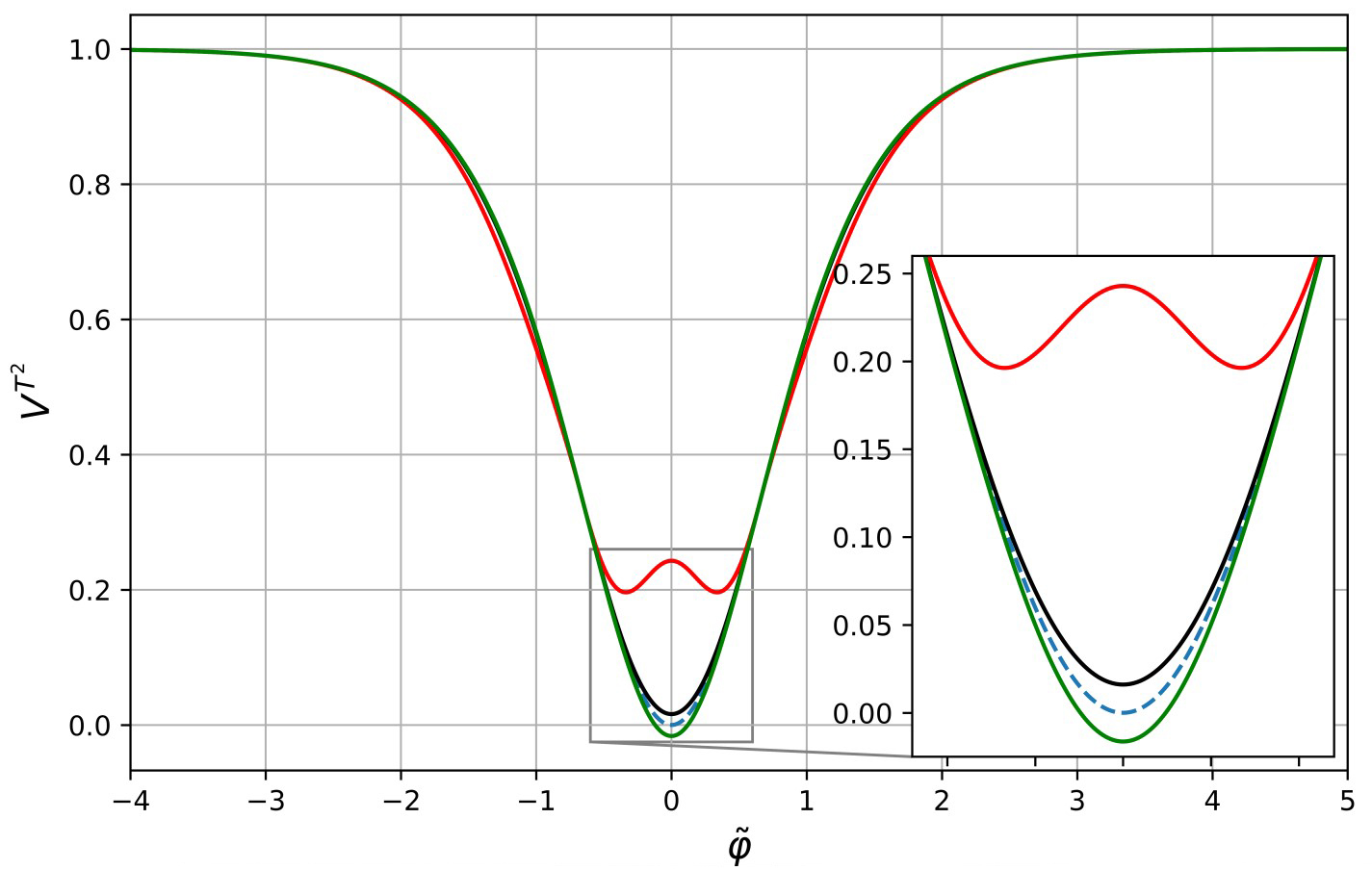
Using the generalized renormalisation group formalism, we calculate quantum corrections to the effective potential in α-attractor models describing the inflationary stage of the Universe evolution. We demonstrate that quantum corrections lead to a change in the initial classical potential, changing its value at the minimum, which can be interpreted as a manifestation of the cosmological constant or dark energy.
Acknowledgements
References
[1] A. H. Guth, The inflationary universe: A possible solution to the horizon and flatness problems,Physical Review D 23 (1981) 347–356.doi:10.1103/PhysRevD.23.347.
[2] A. A. Starobinsky, A new type of isotropic cosmological models without singularity, PhysicsLetters B 91 (1980) 99–102.doi:10.1016/0370-2693(80)90670-X.
[3] J. Martin, C. Ringeval, V. Vennin, Encyclopædia Inflationaris, Physics of the Dark Universe 5–6(2014) 75–235.arXiv:1303.3787,doi:10.1016/j.dark.2014.01.003.
[4] P. A. R. Ade et al., Improved constraints on primordial gravitational waves using Planck, WMAP,and BICEP/Keck observations through the 2018 observing season, Physical Review Letters127 (15) (2021) 151301.arXiv:2110.00483,doi:10.1103/PhysRevLett.127.151301.
[5] Y. Akrami et al., Planck 2018 results: X. Constraints on inflation, Astronomy & Astrophysics 641(2020) A10.arXiv:1807.06211,doi:10.1051/0004-6361/201833887.
[6] Y. Akrami, R. Kallosh, A. Linde, V. Vardanyan, Dark energy,α-attractors, and large-scale struc-ture surveys, Journal of Cosmology and Astroparticle Physics 06 (2018) 041.arXiv:1712.09693,doi:10.1088/1475-7516/2018/06/041.
[7] D. I. Kazakov, R. M. Iakhibbaev, D. M. Tolkachev, Leading all-loop quantum contribution to theeffective potential in general scalar field theory, Journal of High Energy Physics 04 (2023) 128.arXiv:2209.08019,doi:10.1007/JHEP04(2023)128.
[8] D. I. Kazakov, R. M. Iakhibbaev, D. M. Tolkachev, Leading all-loop quantum contribution to theeffective potential in the inflationary cosmology, Journal of Cosmology and Astroparticle Physics09 (2023) 049.arXiv:2308.03872,doi:10.1088/1475-7516/2023/09/049.
[9] R. Kallosh, A. Linde, D. Roest, Superconformal inflationaryα-attractors, Journal of High EnergyPhysics 11 (2013) 198.arXiv:1311.0472,doi:10.1007/JHEP11(2013)198.
[10] R. Kallosh, A. Linde, Cosmological attractors and asymptotic freedom of the inflaton field,Journal of Cosmology and Astroparticle Physics 06 (2016) 047.arXiv:1604.00444,doi:10.1088/1475-7516/2016/06/047.
[11] M. Galante, R. Kallosh, A. Linde, D. Roest, Unity of cosmological inflation attractors, Physical Re-view Letters 114 (14) (2015) 141302.arXiv:1412.3797,doi:10.1103/PhysRevLett.114.141302.
[12] M. Scalisi, Cosmologicalα-attractors and de Sitter landscape, Journal of High Energy Physics 12(2015) 134.arXiv:1506.01368,doi:10.1007/JHEP12(2015)134.
[13] R. Kallosh, A. Linde, Polynomialα-attractors, Journal of Cosmology and Astroparticle Physics04 (04) (2022) 017.arXiv:2202.06492,doi:10.1088/1475-7516/2022/04/017.
[14] K. Dimopoulos, C. Owen, Quintessential inflation withα-attractors, Journal of Cosmology andAstroparticle Physics 06 (2017) 027.arXiv:1703.00305,doi:10.1088/1475-7516/2017/06/027.
[15] S. R. Coleman, E. J. Weinberg, Radiative corrections as the origin of spontaneous symmetrybreaking, Physical Review D 7 (1973) 1888–1910.doi:10.1103/PhysRevD.7.1888.
[16] R. Jackiw, Functional evaluation of the effective potential, Physical Review D 9 (1974) 1686.doi:10.1103/PhysRevD.9.1686.
[17] N. N. Bogoliubov, D. V. Shirkov, Introduction to the Theory of Quantized Fields, Nauka, Moscow,1957, English transl.: Introduction to the Theory of Quantized Fields, 3rd ed., Wiley, New York,1980.
[18] W. Zimmermann, Convergence of Bogolyubov’s method of renormalization in momentum space,Communications in Mathematical Physics 15 (1969) 208–234.doi:10.1007/BF01645676.
[19] K. Hepp, Proof of the Bogolyubov–Parasiuk theorem on renormalization, Communications inMathematical Physics 2 (1966) 301–326.doi:10.1007/BF01773358.
[20] N. N. Bogoliubow, O. S. Parasiuk, ̈Uber die Multiplikation der Kausalfunktionen in der Quanten-theorie der Felder, Acta Mathematica 97 (1957) 227–266.
[21] R. Kallosh, A. Linde, Universality class in conformal inflation, Journal of Cosmology and As-troparticle Physics 07 (2013) 002.arXiv:1306.5220,doi:10.1088/1475-7516/2013/07/002.