

Abstract
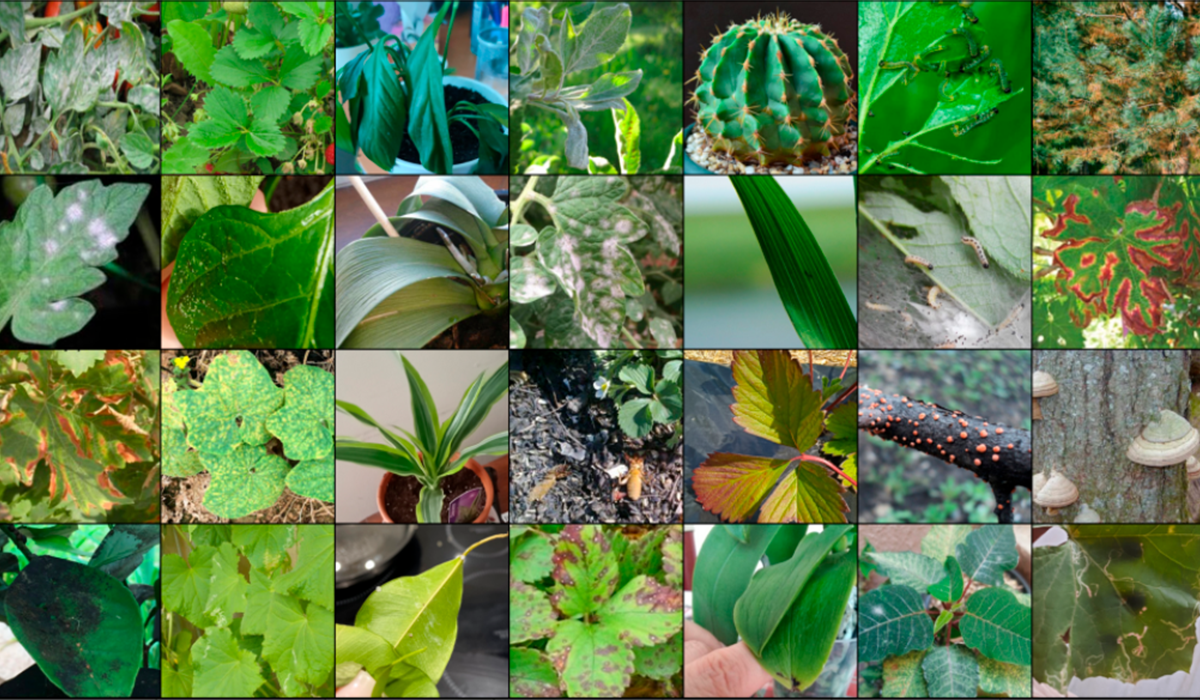
Accurate identification of disease and correct treatment policy can save and increase yield. Different deep learning methods have emerged as an effective solution to this problem. Still, the challenges posed by limited datasets and the similarities in disease symptoms make traditional methods, such as transfer learning from models pre-trained on large-scale datasets like ImageNet, less effective. In this study, a self-collected dataset from the DoctorP project, consisting of 46 distinct classes and 2615 images, was utilized. DoctorP is a multifunctional platform for plant disease detection oriented on agricultural and ornamental crop. The platform has different interfaces like mobile applications for iOS and Android, a Telegram bot, and an API for external services. Users and services send photos of the diseased plants in to the platform and can get prediction and treatment recommendation for their case. The platform supports a wide range of disease classification models. MobileNet_v2 and a Triplet loss function were previously used to create models. Extensive increase in the number of disease classes forces new experiment with architectures and training approaches. In the current research, an effective solution based on ConvNeXt architecture and Large Margin Cosine Loss is proposed to classify 46 different plant diseases. The training is executed in limited training dataset conditions. The number of images per class ranges from a minimum of 30 to a maximum of 130. The accuracy and F1-score of the suggested architecture equal to 88.35% and 0.9 that is much better than pure transfer learning or old approach based on Triplet loss. New improved pipeline has been successfully implemented in the DoctorP platform, enhancing its ability to diagnose plant diseases with greater accuracy and reliability.
References
[1] R. Ramanjot, U. Mittal, A. Wadhawan, J. Singla, N. Z. Jhanjhi, R. M. Ghoniem, S. K. Ray, A. Ab-delmaboud, Plant disease detection and classification: A systematic literature review, Sensors 23(2023) 4769. doi:https://doi.org/10.3390/s23104769.
[2] S. Muhammad, S. Babar, E. Shaker, A. Akhtar, U. Asad, A. Fayadh, G. Tsanko, H. Tariq, A. Far-man, An advanced deep learning models-based plant disease detection: A review of recent research,Frontiers in Plant Science 14 (2023). doi:https://doi.org/10.3389/fpls.2023.1158933.
[3] J. V. A. Porto, A. C. Dorsa, V. A. M. Weber, K. R. A. Porto, H. Pistori, Usage of few-shotlearning and meta-learning in agriculture: A literature review, Smart Agricultural Technology 5(2023) 100307. doi:https://doi.org/10.1016/j.atech.2023.100307.
[4] M. Dyrmann, H. Karstoft, H. S. Midtiby, Plant species classification using deep convolutionalneural networks, Biosystems Engineering 151 (2016) 72–80. doi:https://doi.org/10.1016/j.biosystemseng.2016.08.002.
[5] A. K. Abasi, S. N. Makhadmeh, O. A. Alomari, M. Tubishat, H. J. Mohammed, Enhancing riceleaf disease classification: A customized convolutional neural network approach, Sustainability 15(2023) 15039. doi:https://doi.org/10.3390/su152015039.
[6] K. P. Ferentinos, Deep learning models for plant disease detection and diagnosis, Computers andElectronics in Agriculture 145 (2018) 311–318. doi:https://doi.org/10.1016/j.compag.2018.01.009.
[7] A. Picon, M. Seitz, A. Alvarez-Gila, P. Mohnke, A. Ortiz-Barredo, J. Echazarra, Crop conditionalconvolutional neural networks for massive multi-crop plant disease classification over cell phoneacquired images taken on real field conditions, Computers and Electronics in Agriculture 167(2019) 105093. doi:https://doi.org/10.1016/j.compag.2019.105093.
[8] F. Adnan, M. J. Awan, A. Mahmoud, H. Nobanee, A. Yasin, A. M. Zain, EfficientNetB3-adaptiveaugmented deep learning (AADL) for multi-class plant disease classification, IEEE Access 11(2023) 85426–85440. doi:https://doi.org/10.1109/ACCESS.2023.3303131.
[9] D. P. Hughes, M. Salathe, An open access repository of images on plant health to enable thedevelopment of mobile disease diagnostics, arXiv (2015). arXiv:1511.08060, doi:https://arxiv.org/abs/1511.08060.
[10] Y. Lu, X. Tao, N. Zeng, J. Du, R. Shang, Enhanced CNN classification capability for small ricedisease datasets using progressive WGAN-GP: Algorithms and applications, Remote Sensing 15(2023) 1789. doi:https://doi.org/10.3390/rs15071789.
[11] Y. Wang, Y. Yin, Y. Li, T. Qu, Z. Guo, M. Peng, S. Jia, Q. Wang, W. Zhang, F. Li, Classificationof plant leaf disease recognition based on self-supervised learning, Agronomy 14 (2024) 500. doi:https://doi.org/10.3390/agronomy14030500.
[12] J. Deng, W. Dong, R. Socher, L. J. Li, K. Li, L. Fei-Fei, ImageNet: A large-scale hierarchical imagedatabase, in: Proceedings of the IEEE Conference on Computer Vision and Pattern Recognition,Miami, FL, USA, 2009, pp. 248–255. doi:https://doi.org/10.1109/CVPR.2009.5206848.
[13] G. Koch, R. Zemel, R. Salakhutdinov, Siamese neural networks for one-shot image recognition,in: Proceedings of the ICML Deep Learning Workshop, Lille, France, 2015, pp. 1–8.
[14] D. Arg ̈ueso, A. Picon, U. Irusta, A. Medela, M. G. San-Emeterio, A. Bereciartua, A. Alvarez-Gila, Few-shot learning approach for plant disease classification using images taken in the field,Computers and Electronics in Agriculture 175 (2020) 105542. doi:https://doi.org/10.1016/j.compag.2020.105542.
[15] S. Chopra, R. Hadsell, Y. LeCun, Learning a similarity metric discriminatively, with applicationto face verification, in: Proceedings of the IEEE Conference on Computer Vision and PatternRecognition, San Diego, CA, USA, 2005, pp. 539–546. doi:https://doi.org/10.1109/CVPR.2005.202.
[16] F. Schroff, D. Kalenichenko, J. Philbin, FaceNet: A unified embedding for face recognition andclustering, in: Proceedings of the IEEE Conference on Computer Vision and Pattern Recognition,Boston, MA, USA, 2015, pp. 815–823. doi:https://doi.org/10.1109/CVPR.2015.7298682.
[17] I. Egusquiza, A. Picon, U. Irusta, A. Bereciartua-Perez, T. Eggers, C. Klukas, E. Aramendi,R. Navarra-Mestre, Analysis of few-shot techniques for fungal plant disease classification andevaluation of clustering capabilities over real datasets, Frontiers in Plant Science 13 (2022) 813237.doi:https://doi.org/10.3389/fpls.2022.813237.
[18] A. Uzhinskiy, G. Ososkov, P. Goncharov, A. Nechaevskiy, A. Smetanin, One-shot learning withtriplet loss for vegetation classification tasks, Computer Optics 45 (2021) 608–614.
[19] M. Sandler, A. Howard, Z. Zhu, A. Zhmoginov, L.-C. Chen, MobileNetV2: Inverted residuals andlinear bottlenecks, arXiv (2018). doi:https://arxiv.org/abs/1801.04381.
[20] W. Liu, Y. Wen, Z. Yu, M. Li, S. Raj, L. Song, SphereFace: Deep hypersphere embedding forface recognition, arXiv (2017). doi:https://arxiv.org/abs/1704.08063.
[21] J. Deng, J. Guo, J. Yang, N. Xue, I. Kotsia, S. Zafeiriou, ArcFace: Additive angular margin loss A. UzhinskiyNatural Sci. Rev.2100201 (2025)for deep face recognition, arXiv (2018). doi:https://arxiv.org/abs/1801.07698.
[22] Q. Dai, Y. Guo, Z. Li, S. Song, S. Lyu, D. Sun, Y. Wang, Z. Chen, Citrus disease image generationand classification based on improved FastGAN and EfficientNet-B5, Agronomy 13 (2023) 988. doi:https://doi.org/10.3390/agronomy13040988.
[23] M. Tan, Q. V. Le, EfficientNet: Rethinking model scaling for convolutional neural networks, arXiv(2019). doi:https://arxiv.org/abs/1905.11946.
[24] H. Wang, Y. Wang, Z. Zhou, X. Ji, D. Gong, J. Zhou, Z. Li, W. Liu, CosFace: Large MarginCosine Loss for deep face recognition, arXiv (2018). doi:https://arxiv.org/abs/1801.09414.
[25] Z. Liu, H. Mao, C.-Y. Wu, C. Feichtenhofer, T. Darrell, S. Xie, A ConvNet for the 2020s, arXiv(2022). doi:https://arxiv.org/abs/2201.03545.
[26] G. Ososkov, A. Nechaevskiy, A. Uzhinskiy, P. Goncharov, Architecture and basic principles ofthe multifunctional platform for plant disease detection, in: CEUR Workshop Proceedings, GRID2018 — Selected Papers of the 8th International Conference “Distributed Computing and Grid-Technologies in Science and Education”, 2018, pp. 200–206.
[27] M. Zuev, Y. Butenko, M. ́Cosi ́c, A. Nechaevskiy, D. Podgainy, I. Rahmonov, A. Stadnik, O. Strel-tsova, ML/DL/HPC ecosystem of the HybriLIT heterogeneous platform (MLIT JINR): New op-portunities for applied research, in: Proceedings of the 6th International Workshop on DeepLearning in Computational Physics (DLCP2022), 2022.
[28] L. J. P. Maaten, G. E. Hinton, Visualizing high-dimensional data using t-SNE, Journal of MachineLearning Research 9 (2008) 2579–2605.