

Abstract
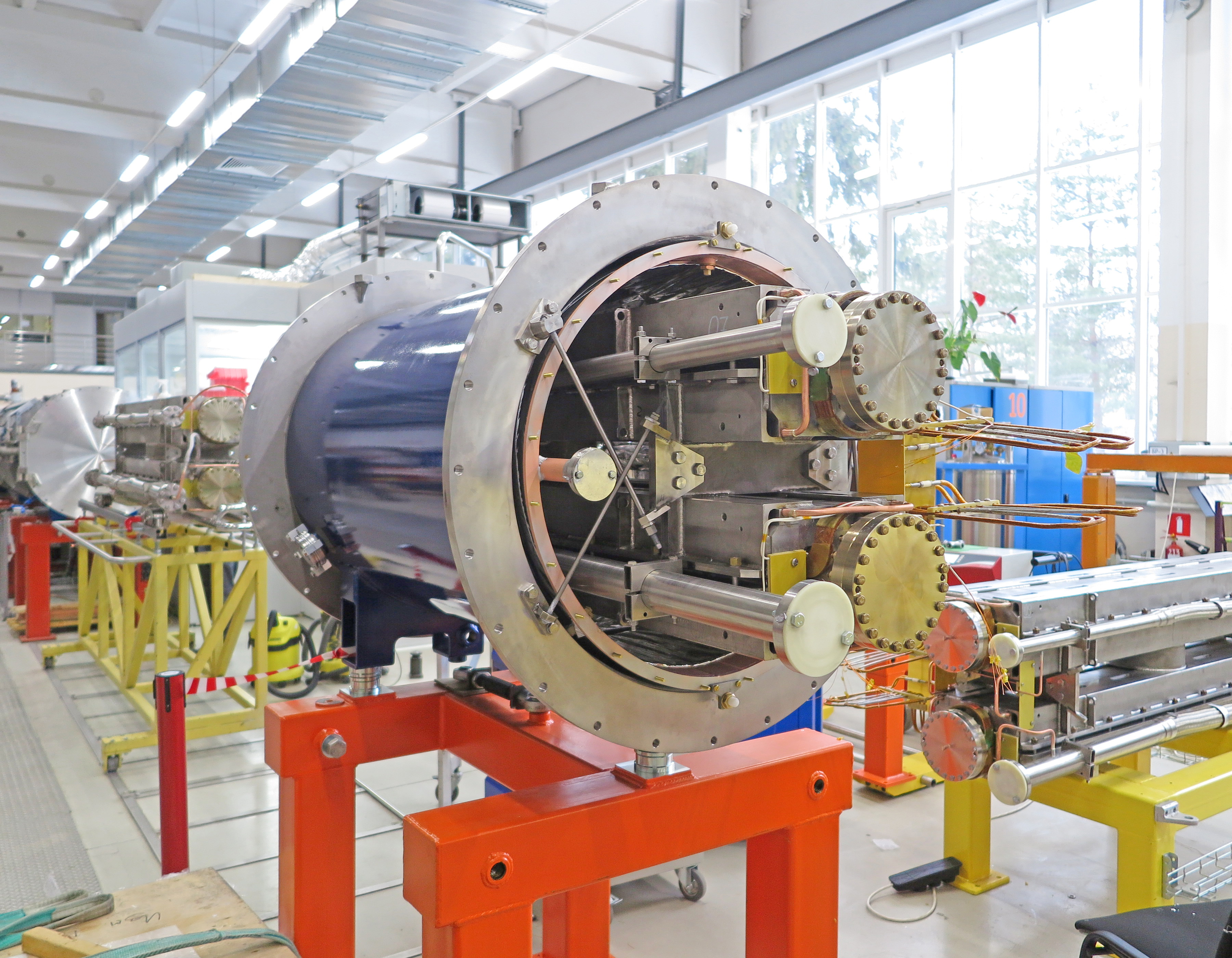
The article presents an overview of the work carried out at the Joint Institute for Nuclear Research in Dubna since the early 1970s aimed at creating superconducting (SC) magnets for charged particle accelerators. The specified studies made it possible to build the world’s first SC heavy-ion fast-cycling synchrotron — the Nuclotron; magnets for the SIS100 synchrotron of the FAIR project; magnetic systems of the SC Booster and collider of the NICA complex. It also resulted in a development of SC winding for magnet of the medical cyclotron for proton therapy MSC-230, a model magnet for the Chinese HIAF collider project with a record (up to 10 T/s) rate of magnetic field change, a 3-MJ energy storage device based on high-temperature superconductor (HTS), and a concept of magnets for the New Nuclotron made of HTS material for operation at a winding temperature of about 50 K.
References
[1] A. M. Baldin, V. V. Vasilishin, E. M. Dyachkov, A. G. Zeldovich, L. P. Zinoviev, I. B. Issinsky,A. D. Kirillov, E. M. Kulakova, L. G. Makarov, I. N. Semenyushkin, A. A. Smirnov, V. L.Stepanyuk, V. A. Mikhailov, et al., Nuclotron — accelerator complex of relativistic nuclei inVBLHEP JINR, in: Proceedings of 4th All-Union Conference on Charged Particle Accelerators,Nauka, Vol. II, 1974, pp. 4–8.
[2] A. Baldin, et al., Nuclotron status report, IEEE Transactions on Nuclear Science NS30 (4) (1983)3247–3249; 1983 Particle Accelerator Conference: Accelerator Engineering and Technology, SantaFe, New Mexico, 1983.
[3] H. G. Khodzhibagiyan, A. A. Smirnov, The concept of a superconducting magnet system for theNuclotron, in: Proceedings of the 12th International Cryogenic Engineering Conference, ICEC12,Southampton, 1988, pp. 841–844.
[4] A. M. Baldin, et al., Superconducting fast cycling magnets of the Nuclotron, IEEE Transactionson Applied Superconductivity 5 (1995) 875–877.doi:10.1109/77.402687.
[5] H. G. Khodzhibagiyan, A. D. Kovalenko, E. Fischer, Some aspects of cable design for fast cyclingsuperconducting synchrotron magnets, IEEE Transactions on Applied Superconductivity 14 (2)(2004).doi:10.1109/TASC.2004.830386.
[6] H. Khodzhibagiyan, et al., From Nuclotron synchrotron to NICA collider — common cryogenicconcept for various superconducting magnets, their design specifics and test results, IEEE Trans-actions on Applied Superconductivity 34 (5) (2024).doi:10.1109/TASC.2024.3368993.
[7] G. Moritz, C. Muehle, M. Anerella, A. Ghosh, W. Sampson, P. Wanderer, E. Willen, N. Agapov,H. Khodzhibagiyan, A. Kovalenko, W. V. Hassenzahl, M. N. Wilson, Towards fast-pulsed super-conducting synchrotron magnets, in: Proceedings of the 2001 Particle Accelerator Conference,Chicago, 2001, pp. 211–213.
[8] E. Fischer, et al., Status of the superconducting magnets for the SIS100 synchrotron and theNICA project, IEEE Transactions on Applied Superconductivity 23 (3) (2013) 6397567.doi:10.1109/TASC.2012.2232952.
[9] E. Fischer, P. Akishin, H. Khodzhibagiyan, A. Kovalenko, G. Kuznetsov, G. Moritz, A. Smirnov,Minimization of AC power losses in fast cycling window frame 2 T superferric magnets with theyoke at 4.5 K, Report at ASC 2004, Jacksonville, Florida, USA, Oct. 2004.
[10] A. Kovalenko, N. Agapov, E. Fischer, H. Khodzhibagiyan, G. Kuznetsov, G. Moritz, A. Smirnov,New results on minimizing AC power losses in a fast cycling 2 T superferric dipole with a coldyoke, IEEE Transactions on Applied Superconductivity 16 (2) (2006) 338–341.doi:10.1109/TASC.2006.873341.
[11] A. Kovalenko, N. Agapov, A. Alfeev, H. Khodzhibagiyan, G. Kuznetsov, V. Seleznev,A. Shabunov, A. Starikov, E. Fischer, G. Moritz, C. Muehle, P. Spiller, A. Kalimov, Full lengthsuperferric dipole and quadrupole prototype magnets for the SIS100 at GSI: Status of the designand manufacturing, in: Proceedings of EPAC 06, Edinburgh, GB, 2006, pp. 2583–2585.
[12] E. Fischer, A. Alfeev, A. Kalimov, H. Khodzhibagiyan, A. Kovalenko, G. Kuznetsov, G. Moritz,C. Muehle, V. Seleznev, Status of the design of a full length superferric dipole and quadrupolemagnets for the FAIR SIS100 synchrotron, IEEE Transactions on Applied Superconductivity17 (2) (2007) 1078–1082; ASC 06, Seattle, USA, Sep. 2006.doi:10.1109/TASC.2007.897278.
[13] H. G. Khodzhibagiyan, et al., Production and test status of the superconducting magnets forthe NICA project and the SIS100 synchrotron, IEEE Transactions on Applied Superconductivity29 (5) (2019) 4100806.doi:10.1109/TASC.2019.2901591.
[14] A. D. Kovalenko, N. N. Agapov, V. G. Aksenov, I. E. Karpunina, H. G. Khodzhibagiyan, G. L.Kuznetsov, M. A. Voevodin, G. Moritz, E. Fisher, G. Hess, C. Muehle, Progress in the design andstudy of a superferric dipole magnet for the GSI fast-pulsed synchrotron SIS100, IEEE Transac-tions on Applied Superconductivity 14 (2) (2004) 321–324.doi:10.1109/TASC.2004.829112.
[15] G. Moritz, E. Fischer, H. Khodzhibagiyan, A. Kovalenko, A. Nyilas, R. Burgmer, D. Krischel,P. Schmidt, W. G ̈artner, M. Gehring, W. Walter, A. Wessner, Mechanical coil structure of theFAIR SIS100 magnets, IEEE Transactions on Applied Superconductivity 17 (2) (2007) 1169–1172;ASC 06, Seattle, USA, Sep. 2006.doi:10.1109/TASC.2007.897263.
[16] Nuclotron-based ion collider facility,https://nica.jinr.ru.
[17] H. Khodzhibagiyan, et al., Cryogenic test of the full-size superconducting magnet for the Boostersynchrotron of the NICA project, Physics Procedia 36 (2012) 1083–1086.doi:10.1016/j.phpro.2012.06.110.
[18] H. Khodzhibagiyan, et al., Thermodynamic characteristics of doublets of quadrupole magnets for the Booster synchrotron at the NICA accelerator complex, Physics of Particles and Nuclei Letters19 (6) (2022) 808–813.doi:10.1134/S1547477122060243.
[19] H. Khodzhibagiyan, et al., Superconducting magnets for the NICA accelerator collider project,IEEE Transactions on Applied Superconductivity 26 (4) (2016) 7414419.doi:10.1109/TASC.2016.2532363.
[20] A. V. Butenko, et al., First experiments with accelerated ion beams in the Booster of the NICAaccelerator complex, in: Proceedings of IPAC2021, Campinas, SP, Brazil, 2021.doi:10.18429/JACoW-IPAC2021-MOPAB025.
[21] A. V. Butenko, et al., NICA Booster: Superconducting synchrotron of a new generation, Physics— Uspekhi 66 (2023) 195–212. https://doi.org/10.3367/UFNe.2021.12.039138.
[22] H. Khodzhibagiyan, et al., An approach to development of the HTS magnet for SMES at JINR,Journal of Physics: Conference Series 1590 (2020) 012057. IOP Publishing.doi:10.1088/1742-6596/1590/1/012057.
[23] Recent advances in SuperOx 2G HTS wire manufacturing facilities, performance and customiza-tion, Report at ASC2020, Louisville, CO, USA, 2020.
[24] H. Khodzhibagiyan, V. Kekelidze, G. Kuznetsov, G. Trubnikov, et al., Quadrupole supercon-ducting model magnet for upgrade of the Nuclotron synchrotron, IEEE Transactions on AppliedSuperconductivity 32 (6) (2022) 1–1.doi:10.1109/TASC.2022.3151579.
[25] D. Abin, M. Osipov, S. Pokrovskii, H. Khodzhibagiyan, et al., Local quality control of helicalCORC cable winding, IEEE Transactions on Applied Superconductivity 32 (4) (2022) 1–1.doi:10.1109/TASC.2022.3159276.
[26] J. Zheng, Y. Cheng, M. Li, M. Novikov, et al., Engineering design of 1 MJ HTS SMES system withkA-level current capacity for NICA accelerator, IEEE Transactions on Applied Superconductivity99 (2024) 1–5.doi:10.1109/TASC.2024.3446286.
[27] H. Khodzhibagiyan, et al., Quadrupole superconducting model for update of the Nuclotronsynchrotron, IEEE Transactions on Applied Superconductivity 32 (6) (2022) 4003704.doi:10.1109/TASC.2022.3151579.
[28] M. S. Novikov, et al., Development of technologies for radiation pinning centers in 2nd generationHTS tapes for magnets of the New Nuclotron with nitrogen cooling, in: Proceedings of the LaPlas-2022 Conference, Moscow, 2022.
[29] G. G. Khodjibagiyan, M. S. Novikov, E. Z. Fisher, A. V. Shemchuk, The concept of the HTSmagnetic system of the New Nuclotron synchrotron, Particles and Nuclei, Letters 21 (1) (2024)68–75.
[30] A. V. Shemchuk, et al., HTS prototype of the quadrupole magnet of the New Nuclotron, in:Proceedings of the LaPlas-2022 Conference, Moscow, 2022.