

Abstract
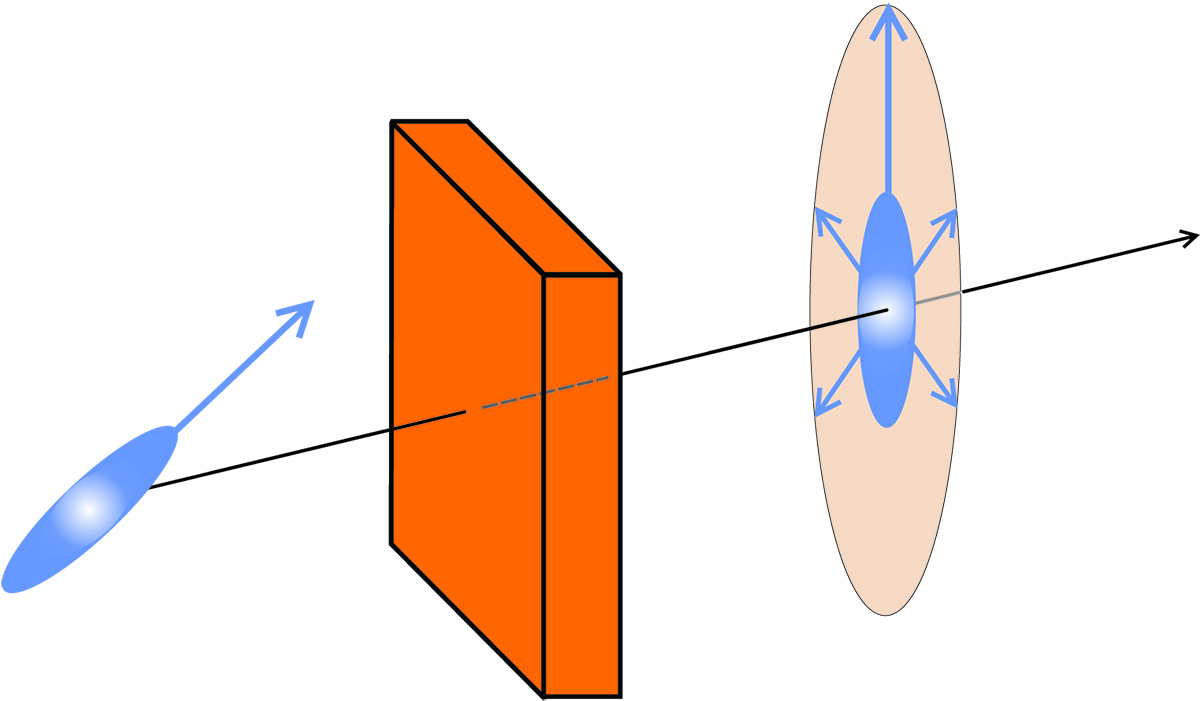
Refracton of particles (nucleons, nuclei, γ-quanta) in matter with polarized protons (nuclei) results in revealing coherent quasi-optical phenomenon of nuclear spin precession of particles (nuclei) in the pseudomagnetic field of matter with polarized spins and the phenomenon of birefringence of particles (nuclei) with spin S ⩾ 1. These phenomena can be observed and studied at the Nuclotron-M/NICA complex. The similar effects for γ-quanta could be observed at the LINAC accelerator.Quasi-optical coherent phenomena of spin rotation and dichroism are not caused by strong interactions only, the T-odd P-odd, T-odd P-even, and T-even P-odd interactions also contribute. Limits on the values of these contributions at the energies available at the Nuclotron-M/NICA complex can be obtained by investigating all these phenomena. When studying polarized particle collisions, it is necessary to consider possible influences of quasi-optical phenomena of spin rotation and spin dichroism caused by nuclear precession and birefringence.
Acknowledgements
References
[1] M. Born, E. Wolf, Principles of optics: Electromagnetic Theory of Propagation, Interference and Diffraction of Light, Pergamon Press, 1965.
[2] E. M. Purcell, Electricity and Magnetism, Berkeley Physics Course, Vol. 2, 2nd ed., McGraw-Hill, New York, 1985.
[3] F. S. Crawford, Waves, Berkeley Physics Course, Vol. 3, McGraw-Hill, New York, 1968.
[4] E. Wichmann, Quantum Physics, Berkeley Physics Course, Vol. 4, McGraw-Hill, New York, 1967.
[5] V. M. Agranovich, Yu. N. Gartstein, Spatial dispersion and negative refraction of light, Soviet
Physics Uspekhi 49(10) (2006) 1029–1044. DOI: https://doi.org/10.1070/PU2006v049n10ABEH006067
[6] L. D. Landau, E. M. Lifshitz, Quantum Mechanics: Non-Relativistic Theory, in L. D. Landau, E. M. Lifshitz, Course of Theoretical Physics, Vol. 3, 3rd ed., Pergamon Press, 1977.
[7] E. Fermi, Nuclear Physics, Course Notes compiled by J. Orear, A. H. Rosenfeld, R. A. Schluter, University of Chicago Press, Chicago, 1950.
[8] R. Feynman, R. Leighton, M. Sands, Lectures on Physics, Vol. I–III, Addison-Wesley, Reading, Massachusetts, Palo Alto, London, 1965. DOI: https://doi.org/10.1119/1.1972241
[9] D. M. Greenberger, A. W. Overhauser, Coherence effects in neutron diffraction and gravity experiments, Reviews of Modern Physics 51(1) (1979) 43–78. DOI: https://doi.org/10.1103/RevModPhys.51.43
[10] V. G. Baryshevskii, V. L. Lyuboshitz, Rotation of the polarization plane of gamma quanta in passing through a polarized electron target, Yadernaya Fizika 2 (1965) 666–670.
[11] V. G. Baryshevskii, O. V. Dumbrais, V. L. Lyuboshitz, Concerning the rotation of the plane of linear polarization of γ-quanta in a magnetized ferromagnet, JETP Letters 15(2) (1972) 78–81.
[12] V. M. Lobashev, L. A. Popeko, L. M. Smotritskii, A. P. Serebrov, E. A. Kolomenskii, Experimental observation of rotation of the plane of linear polarization of γ-quanta in magnetized ferromagnets, JETP Letters 14(6) (1971) 251–254 (Pis’ma Zh. Eksp. Teor. Fiz. 14 (1971) 373–
376).
[13] V. M. Lobashev, E. A. Kolomenskii, L. A. Popeko, A. P. Serebrov, L. M. Smotritskii, G. I. Kharkevich, Rotation of the plane of polarization of γ-quanta and left–right asymmetry of scattering by thick magnetized scatterers, Soviet Physics JETP 41(4) (1975) 606–609 (Journal of Experimental and Theoretical Physics 68(4) (1975) 1220–1227).
[14] P. Bock, P. Luksch, Observation of the Faraday effect with 230 keV and 330 keV photons, Lettereal Nuovo Cimento 2(21) (1971) 1081–1085. DOI: https://doi.org/10.1007/BF02780625
[15] M. L. Goldberger, K. M. Watson, Collision Theory, Wiley, New York, 1984.
[16] V. G. Baryshevskii, M. I. Podgoretskii, Nuclear precession of neutrons, Journal of Experimental and Theoretical Physics 47 (1964) 1050–1054, [in Russian]; (Soviet Physics. JETP 20 (1965) 704).
[17] A. Abragam, G. L. Bacchella, H. Gl¨attli, P. Meriel, J. Piesvaux, M. Pinot, Pseudo Magnetic Moments of 1H and 51V Measured by a New Method, Physical Review Letters 31, 12 (1973) 776–779. DOI: https://doi.org/10.1103/PhysRevLett.31.776
[18] M. Forte, Neutron spin precession in polarized nuclear targets, Nuovo Cimento A 18(4) (1973) 726–736. DOI: https://doi.org/10.1007/BF02727588
[19] F. C. Michel, Parity nonconservation in nuclei, Physical Review 133(2B) (1964) B329–B349. DOI: https://doi.org/10.1103/PhysRev.133.B329
[20] M. Forte, B. R. Heckel, N. F. Ramsey, K. Green, G. L. Greene, J. Byrne, J. M. Pendlebury, First measurement of parity–nonconserving neutron–spin rotation: The tin isotopes, Physical Review Letters 45(26) (1980) 2088–2092. DOI: https://doi.org/10.1103/PhysRevLett.45.2088
[21] V. G. Baryshevsky, Channeling, Radiation and Reactions in Crystals at High Energies, Belarusian State University Press, Minsk, 1982.
[22] V. G. Baryshevskii, Nuclear Optics of Polarized Media, Belarusian State University Press, Minsk, 1976.
[23] V. G. Baryshevsky, Nuclear Optics of Polarized Media, Energoatomizdat, Moscow, 1995.
[24] P. J. Hughes, Neutron Optics, Interscience Publisher, New York, 1954. DOI: https://doi.org/10.1119/1.1933809
[25] A. I. Frank, Fundamental properties of the neutron: Fifty years of research, Soviet Physics Uspekhi 25(5) (1982) 280–297. DOI: https://doi.org/10.1070/PU1982v025n05ABEH004548
[26] Yu. G. Abov, A. D. Gulko, P. A. Krupchitsky, Polarized Slow Neutrons, Atomizdat, Moscow, 1966.
[27] I. I. Gurevich, L. V. Tarasov, Low–Energy Neutron Physics, North Holland Publishing Co., Amsterdam, 1968.
[28] L. D. Landau, E. M. Lifshitz, L. P. Pitaevskii, Electrodynamics of Continuous Media, in: L. D. Landau, E. M. Lifshitz (eds.), Course of Theoretical Physics, Vol. 8, 2nd ed., Butterworth-Heinemann, 1984.
[29] L. P. Pitaevskii, Electric forces in a transparent dispersive medium, Soviet Physics JETP 12, 5 (1961) 1008–1013 [Journal of Experimental and Theoretical Physics 39 (1960) 1450–1458].
[30] M. Gell-Mann, M. L. Goldberger, W. E. Thirring, Use of causality conditions in quantum theory, Physical Review 95 (1954) 1612–1627. DOI: https://doi.org/10.1103/PhysRev.95.1612
[31] V. Olmos de Le´on, H. Schmieden, H. W. Grießhammer, et al., Low-energy Compton scattering and the polarizabilities of the proton, European Physical Journal A 10 (2001) 207–215. DOI: https://doi.org/10.1007/s100500170132
[32] F. Wissmann, Compton scattering: Investigating the structure of the nucleon with real photons, Springer Tracts in Modern Physics, Vol. 200, Springer, 2004. DOI: https://doi.org/10.1007/b12999
[33] M. Schumacher, Polarizability of the nucleon and Compton scattering, Progress in Particle and Nuclear Physics 55 (2005) 567–646. DOI: https://doi.org/10.1016/j.ppnp.2005.01.033
[34] P. S. Baranov, A. I. L’vov, V. A. Petrun’kin, L. N. Shtarkov, Low-energy γp scattering and determination of proton polarizabilities, Physics of Atomic Nuclei 65 (2002) 261–275. DOI: https://doi.org/10.1134/1.1451939
[35] D. Drechsel, B. Pasquini, M. Vanderhaeghen, Dispersion relations in real and virtual Compton scattering, Physics Reports 378 (2003) 99–205. DOI: https://doi.org/10.1016/S0370-1573(02)00636-1
[36] V. G. Baryshevsky, Dispersion theory of nucleon (nucleus) Compton scattering spin polarizabilities and quasi-optical -ray polarization plane rotation and birefringence effect in a matter with polarized protons (nuclei), arXiv:2411.04960v2 [hep-ph].
[37] V. G. Baryshevsky, High-Energy Nuclear Optics of Polarized Particles, World Scientific Publishing, 2012. DOI: https://doi.org/10.1142/9789814324847
[38] V. G. Baryshevsky, On the birefringence of γ-quanta in a polarized nuclear target, Yadernaya Fizika 4(5) (1966) 1045–1047 [in Russian].
[39] R. G. Sachs, L. L. Foldy, The scattering of gamma-rays by nucleons, Physical Review 80 (1950) 824–835. DOI: https://doi.org/10.1103/PhysRev.80.824
[40] A. M. Baldin, Optical anisotropy of atomic nuclei, Soviet Physics JETP 10 (1960) 142–146 [Journal of Experimental and Theoretical Physics 37 (1959) 202–207, in Russian].
[41] A. M. Baldin, S. F. Semenko, On the theory of the optical anisotropy of atomic nuclei, Soviet Physics JETP 13 (1961) 306–312 [Journal of Experimental and Theoretical Physics 39 (1960) 434–442, in Russian].
[42] S. Saito, Low-energy theorem for Compton scattering, Physical Review 184 (1969) 1894–1902. DOI: https://doi.org/10.1103/PhysRev.184.1894
[43] K. Abe, et al., Measurements of the proton and deuteron spin structure functions g1 and g2,
Physical Review D 58 (1998), 112003 1–50. DOI: https://doi.org/10.1016/S0940-2993(98)80070-5
[44] E. M. Darwish, H. Arenh¨ovel, M. Schwamb, Final-state interaction in spin asymmetry and GDH sum rule for incoherent pion production on the deuteron, European Physical Journal A 17 (2003) 513–521. DOI: https://doi.org/10.1140/epja/i2003-10023-5
[45] H. Arenh¨ovel, A. Fix, Incoherent pion photoproduction on the deuteron with polarization observables. I. Formal expressions, Physical Review C 72 (2005), 064004 1–17. DOI: https://doi.org/10.1103/PhysRevC.72.064004
[46] O. Hanstein, D. Drechsel, L. Tiator, Multipole analysis of pion photoproduction based on fixed-t dispersion relations and unitarity, Nuclear Physics A 632 (1998) 561–575. DOI: https://doi.org/10.1016/S0375-9474(98)00818-5
[47] M. I. Levchuk, M. Schumacher, F. Wissmann, The inclusive reaction d(γ, π)N N in the first resonance region, arXiv:nucl-th/0011041 (2000) 1–15.
[48] M. Schumacher, M. D. Scadron, Dispersion theory of nucleon Compton scattering and polarizabilities, Fortschritte der Physik 61 (2013) 703–741. DOI: https://doi.org/10.1002/prop.201300007
[49] M. Schumacher, Structure of the nucleon and spin-polarizabilities, Nuclear Physics A 826 (2009) 131–147. DOI: https://doi.org/10.1016/j.nuclphysa.2009.05.093
[50] M. Schumacher, M. I. Levchuk, Polarizability of the nucleon, Nuclear Physics A 858 (2011) 48–65. DOI: https://doi.org/10.1016/j.nuclphysa.2011.04.002
[51] D. Drechsel, S. S. Kamalov, L. Tiator, Unitary isobar model — MAID2007, European Physical Journal A 34 (2007) 69–97. DOI: https://doi.org/10.1140/epja/i2007-10490-6
[52] H. Dutz, V. G. Lagerquist, S. Goertz, Recent activities of the Bonn polarized target group, Proc. 25th International Spin Physics Symposium (SPIN 2023), Durham, NC, USA, 24–29 Sept. 2023. DOI: https://doi.org/10.22323/1.456.0221
[53] V. Andrieux, A. Berlin, N. Doshita et al., The large COMPASS polarized solid ammonia target for Drell–Yan measurements with a pion beam, NIM A1025 (2022) 166069(1–10), DOI: https://doi.org/10.1016/j.nima.2021.166069
[54] B. Pasquini, M. Vanderhaeghen, Dispersion theory in electromagnetic interactions, Annual Review of Nuclear and Particle Science 68 (2018) 75–100. DOI: https://doi.org/10.1146/annurev-nucl-101917-020843
[55] X. Li, M. W. Ahmed, A. Banu, et al., Proton Compton scattering from linearly polarized gamma rays, Physical Review Letters 128, 13 (2022), 132502 1–6. DOI: https://doi.org/10.1103/PhysRevLett.128.132502
[56] E. Mornacchi, et al. [A2 Collaboration at MAMI], Measurement of Compton scattering at MAMI for the extraction of the electric and magnetic polarizabilities of the proton, Physical Review Letters 128 (2022), 132503 1–6.
[57] A. I. L’vov, Theoretical aspects of the polarizability of the nucleon, International Journal of Modern Physics A 8 (1993) 5267–5303. DOI: https://doi.org/10.1142/S0217751X93002095
[58] M. I. Levchuk, A. I. L’vov, V. A. Petrun’kin, Photon scattering on quasi-free neutrons in the reaction γd → γ′np and neutron polarizabilities, Few-Body Systems 16 (1994) 101–125. DOI: https://doi.org/10.1007/BF01355284
[59] M. Biroth, P. Achenbach, E. Downie, A. Thomas, Design of the Mainz active polarized proton target, Proc. XVI Int. Workshop on Polarized Sources, Targets, and Polarimetry (PSTP 2015), Bochum, Germany, 14–18 Sept. 2015. DOI: https://doi.org/10.22323/1.243.0005
[60] M. Bornstein, H. Dutz, S. Goertz, S. Runkel, The polarized target at the CBELSA/TAPS experiment, Proc. 23rd Int. Spin Physics Symposium (SPIN 2018), Ferrara, Italy, 10–14 Sept. 2018.
[61] L. D. Landau, E. M. Lifshitz, The classical theory of fields, in L. D. Landau, E. M. Lifshitz (eds.), Course of Theoretical Physics, Vol. 2, 4th ed., Pergamon Press, 1975.
[62] V. B. Berestetskii, E. M. Lifshitz, L. P. Pitaevskii, Quantum Electrodynamics, in: L. D. Landau, E. M. Lifshitz (eds.), Course of Theoretical Physics, Vol. 4, 2nd ed., Butterworth-Heinemann, 1982.
[63] N. Cabibbo, G. Da Prato, G. De Franceschi, and U. Mosco, New Method for Producing and Analyzing Linearly Polarized Gamma-Ray Beams, Physical Review Letters 9 (1962) 270. DOI: https://doi.org/10.1103/PhysRevLett.9.270
[64] N. Cabibbo, G. Da Prato, G. De Franceschi, and U. Mosco, Circular Polarization of High-Energy γ Rays by Birefringence in Crystals, Physical Review Letters 9 (1962) 435. DOI: https://doi.org/10.1103/PhysRevLett.9.435
[65] N. Cabibbo, G. Da Prato, G. De Franceschi, and U. Mosco, Absorption of γ-rays in crystals and the production and analysis of linearly polarized γ-rays, Nuovo Cimento, 27 (1963) 979–994. DOI: https://doi.org/10.1007/BF02783286
[66] H. R. Weller, M. W. Ahmed, Y. K. Wu, Nuclear Physics Research at the High Intensity Gamma-Ray Source (HIγS), Nuclear Physics News, 25(3) (2015) 19–24. DOI: https://doi.org/10.1080/10619127.2015.1035932
[67] V. V. Tikhomirov, Hard gamma-quanta source based on the electron and positron radiation in the field of planes formed by atomic chains, Journal of the Belarusian State University. Physics, 3 (2023) 65–74 [in Russian].
[68] J. W. Chen, H. W. Grießhammer, M. J. Savage, R. P. Springer, The polarizability of the deuteron, Nuclear Physics A 644(3) (1998) 221–234. DOI: https://doi.org/10.1016/S0375-9474(98)80012-2
[69] E. D. Commins and P. H. Bucksbaum Weak Interactions of Leptons and Quarks, Cambridge University Press, 1983.
[70] E. Klempt, F. Bradamante, A. Martin, J.-M. Richard, Physics Reports 368 (2002) 119. DOI: https://doi.org/10.1016/S0370-1573(02)00144-8
[71] E. Widmann, FLAIR, A next-generation facility for low-energy antiprotons, in: 8th International Conference on Nuclear Physics at Storage Rings, STORI11 October 9–14, 2011 Frascati (Rome) Italy, PoS(STORI11)035. DOI: https://doi.org/10.22323/1.150.0035
[72] H. Str¨oher, P. Lenisa, F. Rathmann, The road towards polarized antiprotons, in: 8th International Conference on Nuclear Physics at Storage Rings, STORI11 October 9–14, 2011 Frascati (Rome) Italy, PoS(STORI11)030. DOI: https://doi.org/10.22323/1.150.0030
[73] V. G. Baryshevsky. Rotation of particle spin in a storage ring with a polarized beam and measurement of the particle EDM, tensor polarizability and elastic zero-angle scattering amplitude, Journal of Physics G: Nuclear and Particle Physics 35 (2008), 035102. DOI: https://doi.org/10.1088/0954-3899/35/3/035102
[74] V. G. Baryshevsky, Growth of Interaction Between Antiprotons (Negative Hyperons) and Nuclei in Polarized Matter: The Possibility to Study the Spin-Dependent Part of the Forward Scattering Amplitude in the Range of Low-Energies, arXiv:1202.3897v2 [nucl-th].
[75] V. G. Baryshevsky, Growth of nuclear spin precession frequency of antiprotons (negative hyperons) under deceleration in matter with polarized nuclei, Physics Letters B 711(5) (2012) 394–397. DOI: https://doi.org/10.1016/j.physletb.2012.04.031
[76] A. Abragam and M. Goldman Nuclear Magnetism: Order and Disorder, Oxford University Press, 1982. DOI: https://doi.org/10.1063/1.2914893
[77] H. Gl¨attli and J. Coustham, Spin-dependent scattering and absorption of thermal neutrons on dynamically polarized nuclei, J. Phys. France 44 (1983) 957—965. DOI: https://doi.org/10.1051/jphys:01983004408095700
[78] B. van den Brandt, H. Gl¨attli, I. Grillo, et al., An experimental approach to the dynamics of nuclear polarisation, Nuclear Instruments and Methods A 526(1–2) (2004) 81–90. DOI: https://doi.org/10.1016/j.nima.2004.03.155
[79] F. M. Piegsa, B. van den Brandt, P. Hautle and J.A. Konter, Neutron spin phase imaging, Nuclear Instruments and Methods A 586 (2008) 15–17. DOI: https://doi.org/10.1016/j.nima.2007.11.032
[80] F. M. Piegsa, B. van den Brandt, H. Gl¨attli, et. al. A Ramsey apparatus for the measurement of the incoherent neutron scattering length of the deuteron, Nuclear Instruments and Methods A 589(2) (2008) 318–329. DOI: https://doi.org/10.1016/j.nima.2008.02.020
[81] A. Anghel, F. Atchison, B. Blau, B. van den Brandt, et. al., The PSI ultra-cold neutron source, Nuclear Instruments and Methods A 611(2–3) (2009) 272–275. DOI: https://doi.org/10.1016/j.nima.2009.07.077
[82] A. S. Davydov, Quantum Mechanics, Pergamon Press, Oxford, 1965.
[83] J. S. Cohen, Formation of protonium in collisions of antiprotons with H and H-, Physical Review A 36(5) (1987) 2024–2030. DOI: https://doi.org/10.1103/PhysRevA.36.2024
[84] V. G. Baryshevsky, Scattering of Antiprotons by Nuclei (Atoms) in the Range of Low Energies eV. Mirror Reflection, Diffraction, and Channeling of Antiprotons in Crystals, arXiv:1404.0197v1[nucl-th].
[85] C. G. Shull, Neutron spin-neutron orbit interaction with slow neutrons, Physical Review Letters 10 (1963) 297. DOI: https://doi.org/10.1103/PhysRevLett.10.297
[86] V. G. Baryshevsky, P- and T-violating phenomena in the passage of neutrons through matter containing polarized nuclei, Soviet Journal of Nuclear Physics 38 (1983) 699–703 (Yadernaya Fizika 38 1162–1169).
[87] V. G. Baryshevsky, Neutron weak spin rotation due to nuclear polarization, Physics Letters B 120(4–6) (1983) 267–269. DOI: https://doi.org/10.1016/0370-2693(83)90441-0
[88] V. G. Baryshevsky, I. Ya. Dubovskaya, Spin rotation of high-energy particles in a nuclear pseudomagnetic field of a polarized target, Physics Letters B 256(3–4) (1991) 529–532. DOI: https://doi.org/10.1016/0370-2693(91)91803-4
[89] V. G. Baryshevsky, Spin oscillations of high-energy particles (nuclei) passing through matter and the possibility of measuring the spin-dependent part of the amplitude of zero-angle elastic coherent scattering, Journal of Physics G 19(2) (1993) 273–282. DOI: https://doi.org/10.1088/0954-3899/19/2/009
[90] V. G. Baryshevsky, A. G. Shechtman, Proton (neutron) spin rotation in a polarized nuclear target: Method for investigating nuclear interactions, Physical Review C 53(1) (1996) 267–276.
[91] V. G. Baryshevsky and A. R. Bartkevich, Tensor polarization of deuterons passing through matter, Journal of Physics G: Nuclear and Particle Physics 39 (2012) 125002 (15pp). DOI: https://doi.org/10.1088/0954-3899/39/12/125002
[92] V. G. Baryshevsky, A. Rouba, On the possibility of measuring the imaginary part of the spin-dependent amplitude of zero-angle coherent elastic scattering in the experiment on transmission (filtering) of a beam of nonpolarized protons through a polarized deuteron target, in SPIN2010 Abstracts of the 19th International Spin Physics Symposium (J¨ulich, Germany, 2010), p. 49.
[93] V. G. Baryshevsky. “Optical” spin rotation phenomenon and spin filtering of antiproton (proton, deuteron) beams in a pseudomagnetic field of a polarized target: the possibility of measuring the real part of the coherent zero-angle scattering amplitude, LANL e-print arXiv:1101.3146 (2011).
[94] V. G. Baryshevsky, A. G. Shekhtman. Neutron (proton) spin rotation in a polarized nuclear target: A new method for investigating exotic baryon states, Soviet Journal of Nuclear Physics 57 (1994) 1299–1303 (Yadernaya Fizika 57 1370–1374).
[95] P. L. Csonka. Could we build polarized proton storage rings?, Nuclear Instruments and Methods 63, 3 (1968) 247–252. DOI: https://doi.org/10.1016/0029-554X(68)90575-2
[96] F. Rathmann, C. Montag, D. Fick, J. Tonh¨auser, W. Br¨uckner, H.G. Gaul, M. Grieser, B. Povh, M. Rall, E. Steffens, F. Stock, K. Zapfe, B. Braun, G. Graw, W. Haeberli, New method to polarize protons in a storage ring and implications to polarize antiprotons, Physical Review Letters 71 (1993) 1379–1382. DOI: https://doi.org/10.1103/PhysRevLett.71.1379
[97] V. Barone et al., Antiproton-proton scattering experiments with polarization, PAX Collaboration, LANL e-Print arXiv:hep-ex/0505054 (2005).
[98] A. I. Milstein, V. M. Strakhovenko, Polarizing mechanisms for stored p and ¯p beams interacting with a polarized target, Physical Review E 72(6) (2005) 066503–066508; LANL e-print arXiv:physics/0504183v1. DOI: https://doi.org/10.1103/PhysRevE.72.066503
[99] N. N. Nikolaev, F. F. Pavlov, Spin filtering in storage rings, LANL e-print arXiv:hep-ph/0512051v1 (2005).
[100] N. N. Nikolaev, F. F. Pavlov, Polarization buildup of stored protons and antiprotons: FILTEX result and implications for PAX at FAIR, LANL e-print arXiv:hep-ph/0601184v2 (2006).
[101] N. N. Nikolaev, F. F. Pavlov, Spin filtering of stored (anti)protons: from FILTEX to COSY to AD to FAIR, LANL e-print arXiv:hep-ph/0701175v1 (2007). DOI: https://doi.org/10.1063/1.2750928
[102] A. I. Milstein, S. G. Salnikov, V. M. Strakhovenko, Polarization effects in non-relativistic e − p scattering, Nuclear Instruments and Methods B 266(15) (2008) 3453–3457. DOI: https://doi.org/10.1016/j.nimb.2008.04.010
[103] Barschel et al. Measurement of the spin-dependence of the p − ¯p interaction at the AD-ring, LANL e-print arXiv:0904.2325v1 (2009).
[104] L. P. Pitaevskii, E. M. Lifshitz, Physical Kinetics, in L. D. Landau, E. M. Lifshitz (eds.), Course of Theoretical Physics, Vol. 10 (Butterworth-Heinemann, 1981).
[105] J. M. Luttinger, W. Kohn, Quantum theory of electrical transport phenomena. II, Physical Review 109(6) (1958) 1892–1909. DOI: https://doi.org/10.1103/PhysRev.109.1892
[106] V. Baryshevsky, K. Batrakov, S. Cherkas, Deuteron spin oscillation and rotation as a universal method of the N-N scattering amplitude study, LANL e-print arXiv:hep-ph/9907464v1 (1999).
[107] V. G. Baryshevsky, K.G. Batrakov and S.L. Cherkas, Influence of a beam multiple scattering on spin rotation, in Y. S. Kim, L. M. Tomil’chik, A. Z. Gazizov (eds.) Proceedings of International Workshop on Quantum Systems: Quantum System ’96 Minsk, 1996 (1996) pp. 142–146.
[108] V. G. Baryshevsky, A.R. Shirvel, Influence of multiple scattering on high-energy deuteron quasi-optical birefringence effect, LANL e-print arXiv:1101.2408v1 (2011).
[109] V. G. Baryshevsky. Birefringence of particles (nuclei, atoms) of spin S ⩾ 1 in matter, Physics Letters A 171(5–6) (1992) 431–434. DOI: https://doi.org/10.1016/0375-9601(92)90672-9
[110] V. Baryshevsky, A. Rouba, R. Engels, et.al., First observation of spin dichroism with deuterons up to 20 MeV in a carbon target, LANL e-print arXiv:hep-ex/0501045 (2005).
[111] V. G. Baryshevsky, C. D¨uweke, R. Emmerich, et.al., Deuteron spin dichroism: from theory to first experimental results, in Proc. of the 17th International Spin Physics Symposium (SPIN2006) (Kyoto, Japan, 2007), AIP Conf. Proc. 915, p. 777. DOI: https://doi.org/10.1063/1.2750893
[112] H. Seyfarth, R. Engels, F. Rathmann, V. Baryshevsky, et.al., Production of a beam of tensor-polarized deuterons using a carbon target, Physical Review Letters 104(22) (2010) 222501. DOI: https://doi.org/10.1103/PhysRevLett.104.222501
[113] L. S. Azhgirei, Yu. V. Gurchin, A. Yu. Isupov, et.al., Observation of tensor polarization of deuteron beam traveling through matter, Physics of Particles and Nuclei Letters 5(5) (2008) DOI: https://doi.org/10.1134/S1547477108050051
432–436.
[114] L. S. Azhgirey, V. P. Ladygin, A. V. Tarasov and L. S. Zolin, Observation of tensor polarization of deuteron beam travelling through matter, in Abstracts of XII Workshop on High Energy Spin Physics, DSPIN2007 (Dubna, Russia, September 3–7, 2007), p. 6.
[115] L. S. Azhgirei, T. A. Vasiliev, Yu. V. Gurchin, V. N. Zhmyrov, et. al., Measurement of tensor polarization of a deuteron beam passing through matter, Pis’ma v Zhurnal Fizika Elementarnykh Chastits i Atomnogo Yadra, No. 1(157) (2010) pp. 49—58 (Physics of Particles and Nuclei Letters, 7, 1 (2010) pp. 27—32). DOI: https://doi.org/10.1134/S1547477110010073
[116] G. G. Ohlsen, Polarization transfer and spin correlation experiments in nuclear physics, Reports on Progress in Physics 35 (1972) 717–801. DOI: https://doi.org/10.1088/0034-4885/35/2/305
[117] V. G. Baryshevsky, A. Rouba, Influence of Coulomb-nuclear interference on the deuteron spin dichroism phenomenon in a carbon target in the energy interval 5–20 MeV, Physics Letters B 683(2–3) (2010) 229–234. DOI: https://doi.org/10.1016/j.physletb.2009.12.003
[118] W. Czyz and L. C. Maximon, High energy, small angle elastic scattering of strongly interacting composite particles, Annals of Physics 52(1) (1969) 59–121. DOI: https://doi.org/10.1016/0003-4916(69)90321-2
[119] S. Fl¨ugge (ed.). Encyclopedia of Physics Structure of Atomic Nuclei, Vol. 39 (Springer-Verlag, Berlin, 1957).
[120] R. J. Glauber, Lecture in theoretical physics, eds. W. Brittin, L. Dunham, Interscience Publishers, New York (1959), 315 p.
[121] A. G. Sitenko, On the theory of nuclear reaction involving complex particles, Ukrainian Journal of Physics 4 (1959) 152–163 [in Russian].
[122] H. Seyfarth, V. Baryshevsky, C. D¨uweke, et. al., Resonance-like production of tensor polarization in the interaction of an unpolarized deuteron beam with graphite targets, Journal of Physics: Conference Series 295 (2011), 012125. DOI: https://doi.org/10.1088/1742-6596/295/1/012125
[123] S. Anishchenko, V. Baryshevsky, A. Gurinovich, Possibilities to observe nuclear optical phenomena for protons and nuclei at Nuclotron-M and NICA, The XVI-th International School-Conference “The Actual Problems of Microworld Physics”, Minsk, Belarus, 24–31 August, 2025, https://indico.jinr.ru/event/5315/contributions/32971/
[124] V. P. Ladygin on behalf of SPRINT@NICA group, Spin Physics Research Infractrucrure and Technologies at NICA (SPRINT@NICA), 26-th International Spin Symposium (SPIN-2025) 22-26 September 2025, Qingdao, China.
[125] V. Baryshevsky, High Energy Nuclear Optics of Polarized Protons and Nuclei: Research at Complex Nuclotron M-NICA The XVI-th International School-Conference “The Actual Problems of Microworld Physics”, Minsk, Belarus, 24–31 August, 2025,
https://indico.jinr.ru/event/5315/contributions/33035/.
[126] V. G. Baryshevsky, Birefringence effect in the nuclear pseudoelectric field of matter and an external electric field for a deuteron (nucleus) rotating in a storage ring, arXiv:hep-ph/0504064(2005).
[127] F. Farley et al., Measurement of the anomalous magnetic moment of the muon, Physical Review Letters 93(5) (2004).
[128] H. Huang, S. Y. Lee, and L. Ratner, The evolution of tensor polarization, in Proceedings of the 1993 Particle Accelerator Conference (IEEE, Washington, D.C., 1993) 432–434. DOI: https://doi.org/10.1109/PAC.1993.308890
[129] A. J. Silenko, General dynamics of tensor polarization of particles and nuclei in external fields, Journal of Physics G: Nuclear and Particle Physics 42(7) (2015) 075109. DOI: https://doi.org/10.1088/0954-3899/42/7/075109
[130] N. N. Nikolaev, F. Rathmann, A. J. Silenko, and Yu. N. Uzikov, New approach to search for parity-even and parity-odd time-reversal violation beyond the Standard Model in a storage ring, Physics Letters B 811 (2020) 135983. DOI: https://doi.org/10.1016/j.physletb.2020.135983
[131] V. Baryshevsky and G. Shekhtman, Spin-dependent effects in particle physics, Physical Review C 53 (1996) 267–272. DOI: https://doi.org/10.1103/PhysRevC.53.267
[132] S. R. Mane, Yu. M. Shatunov, and K. Yokoya, Spin-polarized charged particle beams in high energy accelerators,Reports on Progress in Physics 68(9) (2005) 1997–2265. DOI: https://doi.org/10.1088/0034-4885/68/9/R01
[133] P. K. Kurilkin, V. P. Ladygin, T. Uesaka, et. al., The 270 MeV deuteron beam polarimeter at the Nuclotron Internal Target Station, Nuclear Instruments and Methods in Physics Research A 642(1) (2011) 45–51. DOI: https://doi.org/10.1016/j.nima.2011.03.054
[134] S. V. Anischenko, V. G. Baryshevsky, A. A. Gurinovich and V. P. Ladygin, About possibility to observe spin dichroism effect (the effect of tensor polarization acquiring) for a nonpolarized deuteron beam passing through the nonpolarized internal target of Nuclotron, arXiv:2508.11718 [nucl-th].
[135] A. Dorokhov. Production of polarized vector mesons, in Abstracts of XII Workshop on High Energy Spin Physics, DSPIN2007 (Dubna, Russia, September 3–7, 2007), p. 12.
[136] I. P. Ivanov, N. N. Nikolaev, A .A. Savin, Diffractive vector meson production at HERA: From soft to hard QCD, Physics of Particles and Nuclei 37 (2006) 1–85 (arXiv:hep-ph/0501034). DOI: https://doi.org/10.1134/S1063779606010011
[137] J. H¨ufner, B. Kopeliovich, and J. Nemchik, Glauber multiple scattering theory for the photo- production of vector mesons off nuclei and the role of the coherence length, Physics Letters B 383(3) (1996) 362–366. DOI: https://doi.org/10.1016/0370-2693(96)00762-9
[138] V. G. Baryshevsky. About possible influence of birefringence effect on processes of production (photoproduction, electroproduction) of vector mesons (particles with the spin S ⩾ 1) in nuclei, LANL e-print arXiv:0708.4174v1 (2007).
[139] L. Stodolsky, Application of nuclear coherence properties to elementary–particle reactions, Physical Review 144(4) (1966) 1145–1153. DOI: https://doi.org/10.1103/PhysRev.144.1145
[140] S. R. Gevorkyan, A. V. Guskov, Impact of vector meson polarization on its interaction with matter. European Physical Journal C 84(7) (2024) 1–4. DOI: https://doi.org/10.1140/epjc/s10052-023-12369-y
[141] V. Abazov et al. (SPD Collaboration). “Technical Design Report of the Spin Physics Detector at NICA” Natural Sci. Rev. 1 1 (2024), DOI: 10.54546/NaturalSciRev.100101 (arXiv:2404.08317v2[hep-ex]).
[142] S. Anishchenko, Vladimir Baryshevsky, A. Gurinovich, Deuteron dichroism effect: observation possibilities at complex Nuclotron M-NICA, Spin Physics Detector Project: SPD first stage physics N14, Oct 7, 2025. https://indico.jinr.ru/event/5612 (2025FirstStep-SPD_DichroismFinal.pdf).
[143] B. Bonin, A. Boudard, H. Fanet, et. al., POMME: A medium energy deuteron polarimeter based on semi-inclusive α-carbon scattering, Nuclear Instruments and Methods in Physics Research A 288(2–3) (1990) 389-398. DOI: https://doi.org/10.1016/0168-9002(90)90129-T
[144] E. Tomasi-Gustafsson, V. P. Ladygin, M. Boivin, Calibration of the polarimeter POMME with polarized deuterons at 1.8 GeV, Nuclear Instruments and Methods in Physics Research A 366(1) (1995) 96–99. DOI: https://doi.org/10.1016/0168-9002(95)00556-0
[145] V. P. Ladygin, E. Tomasi-Gustafsson, J. Ball, et.al., Analyzing powers for the inclusive reaction of deuterons on carbon at energies between 0.175 and 1.6 GeV, Nuclear Instruments and Methods in Physics Research A 404(1) (1998) 129–142. DOI: https://doi.org/10.1016/S0168-9002(97)01135-2
License

This work is licensed under a Creative Commons Attribution-NonCommercial 4.0 International License.