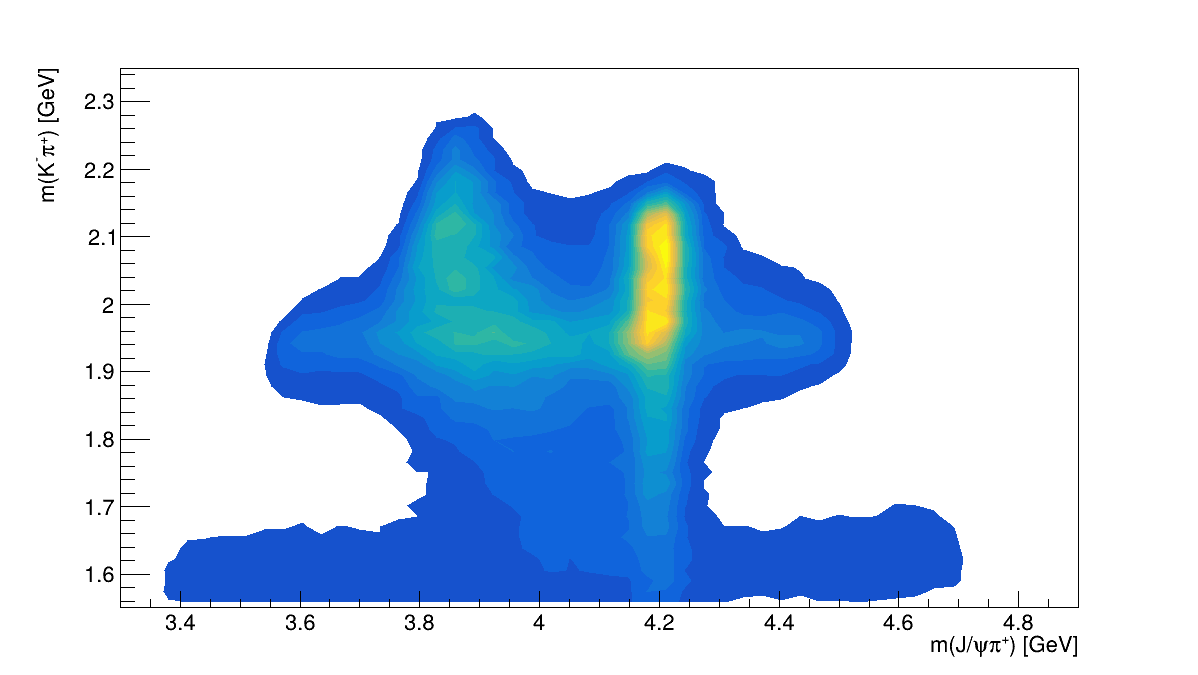
Physics Mathematical and Computer Sciences DOI: 10.54546/NaturalSciRev.100802 Multivariate amplitude analysis of the cascade particle decays based on the Nearest Neighbors fitting The Nearest Neighbors estimation of likelihood is implemented for the multivariate amplitude analysis of the cascades of particle decays. In this approach Monte Carlo simulated events that are used to describe data are assigned weights dependent on the parameters of the theoretical fitting model. Each of such weighted events is considered as contributing to N-dimensional probability density function (p.d.f.) in its neighborhood in the parameter space. No analytic p.d.f. or cpu-intensive re-generation of N-dimensional p.d.f. at each fit step are required. The method allows accurate accounting for reconstruction effects, demands modest cpu resources and can be effectively multi-threaded. General setup of the fit as well as toy example of the amplitude analysis of B-meson decays are demonstrated. I. V. Yeletskikh, A. O. Vasyukov 13.08.2026
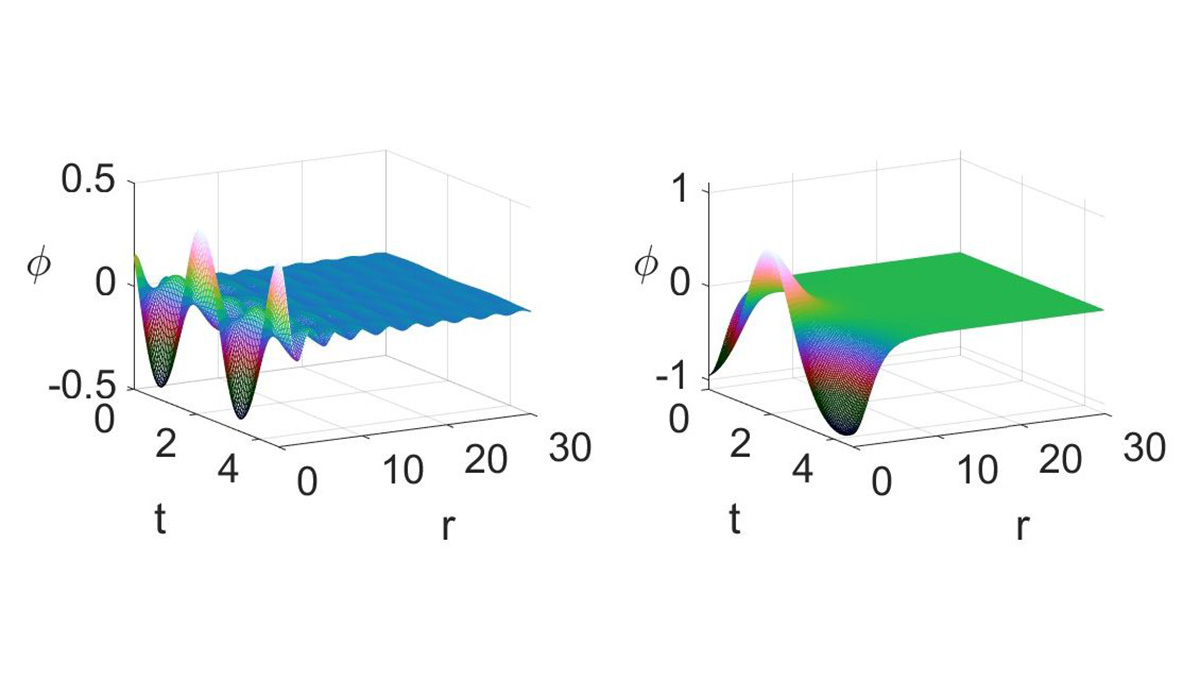
70th anniversary of JINR DOI: 10.54546/NaturalSciRev.200605 Computational schemes based on the continuous analogue of Newton’s method in the numerical study of complex physical systems at JINR The Continuous analogue of Newton's method (CANM), developed at JINR since the 1970s, is one of most important areas of research at Laboratory of Computing Techniques (LCTA) -- Meshcheryakov Laboratory of Information Technologies (MLIT). CANM and its generalization are powerful tools for the effective numerical solution of nonlinear problems within a wide range of complex physical systems studied at JINR. This review article provides a general framework for the CANM-based approach, the main stages in the development and applications of CANM for solving various types of nonlinear problems that have been on the agenda in different years. The results of the development and application of CANM-based iterative methods, obtained over the past 20 years, are presented in more detail. Corrected: 17 March 2026 (the revision date was initially misspelled ( 17 January 2026), the correct spelling is 17 February 2026; the acceptance date was initially misspelled ( 26 January 2026), the correct spelling is 26 February 2026). Elena V. Zemlyanaya, Ochbadrakh Chuluunbaatar 17.03.2026