

Abstract
We review the results of applying the statistical field-theoretic approach to the problem of fully developed turbulence in nonrelativistic three-dimensional magnetohydrodynamics (MHD), which have been obtained over the past forty years. The review covers both general aspects of the physics of MHD turbulence and the necessary mathematical machinery of statistical field theory, including elements of renormalization theory and the renormalization-group (RG) method. The approach is illustrated using a stochastic model of stationary, locally homogeneous, fully developed three-dimensional MHD turbulence in the general case of a medium with broken spatial parity (helical MHD). In this model, RG techniques make it possible to establish the existence of several infrared-stable scaling regimes and to calculate the critical dimensions of various composite operators, the infrared asymptotics of correlation functions, and the amplitude factors in scaling laws, as well as to incorporate the effects of compressibility, anisotropy, etc.
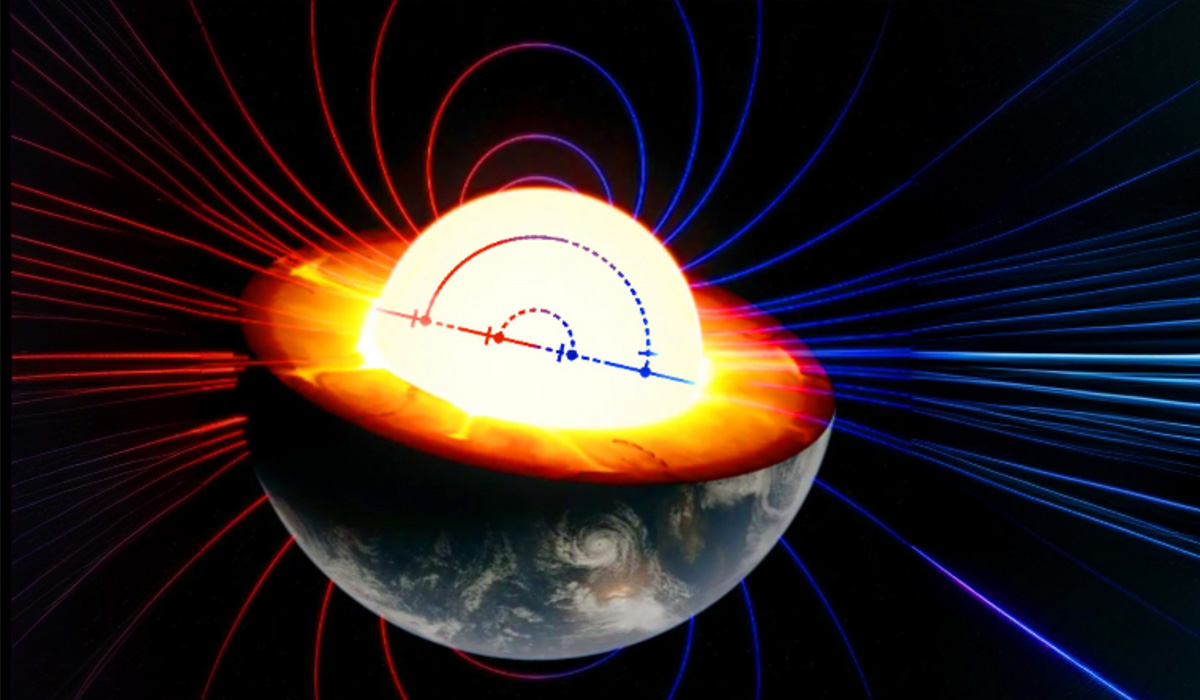
For an important class of helical MHD systems, the field-theoretic approach provides an elegant formulation of the fundamental problem of large-scale turbulent dynamo action — namely, the generation of a large-scale magnetic field ⟨b⟩ = B (where b denotes magnetic fluctuations) at the expense of the energy of turbulent fluctuations — via the decay of the initial unstable vacuum state ⟨b⟩ = 0 as a result of dynamical spontaneous symmetry breaking in the spirit of the Coleman-Weinberg mechanism, followed by stabilization of the theory in the vicinity of the new ground state ⟨b⟩ = B (the dynamo regime). The field-theoretic formulation we developed, together with a generalization of the standard Feynman diagrammatic technique to the dynamo regime, not only makes it possible to treat within a unified framework the existing theoretical approaches to helical magnetohydrodynamics (kinematic MHD, large-scale dynamo theory), but also extends the RG formalism to the dynamo regime, which — unlike closure procedures still common in dynamo theory — is particularly well suited for studying statistically stationary turbulent states. The richness of MHD physics in the dynamo regime is illustrated both in the emergence of new effects (Goldstone-type corrections to Alfvén waves, anisotropic corrections associated with the transport of the large-scale field) and in the theoretically predicted strong dependence of the magnetic energy-spectrum slope on the degree of mirror-symmetry breaking.
Acknowledgements
References
[1] L. T. Adzhemyan, N. V. Antonov, A. N. Vasil’ev, Quantum field renormalization group in the theory of fully developed turbulence, Physics-Uspekhi 39 (1996) 1193–1219, https://ufn.ru/en/articles/1996/12/a/. doi:10.1070/PU1996v039n12ABEH000183. DOI: https://doi.org/10.1070/PU1996v039n12ABEH000183
[2] L. Adzhemyan, A. N. Vasiliev, N. V. Antonov, The field theoretic renormalization group in fully developed turbulence, Gordon & Breach, 1999.
[3] A. N. Vasil’ev, The field theoretic renormalization group in critical behavior theory and stochastic dynamics, Chapman & Hall/CRC, 2004. DOI: https://doi.org/10.1201/9780203483565
[4] W. D. McComb, Theory of turbulence, Reports on Progress in Physics 58 (10) (1995) 1117, https://dx.doi.org/10.1088/0034-4885/58/10/001. doi:10.1088/0034-4885/58/10/001. DOI: https://doi.org/10.1088/0034-4885/58/10/001
[5] W. D. McComb, The physics of fluid turbulence, Oxford University Press, 1990. DOI: https://doi.org/10.1093/oso/9780198561606.001.0001
[6] V. Yakhot, S. A. Orszag, Renormalization-group analysis of turbulence, Physical Review Letters 57 (1986) 1722–1724, https://link.aps.org/doi/10.1103/PhysRevLett.57.1722. doi:10.1103/PhysRevLett.57.1722. DOI: https://doi.org/10.1103/PhysRevLett.57.1722
[7] V. Yakhot, S. Orszag, Renormalization group analysis of turbulence. I. Basic theory, Journal of Scientific Computing 1 (1986) 3–51, https://doi.org/10.1007/BF01061452. doi:10.1007/BF01061452. DOI: https://doi.org/10.1007/BF01061452
[8] R. H. Kraichnan, An interpretation of the Yakhot-Orszag turbulence theory, Physics of Fluids 30 (1987) 2400–2405. doi:10.1063/1.866130. DOI: https://doi.org/10.1063/1.866130
[9] E. V. Teodorovich, On the Yakhot-Orszag theory of turbulence, Fluid Dynamics 29 (1994) 770–779. doi:10.1007/BF02040784. DOI: https://doi.org/10.1007/BF02040784
[10] G. L. Eyink, The renormalization group method in statistical hydrodynamics, Physics of Fluids 6 (1994) 3063–3078. doi:10.1063/1.868131. DOI: https://doi.org/10.1063/1.868131
[11] Y. Zhou, Turbulence theories and statistical closure approaches, Physics Reports 935 (2021) 1–117, https://www.sciencedirect.com/science/article/pii/S0370157321002763. doi: https://doi.org/10.1016/j.physrep.2021.07.001. DOI: https://doi.org/10.1016/j.physrep.2021.07.001
[12] L. Canet, Functional renormalisation group for turbulence, Journal of Fluid Mechanics 950 (2022) P1. doi:10.1017/jfm.2022.808. DOI: https://doi.org/10.1017/jfm.2022.808
[13] D. Biskamp, Magnetohydrodynamic turbulence, Cambridge University Press, 2003. DOI: https://doi.org/10.1017/CBO9780511535222
[14] A. Beresnyak, A. Lazarian, Turbulence in magnetohydrodynamics, De Gruyter, 2019. DOI: https://doi.org/10.1515/9783110263282
[15] G. Parisi, Statistical field theory, Addison-Wesley, 1988. DOI: https://doi.org/10.1063/1.2811677
[16] J. Zinn-Justin, Quantum Field Theory and Critical Phenomena, 5th Edition, Oxford University Press, 2021. DOI: https://doi.org/10.1093/oso/9780198834625.001.0001
[17] J. Zinn-Justin, Phase transitions and renormalization group, Oxford University Press, 2007. DOI: https://doi.org/10.1093/acprof:oso/9780199227198.001.0001
[18] D. J. Amit, V. Mart´ın-Mayor, Field theory, the renormalization group, and critical phenomena, 3rd Edition, WSP, 2005. DOI: https://doi.org/10.1142/5715
[19] U. C. T¨auber, Critical dynamics: a field theory approach to equilibrium and non-equilibrium scaling behavior, Cambridge University Press, 2014. DOI: https://doi.org/10.1017/CBO9781139046213
[20] A. Kamenev, Field theory of non-equilibrium systems, Cambridge University Press, 2011. DOI: https://doi.org/10.1017/CBO9781139003667
[21] G. Eyink, Turbulence noise, Journal of Statistical Physics 83 (1996) 955–1019. doi:10.1007/BF02179551. DOI: https://doi.org/10.1007/BF02179551
[22] M. Hnatiˇc, J. Honkonen, T. Luˇcivjansk´y, Advanced field-theoretical methods in stochastic dynamics and theory of developed turbulence, Acta Physica Slovaca 66 (2016) 69. arXiv:1611.06741.
[23] C. Aron, D. G. Barci, L. F. Cugliandolo, Z. G. Arenas, G. S. Lozano, Dynamical symmetries of Markov processes with multiplicative white noise, Journal of Statistical Mechanics: Theory and Experiment 2016 (5 (2016) 053207, https://doi.org/10.1088%2F1742-5468%2F2016%2F05%2F053207. doi:10.1088/1742-5468/2016/05/053207. DOI: https://doi.org/10.1088/1742-5468/2016/05/053207
[24] P. C. Martin, E. D. Siggia, H. A. Rose, Statistical dynamics of classical systems, Physical Review A 8 (1973) 423–437, https://link.aps.org/doi/10.1103/PhysRevA.8.423. doi:10.1103/PhysRevA.8.423. DOI: https://doi.org/10.1103/PhysRevA.8.423
[25] H. Janssen, On a lagrangian for classical field dynamics and renormalization group calculations of dynamical critical properties, Journal of Physics B 23 (1976) 377, https://doi.org/10.1007/BF01316547. doi:10.1007/BF01316547. DOI: https://doi.org/10.1007/BF01316547
[26] C. De Dominicis, Techniques de renormalisation de la th´eorie des champs et dynamique des ph´enom`enes critiques, Le Journal de Physique Colloques 37 (1976) 247–253. doi:10.1051/jphyscol:1976138. DOI: https://doi.org/10.1051/jphyscol:1976138
[27] A. Vasil’ev, Functional methods in quantum field theory and statistical physics, Gordon and Breach, 1998.
[28] I. Montvay, G. M¨unster, Quantum fields on a lattice, Cambridge University Press, 1994. DOI: https://doi.org/10.1017/CBO9780511470783
[29] J. Smit, Introduction to quantum fields on a lattice, Vol. 15 of Cambridge Lecture Notes in Physics, Cambridge University Press, 2002. DOI: https://doi.org/10.1017/CBO9780511583971
[30] A. L. Kataev, K. V. Stepanyantz, Algebraic structure of the renormalization group in the renormalizable QFT theories, International Journal of Modern Physics A 39 (2024) 2445001. doi:10.1142/S0217751X24450015. DOI: https://doi.org/10.1142/S0217751X24450015
[31] M. Mari˜no, Instantons and large N: An introduction to non-perturbative methods in quantum field theory, Cambridge University Press, 2015. DOI: https://doi.org/10.1017/CBO9781107705968
[32] L. T. Adzhemyan, J. Honkonen, M. V. Kompaniets, A. N. Vasil’ev, Improved ϵ expansion for three dimensional turbulence: Two-loop renormalization near two dimensions, Physical Review E 71 (2005) 036305, https://link.aps.org/doi/10.1103/PhysRevE.71.036305. doi:10.1103/PhysRevE.71.036305. DOI: https://doi.org/10.1103/PhysRevE.71.036305
[33] J. Henriksson, The critical O(N) CFT: Methods and conformal data, Physics Reports 1002 (2023) 1–72, https://doi.org/10.1016/j.physrep.2022.12.002. doi:10.1016/j.physrep.2022.12.002. DOI: https://doi.org/10.1016/j.physrep.2022.12.002
[34] C. De Dominicis, I. Giardina, Random fields and spin glasses: A field theory approach, Cambridge University Press, 2006. DOI: https://doi.org/10.1017/CBO9780511534836
[35] M. C. Angelini, Real-space renormalization group for spin glasses, arXiv preprint (Feb. 2023). arXiv:2302.05292.
[36] N. V. Antonov, A. A. Ignatieva, Critical behaviour of a fluid in a random shear flow: Renormalization group analysis of a simplified model, Journal of Physics A 39 (44) (2006) 13593–13620, https://doi.org/10.1088/0305-4470/39/44/001. doi:10.1088/0305-4470/39/44/001. DOI: https://doi.org/10.1088/0305-4470/39/44/001
[37] N. V. Antonov, A. V. Malyshev, Inertial-range behavior of a passive scalar field in a random shear flow: Renormalization group analysis of a simple model, Journal of Statistical Physics 146 (2012) 33–55, https://doi.org/10.1007/s10955-011-0399-0. doi:10.1007/s10955-011-0399-0. DOI: https://doi.org/10.1007/s10955-011-0399-0
[38] L. Sch¨afer, Excluded volume effects in polymer solutions: As explained by the renormalization group, Springer, 1999. doi:10.1007/978-3-642-60093-7. DOI: https://doi.org/10.1007/978-3-642-60093-7
[39] T. A. Vilgis, Polymer theory: Path integrals and scaling, Physics Reports 336 (3) (2000) 167–254, https://doi.org/10.1016/S0370-1573(99)00122-2. doi:10.1016/S0370-1573(99)00122-2. DOI: https://doi.org/10.1016/S0370-1573(99)00122-2
[40] J. Qin, D. C. Morse, Renormalized one-loop theory of correlations in disperse polymer blends, The Journal of Chemical Physics 130 (22) (2009) 224902, https://doi.org/10.1063/1.3124799. doi:10.1063/1.3124799. DOI: https://doi.org/10.1063/1.3124799
[41] S. Metayer, S. Teber, Field-theory approach to flat polymerized membranes, Journal of Statistical Mechanics: Theory and Experiment (2025) 092001, https://doi.org/10.1088/1742-5468/add516. arXiv:2412.18490, doi:10.1088/1742-5468/add516. DOI: https://doi.org/10.1088/1742-5468/add516
[42] M. W. Matsen, Field theoretic approach for block polymer melts: SCFT and FTS, The Journal of Chemical Physics 152 (11) (2020) 110901, https://doi.org/10.1063/1.5145098. doi:10.1063/1.5145098. DOI: https://doi.org/10.1063/1.5145098
[43] E. Medina, T. Hwa, M. Kardar, Y.-C. Zhang, Burgers equation with correlated noise: Renormalization group analysis and applications to directed polymers and interface growth, Physical Review A 39 (1989) 3053–3075, https://link.aps.org/doi/10.1103/PhysRevA.39.3053. doi:10.1103/PhysRevA.39.3053. DOI: https://doi.org/10.1103/PhysRevA.39.3053
[44] T. Halpin-Healy, Y.-C. Zhang, Kinetic roughening phenomena, stochastic growth, directed polymers and all that, Physics Reports 254 (4–6) (1995) 215–414, https://doi.org/10.1016/0370-1573(94)00087-J. doi:10.1016/0370-1573(94)00087-J. DOI: https://doi.org/10.1016/0370-1573(94)00087-J
[45] L. Canet, H. Chat´e, B. Delamotte, N. Wschebor, Non-perturbative renormalisation group for the Kardar Parisi-Zhang equation: General framework and first applications, Physical Review E 84 (6) (2011) 061128, https://doi.org/10.1103/PhysRevE.84.061128. doi:10.1103/PhysRevE.84.061128. DOI: https://doi.org/10.1103/PhysRevE.84.061128
[46] N. V. Antonov, N. M. Gulitskiy, P. I. Kakin, N. M. Lebedev, M. M. Tumakova, Field-theoretic renormalization group in models of growth processes, surface roughening and non-linear diffusion in random environment: mobilis in mobili, Symmetry 15 (8) (2023) 1556, https://doi.org/10.3390/sym15081556. doi:10.3390/sym15081556. DOI: https://doi.org/10.3390/sym15081556
[47] B. Lee, Renormalization group calculation for the reaction kA → OE, Journal of Physics A 27 (8) (1994) 2633–2652. doi:10.1088/0305-4470/27/8/004. DOI: https://doi.org/10.1088/0305-4470/27/8/004
[48] B. P. Lee, J. Cardy, Renormalization group study of the A+B→ ∅ diffusion-limited reaction, Journal of Statistical Physics 80 (5) (1995) 971–1007. doi:10.1007/BF02179861. DOI: https://doi.org/10.1007/BF02179861
[49] G. Odor, Universality classes in nonequilibrium lattice systems, Reviews of Modern Physics ´ 76 (2004) 663–724, https://link.aps.org/doi/10.1103/RevModPhys.76.663. doi:10.1103/RevModPhys.76.663. DOI: https://doi.org/10.1103/RevModPhys.76.663
[50] U. C. T¨auber, M. Howard, B. P. Vollmayr-Lee, Applications of field-theoretic renormalization group methods to reaction–diffusion problems, Journal of Physics A 38 (17) (2005) R79–R131, https://doi.org/10.1088/0305-4470/38/17/R01. doi:10.1088/0305-4470/38/17/R01. DOI: https://doi.org/10.1088/0305-4470/38/17/R01
[51] D. Shapoval, V. Blavatska, M. Dudka, Survival in two-species reaction-diffusion system with L´evy flights: Renormalization group treatment and numerical simulations, Journal of Physics A: Mathematical and Theoretical 55 (2022) 455002, https://doi.org/10.1088/1751-8121/ac9c39. doi:10.1088/1751-8121/ac9c39. DOI: https://doi.org/10.1088/1751-8121/ac9c39
[52] M. Hnatiˇc, J. Honkonen, Velocity-fluctuation-induced anomalous kinetics of the reaction A + A → ∅, Physical Review E 61 (2000) 3904–3911, https://doi.org/10.1103/PhysRevE.61.3904. doi:10.1103/PhysRevE.61.3904. DOI: https://doi.org/10.1103/PhysRevE.61.3904
[53] N. V. Antonov, A. S. Kapustin, Effects of turbulent mixing on critical behaviour in the presence of compressibility: Renormalization group analysis of two models, Journal of Physics A: Mathematical and Theoretical 43 (2010) 405001, https://doi.org/10.1088/1751-8113/43/40/405001. doi:10.1088/1751 8113/43/40/405001. DOI: https://doi.org/10.1088/1751-8113/43/40/405001
[54] M. Hnatiˇc, J. Honkonen, T. Luˇcivjansk´y, Study of anomalous kinetics of the annihilation reaction A + A → ∅, Theoretical and Mathematical Physics 169 (2011) 1481–1488, https://doi.org/10.1007/s11232-011-0124 9.doi:10.1007/s11232-011-0124-9. DOI: https://doi.org/10.1007/s11232-011-0124-9
[55] M. Hnatiˇc, J. Honkonen, T. Luˇcivjansk´y, Two-loop calculation of anomalous kinetics of the reaction A + A → ∅ in randomly stirred fluid, The European Physical Journal B 86 (2013) 214, https://doi.org/10.1140/epjb/e2013-30982-9. doi:10.1140/epjb/e2013-30982-9. DOI: https://doi.org/10.1140/epjb/e2013-30982-9
[56] A. S. Il’yn, V. A. Sirota, K. P. Zybin, Turbulent transport in reaction–diffusion systems, Physical Review E 99 (2019) 052220, https://doi.org/10.1103/PhysRevE.99.052220. doi:10.1103/PhysRevE.99.052220. DOI: https://doi.org/10.1103/PhysRevE.99.052220
[57] M. Hnatiˇc, M. Kecer, T. Luˇcivjansk´y, Anomalous kinetics of a multi-species reactiondiffusion system: Effect of random velocity fluctuations, Physics of Particles and Nuclei Letters 20 (2023) 1081–1083, https://doi.org/10.1134/S1547477123050370. doi:10.1134/S1547477123050370. DOI: https://doi.org/10.1134/S1547477123050370
[58] M. Hnatiˇc, M. Kecer, T. Luˇcivjansk´y, Two-species reaction–diffusion system in the presence of random velocity fluctuations, Theoretical and Mathematical Physics 217 (2023) 1437–1445, https://doi.org/10.1134/S0040577923100021. doi:10.1134/S0040577923100021. DOI: https://doi.org/10.1134/S0040577923100021
[59] M. Hnatiˇc, M. Kecer, T. Luˇcivjansk´y, Renormalization Group Analysis of Two-Species ReactionDiffusion System: Crossover between Long-Range and Short-Range Spreading, Physics of Particles and Nuclei Letters 22 (2025) 522–524, https://doi.org/10.1134/S1547477125700086. doi:10.1134/S1547477125700086. DOI: https://doi.org/10.1134/S1547477125700086
[60] H. Hinrichsen, Non-equilibrium critical phenomena and phase transitions into absorbing states, Advances in Physics 49 (2000) 815. DOI: https://doi.org/10.1080/00018730050198152
[61] H.-K. Janssen, U. C. T¨auber, The field theory approach to percolation processes, Annals of Physics 315 (1) (2005) 147–192, special Issue, https://www.sciencedirect.com/science/ article/pii/S0003491604001769. doi:https://doi.org/10.1016/j.aop.2004.09.011. DOI: https://doi.org/10.1016/j.aop.2004.09.011
[62] M. Henkel, H. Hinrichsen, S. L¨ubeck, Non-Equilibrium Phase Transitions, Vol. I: Absorbing Phase Transitions, Springer, 2008.
[63] M. Hnatiˇc, J. Honkonen, T. Luˇcivjansk´y, L. Miˇziˇsin, Universality classes of percolation processes: Renormalization group approach, Symmetry 15 (9) (2023) 1696, https://doi.org/10.3390/ sym15091696. doi:10.3390/sym15091696. DOI: https://doi.org/10.3390/sym15091696
[64] L. T. Adzhemyan, M. Hnatiˇc, E. V. Ivanova, M. V. Kompaniets, T. Luˇcivjansk´y, L. Miˇziˇsin, Fieldtheoretic analysis of directed percolation: Three-loop approximation, Physical Review E 107 (2023) 064138, https://doi.org/10.1103/PhysRevE.107.064138. doi:10.1103/PhysRevE.107.064138. DOI: https://doi.org/10.1103/PhysRevE.107.064138
[65] M. Hnatiˇc, M. Kecer, M. V. Kompaniets, T. Luˇcivjansk´y, L. Miˇziˇsin, Y. G. Molotkov, Fieldtheoretic analysis of dynamic isotropic percolation: Three-loop approximation, Physical Review E 112 (2025) 014113, https://doi.org/10.1103/87m5-mt2b. doi:10.1103/87m5-mt2b. DOI: https://doi.org/10.1103/87m5-mt2b
[66] L. Adzhemyan, N. Antonov, M. Hnatiˇc, J. Honkonen, P. Kakin, D. Kazakov, M. Komarova, M. Kompaniets, A. Kudlis, T. Luˇcivjansk´y, M. Nalimov, Field-Theoretic Renormalization Group in Models of Critical Behavior, Turbulence and Non-equilibrium Dynamics, World Scientific, 2024, Ch. Chapter 35, pp. 631–674, https://www.worldscientific.com/doi/abs/10.1142/9789811282386_0035. doi:10.1142/9789811282386_0035. DOI: https://doi.org/10.1142/9789811282386_0035
[67] N. V. Antonov, M. Hnatiˇc, J. Honkonen, P. I. Kakin, T. Luˇcivjansk´y, L. Miˇziˇsin, Renormalized Field Theory for Non-equilibrium Systems, La Rivista del Nuovo Cimento 47 (2024) 653–728, https://doi.org/10.1007/s40766-025-00064-5. doi:10.1007/s40766-025-00064-5. DOI: https://doi.org/10.1007/s40766-025-00064-5
[68] A. van Kan, Phase transitions in anisotropic turbulence, Chaos 34 (2024) 122103, https://doi.org/10.1063/5.0232179. doi:10.1063/5.0232179. DOI: https://doi.org/10.1063/5.0232179
[69] E. Knowles (Ed.), Oxford Dictionary of Quotations, 8th Edition, Oxford University Press, 2014. DOI: https://doi.org/10.1093/acref/9780199668700.001.0001
[70] G. Lyttelton, The History of the Life of King Henry the Second, J. Dodsley, 1769, 3rd ed., 6 vols.
[71] J. Carlson, A. Jaffe, A. Wiles, The Millennium Prize Problems, AMS, 2006.
[72] L. Keller, A. Fridman, Differentialgleichung f¨ur die turbulente Bewegung einer kompressiblen Fl¨ussigkeit, in: Proc. 1st Int. Congr. Appl. Mech., 1924, pp. 395–405.
[73] N. N. Bogoliubov, Problems of a Dynamical Theory in Statistical Physics, in: J. de Boer, G. E. Uhlenbeck (Eds.), Studies in Statistical Mechanics, Vol. 1, North-Holland Publishing Company, Amsterdam, 1962, english translation of the 1946 Russian monograph Problemy dinamicheskoi teorii v statisticheskoi fizike.
[74] C. G. Speziale, Analytical methods for the development of Reynolds-stress closures in turbulence, Annual Review of Fluid Mechanics 23 (1991) 107–157, https://www.annualreviews.org/content/journals/10.1146/annurev.fl.23.010191.000543. doi:https://doi.org/10.1146/annurev.fl.23.010191.000543. DOI: https://doi.org/10.1146/annurev.fluid.23.1.107
[75] K. Hanjali´c, Advanced turbulence closure models: a view of current status and future prospects, International Journal of Heat and Fluid Flow 15 (1994) 178–203, https://www.sciencedirect.com/science/article/pii/0142727X94900388. doi:https://doi.org/10.1016/0142-727X(94)90038-8. DOI: https://doi.org/10.1016/0142-727X(94)90038-8
[76] H. W. Wyld, Formulation of the theory of turbulence in an incompressible fluid, Annals of Physics 14 (1961) 143–165, https://doi.org/10.1016/0003-4916(61)90056-2. doi:10.1016/0003-4916(61)90056-2. DOI: https://doi.org/10.1016/0003-4916(61)90056-2
[77] R. H. Kraichnan, The structure of isotropic turbulence at very high Reynolds numbers, Journal of Fluid Mechanics (1959) 497–543. doi:10.1017/S0022112059000362. DOI: https://doi.org/10.1017/S0022112059000362
[78] R. H. Kraichnan, Dynamics of nonlinear stochastic systems, Journal of Mathematical Physics 2 (1) (1961) 124–148. doi:10.1063/1.1724206. DOI: https://doi.org/10.1063/1.1724206
[79] R. H. Kraichnan, Lagrangian history closure approximation for turbulence, Physics of Fluids 8 (1965) 575–598. doi:10.1063/1.1761271. DOI: https://doi.org/10.1063/1.1761271
[80] R. H. Kraichnan, Stochastic Modeling of Isotropic Turbulence, in: L. Sirovich (Ed.), New Perspectives in Turbulence, Springer New York, New York, NY, 1991, pp. 1–54. DOI: https://doi.org/10.1007/978-1-4612-3156-1_1
[81] A. Yoshizawa, Statistical modelling of passive-scalar diffusion in turbulent shear flows, Journal of Fluid Mechanics 195 (1988) 541–555. doi:10.1017/S0022112088002514. DOI: https://doi.org/10.1017/S0022112088002514
[82] S. A. Orszag, Analytical theories of turbulence, Journal of Fluid Mechanics 41 (1970) 363–386, https://doi.org/10.1017/S0022112070000642. doi:10.1017/S0022112070000642. DOI: https://doi.org/10.1017/S0022112070000642
[83] C. G. Speziale, Turbulence modeling for time-dependent RANS and VLES: A review, AIAA Journal 36 (1998) 173–184, https://doi.org/10.2514/2.7499. doi:10.2514/2.7499. DOI: https://doi.org/10.2514/2.7499
[84] P. Spalart, W.-H. Jou, M. Strelets, S. Allmaras, Comments on the Feasibility of LES for Wings, and on a Hybrid RANS/LES Approach, Conference: Advances in DNS/LES, 1997.
[85] Y. Zhiyin, Large-eddy simulation: Past, present and the future, Chinese Journal of Aeronautics 28 (2015) 11–24, https://www.sciencedirect.com/science/article/pii/S1000936114002064. doi:https://doi.org/10.1016/j.cja.2014.12.007. DOI: https://doi.org/10.1016/j.cja.2014.12.007
[86] P. Moin, K. Mahesh, Direct numerical simulation: A tool in turbulence research, Annual Review of Fluid Mechanics 30 (1998) 539–578, https://doi.org/10.1146/annurev.fluid.30.1.539. doi:10.1146/annurev.fluid.30.1.539. DOI: https://doi.org/10.1146/annurev.fluid.30.1.539
[87] S. B. Pope, PDF methods for turbulent reactive flows, Progress in Energy and Combustion Science 11 (1985) 119–192, https://doi.org/10.1016/0360-1285(85)90002-4. doi:10.1016/0360-1285(85)90002-4. DOI: https://doi.org/10.1016/0360-1285(85)90002-4
[88] L. Jahanshaloo, E. Pouryazdanpanah, N. A. Che Sidik, A review on the application of the lattice boltzmann method for turbulent flow simulation, Numerical Heat Transfer; Part A: Applications 64 (2013) 938–953, https://doi.org/10.1080/10407782.2013.807690. doi:10.1080/10407782.2013.807690. DOI: https://doi.org/10.1080/10407782.2013.807690
[89] K. Taira, S. L. Brunton, S. T. M. Dawson, S. W. Rowley, T. Colonius, B. J. McKeon, O. T. Schmidt, S. Gordeyev, V. Theofilis, L. S. Ukeiley, Modal analysis of fluid flows: An overview, AIAA Journal 55 (2017) 4013 4041. doi:10.2514/1.J056060. DOI: https://doi.org/10.2514/1.J056060
[90] M. B. Liu, G. R. Liu, L. W. Zhou, J. Z. Chang, Dissipative Particle Dynamics (DPD): An overview and recent developments, Archives of Computational Methods in Engineering 22 (2015) 529–556, https://doi.org/10.1007/s11831-014-9124-x. doi:10.1007/s11831-014-9124-x. DOI: https://doi.org/10.1007/s11831-014-9124-x
[91] M. A. Gallis, N. P. Bitter, T. P. Koehler, J. R. Torczynski, S. J. Plimpton, G. Papadakis, Molecular-level simulations of turbulence and its decay, Physical Review Letters 118 (2017) 064501, https://link.aps.org/doi/10.1103/PhysRevLett.118.064501. doi:10.1103/PhysRevLett.118.064501. DOI: https://doi.org/10.1103/PhysRevLett.118.064501
[92] A. S. Monin, A. Yaglom, Statistical fluid mechanics: The mechanics of turbulence, Vol. 1, 2, MIT Press, 1975.
[93] U. Frisch, Turbulence: The Legacy of A. N. Kolmogorov, Cambridge University Press, 1995. DOI: https://doi.org/10.1017/CBO9781139170666
[94] P. Bradshaw, An introduction to turbulence and its measurement: thermodynamics and fluid mechanics series, Elsevier, 2013. doi:10.1016/C2013-0-02451-6. DOI: https://doi.org/10.1016/C2013-0-02451-6
[95] S. B. Pope, Turbulent Flows, Cambridge University Press, 2000. DOI: https://doi.org/10.1017/CBO9780511840531
[96] A. N. Kolmogorov, The local structure of turbulence in incompressible viscous fluid for very large Reynolds number, Doklady Akademii Nauk SSSR 30 (1941) 9–13, reprinted in Proc. Roy. Soc. Lond., 434, 1991, pp. 9–13.
[97] A. N. Kolmogorov, On degeneration (decay) of isotropic turbulence in an incompressible viscous liquid, Doklady Akademii Nauk SSSR 31 (1941) 538–540.
[98] A. N. Kolmogorov, Dissipation of energy in locally isotropic turbulence, Doklady Akademii Nauk SSSR 32 (1941) 16–18, reprinted in Proc. Roy. Soc. Lond., 434, 1991, pp. 15–17. DOI: https://doi.org/10.1098/rspa.1991.0076
[99] A. Obukhov, Spectral energy distribution in a turbulent flow, Izvestiya Akademii Nauk, Seriya Geograficheskaya i Geofizicheskaya 5 (1941) 453–466.
[100] H. L. Grant, R. W. Stewart, A. Moilliet, Turbulence spectra from a tidal channel, Journal of Fluid Mechanics 12 (1962) 241–268. doi:10.1017/S002211206200018X. DOI: https://doi.org/10.1017/S002211206200018X
[101] D. Forster, D. R. Nelson, M. J. Stephen, Long-time tails and the large-eddy behavior of a randomly stirred fluid, Physical Review Letters 36 (1976) 867–870. doi:10.1103/PhysRevLett.36.867. DOI: https://doi.org/10.1103/PhysRevLett.36.867
[102] C. DeDominicis, P. C. Martin, Energy spectra of certain randomly-stirred fluids, Physical Review A 19 (1979) 419–422, https://link.aps.org/doi/10.1103/PhysRevA.19.419. doi:10.1103/PhysRevA.19.419. DOI: https://doi.org/10.1103/PhysRevA.19.419
[103] L. Adzhemyan, A. N. Vasil’ev, Y. Pis’mak, Renormalization-group approach in the theory of turbulence: The dimensions of composite operators, Theoretical and Mathematical Physics 57 (1983) 1131–1141. doi:10.1007/BF01018658. DOI: https://doi.org/10.1007/BF01018658
[104] L. T. Adzhemyan, N. V. Antonov, A. N. Vasilev, Infrared divergences and the renormalization group in the theory of fully developed turbulence, Journal of Experimental and Theoretical Physics 68 (4) (1989) 733 742.
[105] N. Antonov, Renormalizing approach to the theory of developed turbulence: Infrared asymptotic of scaling functions, Journal of Mathematical Sciences 54 (1991) 873–879, https://doi.org/10.1007/BF01101114. doi:10.1007/BF01101114. DOI: https://doi.org/10.1007/BF01101114
[106] L. Adzhemyan, N. Antonov, T. Kim, Composite operators, operator expansion, and Galilean invariance in the theory of fully developed turbulence. Infrared corrections to Kolmogorov scaling, Theoretical and Mathematical Physics 100 (1994) 1086–1099, https://doi.org/10.1007/BF01018574. doi:10.1007/BF01018574. DOI: https://doi.org/10.1007/BF01018574
[107] L. T. Adzhemyan, N. V. Antonov, A. N. Vasil’ev, Infrared divergences and the renormalization group in the theory of fully developed turbulence, Journal of Experimental and Theoretical Physics 95 (1989) 1272-1288.
[108] L. T. Adzhemyan, N. V. Antonov, M. V. Kompaniets, A. N. Vasil’ev, Renormalizationgroup approach to the stochastic Navier-Stokes equation: Two-loop approximation, International Journal of Modern Physics B 17 (10) (2003) 2137–2170, https://doi.org/10.1142/S0217979203018193. doi:10.1142/S0217979203018193. DOI: https://doi.org/10.1142/S0217979203018193
[109] L. T. Adzhemyan, J. Honkonen, M. V. Kompaniets, A. N. Vasil’ev, Improved ε expansion for three dimensional turbulence: Summation of nearest dimensional singularities, Physical Review E 68 (2003) 055302, https://link.aps.org/doi/10.1103/PhysRevE.68.055302. doi:10.1103/PhysRevE.68.055302. DOI: https://doi.org/10.1103/PhysRevE.68.055302
[110] L. Adzhemyan, M. Hnatich, J. Honkonen, Improved ε expansion in the theory of turbulence: summation of nearest singularities by inclusion of an infrared irrelevant operator, The European Physical Journal B 73 (2010) 275–285, https://doi.org/10.1140/epjb/e2009-00432-8. doi: 10.1140/epjb/e2009-00432-8. DOI: https://doi.org/10.1140/epjb/e2009-00432-8
[111] L. T. Adzhemyan, N. V. Antonov, P. B. Gol’din, T. L. Kim, M. V. Kompaniets, Renormalization group in the infinite-dimensional turbulence: third-order results, Journal of Physics A 41 (2008) 495002. doi:10.1088/1751-8113/41/49/495002. DOI: https://doi.org/10.1088/1751-8113/41/49/495002
[112] R. Ni, K.-Q. Xia, Kolmogorov constants for the second-order structure function and the energy spectrum, Physical Review E 87 (2013) 023002, https://link.aps.org/doi/10.1103/PhysRevE.87.023002. doi:10.1103/PhysRevE.87.023002. DOI: https://doi.org/10.1103/PhysRevE.87.023002
[113] N. V. Antonov, M. Hnatiˇc, J. Honkonen, P. I. Kakin, T. Luˇcivjansk´y, L. Miˇziˇsin, Renormalized field theory for non-equilibrium systems, La Rivista del Nuovo Cimento 47 (2024) 653–728, https://doi.org/10.1007/s40766-025-00064-5. doi:10.1007/s40766-025-00064-5. DOI: https://doi.org/10.1007/s40766-025-00064-5
[114] N. V. Antonov, M. Gnatich, M. Y. Nalimov, The influence of compressibility on the spectra of highly anisotropic developed turbulence [in russian], JINR Letters, 1997.
[115] E. Jurˇciˇsinov´a, M. Jurˇciˇsin, R. Remeck´y, Influence of helicity on the Kolmogorov regime in fully developed turbulence, Physical Review E 79 (2009) 046319, [Erratum: in Physical Review E, 86, (2012) 049902]. doi:10.1103/PhysRevE.79.046319. DOI: https://doi.org/10.1103/PhysRevE.86.049902
[116] C.-Y. Mou, P. B. Weichman, Multicomponent turbulence, the spherical limit, and nonKolmogorov spectra, Physical Review E 52 (1995) 3738–3796, https://link.aps.org/doi/10.1103/PhysRevE.52.3738. doi:10.1103/PhysRevE.52.3738. DOI: https://doi.org/10.1103/PhysRevE.52.3738
[117] R. H. Kraichnan, Convection of a passive scalar by a quasi-uniform random straining field, Journal of Fluid Mechanics 64 (1974) 737–762, https://doi.org/10.1017/S0022112074001881. doi:10.1017/S0022112074001881. DOI: https://doi.org/10.1017/S0022112074001881
[118] J.-D. Fournier, U. Frisch, J. H. A. Rose, Infinite-dimensional turbulence, Journal of Physics A: Mathematical and Theoretical 11 (1978) 187–198, https://doi.org/10.1088/0305-4470/11/1/020. doi:10.1088/0305-4470/11/1/020. DOI: https://doi.org/10.1088/0305-4470/11/1/020
[119] H. L. Frisch, M. Schulz, Turbulence effects in the high dimensionality limit, Journal of Physics A: Mathematical and Theoretical 211 (1994) 37–42, https://doi.org/10.1016/0378-4371(94) 90066-3. doi:10.1016/0378-4371(94)90066-3. DOI: https://doi.org/10.1016/0378-4371(94)90066-3
[120] L. T. Adzhemyan, N. V. Antonov, A. V. Runov, Anomalous scaling, nonlocality, and anisotropy in a model of the passively advected vector field, Physical Review E 64 (2001) 046310, https://link.aps.org/doi/10.1103/PhysRevE.64.046310. doi:10.1103/PhysRevE.64.046310. DOI: https://doi.org/10.1103/PhysRevE.64.046310
[121] L. T. Adzhemyan, N. V. Antonov, P. B. Gol’din, M. V. Kompaniets, Anomalous scaling of a passive vector field in d dimensions: higher order structure functions, Journal of Physics A 46 (2013) 135002. doi:10.1088/1751-8113/46/13/135002. DOI: https://doi.org/10.1088/1751-8113/46/13/135002
[122] L. T. Adzhemyan, D. A. Evdokimov, M. V. Kompaniets, Hyperlogarithms in the theory of turbulence of infinite dimension, Nuclear Physics B 1008 (2024) 116716. doi:10.1016/j.nuclphysb.2024.116716. DOI: https://doi.org/10.1016/j.nuclphysb.2024.116716
[123] L. T. Adzhemyan, Y. Kirienko, Theory of turbulence for d → ∞: Four-loop approximation of the renormalization group (2024). arXiv:2406.14575.
[124] M. Moshe, J. Zinn-Justin, Quantum field theory in the large N limit: a review, Physics Reports 385 (3) (2003) 69–228, https://www.sciencedirect.com/science/article/pii/S0370157303002631. doi:https://doi.org/10.1016/S0370-1573(03)00263-1. DOI: https://doi.org/10.1016/S0370-1573(03)00263-1
[125] C. Wetterich, Exact evolution equation for the effective potential, Physics Letters B 301 (1) (1993) 90–94, https://www.sciencedirect.com/science/article/pii/037026939390726X. doi:https://doi.org/10.1016/0370-2693(93)90726-X. DOI: https://doi.org/10.1016/0370-2693(93)90726-X
[126] J. Berges, N. Tetradis, C. Wetterich, Non-perturbative renormalization flow in quantum field theory and statistical physics, Physics Reports 363 (2002) 223–386. doi:10.1016/S0370-1573(01) 00098-9. DOI: https://doi.org/10.1016/S0370-1573(01)00098-9
[127] N. Dupuis, L. Canet, A. Eichhorn, W. Metzner, J. Pawlowski, M. Tissier, N. Wschebor, The nonperturbative functional renormalization group and its applications, Physics Reports 910 (2021) 1– 114, https://doi.org/10.1016%2Fj.physrep.2021.01.001. doi:10.1016/j.physrep.2021.01.001. DOI: https://doi.org/10.1016/j.physrep.2021.01.001
[128] L. Canet, B. Delamotte, N. Wschebor, Fully developed isotropic turbulence: Symmetries and exact identities, Physical Review E 91 (2015) 053004. doi:10.1103/PhysRevE.91.053004. DOI: https://doi.org/10.1103/PhysRevE.91.053004
[129] L. Canet, B. Delamotte, N. Wschebor, Fully developed isotropic turbulence: Nonperturbative renormalization group formalism and fixed-point solution, Physical Review E 93 (2016) 063101. doi:10.1103/PhysRevE.93.063101. DOI: https://doi.org/10.1103/PhysRevE.93.063101
[130] M. Tarpin, L. Canet, C. Pagani, N. Wschebor, Breaking of scale invariance in the time dependence of correlation functions in isotropic and homogeneous turbulence, Physics of Fluids 30 (2018) 055102. doi:10.1063/1.5020022. DOI: https://doi.org/10.1063/1.5020022
[131] Z.-S. She, E. Leveque, Universal scaling laws in fully developed turbulence, Physical Review Letters 72 (1996) 336–339. doi:10.1103/PhysRevLett.72.336. DOI: https://doi.org/10.1103/PhysRevLett.72.336
[132] A. Gorbunova, G. Balarac, L. Canet, G. Eyink, V. Rossetto, Spatio-temporal correlations in three-dimensional homogeneous and isotropic turbulence, Physics of Fluids 33 (2021) 045114. doi:10.1063/5.0046677. DOI: https://doi.org/10.1063/5.0046677
[133] L. Gosteva, M. Tarpin, N. Wschebor, L. Canet, Inviscid fixed point of the multidimensional Burgers–Kardar-Parisi-Zhang equation, Physical Review E 110 (2024) 054118. doi:10.1103/PhysRevE.110.054118. DOI: https://doi.org/10.1103/PhysRevE.110.054118
[134] G. Falkovich, K. Gawe˛dzki, M. Vergassola, Particles and fields in fluid turbulence, Reviews of Modern Physics 73 (2001) 913–975. doi:10.1103/RevModPhys.73.913. DOI: https://doi.org/10.1103/RevModPhys.73.913
[135] R. H. Kraichnan, Anomalous scaling of a randomly advected passive scalar, Physical Review Letters 72 (1994) 1016–1019. doi:10.1103/PhysRevLett.72.1016. DOI: https://doi.org/10.1103/PhysRevLett.72.1016
[136] K. Gawe˛dzki, A. Kupiainen, Anomalous Scaling of the Passive Scalar, Physical Review Letters 75 (1995) 3834–3837. doi:10.1103/PhysRevLett.75.3834. DOI: https://doi.org/10.1103/PhysRevLett.75.3834
[137] L. T. Adzhemyan, N. V. Antonov, A. N. Vasil’ev, Renormalization-group, operator product expansion, and anomalous scaling in a model of advected passive scalar, Physical Review E 58 (1998) 1823. doi:10.1103/PhysRevE.58.1823. DOI: https://doi.org/10.1103/PhysRevE.58.1823
[138] L. T. Adzhemyan, N. V. Antonov, V. A. Barinov, Y. S. Kabrits, A. N. Vasil’ev, Calculation of the anomalous exponents in the rapid-change model of passive scalar advection to order ε3, Physical Review E 64 (2001) 056306. doi:10.1103/PhysRevE.64.056306. DOI: https://doi.org/10.1103/PhysRevE.64.056306
[139] N. V. Antonov, J. Honkonen, Anomalous scaling in two models of passive scalar advection: Effects of anisotropy and compressibility, Physical Review E 63 (2001) 036302. doi:10.1103/PhysRevE.63.036302. DOI: https://doi.org/10.1103/PhysRevE.63.036302
[140] N. V. Antonov, M. Hnatich, J. Honkonen, M. Jurˇciˇsin, Turbulence with pressure: Anomalous scaling of a passive vector field, Physical Review E 68 (2003) 046306. doi:10.1103/PhysRevE.68.046306. DOI: https://doi.org/10.1103/PhysRevE.68.046306
[141] L. T. Adzhemyan, N. V. Antonov, J. Honkonen, Anomalous scaling of a passive scalar advected by the turbulent velocity field with finite correlation time: Two-loop approximation, Physical Review E 66 (2002) 036313. doi:10.1103/PhysRevE.66.036313. DOI: https://doi.org/10.1103/PhysRevE.66.036313
[142] L. T. Adzhemyan, N. V. Antonov, J. Honkonen, T. L. Kim, Anomalous scaling of a passive scalar advected by the Navier–Stokes velocity field: Two-loop approximation, Physical Review E 71 (2005) 016303. doi:10.1103/PhysRevE.71.016303. DOI: https://doi.org/10.1103/PhysRevE.71.016303
[143] D. Carati, Colored stochastic noises in the renormalization group approach of turbulence, Physics of Fluids 2 (1990) 1854–1858. doi:10.1063/1.857659. DOI: https://doi.org/10.1063/1.857659
[144] A. L. Fairhall, O. Gat, V. L’vov, I. Procaccia, Anomalous scaling in a model of passive scalar advection: Exact results, Physical Review E 53 (1996) 3518–3535. doi:10.1103/PhysRevE.53.3518. DOI: https://doi.org/10.1103/PhysRevE.53.3518
[145] N. V. Antonov, Anomalous scaling regimes of a passive scalar advected by the synthetic velocity field, Physical Review E 60 (1999) 6691–6707. doi:10.1103/PhysRevE.60.6691. DOI: https://doi.org/10.1103/PhysRevE.60.6691
[146] N. Antonov, Anomalous scaling of a passive scalar advected by the synthetic compressible flow, Journal of Physics D: Applied Physics 144 (2000) 370–386. doi:10.1016/S0167-2789(00)00089-0. DOI: https://doi.org/10.1016/S0167-2789(00)00089-0
[147] L. T. Adzhemyan, N. V. Antonov, J. Honkonen, Anomalous scaling of a passive scalar advected by the turbulent velocity field with finite correlation time: Two-loop approximation, Physical Review E 66 (2002) 036313. doi:10.1103/PhysRevE.66.036313. DOI: https://doi.org/10.1103/PhysRevE.66.036313
[148] N. V. Antonov, N. M. Gulitskiy, A. V. Malyshev, Stochastic Navier-Stokes equation with colored noise: renormalization-group analysis, EPJ Web of Conferences 126 (2016) 04019. doi:10.1051/epjconf/201612604019. DOI: https://doi.org/10.1051/epjconf/201612604019
[149] N. V. Antonov, N. M. Gulitskiy, M. M. Kostenko, A. V. Malyshev, Statistical symmetry restoration in fully developed turbulence: Renormalization group analysis of two models, Physical Review E 97 (2018) 033101. doi:10.1103/PhysRevE.97.033101. DOI: https://doi.org/10.1103/PhysRevE.97.033101
[150] P. C. Hohenberg, B. I. Halperin, Theory of dynamic critical phenomena, Reviews of Modern Physics 49 (1977) 435–479, https://link.aps.org/doi/10.1103/RevModPhys.49.435. doi: 10.1103/RevModPhys.49.435. DOI: https://doi.org/10.1103/RevModPhys.49.435
[151] N. V. Antonov, M. Hnatich, J. Honkonen, Effects of stirring and mixing on the critical behaviour, Journal of Physics A 39 (2006) 7867–7887. doi:10.1088/0305-4470/39/25/S05. DOI: https://doi.org/10.1088/0305-4470/39/25/S05
[152] M. Hnatiˇc, T. Luˇcivjansk´y, L. Miˇziˇsin, Y. Molotkov, A. Ovsiannikov, Renormalization analysis of magnetohydrodynamics: Two-loop approximation, Universe 10 (2024) 240. doi:10.3390/universe10060240. DOI: https://doi.org/10.3390/universe10060240
[153] H. Alfv´en, Existence of electromagnetic-hydrodynamic waves, Nature 150 (1942) 405–406. doi:10.1038/150405d0. DOI: https://doi.org/10.1038/150405d0
[154] K. Hattori, M. Hongo, X.-G. Huang, New developments in relativistic magnetohydrodynamics, Symmetry 14 (2022) 1851. doi:10.3390/sym14091851. DOI: https://doi.org/10.3390/sym14091851
[155] L. D. Landau, E. M. Lifshitz, Fluid mechanics: Landau and Lifshitz: course of theoretical physics, Vol. 6, Elsevier, 2013.
[156] T. G. Cowling, Magnetohydrodynamics, Interscience, 1957. DOI: https://doi.org/10.1063/1.3060498
[157] P. A. Davidson, An introduction to magnetohydrodynamics, Cambridge University Press, 2001. DOI: https://doi.org/10.1017/CBO9780511626333
[158] H. K. Moffatt, Magnetic field generation in electrically conducting fluids, Cambridge University Press, 1978.
[159] F. M. White, Fluid mechanics, 7th Edition, McGraw-Hill, 2011.
[160] A. E. Lifschitz, Magnetohydrodynamics and spectral theory, 1st Edition, no. 4 in Developments in Electromagnetic Theory and Applications, Springer Dordrecht, 1989. DOI: https://doi.org/10.1007/978-94-009-2561-8
[161] S. I. Braginskii, Transport processes in a plasma, in: M. A. Leontovich (Ed.), Reviews of Plasma Physics, Vol. 1, Consultants Bureau, 1965, pp. 205–311, translated from Russian.
[162] R. L¨ust, Über die Ausbreitung von Wellen in einem Plasma, Fortschritte der Physik — Progress of ¨Physics 7 (1959) 503–558, https://doi.org/10.1002/prop.19590070902. doi:10.1002/prop.19590070902. DOI: https://doi.org/10.1002/prop.19590070902
[163] I. Keramidas Charidakos, M. Lingam, P. J. Morrison, R. L. White, A. Wurm, Action principles for extended magnetohydrodynamic models, Physics of Plasmas 21 (2014) 092118, https://doi.org/10.1063/1.4896336. doi:10.1063/1.4896336. DOI: https://doi.org/10.1063/1.4896336
[164] J. P. Freidberg, Ideal MHD, Cambridge University Press, 2014. DOI: https://doi.org/10.1017/CBO9780511795046
[165] M. A. Sadybekov, B. T. Torebek, B. K. Turmetov, Representation of Green’s function of the Neumann problem for a multi-dimensional ball, Complex Variables and Elliptic Equations 61 (2016) 104–123, http://dx.doi.org/10.1080/17476933.2015.1064402. doi:10.1080/17476933.2015.1064402. DOI: https://doi.org/10.1080/17476933.2015.1064402
[166] F. W. King, Hilbert Transforms, Encyclopedia of Mathematics and its Applications, Cambridge University Press, 2009. DOI: https://doi.org/10.1017/CBO9780511735271
[167] J. Sommeria, R. Moreau, Why, how, and when, MHD turbulence becomes two-dimensional, Journal of Fluid Mechanics 118 (1982) 507–518, http://dx.doi.org/10.1017/S0022112082001177. doi:10.1017/S0022112082001177. DOI: https://doi.org/10.1017/S0022112082001177
[168] G. P. Zank, W. H. Matthaeus, The equations of reduced magnetohydrodynamics, Journal of Plasma Physics 48 (1992) 85–100, https://doi.org/10.1017/S002237780001638X. doi:10.1017/S002237780001638X. DOI: https://doi.org/10.1017/S002237780001638X
[169] S. Galtier, S. Nazarenko, A. C. Newell, A. Pouquet, A weak turbulence theory for incompressible magnetohydrodynamics, Journal of Plasma Physics 63 (2000) 447–488, https://doi.org/10.1017/S0022377899008284. doi:10.1017/S0022377899008284. DOI: https://doi.org/10.1017/S0022377899008284
[170] P. Goldreich, S. Sridhar, Toward a theory of interstellar turbulence. II. Strong Alfvenic turbulence, The Astrophysical Journal 438 (1995) 763–775. doi:10.1086/175121. DOI: https://doi.org/10.1086/175121
[171] S. Boldyrev, Spectrum of magnetohydrodynamic turbulence, Physical Review Letters 96 (2006) 115002. doi:10.1103/PhysRevLett.96.115002. DOI: https://doi.org/10.1103/PhysRevLett.96.115002
[172] A. Lazarian, Theoretical approaches to particle propagation and acceleration in turbulent intergalactic medium, Astronomische Nachrichten 327 (2006) 609–614, https://doi.org/10.1002/asna.200610603. doi:10.1002/asna.200610603. DOI: https://doi.org/10.1002/asna.200610603
[173] N. F. Loureiro, S. Boldyrev, Role of magnetic reconnection in magnetohydrodynamic turbulence, Physical Review Letters 118 (2017) 245101, https://link.aps.org/doi/10.1103/PhysRevLett.118.245101. doi:10.1103/PhysRevLett.118.245101. DOI: https://doi.org/10.1103/PhysRevLett.118.245101
[174] S. Boldyrev, N. F. Loureiro, Magnetohydrodynamic turbulence mediated by reconnection, The Astrophysical Journal 844 (2017) 125, https://doi.org/10.3847/1538-4357/aa7d02. doi:10.3847/1538-4357/aa7d02. DOI: https://doi.org/10.3847/1538-4357/aa7d02
[175] S. I. Vainshtein, I. B. Zeldovich, A. A. Ruzmaikin, The turbulent dynamo in astrophysics (in Russian), Nauka, 1980.
[176] S. I. Vainshtein, Magnetic fields in space (in Russian), Nauka, Moscow, 1983.
[177] I. B. Zeldovich, A. A. Ruzmaikin, D. D. Sokoloff, Magnetic fields in astrophysics, Gordon and Breach, 1983.
[178] F. Krause, K.-H. R¨adler, Mean-field magnetohydrodynamics and dynamo theory, Pergamon, 1980. DOI: https://doi.org/10.1515/9783112729694
[179] G. Ruediger, L. Kitchatinov, R. Hollerbach, Magnetic processes in astrophysics: Theory, simulations, experiments, Wiley-VCH, 2013. DOI: https://doi.org/10.1002/9783527648924
[180] A. Shukurov, K. Subramanian, Astrophysical magnetic fields: from galaxies to the early universe, Cambridge University Press, 2022. DOI: https://doi.org/10.1017/9781139046657
[181] H. Moffatt, E. Dormy, Self-exciting fluid dynamos, Cambridge University Press, 2019. DOI: https://doi.org/10.1017/9781107588691
[182] J. Larmor, How could a rotating body such as the Sun become a magnet? Report of the British Association for the Advancement of Science 113 (1919) 159–160.
[183] M. J. Nye, Temptations of theory, strategies of evidence: P. M. S. Blackett and the earth’s magnetism, British Journal for the History of Science 32 (1999) 69–92, https://doi.org/10.1017/S0007087498003495. doi:10.1017/S0007087498003495. DOI: https://doi.org/10.1017/S0007087498003495
[184] T. G. Cowling, The magnetic field of sunspots, Monthly Notices of the Royal Astronomical Society 94 (1934) 39–48. doi:10.1093/mnras/94.1.39. DOI: https://doi.org/10.1093/mnras/94.1.39
[185] Y. B. Zel’dovich, A magnetic field in connection with the two-dimen-sional motion of a conductive turbulent liquid, Journal of Experimental and Theoretical Physics 31 (1956) 154–155.
[186] F. Busse, M. Proctor, Antidynamo and bounding theorems, in: D. Gubbins, E. HerreroBervera (Eds.), Encyclopedia of Geomagnetism and Paleomagnetism, Springer Netherlands, Dordrecht, 2007, pp. 21–23, https://doi.org/10.1007/978-1-4020-4423-6_8. doi:10.1007/978-1-4020-4423-6_8. DOI: https://doi.org/10.1007/978-1-4020-4423-6_8
[187] F. Rincon, Dynamo theories, Journal of Plasma Physics 85 (2019) 205850401, https://doi.org/10.1017/S0022377819000539. doi:10.1017/S0022377819000539. DOI: https://doi.org/10.1017/S0022377819000539
[188] G. O. Roberts, E. C. Bullard, Dynamo action of fluid motions with two-dimensional periodicity, Philosophical Transactions of the Royal Society A 271 (1972) 411–454. doi:10.1098/rsta.1972.0015. DOI: https://doi.org/10.1098/rsta.1972.0015
[189] Y. B. Ponomarenko, Theory of the hydromagnetic generator, Journal of Applied Mechanics and Technical Physics 14 (1973) 775–778. doi:10.1007/BF00853190. DOI: https://doi.org/10.1007/BF00853190
[190] E. Dormy, and A. M. Soward (Eds.), Mathematical aspects of natural dynamos, 1st Edition, Chapman and Hall/CRC, 2007. DOI: https://doi.org/10.1201/9781420055269
[191] E. N. Parker, Hydromagnetic dynamo models, The Astrophysical Journal 122 (1955) 293–314. doi:10.1086/146087. DOI: https://doi.org/10.1086/146087
[192] W. Elsasser, The earth as a dynamo, Scientific American 198 (1958) 44–48. doi:10.1038/ scientificamerican0558-44. DOI: https://doi.org/10.1038/scientificamerican0558-44
[193] S. Braginsky, Self-excitation of a magnetic field during the motion of a highly conducting fluid,
Soviet physics, Journal of experimental and theoretical physics 20 (1964) 726–735.
[194] S. Braginsky, Theory of the hydromagnetic dynamo, Soviet physics, Journal of experimental and
theoretical physics 20 (1964) 1462–1471.
[195] S. Braginsky, Kinematic models of the Earth’s hydrodynamic dynamo, Geomagnetism and Aeronomy 4 (1964) 572–583.
[196] S. Braginsky, Magnetohydrodynamics of the Earth’s core, Geomagnetism and Aeronomy 4 (1964) 698–712.
[197] M. Steenbeck, F. Krause, K.-H. R¨adler, A calculation of the mean electromotive force in an electrically conducting fluid in turbulent motion, under the influence of coriolis forces, Zeitschrift f¨ur Naturforschung 21A (1966) 369–376. DOI: https://doi.org/10.1515/zna-1966-0401
[198] S. Tobias, The turbulent dynamo, Journal of Fluid Mechanics 912 (2021) P1. doi:10.1017/jfm.2020.1055. DOI: https://doi.org/10.1017/jfm.2020.1055
[199] H. K. Moffatt, Some topological aspects of fluid dynamics, Journal of Fluid Mechanics 914 (2021) P1, https://doi.org/10.1017/jfm.2020.230. doi:10.1017/jfm.2020.230. DOI: https://doi.org/10.1017/jfm.2020.230
[200] P. J. Morrison, R. D. Hazeltine, Hamiltonian formulation of reduced magnetohydrodynamics, Physics of Fluids 27 (1984) 886–897, https://doi.org/10.1063/1.864718. doi:10.1063/1.864718. DOI: https://doi.org/10.1063/1.864718
[201] S. Nazarenko, Wave turbulence, 1st Edition, no. 825 in Lecture Notes in Physics, Springer, 2011. DOI: https://doi.org/10.1007/978-3-642-15942-8_1
[202] S. L. Musher, A. M. Rubenchik, V. E. Zakharov, Weak Langmuir turbulence, Physics Reports 252 (1995) 177–274, https://doi.org/10.1016/0370-1573(94)00071-A. doi:10.1016/0370-1573(94)00071-A. DOI: https://doi.org/10.1016/0370-1573(94)00071-A
[203] G. Pelletier, Langmuir turbulence as a critical phenomenon. Part 1. Destruction of the statistical equilibrium of an interacting-modes ensemble, Journal of Plasma Physics 24 (1980) 287–297, https://doi.org/10.1017/S0022377800022832. doi:10.1017/S0022377800022832. DOI: https://doi.org/10.1017/S0022377800022832
[204] G. Pelletier, Langmuir turbulence as a critical phenomenon. Part 2. Application of the dynamical renormalization group method, Journal of Plasma Physics 24 (1980) 421–443, https://doi.org/10.1017/S0022377800010382. doi:10.1017/S0022377800010382. DOI: https://doi.org/10.1017/S0022377800010382
[205] L. T. Adzhemyan, A. N. Vasil’ev, M. Gnatich, Y. M. Pis’mak, Quantum field renormalization group in the theory of stochastic Langmuir turbulence, Theoretical and Mathematical Physics 78 (1989) 260–272, https://doi.org/10.1007/BF01017663. doi:10.1007/BF01017663. DOI: https://doi.org/10.1007/BF01017663
[206] U. Frisch, A. Pouquet, J. L´eorat, A. Mazure, Possibility of an inverse cascade of magnetic helicity in magnetohydrodynamic turbulence, Journal of Fluid Mechanics 68 (1975) 769–778. doi:10.1017/S002211207500122X. DOI: https://doi.org/10.1017/S002211207500122X
[207] A. Pouquet, U. Frisch, J. L´eorat, Strong MHD helical turbulence and the nonlinear dynamo effect, Journal of Fluid Mechanics 77 (1976) 321–354. doi:10.1017/S0022112076002140. DOI: https://doi.org/10.1017/S0022112076002140
[208] E. Priest, T. Forbes, Magnetic reconnection: MHD theory and applications, Cambridge University Press, 2000. DOI: https://doi.org/10.1017/CBO9780511525087
[209] D. Biskamp, Magnetic reconnection in plasmas, Cambridge University Press, 2000. DOI: https://doi.org/10.1017/CBO9780511599958
[210] E. N. Parker, Cosmical magnetic fields, International Series of Monographs on Physics, Clarendon Press, 1979.
[211] S. Childress, A. Gilbert, Stretch, twist, fold: the fast dynamo, Springer-Verlag, 1995. DOI: https://doi.org/10.1063/1.2807692
[212] G. R¨udiger, R. Hollerbach, The magnetic universe, Wiley-VCH, 2004. DOI: https://doi.org/10.1002/3527603654
[213] A. A. Ruzmaikin, A. M. Shukurov, D. D. Sokoloff, Magnetic fields of galaxies, Vol. 133 of Astrophysics and Space Science Library, Springer, 1988. DOI: https://doi.org/10.1007/978-94-009-2835-0
[214] S. Tobias, The solar dynamo, Philosophical Transactions of the Royal Society A 43 (2002) 2741–2756. doi:10.1098/rsta.2002.1090. DOI: https://doi.org/10.1098/rsta.2002.1090
[215] A. Brandenburg, K. Subramanian, Astrophysical magnetic fields and nonlinear dynamo theory, Physics Reports 417 (2005) 1–209. doi:10.1016/j.physrep.2005.06.005. DOI: https://doi.org/10.1016/j.physrep.2005.06.005
[216] F. Rincon, F. Califano, A. A. Schekochihin, V. F., Turbulent dynamo in a collisionless plasma, Proceedings of the National Academy of Sciences of the United States of America 113 (2016) 3950–3953. doi:10.1073/pnas.1525194113. DOI: https://doi.org/10.1073/pnas.1525194113
[217] A. Gailitis, O. Lielausis, E. Platacis, G. Gerbeth, F. Stefani, Colloquium: Laboratory experiments on hydromagnetic dynamos, Reviews of Modern Physics 74 (2002) 973–990. doi: 10.1103/RevModPhys.74.973. DOI: https://doi.org/10.1103/RevModPhys.74.973
[218] M. D. Nornberg, E. J. Spence, R. D. Kendrick, C. M. Jacobson, C. B. Forest, Intermittent magnetic field excitation by a turbulent flow of liquid sodium, Physical Review Letters 97 (2006) 044503. doi:10.1103/PhysRevLett.97.044503. DOI: https://doi.org/10.1103/PhysRevLett.97.044503
[219] R. Monchaux, M. Berhanu, M. Bourgoin, M. Moulin, P. Odier, J.-F. Pinton, R. Volk, S. Fauve, N. Mordant, F. P´etr´elis, A. Chiffaudel, F. Daviaud, B. Dubrulle, C. Gasquet, L. Mari´e, F. Ravelet, Generation of a magnetic field by dynamo action in a turbulent flow of liquid sodium, Physical Review Letters 98 (2007) 044502. doi:10.1103/PhysRevLett.98.044502. DOI: https://doi.org/10.1103/PhysRevLett.98.044502
[220] F. Stefani, A. Gailitis, G. Gerbeth, Magnetohydrodynamic experiments on cosmic magnetic fields, Journal of Applied Mathematics and Mechanics 88 (2008) 930–954. doi:10.1002/zamm.200800102. DOI: https://doi.org/10.1002/zamm.200800102
[221] D. Brito, T. Alboussi`ere, P. Cardin, N. Gagni`ere, D. Jault, P. La Rizza, J.-P. Masson, H.-C. Nataf, D. Schmitt, Zonal shear and super-rotation in a magnetized spherical Couette-flow experiment, Physical Review E 83 (2011) 066310. doi:10.1103/PhysRevE.83.066310. DOI: https://doi.org/10.1103/PhysRevE.83.066310
[222] K. Rahbarnia, B. P. Brown, M. M. Clark, E. J. Kaplan, M. D. Nornberg, A. M. Rasmus, N. Z. Taylor, C. B. Forest, F. Jenko, A. Limone, J.-F. Pinton, N. Plihon, G. Verhille, Direct observation of the turbulent emf and transport of magnetic field in a liquid sodium experiment, The Astrophysical Journal 759 (2012) 80. doi:10.1088/0004-637X/759/2/80. DOI: https://doi.org/10.1088/0004-637X/759/2/80
[223] B. E. Goldstein, E. J. Smith, A. Balogh, T. S. Horbury, M. L. Goldstein, D. A. Roberts, Properties of magnetohydrodynamic turbulence in the solar wind as observed by Ulysses at high heliographic latitudes, Geophysical Research Letters 22 (1995) 3393–3396. doi:10.1029/95GL03183. DOI: https://doi.org/10.1029/95GL03183
[224] J. W. Armstrong, B. J. Rickett, S. R. Spangler, Electron Density Power Spectrum in the Local Interstellar Medium, The Astrophysical Journal 443 (1995) 209–221. doi:10.1086/175515. DOI: https://doi.org/10.1086/175515
[225] A. Chepurnov, A. Lazarian, Extending the big power law in the sky with turbulence spectra from wisconsin Hα mapper data, The Astrophysical Journal 710 (2010) 853–858. doi:10.1088/0004637X/710/1/853. DOI: https://doi.org/10.1088/0004-637X/710/1/853
[226] C. C. Finlay, et al., International geomagnetic reference field: The eleventh generation, Geophysical Journal International 183 (2010) 1216–1230. doi:10.1111/j.1365-246X.2010.04804.x. DOI: https://doi.org/10.1111/j.1365-246X.2010.04804.x
[227] C. L. Johnson, M. E. Purucker, H. Korth, B. J. Anderson, R. M. Winslow, M. M. H. Al Asad, J. A. Slavin, I. I. Alexeev, R. J. Phillips, M. T. Zuber, S. C. Solomon, Messenger observations of Mercury’s magnetic field structure, Journal of Geophysical Research E 117 (2012) E00L14. doi:10.1029/2012JE004217. DOI: https://doi.org/10.1029/2012JE004217
[228] K. M. Moore, H. Cao, J. Bloxham, D. J. Stevenson, J. E. P. Connerney, S. J. Bolton, Time variation of Jupiter’s internal magnetic field consistent with zonal wind advection, Nature Astronomy 3 (2019) 730–735. doi:10.1038/s41550-019-0772-5. DOI: https://doi.org/10.1038/s41550-019-0772-5
[229] J. E. P. Connerney, S. Kotsiaros, R. J. Oliversen, J. R. Espley, J. L. Joergensen, P. S. Joergensen, J. M. G. Merayo, M. Herceg, J. Bloxham, K. M. Moore, S. J. Bolton, S. M. Levin, A new model of Jupiter’s magnetic field from Juno’s first nine orbits, Geophysical Research Letters 45 (2018) 2590–2596. doi:10.1002/2018GL077312. DOI: https://doi.org/10.1002/2018GL077312
[230] S. Chandrasekhar, Hydrodynamic and hydromagnetic stability, Clarendon Press, 1961.
[231] A. Favre, Statistical Equations of Turbulent Gases, in: M. A. Lavrentiev (Ed.), Problems of Hydrodynamics and Continuum Mechanics, SIAM, 1969, pp. 37–44.
[232] H. Politano, A. Pouquet, von K´arm´an–Howarth equation for magnetohydrodynamics and its consequences on third-order longitudinal structure and correlation functions, Physical Review E 57 (1998) R21, https://link.aps.org/doi/10.1103/PhysRevE.57.R21. doi:10.1103/PhysRevE.57.R21. DOI: https://doi.org/10.1103/PhysRevE.57.R21
[233] F. Stefani, Liquid-metal experiments on geophysical and astrophysical phenomena, Nature Reviews Physics 6 (2024) 409–425, https://doi.org/10.1038/s42254-024-00724-1. doi:10.1038/s42254-024-00724-1. DOI: https://doi.org/10.1038/s42254-024-00724-1
[234] P. D. Mininni, A. G. Pouquet, D. C. Montgomery, Small-scale structures in three-dimensional magnetohydrodynamic turbulence, Physical Review Letters 97 (2006) 244503, https://link.aps.org/doi/10.1103/PhysRevLett.97.244503. doi:10.1103/PhysRevLett.97.244503. DOI: https://doi.org/10.1103/PhysRevLett.97.244503
[235] T. D. Lee, Small-scale structures in three-dimensional magnetohydrodynamic turbulence, Quarterly of Applied Mathematics 10 (1952) 69–74, https://doi.org/10.1090/qam/51081. doi:10.1090/qam/51081. DOI: https://doi.org/10.1090/qam/51081
[236] T. Stribling, W. H. Matthaeus, Statistical properties of ideal three-dimensional magnetohydrodynamics, Physics of Fluids B 2 (1990) 1979–1988, https://doi.org/10.1063/1.859419. doi:10.1063/1.859419. DOI: https://doi.org/10.1063/1.859419
[237] R. Kraichnan, Helical turbulence and absolute equilibrium, Journal of Fluid Mechanics 59 (1973) 745–752, https://doi.org/10.1017/S0022112073001837. doi:10.1017/S0022112073001837. DOI: https://doi.org/10.1017/S0022112073001837
[238] A. Z. Patashinskii, V. L. Pokrovskii, Fluctuation theory of phase transitions, Pergamon Press, Oxford, 1979.
[239] R. H. Kraichnan, Kolmogorov’s hypotheses and Eulerian turbulence theory, Physics of Fluids 7 (1964) 1723–1734, https://doi.org/10.1063/1.2746572. doi:10.1063/1.2746572. DOI: https://doi.org/10.1063/1.2746572
[240] H. Tennekes, Eulerian and Lagrangian time microscales in isotropic turbulence, Journal of Fluid Mechanics 67 (1975) 561–567, https://doi.org/10.1017/S0022112075000468. doi:10.1017/S0022112075000468. DOI: https://doi.org/10.1017/S0022112075000468
[241] X. He, P. Tong, Kraichnan’s random sweeping hypothesis in homogeneous turbulent convection, Physical Review E 83 (2011) 037302, https://link.aps.org/doi/10.1103/PhysRevE.83.037302. doi:10.1103/PhysRevE.83.037302. DOI: https://doi.org/10.1103/PhysRevE.83.037302
[242] P. S. Iroshnikov, Turbulence of a conducting fluid in a strong magnetic field, Astronomicheskii Zhurnal 40 (1963) 742.
[243] C.-Y. Tu, E. Marsch, MHD structures, waves and turbulence in the solar wind: Observations and theories, 1st Edition, Springer Dordrecht, 1995.
[244] R. T. Wicks, T. S. Horbury, C. H. K. Chen, A. A. Schekochihin, Power and spectral index anisotropy of the entire inertial range of turbulence in the fast solar wind, Monthly Notices of the Royal Astronomical Society 407 (2010) L31–L35, https://doi.org/10.1111/j.1745-3933.2010.00898.x. doi:10.1111/j.1745-3933.2010.00898.x. DOI: https://doi.org/10.1111/j.1745-3933.2010.00898.x
[245] G. He, G. Jin, Y. Yang, Space-time correlations and dynamic coupling in turbulent flows, Annual Review of Fluid Mechanics 49 (2017) 51–70, https://doi.org/10.1146/annurev-fluid-010816-060309. doi:10.1146/annurev-fluid-010816-060309. DOI: https://doi.org/10.1146/annurev-fluid-010816-060309
[246] J.-D. Fournier, P.-L. Sulem, P. A, Infrared properties of forced magnetohydrodynamic turbulence, Journal of Physics A 15 (1982) 1393–1420, https://doi.org/10.1088/0305-4470/15/4/037. doi:10.1088/0305-4470/15/4/037. DOI: https://doi.org/10.1088/0305-4470/15/4/037
[247] L. Adzhemyan, A. Vasil’ev, M. Gnatich, Quantum-field renormalization group in the theory of turbulence: Magnetohydrodynamics, Theoretical and Mathematical Physics 64 (1985) 777–785, https://doi.org/10.1007/BF01017957. doi:10.1007/BF01017957. DOI: https://doi.org/10.1007/BF01017957
[248] K. Furutsu, On the statistical theory of electromagnetic waves in a fluctuating medium (1), Journal of Research of the National Bureau of Standards Sect. D 67 (1963) 303–323. DOI: https://doi.org/10.6028/jres.067D.034
[249] E. Novikov, Functionals and Random Force Methods for Turbulence Theory, Soviet Physics — Journal of Experimental and Theoretical Physics 47 (5) (1964) p. 1919.
[250] L. T. Adzhemyan, M. Hnatich, D. Horv´ath, M. Stehlik, Calculation of spectra of turbulence in the energy-containing and inertial ranges, Physical Review E 58 (1998) 4511–4523, https://link.aps.org/doi/10.1103/PhysRevE.58.4511. doi:10.1103/PhysRevE.58.4511. DOI: https://doi.org/10.1103/PhysRevE.58.4511
[251] L. T. Adzhemyan, A. N. Vasil’ev, M. Gnatich, Turbulent dynamo as spontaneous symmetry breaking, Theoretical and Mathematical Physics 72 (1987) 940–950. doi:10.1007/BF01018300. DOI: https://doi.org/10.1007/BF01018300
[252] A. Pouquet, J.-D. Fournier, P. L. Sulem, Is helicity relevant for large scale steady state threedimensional turbulence? Journal de Physique Lettres 39 (1978) 199–203. doi:10.1051/jphyslet:019780039013019900. DOI: https://doi.org/10.1051/jphyslet:019780039013019900
[253] S. Coleman, E. Weinberg, Radiative corrections as the origin of spontaneous symmetry breaking, Physical Review D 7 (1973) 1888–1910. doi:10.1103/PhysRevD.7.1888. DOI: https://doi.org/10.1103/PhysRevD.7.1888
[254] A. P. Kazantsev, Enhancement of a magnetic field by a conducting fluid, Soviet Physics — Journal of Experimental and Theoretical Physics 26 (1968) 1031.
[255] R. H. Kraichnan, Small-scale structure of a scalar field convected by turbulence, Physics of Fluids 11 (1968) 945–953. doi:10.1063/1.1692063. DOI: https://doi.org/10.1063/1.1692063
[256] N. V. Antonov, N. M. Gulitskiy, Two-Loop Calculation of the Anomalous Exponents in the Kazantsev Kraichnan Model of Magnetic Hydrodynamics, in: G. Adam, J. Buˇsa, M. Hnatiˇc (Eds.), Mathematical Modeling and Computational Science, Vol. 7125 of International Conference, MMCP 2011, Springer Berlin Heidelberg, 2012, pp. 128–135. doi:10.1007/978-3-642-28212-6_11. DOI: https://doi.org/10.1007/978-3-642-28212-6_11
[257] N. V. Antonov, N. M. Gulitskiy, Anomalous scaling and large-scale anisotropy in magnetohydrodynamic turbulence: Two-loop renormalization-group analysis of the Kazantsev-Kraichnan kinematic model, Physical Review E 85 (2012) 128–135. doi:10.1103/physreve.85.065301. DOI: https://doi.org/10.1103/PhysRevE.85.065301
[258] N. V. Antonov, N. M. Gulitskiy, [Erratum: Anomalous scaling and large-scale anisotropy in magnetohydrodynamic turbulence: Two-loop renormalization-group analysis of the KazantsevKraichnan kinematic model, Physical Review E 85, 065301(R) (2012)], Physical Review E 87 (2013) 039902, https://link.aps.org/doi/10.1103/PhysRevE.87.039902. doi:10.1103/PhysRevE.87.039902. DOI: https://doi.org/10.1103/PhysRevE.87.039902
[259] E. Jurˇciˇsinov´a, M. Jurˇciˇsin, R. Remeck´y, Turbulent magnetic Prandtl number in kinematic magnetohydrodynamic turbulence: Two-loop approximation, Physical Review E 84 (2011) 046311. doi:10.1103/PhysRevE.84.046311. DOI: https://doi.org/10.1103/PhysRevE.84.046311
[260] N. V. Antonov, M. M. Kostenko, Anomalous scaling in magnetohydrodynamic turbulence: Effects of anisotropy and compressibility in the kinematic approximation, Physical Review E 92 (2015) 053013. doi:10.1103/PhysRevE.92.053013. DOI: https://doi.org/10.1103/PhysRevE.92.053013
[261] E. Jurˇciˇsinov´a, M. Jurˇciˇsin, M. Menkyna, R. Remeck´y, Evidence for enhancement of anisotropy persistence in kinematic magnetohydrodynamic turbulent systems with finite-time correlations, Physical Review E 104 (2021) 015101. doi:10.1103/PhysRevE.104.015101. DOI: https://doi.org/10.1103/PhysRevE.104.015101
[262] N. V. Antonov, M. M. Kostenko, Anomalous scaling of passive scalar fields advected by the Navier-Stokes velocity ensemble: Effects of strong compressibility and large-scale anisotropy, Physical Review E 90 (2014) 063016. doi:10.1103/PhysRevE.90.063016. DOI: https://doi.org/10.1103/PhysRevE.90.063016
[263] N. V. Antonov, M. M. Kostenko, Renormalization Group in the Problem of Active Scalar Advection, Journal of Mathematical Sciences 257 (2021) 425–441. doi:10.1007/s10958-021-05492-2. DOI: https://doi.org/10.1007/s10958-021-05492-2
[264] M. Hnatiˇc, P. Zalom, Helical turbulent Prandtl number in the A model of passive vector advection, Physical Review E 94 (2016) 053113. doi:10.1103/PhysRevE.94.053113. DOI: https://doi.org/10.1103/PhysRevE.94.053113
[265] N. V. Antonov, N. M. Gulitskiy, Passive advection of a vector field: Anisotropy, finite correlation time, exact solution, and logarithmic corrections to ordinary scaling, Physical Review E 92 (2015) 043018. doi:10.1103/PhysRevE.92.043018. DOI: https://doi.org/10.1103/PhysRevE.92.043018
[266] E. Jurˇciˇsinov´a, M. Jurˇciˇsin, P. Zalom, Turbulent Prandtl number of a passively advected vector field in helical environment: Two-loop renormalization group result, Physical Review E 89 (2014) 043023. doi:10.1103/PhysRevE.89.043023. DOI: https://doi.org/10.1103/PhysRevE.89.043023
[267] E. Jurˇciˇsinov´a, M. Jurˇciˇsin, R. Remeck´y, Turbulent Prandtl number in the A model of passive vector admixture, Physical Review E 93 (2016) 033106. doi:10.1103/PhysRevE.93.033106. DOI: https://doi.org/10.1103/PhysRevE.93.033106
[268] N. V. Antonov, N. M. Gulitskii, M. M. Kostenko, T. Luˇcivjansky, Renormalization group analysis of models of advection of a vector admixture and a tracer field by a compressible turbulent flow, Theoretical and Mathematical Physics 200 (2019) 1294–1312. doi:10.1134/S0040577919090046. DOI: https://doi.org/10.1134/S0040577919090046
[269] M. Vergassola, Anomalous scaling for passively advected magnetic fields, Physical Review E 53 (1996) R3021–R3024, https://link.aps.org/doi/10.1103/PhysRevE.53.R3021. doi:10.1103/PhysRevE.53.R3021. DOI: https://doi.org/10.1103/PhysRevE.53.R3021
[270] D. Vincenzi, The Kraichnan–Kazantsev dynamo, Journal of Statistical Physics 106 (2002) 1073–1091, https://doi.org/10.1023/A:1014089820881. doi:10.1023/A:1014089820881. DOI: https://doi.org/10.1023/A:1014089820881
[271] H. Arponen, P. Horvai, Dynamo effect in the Kraichnan magnetohydrodynamic turbulence, Journal of Statistical Physics 129 (2007) 205–239, https://doi.org/10.1007/s10955-007-9399-5. doi:10.1007/s10955-007-9399-5. DOI: https://doi.org/10.1007/s10955-007-9399-5
[272] H. Arponen, Steady-state existence of passive vector fields under the Kraichnan model, Physical Review E 81 (2010) 036325, https://link.aps.org/doi/10.1103/PhysRevE.81.036325. doi:10.1103/PhysRevE.81.036325. DOI: https://doi.org/10.1103/PhysRevE.81.036325
[273] N. V. Antonov, Renormalization group, operator product expansion and anomalous scaling in models of turbulent advection, Journal of Physics A: Mathematical and General 39 (2006) 7825. doi:10.1088/0305-4470/39/25/S04. DOI: https://doi.org/10.1088/0305-4470/39/25/S04
[274] N. G. van Kampen, Stochastic processes in physics and chemistry, North-Holland, Amsterdam, 2007. DOI: https://doi.org/10.1016/B978-044452965-7/50006-4
[275] C. De Dominicis, Techniques de renormalisation de la th´eorie des champs et dynamique des ph´enomenes critiques, in: Journal de Physique, Colloque, Vol. 37, 1976, p. 247. DOI: https://doi.org/10.1051/jphyscol:1976138
[276] H. K. Janssen, On the renormalized field theory of nonlinear critical relaxation, From Phase Transitions to Chaos. Eds. G. Gy¨orgyi, I. Kondor, L. Sasv´ari, T. T´el (World Scientific, Singapore, 1992), 1992. DOI: https://doi.org/10.1142/9789814355872_0007
[277] B. Oksendal, Stochastic differential equations: An introduction with applications, Springer, 2010.
[278] G. Da Prato, J. Zabczyk, Stochastic equations in infinite dimensions, 2nd Edition, Cambridge University Press, 2014. DOI: https://doi.org/10.1017/CBO9781107295513
[279] C. C. Chow, M. A. Buice, Path integral methods for stochastic differential equations (2012). arXiv:1009.5966, doi:10.48550/arXiv.1009.5966.
[280] G. Korn, T. Korn, Mathematical handbook for scientists and engineers: Definitions, theorems, and formulas for reference and review, Dover Civil and Mechanical Engineering, Dover Publications, 2013, https://books.google.sk/books?id=A4XCAgAAQBAJ.
[281] M. Hnatiˇc, J. Honkonen, T. Luˇcivjansk´y, Advanced field-theoretical methods in stochastic dynamics and theory of developed turbulence, Acta Physica Slovaca 66 (2016) 69–264, https://doi.org/10.48550/arXiv.1611.06741.
[282] J. Honkonen, Reaction models in stochastic field theory, Theoretical and Mathematical Physics 169 (2011) 1460–1469, https://doi.org/10.1007/s11232-011-0122-y. doi:10.1007/s11232-011-0122-y. DOI: https://doi.org/10.1007/s11232-011-0122-y
[283] L. D. Faddeev, A. A. Slavnov, Gauge fields. Introduction to quantum theory, 2nd Edition, Addison Wesley, 1991.
[284] E. Gozzi, M. Reuter, W. D. Thacker, Hidden BRS invariance in classical mechanics. II, Physical Review D 40 (1989) 3363–3377. doi:10.1103/PhysRevD.40.3363. DOI: https://doi.org/10.1103/PhysRevD.40.3363
[285] E. Gozzi, Hidden BRS invariance in classical mechanics, Physics Letters B 201 (1988) 525–528. doi:10.1016/0370-2693(88)90611-9. DOI: https://doi.org/10.1016/0370-2693(88)90611-9
[286] J. Honkonen, Ito and Stratonovich calculuses in stochastic field theory, in: The 12th Small Triangle Meeting on Theoretical Physics – Stakˇc´ın, September 19–22, 2010, Institute of Experimental Physics, SAS, 2011, pp. 21–30, https://arxiv.org/abs/1102.1581. arXiv:1102.1581.
[287] J. Honkonen, M. Komarova, M. Nalimov, Large-order asymptotes for dynamic models near equilibrium, Nuclear Physics B 707 (3) (2005) 493–508, https://doi.org/10.1016%2Fj.nuclphysb. 2004.11.016. doi:10.1016/j.nuclphysb.2004.11.016. DOI: https://doi.org/10.1016/j.nuclphysb.2004.11.016
[288] N. N. Bogoliubov, D. V. Shirkov, S. Chomet, Introduction to the theory of quantized fields, Vol. 59, Interscience, 1959.
[289] M. Hnatiˇc, J. Honkonen, T. Luˇcivjansk´y, Symmetry breaking in stochastic dynamics and turbulence, Symmetry 11 (2019) 1193. doi:10.3390/sym11101193. DOI: https://doi.org/10.3390/sym11101193
[290] A. M. Polyakov, Turbulence without pressure, Physical Review E 52 (1995) 6183–6188. doi: 10.1103/PhysRevE.52.6183. DOI: https://doi.org/10.1103/PhysRevE.52.6183
[291] E. V. Ivashkevich, Symmetries of the stochastic Burgers equation, Journal of Physics A: Mathematical and General 30 (1997) L525. doi:10.1088/0305-4470/30/15/008. DOI: https://doi.org/10.1088/0305-4470/30/15/008
[292] A. Berera, D. Hochberg, Gauge symmetry and Slavnov-Taylor identities for randomly stirred fluids, Physical Review Letters 99 (2007) 254501. doi:10.1103/PhysRevLett.99.254501. DOI: https://doi.org/10.1103/PhysRevLett.99.254501
[293] A. Berera, D. Hochberg, Gauge fixing, BRS invariance and Ward identities for randomly stirred flows, Nuclear Physics B 814 (2009) 522–548. doi:10.1016/j.nuclphysb.2009.01.014. DOI: https://doi.org/10.1016/j.nuclphysb.2009.01.014
[294] M. Hnatiˇc, T. Luˇcivjansk´y, L. Miˇziˇsin, Y. Molotkov, A. Ovsiannikov, Two-loop turbulent helical magnetohydrodynamics: Large-scale dynamo and energy spectrum, Physical Review E 112 (2025) 015211, https://link.aps.org/doi/10.1103/xhzb-5hr4. doi:10.1103/xhzb-5hr4. DOI: https://doi.org/10.1103/xhzb-5hr4
[295] T.-P. Cheng, L.-F. Li, Gauge theory of elementary particle physics, Oxford University Press, 1984.
[296] M. Hnatich, J. Honkonen, M. Jurcisin, Stochastic magnetohydrodynamic turbulence in space dimensions d ⩾ 2, Physical Review E 64 (2001) 056411, https://link.aps.org/doi/10.1103/PhysRevE.64.056411. doi:10.1103/PhysRevE.64.056411. DOI: https://doi.org/10.1103/PhysRevE.64.056411
[297] J. Honkonen, M. Nalimov, Two-parameter expansion in the renormalization-group analysis of turbulence, Journal of Physics B 99 (1995) 297–303, https://doi.org/10.1007/s002570050040. doi:10.1007/s002570050040. DOI: https://doi.org/10.1007/s002570050040
[298] J. Honkonen, Asymptotic behavior of the solution of the two-dimensional stochastic vorticity equation, Physical Review E 58 (1998) 4532–4540, https://link.aps.org/doi/10.1103/PhysRevE.58.4532. doi:10.1103/PhysRevE.58.4532. DOI: https://doi.org/10.1103/PhysRevE.58.4532
[299] J. Honkonen, Renormalization-group analysis of two-dimensional fluid stirred by random force with long-range correlations, International Journal of Modern Physics B 12 (1998) 1291–1300, https://doi.org/10.1142/S0217979298000715. doi:10.1142/S0217979298000715. DOI: https://doi.org/10.1142/S0217979298000715
[300] E. R. Speer, Generalized Feynman amplitudes, Princeton University Press, 1969. DOI: https://doi.org/10.1515/9781400881864
[301] L. T. Adzhemyan, M. Hnatich, D. Horv´ath, M. Stehl´ık, Infrared properties of an anisotropically driven MHD turbulence, International Journal of Modern Physics B 09 (1995) 3401–3419. doi: 10.1142/S0217979295001348. DOI: https://doi.org/10.1142/S0217979295001348
[302] L. T. Adzhemyan, A. N. Vasil’ev, M. Gnatich, Renormalization-group approach to the theory of turbulence. Inclusion of a passive admixture, Theoretical and Mathematical Physics 58 (1984) 47–51, https://doi.org/10.1007/BF01031034. doi:10.1007/BF01031034. DOI: https://doi.org/10.1007/BF01031034
[303] D. Biskamp, W.-Ch. M¨uller, Scaling properties of three-dimensional isotropic magnetohydrodynamic turbulence, Physics of Plasmas 7 (2000) 4889–4900, https://doi.org/10.1063/1.1322562. doi:10.1063/1.1322562. DOI: https://doi.org/10.1063/1.1322562
[304] P. Langevin, Sur la th´eorie du mouvement brownien, Comptes-rendus de l’Acad mie des Sciences de Paris 146 (1908) 530–533.
[305] D. N. Zubarev, Nonequilibrium Statistical Thermodynamics, Springer US, New York, 1974. DOI: https://doi.org/10.21236/AD0784411
[306] B. Shakhov, M. Jurcisin, E. Jurcisinova, M. Stehlik, The spontaneous magnetic field direction in an anisotropic MHD dynamo, Kinematics and Physics of Celestial Bodies 28 (2012) 225–231, https://doi.org/10.3103/S0884591312050066. doi:10.3103/S0884591312050066. DOI: https://doi.org/10.3103/S0884591312050066
[307] P. Tzeferacos, A. Rigby, A. Bott, et al., Laboratory evidence of dynamo amplification of magnetic fields in a turbulent plasma, Nature Communications 9 (2018) 591, https://doi.org/10.1038/s41467-018-02953-2. doi:10.1038/s41467-018-02953-2. DOI: https://doi.org/10.1038/s41467-018-02953-2
[308] Z. Tigrine, H.-C. Nataf, N. Schaeffer, P. Cardin, F. Plunian, Torsional Alfv´en waves in a dipolar magnetic field: experiments and simulations, Geophysical Journal International 219 (2019) S83–S100, https://doi.org/10.1093/gji/ggz112. doi:10.1093/gji/ggz112. DOI: https://doi.org/10.1093/gji/ggz112
[309] N. Gillet, D. Jault, E. Canet, A. Fournier, Fast torsional waves and strong magnetic field within the Earth’s core, Nature 465 (2010) 74–77, https://doi.org/10.1038/nature09010. doi:10.1038/nature09010. DOI: https://doi.org/10.1038/nature09010
[310] L. Adzhemyan, N. Antonov, A. Mazzino, P. Muratore-Ginanneschi, A. Runov, Pressure and intermittency in passive vector turbulence, Europhysics Letters 55 (2001) 801. doi:10.1209/ epl/i2001-00351-x. DOI: https://doi.org/10.1209/epl/i2001-00351-x
[311] P. Caselli, The fractional ionization in molecular cloud cores, Symposium — International Astronomical Union 197 (2000) 41–50, https://doi.org/10.1017/S0074180900164666. doi: 10.1017/S0074180900164666. DOI: https://doi.org/10.1017/S0074180900164666
[312] P. S. Li, C. F. McKee, R. I. Klein, Magnetized interstellar molecular clouds — I. Comparison between simulations and Zeeman observations, Monthly Notices of the Royal Astronomical Society 452 (2015) 2500 2527, https://doi.org/10.1093/mnras/stv1437. doi:10.1093/mnras/stv1437. DOI: https://doi.org/10.1093/mnras/stv1437
[313] Planck Collaboration, Planck intermediate results — XXXV. Probing the role of the magnetic field in the formation of structure in molecular clouds, Astronomy and Astrophysics 586 (2016) A138, https://doi.org/10.1051/0004-6361/201525896. doi:10.1051/0004-6361/201525896. DOI: https://doi.org/10.1051/0004-6361/201525896
[314] J. Malzac, P. Lubi´nski, A. A. Zdziarski, M. C. Bel, M. T¨urler, P. Laurent, An intense state of hard X-ray emission of Cyg X-1 observed by INTEGRAL coincident with TeV measurements, Astronomy and Astrophysics 452 (2008) 527–534, https://doi.org/10.1051/0004-6361:200810227. doi:10.1051/0004-6361:200810227. DOI: https://doi.org/10.1051/0004-6361:200810227
[315] M. D. Santo, R. B. J. Malzac, L. Bouchet, G. D. Cesare, The magnetic field in the X-ray corona of Cygnus X-1, Monthly Notices of the Royal Astronomical Society 430 (2013) 209–220, https://doi.org/10.1093/mnras/sts574. doi:10.1093/mnras/sts574. DOI: https://doi.org/10.1093/mnras/sts574
[316] J. C. A. Miller-Jones, et al., Cygnus X-1 contains a 21–solar mass black hole–Implications for massive star winds, Science 371 (2012) 1046–1049, https://doi.org/10.1126/science.abb3363. doi:10.1126/science.abb3363. DOI: https://doi.org/10.1126/science.abb3363
[317] J. N. Bahcall, M. H. Pinsonneault, S. Basu, Current epoch and time dependences, neutrinos, and helioseismological properties, The Astrophysical Journal 555 (2001) 990–1012, https://doi.org/10.1086/321493. doi:10.1086/321493. DOI: https://doi.org/10.1086/321493
[318] Y. Fan, Magnetic fields in the solar convection zone, Living Reviews in Solar Physics 18 (2021) 1–96, https://doi.org/10.1007/s41116-021-00031-2. doi:10.1007/s41116-021-00031-2. DOI: https://doi.org/10.1007/s41116-021-00031-2
[319] P. Charbonneau, Solar dynamo theory, Annual Review of Astronomy and Astrophysics 52 (2014) 251–290, https://doi.org/10.1146/annurev-astro-081913-040012. doi:10.1146/annurev-astro-081913-040012. DOI: https://doi.org/10.1146/annurev-astro-081913-040012
[320] J. Reyes-Iturbide, I. Ram´ırez-Ballinas, M. Rosado, D. N´u˜nez, P. Ambrocio-Cruz, L. Arias, R. Gabbasov, Supernova remnant W51C: optical and X-ray emission analysis, Monthly Notices of the Royal Astronomical Society 516 (2022) 6055–6065, https://doi.org/10.1093/mnras/stac2568. doi:10.1093/mnras/stac2568. DOI: https://doi.org/10.1093/mnras/stac2568
[321] J. Fang, L. Zhang, On the non-thermal emission from the supernova remnant W51C, Monthly Notices of the Royal Astronomical Society 405 (2010) 462–466, https://doi.org/10.1111/j.1365-2966.2010.16455.x. doi:10.1111/j.1365-2966.2010.16455.x. DOI: https://doi.org/10.1111/j.1365-2966.2010.16455.x
[322] C. Sarazin, The Intracluster Medium, in: A. Fabian (Ed.), Clusters and Superclusters of Galaxies, Vol. 366 of NATO ASI Series, Springer, 1992, pp. 1–51, https://doi.org/10.1007/978-94-011-2482-9_9. doi:10.1007/978-94-011-2482-9_9. DOI: https://doi.org/10.1007/978-94-011-2482-9_9
[323] F. Govoni, L. Feretti, Magnetic field in clusters of galaxies, International Journal of Modern Physics D 13 (2004) 1549–1594, https://doi.org/10.1142/S0218271804005080. doi:10.1142/S0218271804005080. DOI: https://doi.org/10.1142/S0218271804005080
[324] K. T. Kim, P. C. Tribble, P. P. Kronberg, Detection of excess rotation measure due to intracluster magnetic fields in clusters of galaxies, The Astrophysical Journal 379 (1991) 80–88, https://doi.org/10.1086/170484. doi:10.1086/170484. DOI: https://doi.org/10.1086/170484
[325] F. Reale, Coronal loops: observations and modeling of confined plasma, Living Reviews in Solar Physics 11 (2014) 1549–1594, https://doi.org/10.12942/lrsp-2014-4. doi:10.12942/lrsp-2014-4. DOI: https://doi.org/10.12942/lrsp-2014-4
[326] V. Nakariakov, E. Verwichte, Coronal waves and oscillations, Living Reviews in Solar Physics 2 (2005) 1–65, https://doi.org/10.12942/lrsp-2005-3. doi:10.12942/lrsp-2005-3. DOI: https://doi.org/10.12942/lrsp-2005-3
[327] V. Souza, D. Koga, W. Gonzalez, F. R. Cardoso, Observational aspects of magnetic reconnection at the Earth’s magnetosphere, Brazilian Journal of Physics 47 (2017) 447–459, https://doi.org/10.1007/s13538-017 0514-z. doi:10.1007/s13538-017-0514-z. DOI: https://doi.org/10.1007/s13538-017-0514-z
[328] E. Lucek, D. Constantinescu, M. Goldstein, J. L. J. Pickett, F. Pin¸con, R. A. Sahraoui, Treumann, S. N. Walker, The magnetosheath, Space Science Reviews 118 (2005) 95–152, https://doi.org/10.1007/s11214-005-3825-2. doi:10.1007/s11214-005-3825-2. DOI: https://doi.org/10.1007/s11214-005-3825-2
[329] W. Baumjohann, G. Paschmann, C. A. Cattell, Average plasma properties in the central plasma sheet, Journal of Geophysical Research 94 (1989) 6597–6606, https://doi.org/10.1029/JA094iA06p06597. doi:10.1029/JA094iA06p06597. DOI: https://doi.org/10.1029/JA094iA06p06597
[330] A. Lui, Dynamics of the magnetotail plasma sheet current, Atmosphere 14 (2023) 222, https://doi.org/10.3390/atmos14020222. doi:10.3390/atmos14020222. DOI: https://doi.org/10.3390/atmos14020222
[331] A. M. Dziewonski, D. L. Anderson, Preliminary reference Earth model, Physics of the Earth and Planetary Interiors 25 (1981) 297–356, https://doi.org/10.1016/0031-9201(81)90046-7. doi:10.1016/0031-9201(81)90046-7. DOI: https://doi.org/10.1016/0031-9201(81)90046-7
[332] M. Xie, J. Fu, A. B. Belonoshko, Equation of state and thermodynamic properties of liquid Fe-O in the Earth’s outer core, Geoscience Frontiers 16 (2025) 101847, https://doi.org/10.1016/j.gsf.2024.101847. doi:10.1016/j.gsf.2024.101847. DOI: https://doi.org/10.1016/j.gsf.2024.101847
[333] B. Buffett, Tidal dissipation and the strength of the Earth’s internal magnetic field, Nature 468 (2010) 952–954, https://doi.org/10.1038/nature09643. doi:10.1038/nature09643. DOI: https://doi.org/10.1038/nature09643
[334] R. W. Schunk, A. F. Nagy, Electron temperatures in the F region of the ionosphere: Theory and observations, Reviews of Geophysics 16 (1978) 355–399, https://doi.org/10.1029/RG016i003p00355. doi:10.1029/RG016i003p00355. DOI: https://doi.org/10.1029/RG016i003p00355
[335] A. Chulliat, P. Vigneron, G. Hulot, First results from the Swarm dedicated ionospheric field inversion chain, Earth, Planets and Space 68 (2016) 104–122, https://doi.org/10.1186/s40623-016-0481-6. doi:10.1186/s40623-016-0481-6. DOI: https://doi.org/10.1186/s40623-016-0481-6
[336] M. Berhanu, G. Verhille, J. Boisson, B. Gallet, C. Gissinger, S. Fauve, N. Mordant, F. P´etr´elis, M. Bourgoin, P. Odier, J.-F. Pinton, N. Plihon, S. Aumaˆıtre, A. Chiffaudel, F. Daviaud, B. Dubrulle, C. Pirat, Dynamo regimes and transitions in the VKS experiment, The European Physical Journal B 77 (2010) 459 468, https://doi.org/10.1140/epjb/e2010-00272-5. doi:10.1140/epjb/e2010-00272-5. DOI: https://doi.org/10.1140/epjb/e2010-00272-5
[337] A. C. C. Sips, G. Giruzzi, S. Ide, C. Kessel, T. C. Luce, J. A. Snipes, J. K. Stober, the Integrated Operation Scenario Topical Group of the ITPA, Progress in preparing scenarios for operation of the International Thermonuclear Experimental Reactor, Physics of Plasmas 22 (2015) 021804, https://doi.org/10.1063/1.4904015. doi:10.1063/1.4904015. DOI: https://doi.org/10.1063/1.4904015
[338] A. Sips, J. Schweinzer, T. Luce, S. Wolfe, H. Urano, J. Hobirk, S. Ide, E. Joffrin, C. Kessel, S. Kim, P. Lomas, I. Nunes, T. P¨utterich, F. Rimini, W. Solomon, J. Stober, F. Turco, P. de Vries, JET Contributors, The ASDEX Upgrade team, The DIII-D team, The C-Mod team, The JT-60U team, ITPA-IOS TG members and experts, Assessment of the baseline scenario at q95 ∼ 3 for ITER, Nuclear Fusion 58 (2018) 126010, https://doi.org/10.1088/1741-4326/aade57. doi:10.1088/1741-4326/aade57. DOI: https://doi.org/10.1088/1741-4326/aade57
[339] R.-H. Lu, G.-S. Pan, Z.-J. Wang, Y.-Z. Wen, C.-X. Yu, S.-D. Wan, W. dong Liu, J. Wang, M. Xu, D.-L. Xiao, Y. Yu, Magnetic fluctuations in the plasma of KT-5C tokamak, Physics Letters A 333 (2004) 298–302, https://doi.org/10.1016/j.physleta.2004.10.052. doi:10.1016/j.physleta.2004.10.052. DOI: https://doi.org/10.1016/j.physleta.2004.10.052
[340] H. Araseki, I. R. Kirillov, G. V. Preslitsky, A. P. Ogorodnikov, ICONE15-10081 evaluation of annular linear induction pump efficiency, The Proceedings of the International Conference on Nuclear Engineering (ICONE) 15 (2007) 1–8, https://doi.org/10.1299/jsmeicone.2007.15. _ICONE1510_34. doi:10.1299/jsmeicone.2007.15._ICONE1510_34. DOI: https://doi.org/10.1299/jsmeicone.2007.15._ICONE1510_34
[341] D. H. Kelley, T. Weier, Fluid mechanics of liquid metal batteries, Applied Mechanics Reviews 70 (2018) 020801, https://doi.org/10.1115/1.4038699. doi:10.1115/1.4038699. DOI: https://doi.org/10.1115/1.4038699
[342] M. Seilmayer, F. Stefani, T. Gundrum, T. Weier, G. Gerbeth, M. Gellert, G. R¨udiger, Experimental evidence for a transient Tayler instability in a cylindrical liquid-metal column, Physical Review Letters 108 (2012) 244501, https://link.aps.org/doi/10.1103/PhysRevLett.108.244501. doi:10.1103/PhysRevLett.108.244501. DOI: https://doi.org/10.1103/PhysRevLett.108.244501
[343] L. Spitzer, Physics of fully ionized gases, 2nd Edition, Interscience Publishers, 1962.
[344] J. Fink, L. Leibowitz, Thermophysical properties of sodium, Tech. Rep. ANL-CEN-RSD-79-1, Argonne National Laboratory (1979). DOI: https://doi.org/10.2172/5644097
[345] G. H. Golden, J. V. Tokar, Thermophysical properties of sodium, AEC Research and Development Report ANL-7323, Argonne National Laboratory, Reactor Engineering Division, Argonne, Illinois, chemistry (TID-4500). (1967). doi:10.2172/4511962. DOI: https://doi.org/10.2172/4511962
License

This work is licensed under a Creative Commons Attribution-NonCommercial 4.0 International License.