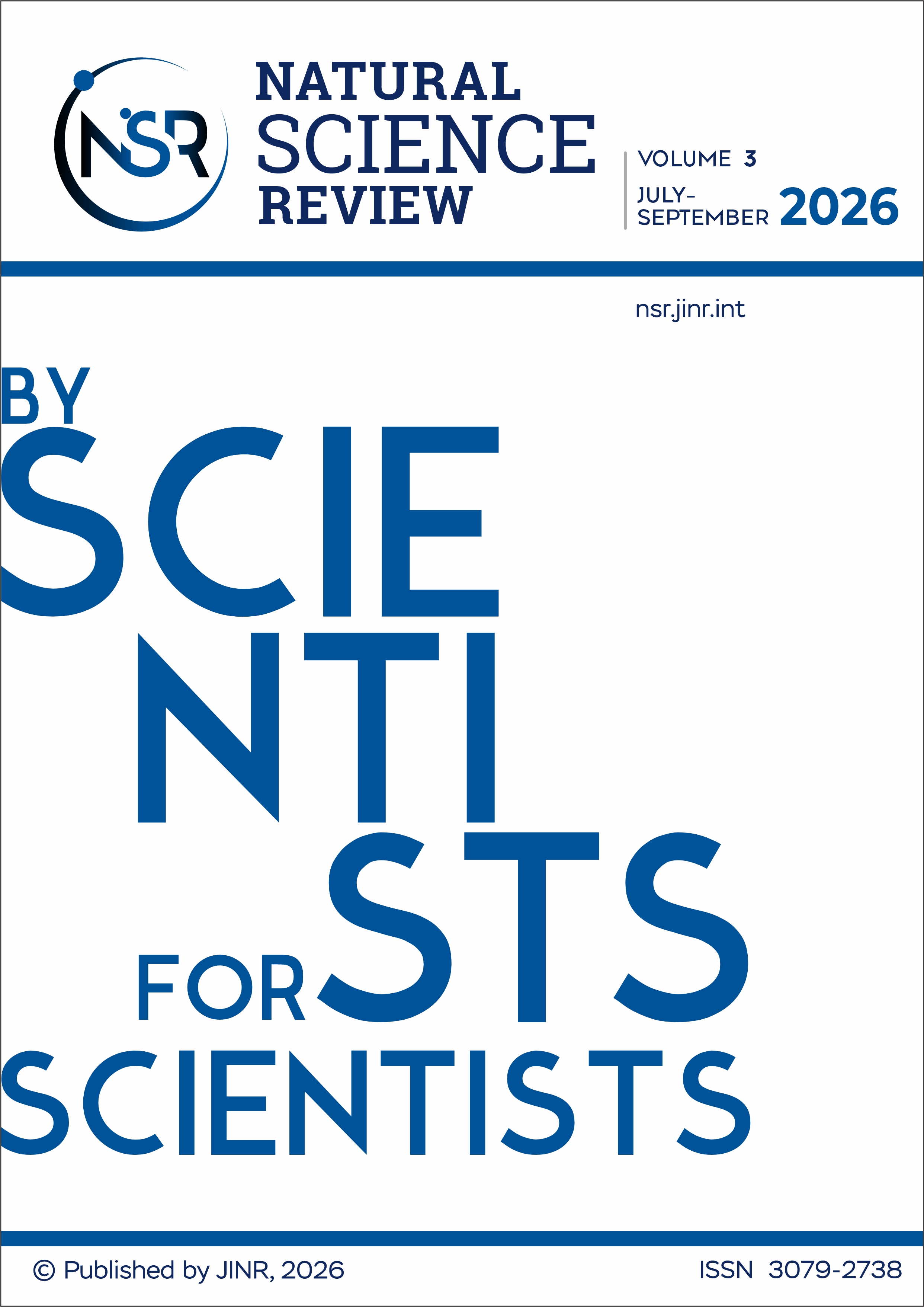
The Natural Science Review electronic journal has been published since 2024 according to the decision of the session of the Committee of Plenipotentiaries of the Governments of the JINR Member States dated 24.03.2024. The international intergovernmental organization Joint Institute for Nuclear Research is the journal’s founder and publisher.
Open issue January — March 2026
All Issue ArticlesThere are no articles for now. The issue will be updated with articles as soon as they are accepted for publication.
Issue 5 (Volume 2) 2025
All Issue Articles
New variants of N = 3, 4 superconformal mechanics
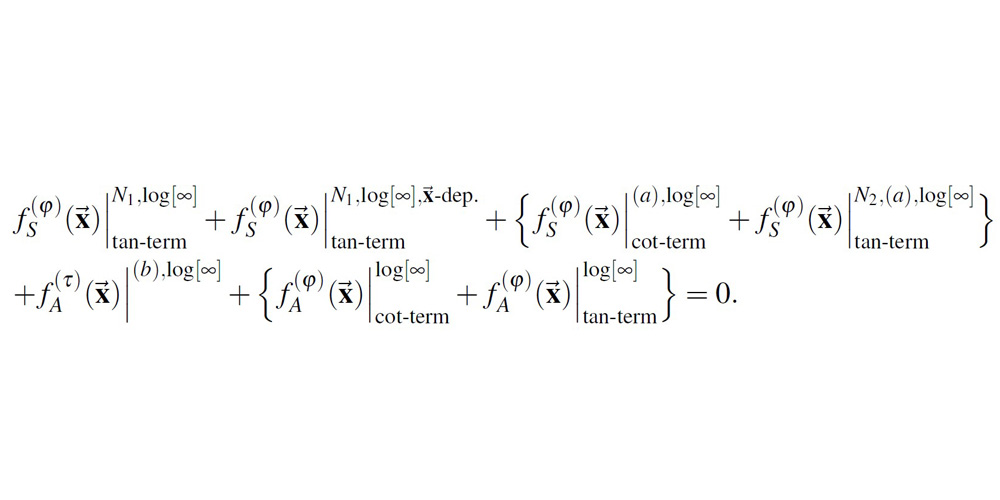
We construct superconformal mechanics with N = 3 and N = 4 supersymmetries that were inspired by analogy with the supersymmetric Schwarzian mechanics. The Schwarzian, being another system with superconformal symmetry, provides insight into the field content of supersymmetric mechanics, most notably, on the number and properties of the fermionic fields involved. Adding more fermionic fields (four in the N = 3 case and eight in the N = 4 case) made it possible to construct systems possessing maximal superconformal symmetries in N = 3 and N = 4, namely osp(3|2) and D(1, 2; α). In the case of N = 4 supersymmetry, we explicitly construct a new variant of N = 4 superconformal mechanics in which all bosonic subalgebras of the D(1, 2; α) superalgebra have a bosonic realization. In addition, the constructed systems involve the so(3) currents whose parameterization is not fixed, which allows one to consider different underlying geometries.
A century of the Bose–Einstein condensation concept and half a century of the JINR experiments for observation of condensate in superfluid 4He (He II)
This short review is devoted to the celebration of two major events in quantum physics. The first one is the birth of the concept of Bose–Einstein condensation (1925) and the second is the experimental proof that it does exist and appears in liquid 4He simultaneously with superfluidity below the λ-point (1975).
Both of these events are tightly related to the Bogoliubov theory of superfluidity (1947). The existence of condensate in the system of interacting bosons is the key ansatz of this theory. Therefore, the experiments started at JINR-Dubna in 1975 confirmed this prediction of the Bogoliubov theory that superfluidity of liquid 4He (He II) should emerge at the same time as the Bose–Einstein condensation.
Corrected:
13 November 2025 (the captions to Figures 1 and 2 were changed)
26 November 2025 (changes were made in formulas (53) and (55))
Complex rational Ruijsenaars model. The two-particle case
We consider a complex rational degeneration of the hyperbolic Ruijsenaars model emerging in the limit ω1 + ω2 → 0 (or b → i in 2d CFT) and investigate the two-particle case in detail. Corresponding wave functions are described by complex hypergeometric functions in the Mellin–Barnes representation. Their dual integral representation and reflection symmetry in the coupling constant are established. Besides, a complex limit of the hyperbolic Baxter Q-operators is considered. Another complex degeneration of the hyperbolic Ruijsenaars model is obtained by taking a special ω1 − ω2 → 0 (or b → 1) limit. Additionally, two new degenerations to the complex Calogero–Sutherland type models are described.
Categories
LATEST NEWS
All News
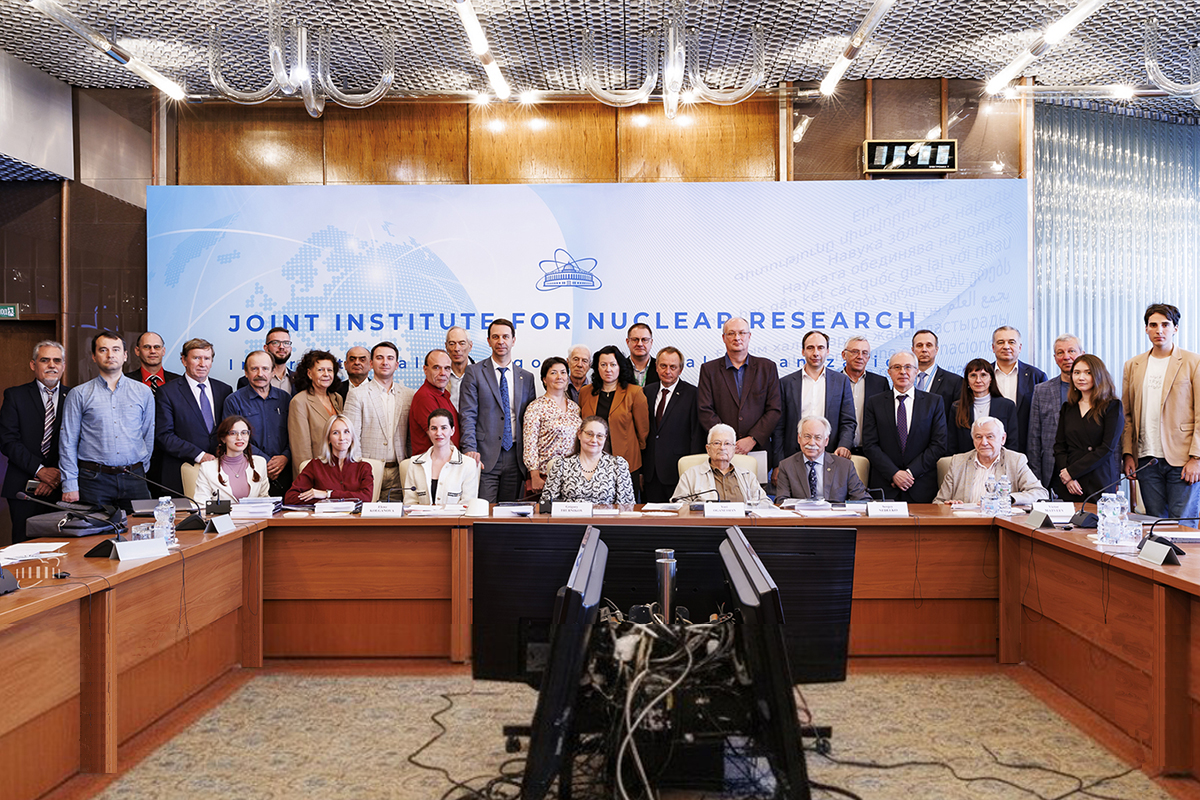
On 16 September 2025, the first meeting of the International Scientific Avisory Board (ISAB) of the Natural Science Review journal, published by the Joint Institute for Nuclear Research, took place at the JINR International Conference Centre in a hybrid format.
In honour of the upcoming 70th anniversary of the Joint Institute for Nuclear Research, which will be celebrated on 26 March 2026, Natural Science Review is launching the submission of articles for the journal's Special Issue.
Dear colleagues,
I am honoured to welcome you to the first issue of the Natural Science Review scientific journal. The appearance of this journal is an important event in the professional life of the entire scientific community of researchers working in the fields of natural, engineering, and related sciences.