

Аннотация
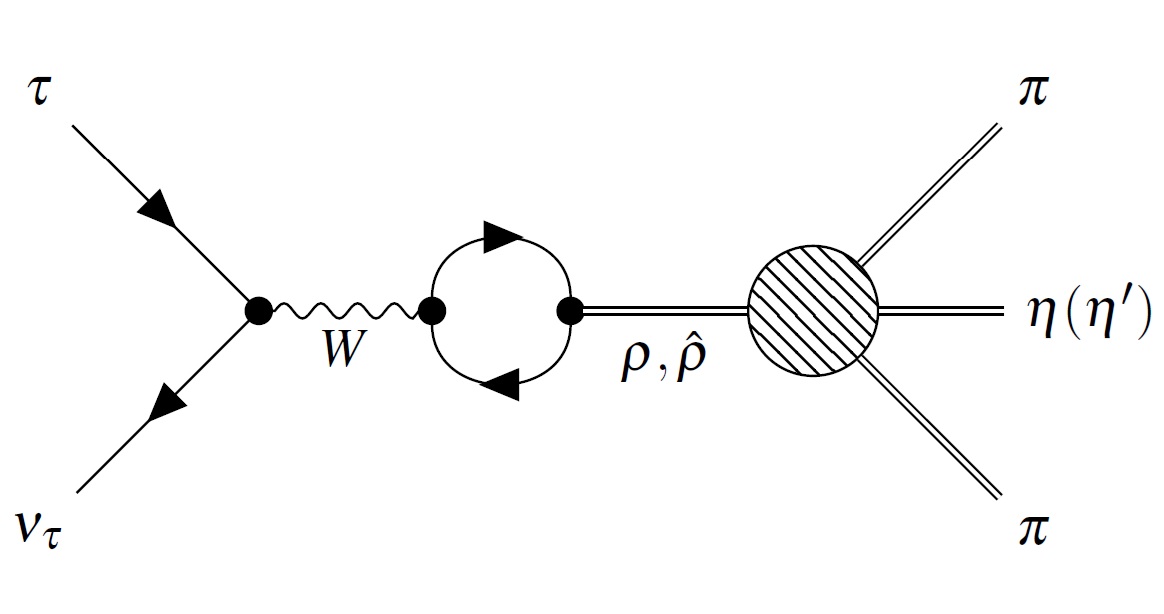
В рамках расширенной модели Намбу–Иона–Лазинио рассмотрены процессы τ → ππη(η′)ντ и τ → πηη(η′)ντ с учётом как основных, так и первых радиально возбуждённых промежуточных состояний. Показано, что в процессах τ → ππη(η′)ντ доминирующим является векторный канал, а в процессах τ → πηη(η′)ντ главный вклад даёт аксиально-векторный канал. Скалярный мезон a0 играет доминирующую роль в процессах с двумя η-мезонами в конечном состоянии. Показана значимость относительной фазы между основными и первыми радиально-возбуждёнными состояниями для данных процессов. Полученные результаты для процесса τ → ππηντ находятся в удовлетворительном согласии с недавними экспериментальными данными BaBar и CMD-3, которые отличаются от усредненных значений, приведенных в таблицах PDG.
Поддерживающие организации
Библиографические ссылки
[1] J. Gasser and H. Leutwyler, Chiral perturbation theory to one loop, Annals of Physics 158 (1984)142.
[2] J. Gasser and H. Leutwyler, Chiral perturbation theory: Expansions in the mass of the strangequark, Nuclear Physics B 250 (1985) 465–516.
[3] Y. Nambu and G. Jona-Lasinio, Dynamical model of elementary particles based on an analogywith superconductivity. 1, Physical Review 122 (1961) 345–358.
[4] T. Eguchi, A new approach to collective phenomena in superconductivity models, Physical ReviewD 14 (1976) 2755.
[5] D. Ebert and M. K. Volkov, Composite meson model with vector dominance based onU(2)invari-ant four quark interactions, Zeitschrift f ̈ur Physik C 16 (1983) 205.
[6] M. K. Volkov, Meson Lagrangians in a superconductor quark model, Annals of Physics 157 (1984)282–303.
[7] M. K. Volkov, Low-energy meson physics in the quark model of superconductivity type, SovietJournal of Particles and Nuclei 17 (1986) 186 [Fizika Elementarnykh Chastits i Atomnogo Yadra17 (1986) 433 (in Russian)].
[8] D. Ebert and H. Reinhardt, Effective chiral hadron Lagrangian with anomalies and Skyrme termsfrom quark flavor dynamics, Nuclear Physics B 271 (1986) 188.
[9] U. Vogl and W. Weise, The Nambu and Jona Lasinio model: Its implications for hadrons andnuclei, Progress in Particle and Nuclear Physics 27 (1991) 195.
[10] S. P. Klevansky, The Nambu–Jona-Lasinio model of quantum chromodynamics, Reviews of Mod-ern Physics 64 (1992) 649.
[11] T. Hatsuda and T. Kunihiro, QCD phenomenology based on a chiral effective Lagrangian, PhysicsReports 247 (1994) 221.
[12] D. Ebert, H. Reinhardt, and M. K. Volkov, Effective hadron theory of QCD, Progress in Particleand Nuclear Physics 33 (1994) 1.
[13] M. K. Volkov and A. E. Radzhabov, The Nambu–Jona-Lasinio model and its development, PhysicsUspekhi 49 (2006) 551.
[14] G. ’t Hooft, Symmetry breaking through Bell–Jackiw anomalies, Physical Review Letters 37 (1976)8–11.
[15] M. K. Volkov, M. Nagy, and V. L. Yudichev, Scalar mesons in the Nambu–Jona-Lasinio model with’t Hooft interaction, Nuovo Cimento A 112 (1999) 225–232.
[16] M. K. Volkov, A. A. Pivovarov, and K. Nurlan, Description of the decayτ→Kππντin the NJL-type chiral quark model, Physical Review D 107 (11) (2023) 116009.
[17] M. K. Volkov, A. A. Pivovarov, and K. Nurlan, Three-mesonτdecays involving kaons andηmesonsin the NJL model, Physical Review D 109 (1) (2024) 016016.
[18] M. K. Volkov, A. A. Pivovarov, and K. Nurlan, Decaysτ→3Kντin theU(3)×U(3)quark NJLmodel, European Physical Journal A 595 (7) (2023) 17.
[19] J. P. Lees et al. (BaBar Collab.), Study of the processe+e−→π+π−ηusing initial state radiation,Physical Review D 97 (2018) 052007.
[20] S. S. Gribanov, A. S. Popov, R. R. Akhmetshin, A. N. Amirkhanov, A. V. Anisenkov, V. M. Aul-chenko, V. S. Banzarov, N. S. Bashtovoy, D. E. Berkaev, A. E. Bondar, et al. Measurement of thee+e−→ηπ+π−cross section with the CMD-3 detector at the VEPP-2000 collider, Journal ofExperimental and Theoretical Physics 01 (2020) 112.
[21] S. Navas et al. (Particle Data Group), Review of particle physics, Physical Review D 110 (3)(2024) 030001.
[22] V. Cherepanov and S. Eidelman, Decaysτ→η(η′)π−π0ντand CVC, Nuclear Physics B: Proceed-ings Supplements 218 (2011) 231–236.
[23] V. M. Aulchenko et al. (SND Collab.), Measurement of thee+e−→ηπ+π−cross section in thecenter-of-mass energy range 1.22–2.00 GeV with the SND detector at the VEPP-2000 collider,Physical Review D 91 (5) (2015) 052013.
[24] M. K. Volkov and C. Weiss, A chiral Lagrangian for excited pions, Physical Review D 56 (1997)221–229.
[25] M. K. Volkov, The pseudoscalar and vector excited mesons in theU(3)×U(3)chiral model, Physicsof Atomic Nuclei 60 (1997) 1920–1929.
[26] M. K. Volkov and A. B. Arbuzov, Meson production processes in electron–positron collisions andtau-lepton decays within the extended Nambu–Jona-Lasinio model, Physics Uspekhi 60 (7) (2017)643–666.
[27] M. K. Volkov, A. A. Pivovarov, and K. Nurlan, Low-energy interactions of mesons with partici-pation of the first radially excited states inU(3)×U(3)NJL model, Symmetry 14 (2) (2022)308.
[28] M. N. Achasov, A. Y. Barnyakov, K. I. Beloborodov, A. V. Berdyugin, D. E. Berkaev, A. G. Bogdan-chikov, A. A. Botov, T. V. Dimova, V. P. Druzhinin, V. B. Golubev, et al. Measurement of thee+e−→ηπ+π−cross section with the SND detector at the VEPP-2000 collider, Physical Re-view D 97 (1) (2018) 012008.
[29] K. Inami et al. (Belle Collab.), Precise measurement of hadronic tau-decays with an eta meson,Physics Letters B 672 (2009) 209–218.
[30] S. Arteaga, L. Y. Dai, A. Guevara, and P. Roig, Physical Review D 106 (9) (2022) 096016.
[31] M. K. Volkov, A. B. Arbuzov, and D. G. Kostunin, Thee+e−→η(η′)2πprocess in the extendedNambu–Jona-Lasinio model, Physical Review C 89 (1) (2014) 015202.
[32] D. Gomez Dumm and P. Roig, Resonance chiral Lagrangian analysis ofτ−→η(′)π−π0ντdecays,Physical Review D 86 (2012) 076009.
[33] M. K. Volkov, A. A. Pivovarov, and K. Nurlan, Decaysτ→f0(π,K)ντandτ→3πντaccountingfor the contribution off0(500), European Physical Journal A 61 (3) (2025) 66.
[34] D. M. Asner et al. (CLEO Collab.), Hadronic structure in the decayτ−→ντπ−π0π0and the signof the tau-neutrino helicity, Physical Review D 61 (2000) 012002.